
A container can look merely late in a tracking portal while the real problem is already moving downstream. The vessel position updates, the ETA slides by a few days, and the shipment stays green because no one has connected the route change to the destination port queue, the inventory promise, or the customer order that depends on that box. By Friday afternoon, the same shipment is red, and the analyst is explaining a delay that could have been visible earlier.
That is the practical question for supply chains managing Red Sea shipping disruption with AI: not whether AI can draw a better map, but whether it can tell a logistics team which shipment is about to become an exception, why the prediction changed, and what work should start before the delay reaches the dock.
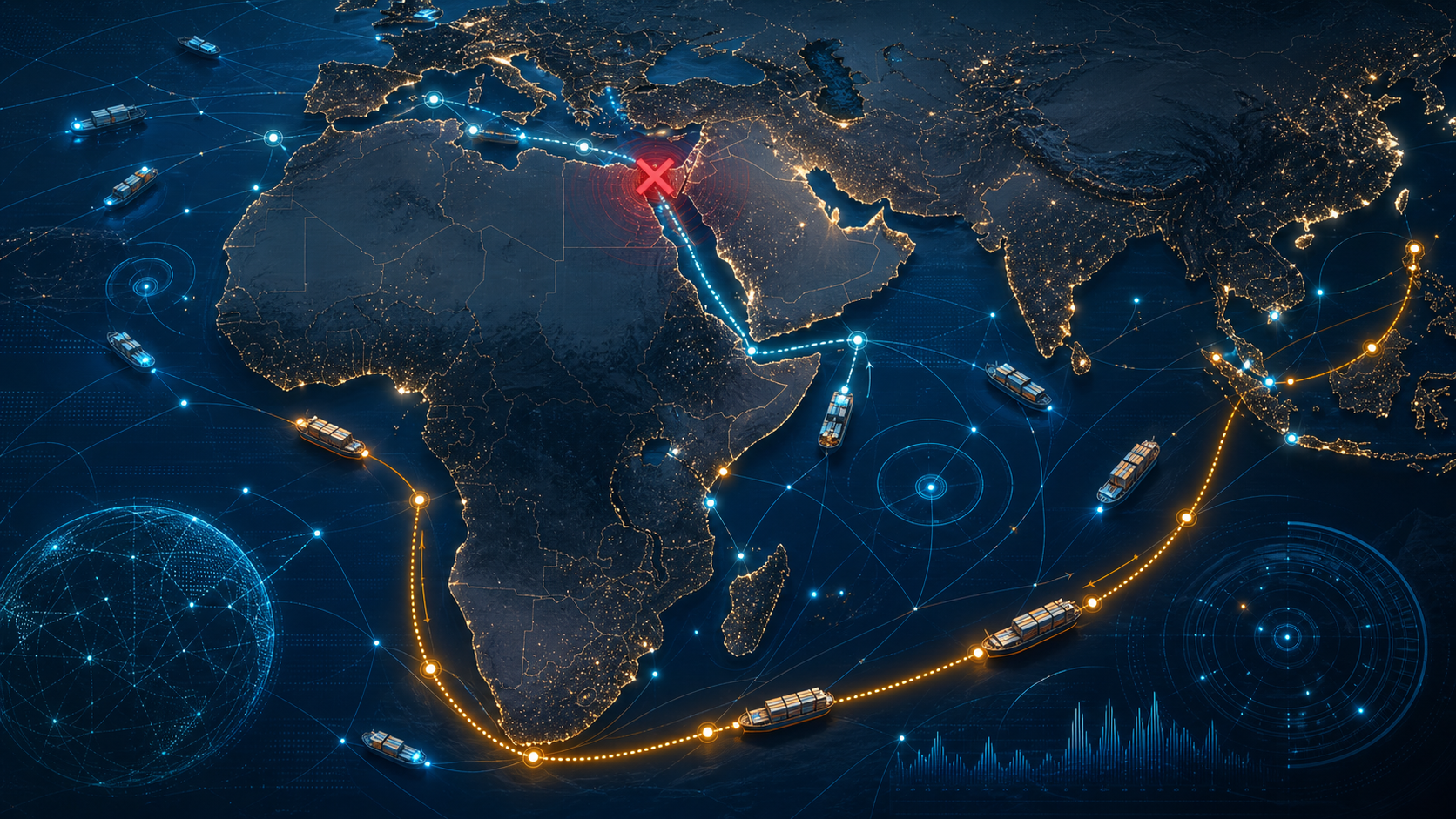
The Red Sea has become a useful stress test because the disruption is not a single late sailing. project44 describes an ongoing pattern that disrupted $6 billion in weekly trade flows, with container vessel traffic through the Suez Canal down about 75% from 2023 levels and the effects persisting into 2025–2026. The same analysis reports transit times up 47% from Southeast Asia to the U.S. East Coast, 33% to Europe, and 25% from China to Europe, pushing median shipping times toward two months.[1]
The Problem Is Not Knowing Where the Ship Was Yesterday
Basic container tracking answers a narrow question: where is my container, or where was the vessel at the last update? That is useful, but it is not enough when the route itself has changed, capacity is being absorbed by longer sailings, port utilization is shifting by terminal, and planners are deciding whether to protect production, preserve customer dates, or pay for expedited recovery.
In a normal delay, a team may be able to wait for a carrier update and adjust the inbound schedule. During a Red Sea rerouting pattern, waiting can create extra work in several places at once. Procurement asks whether supplier commitments still hold. Planning recalculates inventory coverage. The freight team checks whether detention or demurrage exposure is building. Customer operations rewrites delivery messages that would have been easier to send before the promise was missed.
This is where the distinction between tracking and predictive visibility becomes more than a vendor category. Tracking reports status. Predictive visibility tests the status against surrounding conditions and asks whether the shipment is likely to break a plan.
| Operational question | Basic tracking | AI predictive visibility |
|---|---|---|
| Shipment location | Shows current or last-known vessel/container status | Uses location as one input among route, weather, carrier, and port signals |
| ETA change | Reports an updated date when available | Explains likely drivers behind the changed ETA and confidence level |
| Exception handling | Requires people to scan shipments and decide what matters | Ranks shipments that need intervention before downstream commitments fail |
| Planning impact | Often stops at logistics status | Feeds rerouting, inventory, port handling, and customer communication decisions |
What AI Adds to Ocean Visibility
The Siemens AX4 and Portcast example is useful because it describes the mechanics rather than only the aspiration. Siemens says the approach fuses more than 200 data sources, including satellite positioning, vessel metadata, marine weather, port performance analytics, economic indices, and carrier data, to generate explainable ETAs and terminal-level visibility.[2]
The terminal-level part matters. A port name alone can hide the operational difference between a terminal that is becoming difficult and one that is still workable. Siemens gives the example of Terminal De France GMP running at 85–90% yard utilization while Terminal de l'Atlantique remains clear.[2] For a team managing inbound containers, that is not trivia. It changes whether the next action is to call the carrier, prepare for a different pickup window, adjust warehouse labor, or tell a customer-facing team that the risk has moved from ocean transit to port handling.
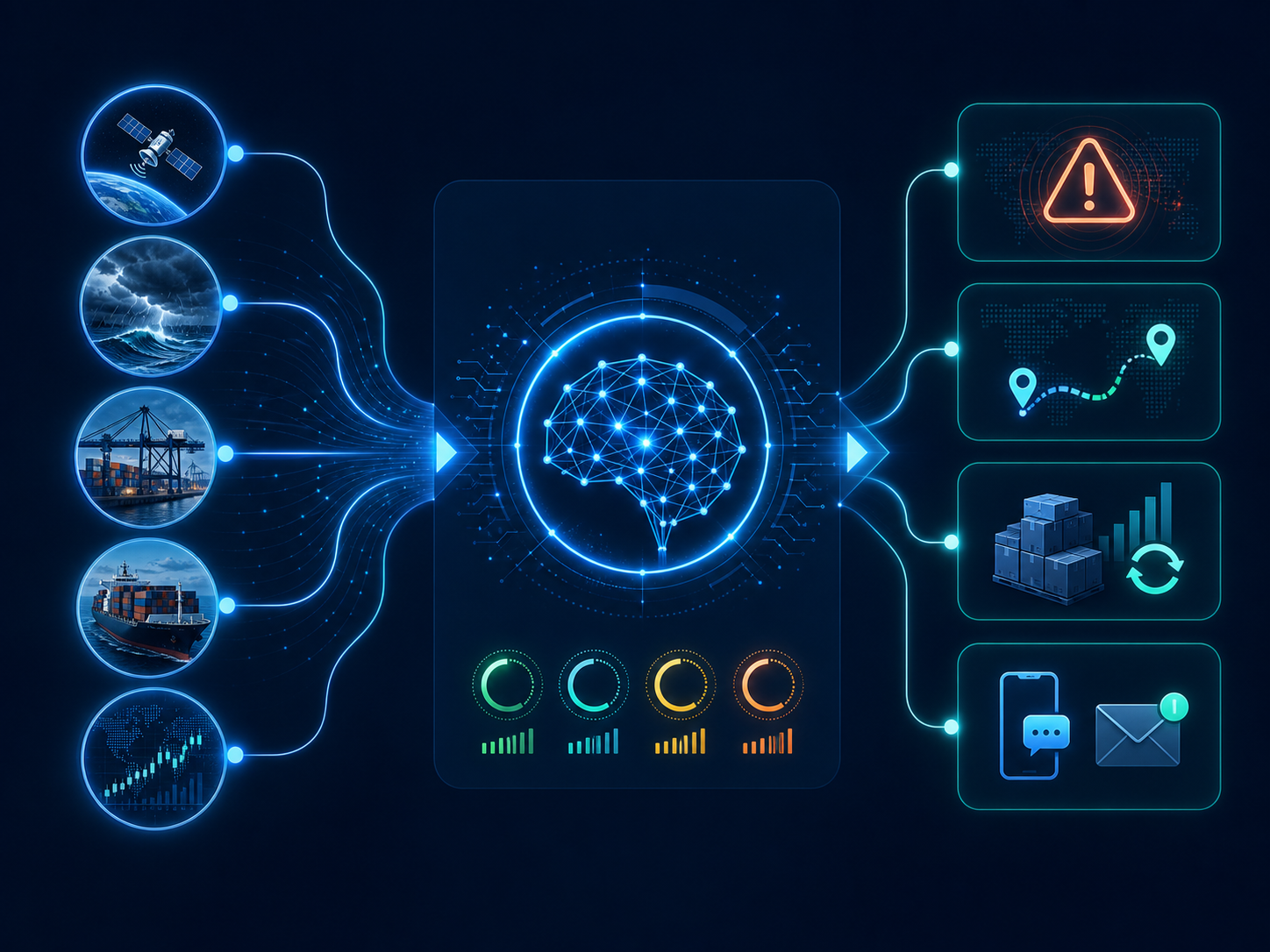
A predictive ocean visibility workflow typically starts before the shipment becomes a formal exception. The platform watches the planned route, actual vessel movement, known diversion patterns, weather and port signals, carrier information, and market or capacity indicators. When the combined signal changes, the system should not simply flash a red icon. It should expose the reason: rerouting around the Cape of Good Hope, deteriorating arrival confidence, rising congestion at the destination terminal, or a carrier schedule change that affects the next handoff.
That explanation is the difference between a useful alert and another dashboard tile. If an ETA changes with no reason code, the analyst still has to investigate. If the system shows the likely cause, confidence, affected orders, and next decision point, the same analyst can move from status checking to exception management.
The Exception Workflow Starts Earlier
For Red Sea disruption management, earlier does not mean guessing weeks ahead with false precision. It means moving the first human review to the point where a decision can still change an outcome. A shipment projected to arrive after a production need date may trigger one workflow. A shipment still likely to arrive on time, but through a port with rising terminal utilization, may trigger another. A shipment tied to a customer order with no substitute inventory may deserve attention before a less critical replenishment load.
The work then becomes more selective:
- Rerouting review: decide whether an alternate routing, port option, or service level is available early enough to matter.
- Inventory review: identify whether safety stock, substitute material, or production resequencing can absorb the projected delay.
- Port and drayage review: watch terminal risk, pickup windows, documentation readiness, and exposure to accessorial charges.
- Customer communication: warn account teams before the missed date becomes the first credible update.
None of those actions is automatic just because a model predicts a delay. The value is in narrowing the queue. A team does not need every delayed container treated like a crisis. It needs the handful of shipments where a delay intersects with a production constraint, a customer promise, a terminal bottleneck, or a cost exposure.
This is also where route and capacity context belongs. J.P. Morgan's analysis of the Red Sea shipping crisis points to rate and capacity implications from the diversions.[3] For logistics teams, those signals are not just finance headlines. They influence whether expedited recovery is available, whether capacity needs to be reserved earlier, and whether a late ocean shipment can realistically be corrected with premium freight.
Why the Savings Show Up in Manual Updates and Avoidable Charges
The Siemens/Portcast deployment reported three outcomes that are more credible than a broad claim of resilience: an 80% reduction in manual tracking updates, a 15% decrease in detention and demurrage charges, and a 5% reduction in expedited freight costs.[2] Those categories line up with the actual pain of disruption work.
Manual tracking updates fall when the system stops making people poll carrier sites, refresh portals, reconcile spreadsheets, and write the same status note into multiple tools. The gain is not that humans disappear from the process. The gain is that they spend less time proving that nothing has changed and more time on the few shipments where something has changed.
Detention and demurrage charges fall for a different reason. These costs often accumulate when the organization sees the risk late: documents are not ready, pickup planning is reactive, terminal conditions are misunderstood, or the shipment arrives into a congested node with no prepared handoff. Predictive visibility can reduce those charges when the alert reaches the people who can act on release, appointment, documentation, and drayage decisions before the free-time clock becomes the problem.
Expedited freight is the most tempting number to overread. A 5% reduction in expedited freight costs in one deployment does not mean AI removes the need for premium freight during a prolonged route disruption.[2] It means earlier warning can prevent some last-minute recoveries by giving planners time to adjust inventory, resequence demand, or choose a less expensive mitigation path.
The Deployment Conditions Matter
The Siemens/Portcast figures should be treated as evidence from a specific vendor-partnership deployment, not as a universal benchmark for every AI visibility tool. The outcomes depend on data coverage, shipment volume, carrier connectivity, exception design, and whether teams actually change how they work once alerts arrive.
A platform that ingests hundreds of signals but cannot connect an alert to an owner will still create chase work. A model that predicts ETAs but cannot explain the driver of change will still push analysts back into investigation. A control tower that flags every late shipment at the same severity will train users to ignore it.
The practical evaluation standard is plain: can the system reduce avoidable human status work and improve the timing of decisions? For a Red Sea-exposed lane, that means testing whether the tool can identify shipments affected by diversions, separate critical from noncritical exceptions, show confidence and reason codes, expose destination port and terminal risks, and feed the workflows used by logistics, planning, and customer operations.
It also means asking uncomfortable data questions during vendor selection. Which carriers and forwarders are covered on the lanes that matter? How often are vessel and terminal signals refreshed? Are port analytics available at the terminal level, or only at the port level? Can the system distinguish between a late vessel and a late container release? Does the alert create a task, or only a notification? Who closes the exception, and what evidence is retained for audit?
Touchless Is Useful Only When It Removes a Real Touch
The Portcast CEO describes a shift toward touchless supply chains, including AI that digitizes shipping documents, classifies risks across millions of web pages, and enables fully touchless auditing. The same discussion notes that progressive companies are beginning to measure what percentage of their operations are touchless.[4]
That language earns its keep only when it removes a specific manual step. Digitizing documents matters if it prevents a container from waiting because paperwork was not ready. Risk classification matters if it keeps analysts from reading broad disruption feeds and guessing which entries affect their shipments. Touchless auditing matters if the system preserves the evidence trail without someone reconstructing it after a charge dispute.
A good automation target is not the decision that still needs judgment. It is the repetitive checking, copying, matching, and escalating that surrounds the decision. In Red Sea disruption work, the human judgment usually belongs in tradeoffs: whether to reroute, whether to consume buffer inventory, whether to split demand, whether to communicate a revised date now or wait for more certainty. AI is more useful when it clears the table for those decisions than when it pretends the decisions no longer exist.
What to Look For in a Red Sea Predictive Visibility Use Case
A serious use case should be defined around lanes, products, and decisions, not around a generic visibility upgrade. The Red Sea pattern affects organizations differently depending on sourcing geography, customer commitments, inventory buffers, and the tolerance for premium recovery. The same ETA prediction can be urgent for one shipment and merely informative for another.
A focused pilot might start with Asia-to-Europe or Southeast Asia-to-U.S. East Coast flows where rerouting and transit-time extension are already visible in the operating plan. The team would not need to automate the entire ocean freight function on day one. It would need to prove that predictive alerts arrive earlier than current carrier updates, that they are accurate enough to trust, and that they trigger a defined response.
- Define the exception: late against required delivery date, high detention risk, inventory exposure, customer-impacting delay, or capacity-risk shipment.
- Connect the data: carrier status, vessel location, routing, weather, terminal conditions, port performance, and order or inventory context.
- Assign ownership: logistics resolves routing and port actions; planning resolves inventory actions; customer operations resolves promise-date communication.
- Measure work removed: fewer manual status updates, fewer preventable accessorial charges, fewer avoidable expedited recoveries, and faster exception closure.
Those measures keep the business case grounded. If a platform claims predictive visibility but the team still spends Monday morning exporting shipment lists, checking carrier portals, and asking planners which late containers matter, the workflow has not changed enough.
The Discipline Is Earlier Intervention, Not Perfect Prediction
AI predictive visibility does not make the Red Sea safe. It does not guarantee lower freight rates, and it does not erase the capacity effects of long diversions around the Cape of Good Hope. The security situation can change quickly, carrier behavior can shift, and a model is only as useful as the data and workflow around it.
For teams exposed to long reroutes and volatile port conditions, the value is more practical: earlier exception detection, fewer manual updates, better targeting of human attention, and less avoidable cost from late reactions. The best AI visibility systems do not just answer where the container is. They show which disruption is likely to hit, how confident the system is, who needs to act, and what decision window is still open.
References
- The Red Sea crisis: Renewed attacks keep shipping at risk, project44
- When sea freight gets smarter: How AI is turning supply chain chaos into competitive advantage, Siemens Digital Logistics, September 5, 2025
- The Impacts of the Red Sea Shipping Crisis, J.P. Morgan
- How Portcast turns supply chain visibility into actionable intelligence, FreightWaves
Comments
Join the discussion with an anonymous comment.