
A late aircraft is still on stand. The inbound bags are moving, but the belt loader arrived after the first ramp sequence should already have started. Catering is waiting for access. The crew has a legal limit later in the day. Nothing looks like a crisis yet, which is exactly the point: AI for airport logistics disruption planning has value in the narrow window before one missed handoff becomes a gate conflict, a baggage exception, and a departure miss.
The case for using AI here does not begin with automation theater. It begins with the amount of disruption that is still operationally reachable. OAG and Microsoft cite industry-controllable causes for nearly 60% of delays, and OAG data shows 22% of U.S. flights were delayed by at least 15 minutes in 2024; after scheduled pushback, a delayed departure can cost about $100 per minute.[1] INFORM puts global airline disruption costs at roughly $60 billion annually, or about 8% of airline revenue.[2] That is too much money to leave to a dashboard that only confirms what the ramp already knows.
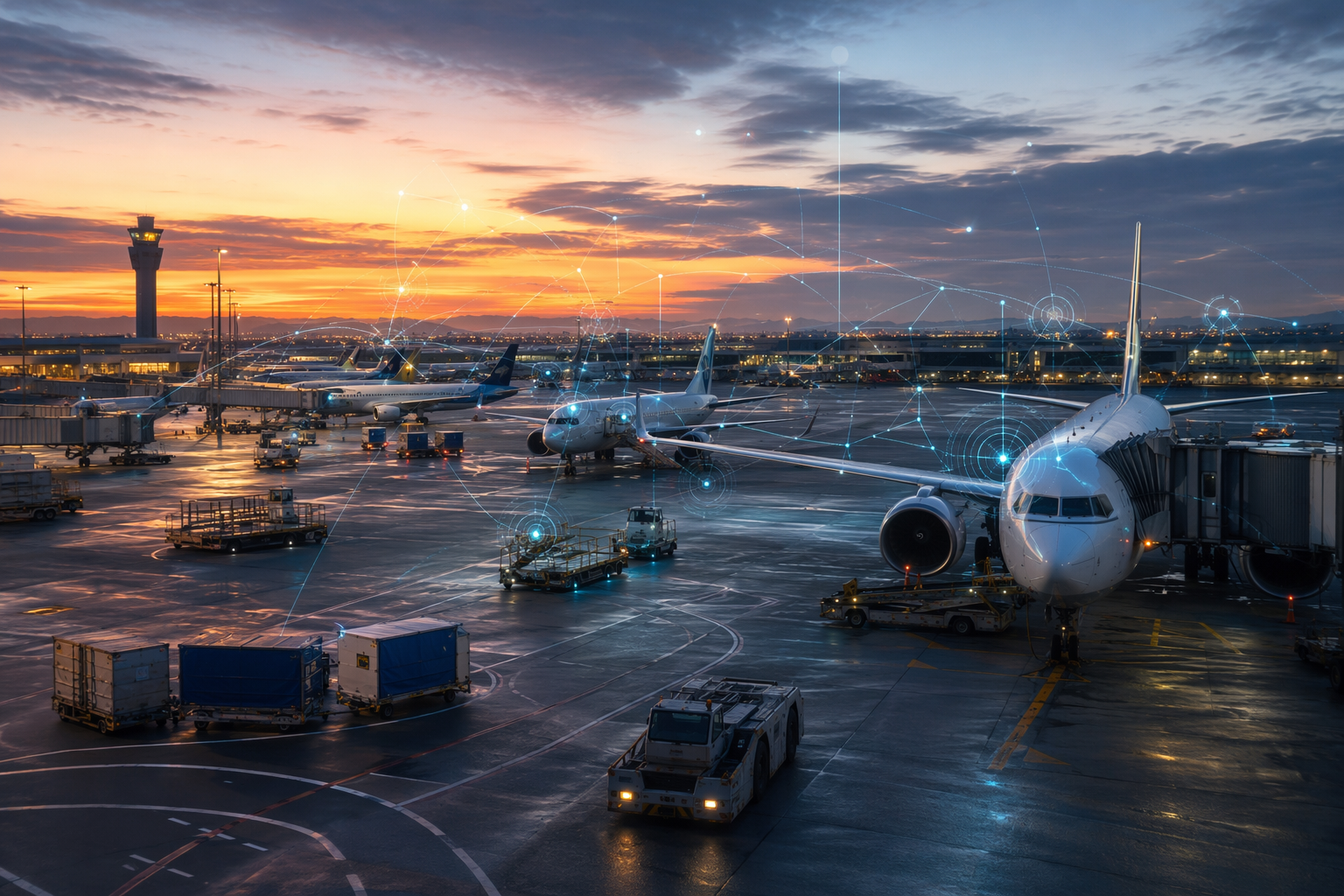
The bounded use case is not “AI runs the airport.” It is more specific: AI reads live turnaround and logistics signals, predicts which small failures are likely to cascade, and helps planners move scarce gates, stands, crews, baggage resources, and service equipment while there is still time to contain the delay. Cargo workflows can sit inside the same airport logistics picture, but the strongest evidence today is still on passenger-flight turnaround operations.
The delay forms before the departure board admits it
Most airport disruption planning fails in the handoffs. A gate plan assumes the inbound stand will clear. A dispatcher assumes the handler has enough people for the next bank. A baggage team assumes a late transfer still has a workable path. Each assumption can be reasonable on its own and still fail together.
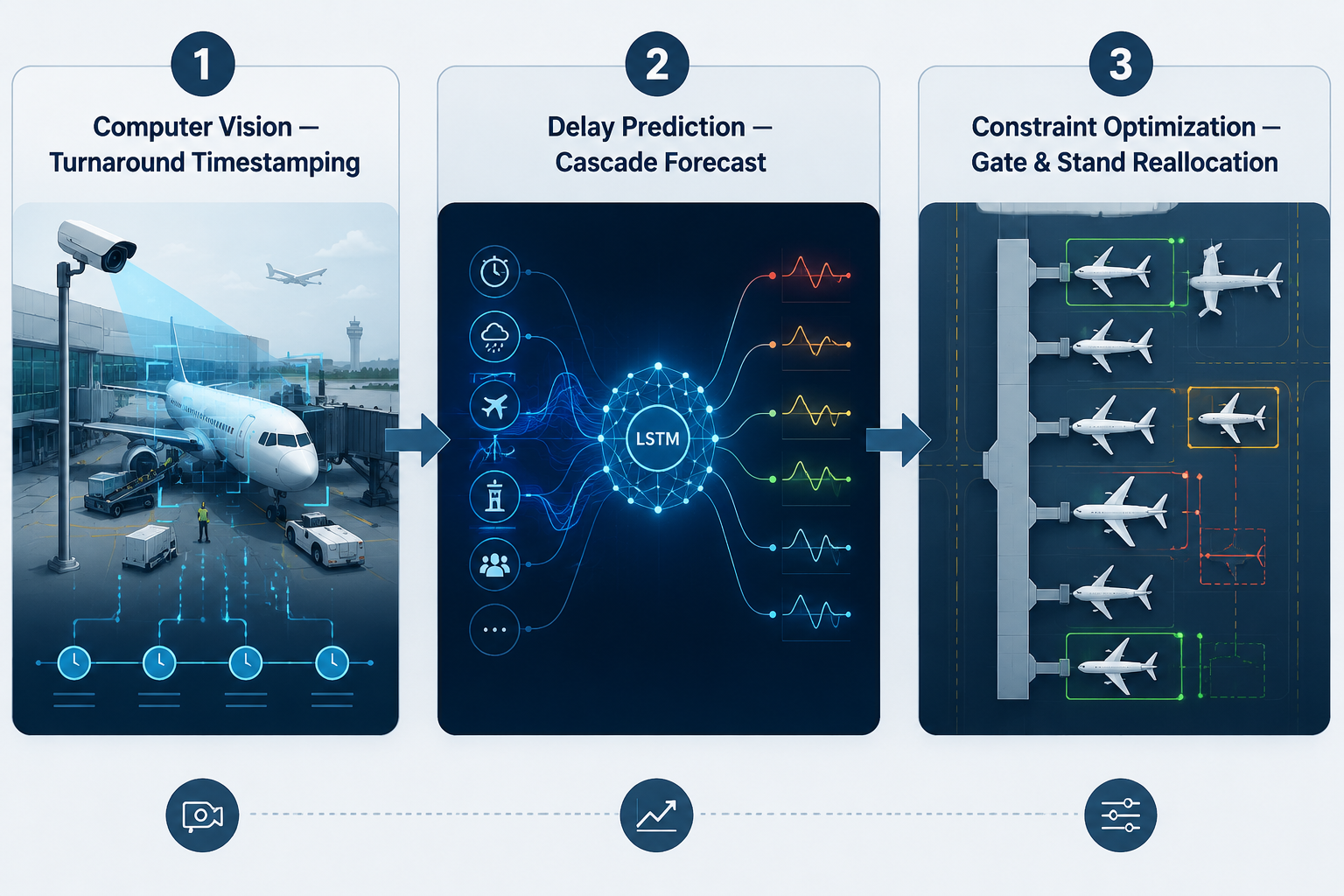
That is why the most useful AI systems in airport logistics do not start by forecasting a vague airport-wide delay risk. They timestamp the work that is actually happening: chocks on, passenger door open, belt loader connected, fuel truck present, bags unloaded, catering complete, boarding started, pushback tug arrived. If those timestamps are late, missing, or inconsistent, the prediction layer is already working with bad fuel.
Assaia’s deployment evidence is useful because it stays close to that operational surface. The reported base covers more than 450,000 turnarounds across 15 airports in Europe and North America, with a 25% reduction in median departure delays.[3] That is not a promise that AI prevents weather, airspace restrictions, or every crew issue. It is evidence that when the system can see turnaround progress in real time, it can help reduce the duration of delays that are still manageable.
What the system has to see
Computer vision is the practical starting point because manual status reporting is often late, partial, or softened by good intentions. A ramp coordinator may know the tug is missing, but if that knowledge sits in a radio exchange or a local chat, the gate planner and downstream dispatcher may not see it until the next decision window has already closed.
A camera-based turnaround system does not need to understand the whole airport. It needs to recognize the specific service milestones that make or break a departure. The value is in converting visual activity into timestamps that planning systems can trust: a belt loader is at the aircraft, the fuel truck has arrived, the bridge is still attached, the tug has not yet appeared. When those events are standardized across stands, the operation gains a live version of the turnaround plan instead of a retrospective explanation.
The data condition matters more than the model label. VE3 cites Gartner’s estimate that 60% of AI projects fail because of bad data.[3] In airport disruption planning, bad data is not an abstract governance problem. It is a planner believing a stand is recoverable when the loader never arrived, or reassigning a gate without seeing that the crew transfer now fails.
Real-time data feeds also need outside context. Ground stops, airspace restrictions, inbound aircraft position, crew readiness, baggage transfer status, and maintenance constraints all affect whether a late turnaround is merely late or about to spread. Readers looking at the upstream signal layer may want the adjacent treatment of how AI predicts supply chain disruptions from airport ground stops, because a ground stop is one of the inputs that changes the value of every local recovery choice.
Prediction is only useful if it changes a handoff
Delay prediction earns its keep when it identifies a probable cascade early enough for somebody to act. LSTM networks are often used because they can read sequences over time: not only that a belt loader is late, but that this kind of lateness, on this stand, with this inbound delay and this bank structure, has a measurable chance of missing pushback. Available evidence supports 82–88% accuracy at a 24-hour horizon for LSTM-style delay prediction, which is useful as directional confidence rather than a guarantee for any single flight.
For an airport logistics team, the model output should not stop at a red risk score. It should answer a narrower operational question: which next resource decision becomes fragile if this aircraft loses another six minutes? The answer may be a gate reassignment, a tug priority, an additional baggage runner, a stand swap, or a crew transfer decision. Prediction without a linked decision rule leaves the recovery work exactly where it was before: on people trying to reconcile partial information under time pressure.
The distinction is important for ROI. A model that correctly predicts delay but does not trigger a different allocation is a reporting improvement, not a disruption-planning system. If a dispatcher still finds out after the bank has collapsed, the airport has bought a better autopsy.
For readers who want the machine-learning background rather than the ramp-side use case, the broader concepts are covered in Machine Learning in Supply Chain Management and in AI Demand Forecasting Accuracy Benchmarks. In airport logistics, the more immediate concern is whether the confidence level arrives before the stand, crew, and gate plan harden.
Optimization is where the cost is recovered
Once the system can see current progress and predict likely knock-on effects, the next layer is constraint optimization. This is where airport logistics disruption planning becomes more than surveillance. The optimizer weighs gates, stands, towing constraints, crew locations, passenger bridges, equipment availability, baggage flows, and departure priorities. It then proposes a recovery plan that fits the constraints better than the first plan now failing on the ground.
| AI layer | Operational signal | Decision it can change |
|---|---|---|
| Computer vision timestamping | Actual turnaround milestones at the stand | Escalate missing equipment, adjust service sequence, confirm whether the aircraft is still recoverable |
| Delay prediction | Probability that a local delay will affect the next movement or departure bank | Prioritize dispatcher attention, crew coordination, and baggage recovery before the delay spreads |
| Gate or stand optimization | Available infrastructure and resource constraints | Reassign gates, swap stands, alter towing plans, or protect high-risk departures |
American Airlines’ Dynamic Gate Assignment work is a useful supporting example because it ties AI to a concrete operational lever: assigning gates in a way that reduces taxi and tow inefficiency. The cited case reports 870,000 gallons of fuel saved per year.[4] That does not prove every airport will get the same result, but it shows why gate decisions belong in the disruption-planning conversation rather than in a separate facilities silo.
Dubai International is another supporting case, with the cited material reporting on-time performance improvement from about 80% to 95%.[4] This figure should be read carefully. Airport-level on-time performance reflects many factors beyond AI, and some published OTP targets in the same case-study environment are forward-looking rather than achieved. The operational lesson is still useful: turnaround visibility and gate coordination can affect punctuality at scale, but the result should not be treated as a plug-and-play benchmark.
The better airport implementations make the optimization layer visible to the people who must execute it. If a system recommends moving an aircraft to a different stand, the handler needs to know whether equipment follows. If a gate swap protects one departure but strands a crew transfer, the plan has merely moved the failure. The dashboard is not the operation; the handoff is.
Why the ROI can be plausible
The ROI case for AI for airport logistics disruption planning is strongest when it is built from avoided operational drag, not from a generic labor-saving claim. The cost stack includes minutes after scheduled pushback, crew and aircraft misalignment, gate occupancy, missed connections, rebooking pressure, fuel burn, baggage exceptions, and downstream schedule recovery. At roughly $100 per delayed minute after scheduled pushback, even a modest reduction in late departures can pay back quickly at a busy airport or hub operation.[1]
The recovery estimate of $150,000–$250,000 per major disruption event is plausible only under certain conditions. The event has to be large enough for delay minutes, resource conflicts, and downstream recovery costs to accumulate. The system has to provide a decision early enough to change the plan. And the airline, airport, and handler have to accept the recommendation quickly enough that the recovery path is still open.
- Fewer late pushbacks: The system flags missing or late turnaround milestones before the scheduled departure window collapses.
- Faster recovery choices: Dispatchers and gate planners see which aircraft, crew, or stand conflict is likely to spread next.
- Better use of constrained assets: Tugs, belt loaders, gates, crews, and stands are reassigned against current conditions rather than stale plans.
- Avoided downstream cost: A protected departure bank reduces the number of secondary fixes required later in the day.
Those are not glamorous benefits, but they are the ones that matter. A six-minute earlier tug escalation does not make a conference slide sparkle. It can, however, keep the aircraft from losing its slot in the next operational sequence.
Market sizing gives some context for why vendors and airport operators are paying attention, but it should not be used as proof of operational value. MarketIntelo estimates the global airline disruption management AI market at $3.2 billion in 2025, growing at a 16.8% compound annual growth rate to $12.8 billion by 2034; it also estimates flight delay prediction as the largest segment at 31.2% and cloud deployment at 67.3% of the 2025 market.[5] Those are third-party directional estimates. The stronger investment argument still comes from measured delay reduction and event-cost recovery.
The coordination problem is not optional
Airport disruption planning crosses organizational boundaries whether the technology design admits it or not. The airport may control stands and gates. The airline may control schedule priorities and passenger reaccommodation. The ground handler may control ramp labor and equipment. Baggage, fueling, catering, maintenance, and crew teams each hold a piece of the recovery path.
That is why a technically accurate system can still fail operationally. If the gate planner sees the prediction but the handler does not receive a usable instruction, the bottleneck stays on the ramp. If a handler sees the equipment conflict but the airline will not authorize a stand swap, the model has identified a problem no one is allowed to solve. AI does not remove the need for authority; it exposes where authority has to move faster.
This is also where maintenance and spare-parts recovery intersect with airport logistics. A late inbound can be recoverable until a defect, missing component, or engineering signoff enters the chain. That adjacent operating layer is covered in how AI bridges airline disruption recovery and spare parts supply chains, but the planning principle is the same: prediction only pays when the responsible parties can act on it before the constraint closes.
Where the evidence is strongest, and where it thins out
The strongest evidence base is passenger-aircraft turnaround: stands, gates, ramp services, crews, baggage, and departure punctuality. That is where the Assaia-style evidence has enough operational volume to be taken seriously, and where the causal chain from timestamp to prediction to resource decision is easiest to inspect.
Cargo should be handled more cautiously. Cargo ramps, warehouse cutoffs, ULD flows, trucking interfaces, and customs processes are clearly part of airport logistics disruption planning, and some of the same AI methods may apply. But the available research base is thinner for cargo-specific outcomes, so it would be a mistake to borrow passenger-turnaround delay reductions and present them as proven cargo results.
Passenger-facing disruption management is also a neighboring problem, not the center of this one. Rebooking, meal vouchers, notifications, and missed-connection handling matter, but they sit after many of the ramp-side decisions discussed here. Readers focused on that layer can use Using AI to Manage Airline Passenger Disruptions as the passenger-side counterpart.
When this becomes a high-ROI use case
AI disruption planning becomes a high-ROI airport logistics use case when three conditions line up. First, the data is clean enough to reflect what is happening at the stand, not what the plan expected to happen. Second, stakeholders coordinate across airline, airport, and handler boundaries with clear authority to change gates, stands, crews, and equipment priorities. Third, the system is used to trigger operational decisions, not simply visualize delay risk.
Under those conditions, the evidence supports expecting shorter delay duration and lower event cost, including the 25% median departure-delay reduction reported across the Assaia deployment base.[3] It does not support claiming disruption elimination. Weather will still close airports. Airspace constraints will still break plans. Crews will still time out. A belt loader can still be late. The difference is whether the operation sees the failure early enough to keep it from becoming everybody’s problem by the second bank of departures.
References
- AI in Aviation Operations, OAG
- A Proactive Approach to Managing Disruptions in Aviation with AI, INFORM Software
- Real-Time Decision Intelligence at the Gate - How AI Handles Disruption in Airport Operations, VE3
- Airport Ground Turnaround Optimization, Enterprise AI Case Studies
- Airline Disruption Management AI Market, MarketIntelo
Comments
Join the discussion with an anonymous comment.