
The July 2026 Zyrtec/cetirizine recall began with the kind of detail no recall platform should be proud to depend on: a pharmacy technician noticed red dots on tablets during dispensing. The FDA notice described four recalled lots of cetirizine hydrochloride tablets, cross-contaminated with ranitidine, with no adverse events reported as of July 23, 2026.[1]
That human catch matters. It also exposes the old operating model. A defect appears downstream. Someone escalates. Quality and distribution teams then work backward through lots, shipment records, trading-partner communications, returns, and documentation while product may still be sitting in pharmacy inventory, distributor stock, or patient-facing channels.
For pharma leaders looking at the Zyrtec/cetirizine recall through a supply-chain lens, the useful question is not whether AI could have prevented that specific event. The better question is what changes when recall management can use serialized product data to detect weak signals, trace affected units, notify the right parties, quarantine inventory, and reconcile the action at lot and serial-number precision.

The recall workflow changes when serialization becomes usable data
Serialization is not new to pharma. What is changing is the practical availability of serialized data across trading partners. The Drug Supply Chain Security Act small-dispenser deadline is November 27, 2026, which keeps pharmacies, manufacturers, repackagers, wholesale distributors, and dispensers under pressure to exchange interoperable product tracing information rather than rely on disconnected local records.[2]
That matters because AI recall management needs a real substrate. A model cannot reliably narrow a recall if the enterprise cannot tell which serialized units were produced, commissioned, packed, shipped, received, dispensed, quarantined, returned, or destroyed. DSCSA serialization, EPCIS data exchange, lot identifiers, serial identifiers, location records, and status events are the difference between automation that can act and automation that merely sends faster emails.
In a serialized recall workflow, the first question is no longer “Which broad lot might be involved?” It becomes “Which exact product identifiers match the risk signal, where are they now, which trading partners touched them, and what instruction should each party receive?”
What an AI-powered pharma recall workflow looks like
The practical workflow has five connected movements. Some are analytical. Some are procedural. The hard part is making them behave as one controlled system when the phone calls start.
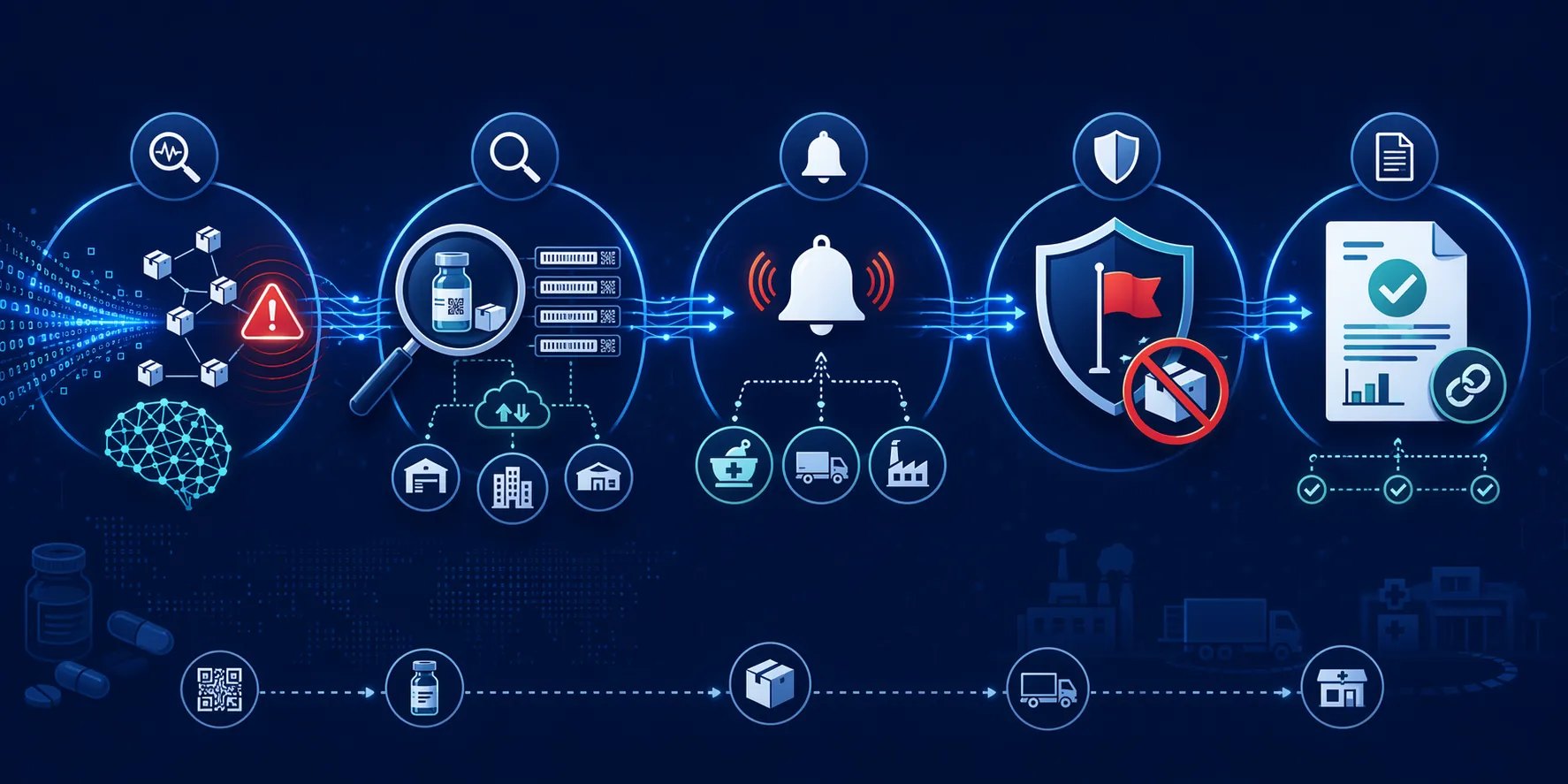
| Workflow movement | What the system does | What still needs human control |
|---|---|---|
| Detect | Scans quality, serialization, inventory, complaints, returns, and trading-partner signals for anomalies | Reviews whether the signal meets escalation or recall criteria |
| Trace | Maps affected lots and serial numbers through EPCIS and enterprise supply chain records | Confirms scope, exclusions, and regulatory interpretation |
| Notify | Routes instructions to distributors, pharmacies, internal teams, and other partners | Approves message content, urgency, and jurisdiction-specific requirements |
| Quarantine | Places stop-movement or hold flags on affected inventory where systems allow it | Confirms physical segregation and exception handling |
| Reconcile and report | Tracks acknowledgments, returns, destruction, unresolved product, and audit evidence | Signs off on closure and maintains GxP documentation |
Detection starts before the formal recall decision
Continuous signal detection is the part of the workflow that most resembles the usual AI promise, but it is also where overclaiming starts. In recall management, AI is not a magic label that sees everything. It is a set of models and rules scanning available signals: quality events, complaint patterns, returns, inventory exceptions, serialized movement records, temperature or handling anomalies where available, and discrepancies between expected and observed product flows.
The operating value is escalation discipline. A weak signal should not automatically become a recall, but it should also not sit unnoticed in a local spreadsheet, a pharmacy note, or an unstructured complaint queue. The system’s job is to assemble related evidence quickly enough that quality teams can decide whether they are looking at noise, an isolated defect, a potential field action, or a recall candidate.
This is where serialization data becomes more than compliance exhaust. If a physical defect, contamination concern, packaging error, suspect product event, or distribution anomaly appears in one location, the recall platform can compare that signal against lot, serial, shipment, and receipt data. The question becomes narrower: are similar signals clustering around the same batch, packaging line, repackager, distribution path, or trading partner?
Tracing is where broad withdrawal can become precision action
Once a recall or field action is being evaluated, tracing is the load-bearing step. A traditional recall often starts with lot-level scope and then depends on distributors, pharmacies, and internal teams to search local systems. Serialized recall management starts with the affected product identifiers and asks where each unit moved.
EPCIS exchange is central here because it gives trading partners a structured way to share event data about serialized product movement. In practical terms, the recall system needs to ingest events such as commissioning, aggregation, shipping, receiving, decommissioning, returns, and exceptions, then connect those events to master data and current inventory visibility.
The operational consequence is not simply speed. It is scope control. If a manufacturer can identify that only certain serial numbers within a lot entered a suspect path, the team has a basis for a narrower hold, more targeted partner notification, and cleaner reconciliation. If the data is incomplete, the system should expose that incompleteness rather than pretend the map is finished.
Notifications need instructions, not just alerts
Recall communication is often described as messaging, but that understates the work. A pharmacy does not need a generic alert. It needs to know whether it has affected product, which identifiers to check, whether to stop dispensing, how to segregate units, how to document the action, whether returns are required, and who to contact when records do not match physical inventory.
AI can help assemble audience-specific instructions from the recall scope and distribution map. A distributor may receive one workflow for warehouse holds and outbound shipment blocks. A pharmacy may receive another for shelf checks and dispensing-system flags. Internal quality, regulatory, customer service, and logistics teams need their own tasks and evidence requirements.
The guardrail is approval. In a GxP environment, recall instructions cannot be treated as casual generated text. Human review remains necessary for regulatory accountability, message accuracy, market-specific obligations, and auditability.
Quarantine has to reach the place product actually sits
A recall system that identifies affected product but cannot stop movement leaves quality teams with a familiar problem: knowledge without control. The stronger pattern connects recall scope to quarantine flags, warehouse management holds, order blocks, distributor instructions, and pharmacy-level checks where integration and partner capability allow it.
This is where digital twins and control-tower approaches enter the architecture. Pharmaceutical Commerce has described AI-enabled control towers and digital twins as tools for improving supply chain visibility and decision support, while supply chain analysis has similarly positioned AI as a way to connect pharma supply chain data that otherwise sits across planning, logistics, and execution systems.[3][4]
For recall management, that visibility is useful only if it supports action. The team needs to see affected units by location and status, but also needs to push stop-movement instructions, track acknowledgments, flag exceptions, and identify inventory that has not been confirmed.
Reconciliation is where the recall proves what happened
The end of a recall is not the last notification. It is the evidence trail: who received instructions, who acknowledged them, which product was found, which product was not found, what was returned, what was destroyed, which exceptions remained open, and when closure was approved.
AI can reduce manual chasing by comparing expected affected inventory against partner responses and serialized return events. If a distributor confirms zero affected units but EPCIS records suggest receipt of serialized product in scope, the system can flag the mismatch. If a pharmacy reports product removed from shelf but not returned or destroyed according to the expected workflow, the exception stays visible.
This is the part executives underestimate most often. Recall teams do not just need to act quickly. They need to prove, later and under scrutiny, that the action was controlled.
The practical technology stack
A credible AI recall stack is not a single application dropped on top of poor records. It is an architecture that connects compliance data, operational systems, analytics, workflow execution, and human approval.
| Layer | Role in recall management | Common failure mode |
|---|---|---|
| Serialization infrastructure | Provides lot, serial, product, package, and trading-partner event data | Data exists for compliance but is not usable for operational recall decisions |
| EPCIS exchange | Shares structured product movement events across trading partners | Events are incomplete, delayed, or difficult to reconcile with internal records |
| AI/ML analytics | Detects anomalies, clusters signals, prioritizes escalation, and highlights scope patterns | Models produce alerts without explainability or validated operating controls |
| Inventory visibility or digital twin | Locates affected product across warehouses, distributors, pharmacies, returns, and holds | Visibility stops at enterprise boundaries or misses physical inventory status |
| Workflow orchestration or control tower | Coordinates notifications, quarantine tasks, acknowledgments, exceptions, and reporting | Messaging is automated but task completion and evidence capture remain manual |
| Human-in-the-loop review | Maintains regulatory accountability, approves decisions, and signs off on closure | Automation outruns validation, SOPs, or quality oversight |
Representative vendors are forming around different parts of this workflow. LSPedia positions OneScan Serialized Recall as a DSCSA-based recall tool and describes Recall+ as an early 2026 product expansion, with OneScan Serialized Recall generally available in October 2025.[5] TraceLink’s MINT and POET offerings, along with its Agentic AI documentation, point toward multi-enterprise transaction exchange and AI-assisted workflows across the supply chain.[6] Sparta Systems’ TrackWise sits closer to the quality management and event-handling side of the recall operating model.[7]
Those names are useful for shortlisting, but the architecture matters more than the logo. A pharma company evaluating vendors should ask where the product sits in the workflow. Is it primarily a serialized recall engine, a trading-partner network, a QMS platform, a control tower, an analytics layer, or an integration wrapper across several of those functions?
What the outcome evidence can and cannot prove
The evidence base for AI-enabled recall management is promising, but it is not all the same kind of evidence. A business case should keep source labels visible.
A 2023 IJRMP study reported 35% faster recall initiation with AI-supported recall management, but this figure should be treated as directional because the available verification is at abstract level rather than a fully reviewed independent benchmark across multiple deployments.[8]
LSPedia claims its OneScan recall tooling can reduce manual recall labor by up to 90%, tied to operational testing with early adopters. That is a vendor claim, not an independent industry average, but it is still useful as a hypothesis to test in a pilot: how many people-hours are spent today on identifying affected product, contacting partners, checking acknowledgments, reconciling returns, and preparing evidence?[5]
Sparta Systems, now part of Honeywell, cites a $10 million to $100 million average cost range for a pharmaceutical recall, attributing the figure to McKinsey. Because that is a secondary citation in the available material, it is better used as a cost-exposure frame than as a precise ROI input unless the original McKinsey source is confirmed.[7]
| Metric | What it suggests | How to treat it |
|---|---|---|
| 35% faster recall initiation | AI-supported workflows may reduce time from signal to formal action | Directional evidence from a 2023 study with abstract-level verification |
| Up to 90% manual labor reduction | Serialized recall automation may remove substantial manual checking and follow-up | Vendor claim from LSPedia, suitable for pilot validation |
| $10M-$100M recall cost range | Recall exposure can be large enough to justify prevention and control investments | Secondary citation by Sparta Systems/Honeywell to McKinsey |
The cleanest business-case metrics are the ones a company can measure in its own process. Time from first signal to escalation. Time from recall decision to partner notification. Percentage of affected serialized units located. Percentage quarantined before further movement. Number of manual touches per recall. Number of unresolved partner exceptions. Time to reconciliation package. These are not marketing abstractions; they are the work.
Where implementation usually gets hard
The biggest obstacle is rarely model sophistication. It is fragmented data. Pharma supply chain and quality information often sits across ERP, WMS, TMS, QMS, serialization repositories, partner portals, spreadsheets, and email. Paxafe has identified fragmented data across ERP, TMS, WMS, and QMS environments as a major barrier for AI in pharma supply chains, alongside validation and change-management challenges.[9]
For recall management, fragmentation shows up in specific ways. Lot records may not line up cleanly with serialized events. Distributor confirmations may arrive outside the platform. Pharmacy inventory may be physically checked but not digitally reconciled. Returns may be received without the expected serial-level status update. A model can flag these gaps, but it cannot make missing operating discipline disappear.
Validation is the second constraint. AI used in a GxP-adjacent recall process needs documented intended use, controlled inputs, tested workflows, access controls, audit trails, exception handling, change control, and human approval points. If a vendor cannot explain how the system will be validated and governed, faster workflow screens are not enough.
Change management is the third. Recall work crosses quality, regulatory, supply chain, distribution, customer service, legal, IT, and external trading partners. The workflow needs named owners for signal review, scope approval, notification release, quarantine execution, partner follow-up, exception closure, and final reporting. Automation that leaves ownership ambiguous will simply make confusion travel faster.
How to frame the business case
A strong business case does not need to claim that AI eliminates recalls. It should argue that the serialization work already being done for DSCSA can be reused to make recalls more precise, faster to initiate, less manual to execute, and easier to document.
The starting point is a baseline recall map. For a recent mock recall or actual field action, measure how long it took to identify affected product, contact trading partners, receive acknowledgments, confirm quarantine, reconcile returns, and close documentation. Count manual handoffs. Count systems touched. Count exceptions that required follow-up. Then test whether serialized recall tooling changes those numbers.
Vendor evaluation should stay close to those operating questions:
- Can the platform ingest and reconcile DSCSA serialization and EPCIS data across relevant trading partners?
- Can it identify affected product at lot and serial-number level, including exceptions and missing data?
- Can it trigger differentiated workflows for manufacturers, distributors, pharmacies, internal quality teams, and returns handlers?
- Can it place or communicate quarantine and stop-movement instructions where product actually resides?
- Can it produce audit-ready evidence without forcing staff to rebuild the story manually after the event?
- Can the AI components be validated, monitored, explained, and overridden under documented quality procedures?
The Zyrtec/cetirizine recall is a useful doorway because it makes the operational pain visible: a downstream defect, a human observation, and a quality system that then has to move quickly from uncertainty to controlled action. The larger use case is not about that one recall. It is about whether pharma companies can turn serialized supply chain data into recall systems that detect earlier, trace more precisely, notify more intelligently, quarantine faster, and reconcile with less manual strain while preserving validation and accountability.
References
- FDA Safety Alerts, U.S. Food and Drug Administration, July 18, 2026, FDA safety alerts
- DSCSA small-dispenser deadline coverage, Pharmaceutical Commerce and DLA Piper, Pharmaceutical Commerce / DLA Piper
- AI control towers and digital twins coverage, Pharmaceutical Commerce, Pharmaceutical Commerce
- AI meets pharma, Supply Chain Management Review, Supply Chain Management Review
- OneScan Serialized Recall product page, LSPedia, LSPedia OneScan Serialized Recall
- MINT, POET, and Agentic AI documentation, TraceLink, TraceLink Agentic AI documentation
- TrackWise recall management resource, Sparta Systems / Honeywell, 2025, Sparta Systems TrackWise
- 2023 IJRMP study on AI-supported recall management, International Journal of Research in Medical and Pharmaceutical Sciences, 2023, IJRMP journal
- AI pharma supply chain implementation risks, Paxafe, Paxafe blog on AI pharma supply chains
Comments
Join the discussion with an anonymous comment.