
The hardest part of a food recall usually happens before anyone calls it a recall. Contamination can occur in a field, a supplier facility, a cooler, or a production room; product keeps moving; paperwork stays clean; finished goods ship; consumers eat it; and only later does the organization get the lab result, complaint pattern, regulator contact, or epidemiological clue that starts the formal event. By then, traceability may tell you where product went, but it cannot give back the days when it was already moving.
That is the central issue in supply chain risk management for food recall: not whether a company can eventually identify lots, send notices, and reconcile returned product, but whether it can see contamination risk early enough to contain it before the affected lots become everyone else’s problem. Food Logistics reported an industry analysis showing an average 23–31 days from contamination to recall initiation, a window long enough for a local quality failure to become a multi-state event.[1]
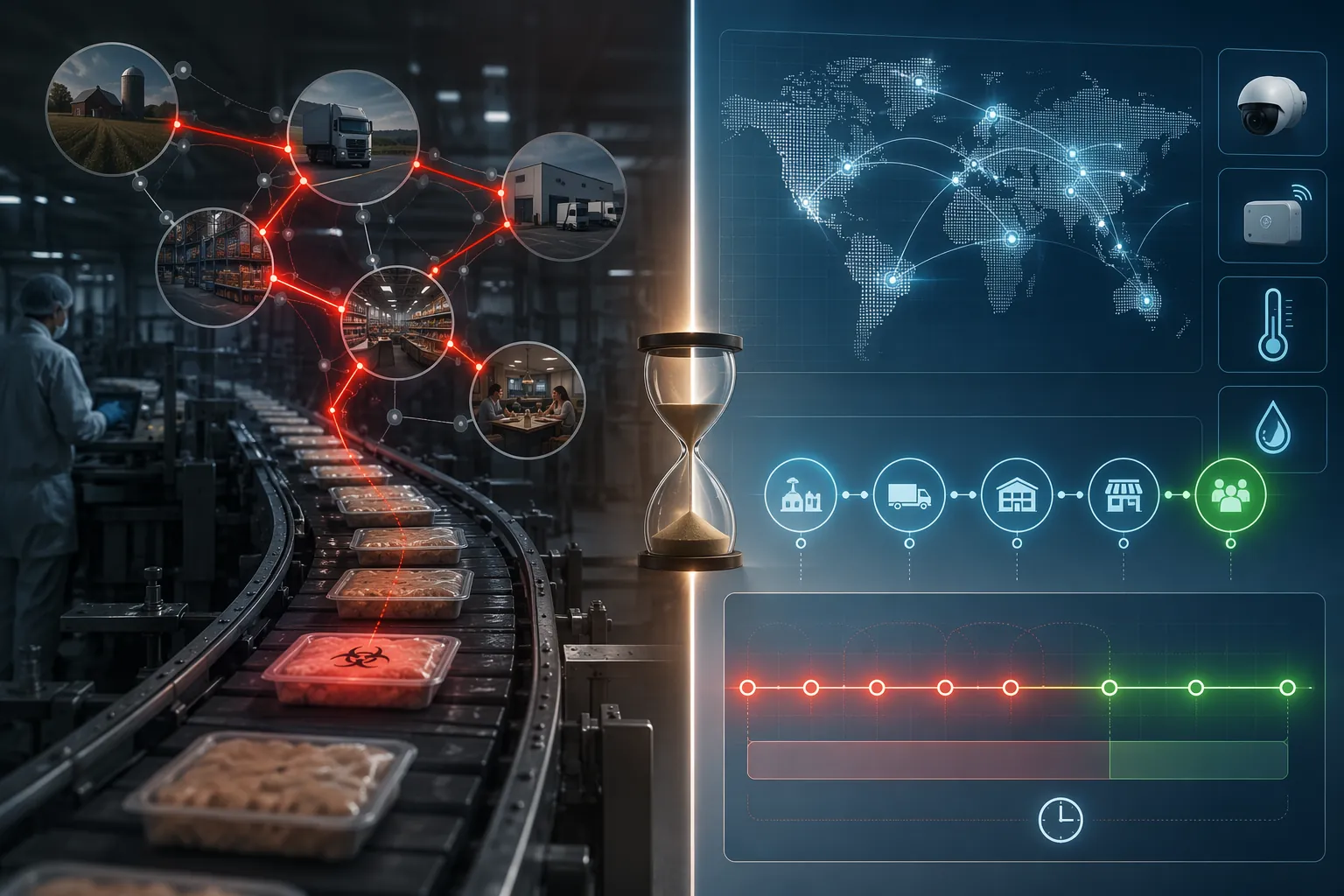
That number explains why better recall administration is not enough. A polished mock recall, a template press release, and a traceability platform can still leave the QA manager staring at a hold room that is too small and a distribution map that is too wide. The question worth asking is where those 23–31 days are being lost, and which signals could have shortened them.
The Recall Problem Is Bigger Than The Recall Count
Mergen AI’s 2025 analysis identified 1,576 FDA events, but that figure should be handled carefully because the dataset covers both food and cosmetics, not food alone.[2] It is useful evidence of failure modes inside FDA-regulated categories, not a clean count of food recalls. A narrower food-and-beverage-only analysis would produce a different denominator.
The more operationally important finding is what sat behind the severe events. In Mergen AI’s segmentation, 73.7% of Class I recalls stemmed from microbial contamination.[2] That matters because microbial failures do not behave like a missing allergen statement found during label review. They multiply quietly, travel through moisture and traffic patterns, hide in niches, and often become visible only after enough evidence accumulates outside the building.
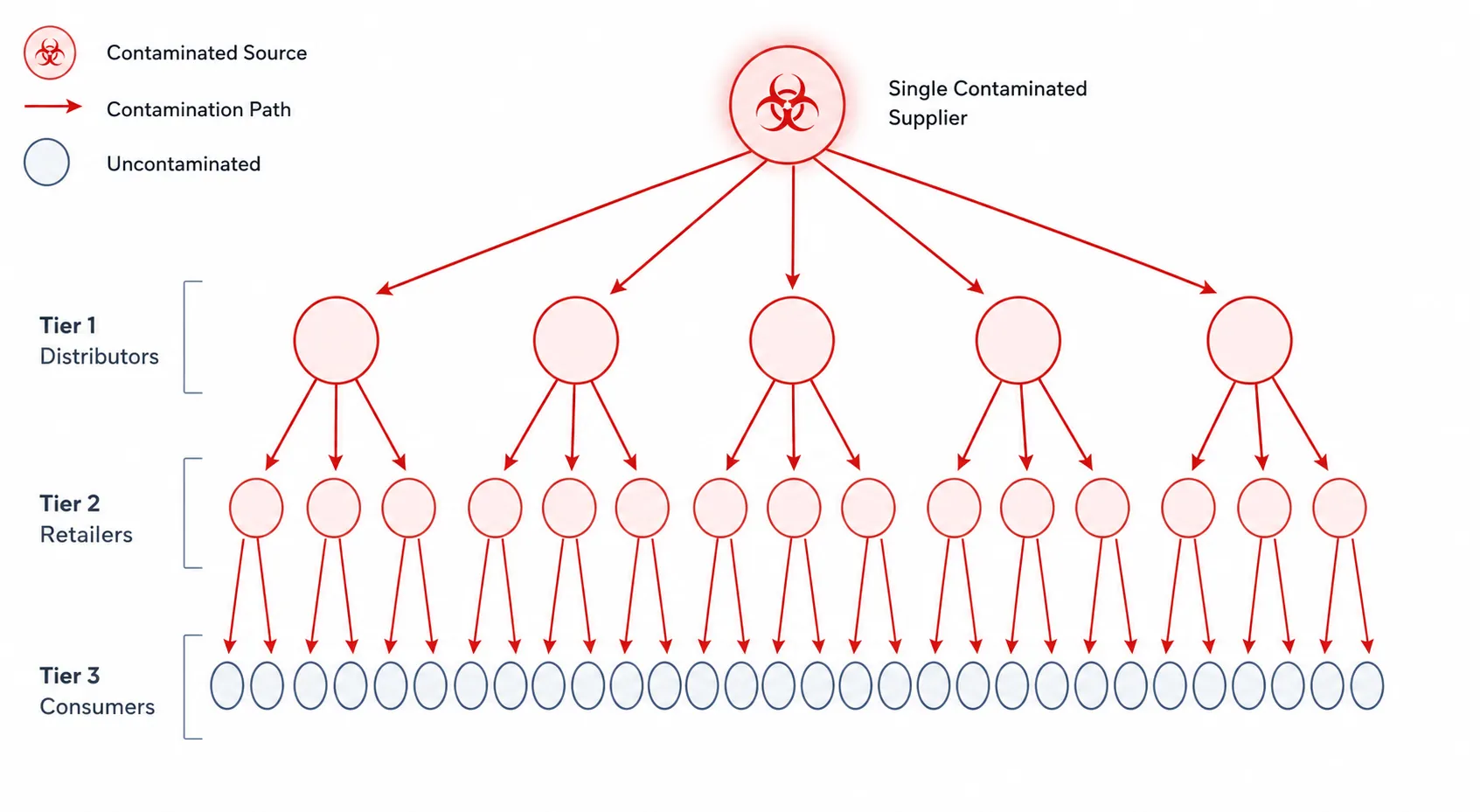
The same analysis described a June 2025 cucumber cascade linked to Bedner Growers, attributing 258 recalls to the broader event chain, including 89 that explicitly cited downstream supplier contamination and 83 that specifically cited cucumbers.[2] Because some of that attribution is analytical reconstruction rather than a direct FDA classification on every individual recall, it should not be overstated as if every record carried the same explicit root-cause label. Even with that caution, the pattern is familiar: one upstream problem, many downstream labels, many customers, and a lot of people downstream trying to prove what they did not know soon enough.
Other severity indicators point in the same direction. CRC Group, analyzing FDA data, reported that units recalled surged 232% in Q1 2025 compared with Q4 2024.[3] FSNS reported that hospitalizations associated with recalled food increased from 230 in 2023 to 487 in 2024, while deaths increased from 8 to 19.[4] These figures do not prove that every food safety system is deteriorating, and they do not isolate one cause. They do show why leaders should stop treating recall volume as a communications inconvenience and start treating detection latency as a food safety control gap.
Where AI Can Actually Shorten The Path To Containment
AI is useful here only if it changes the time between an early risk signal and a containment decision. Faster dashboards are not enough. A model that produces a score nobody in QA trusts, or an alert that cannot be tied to a lot, line, supplier, room, or shipment, is just another inbox.
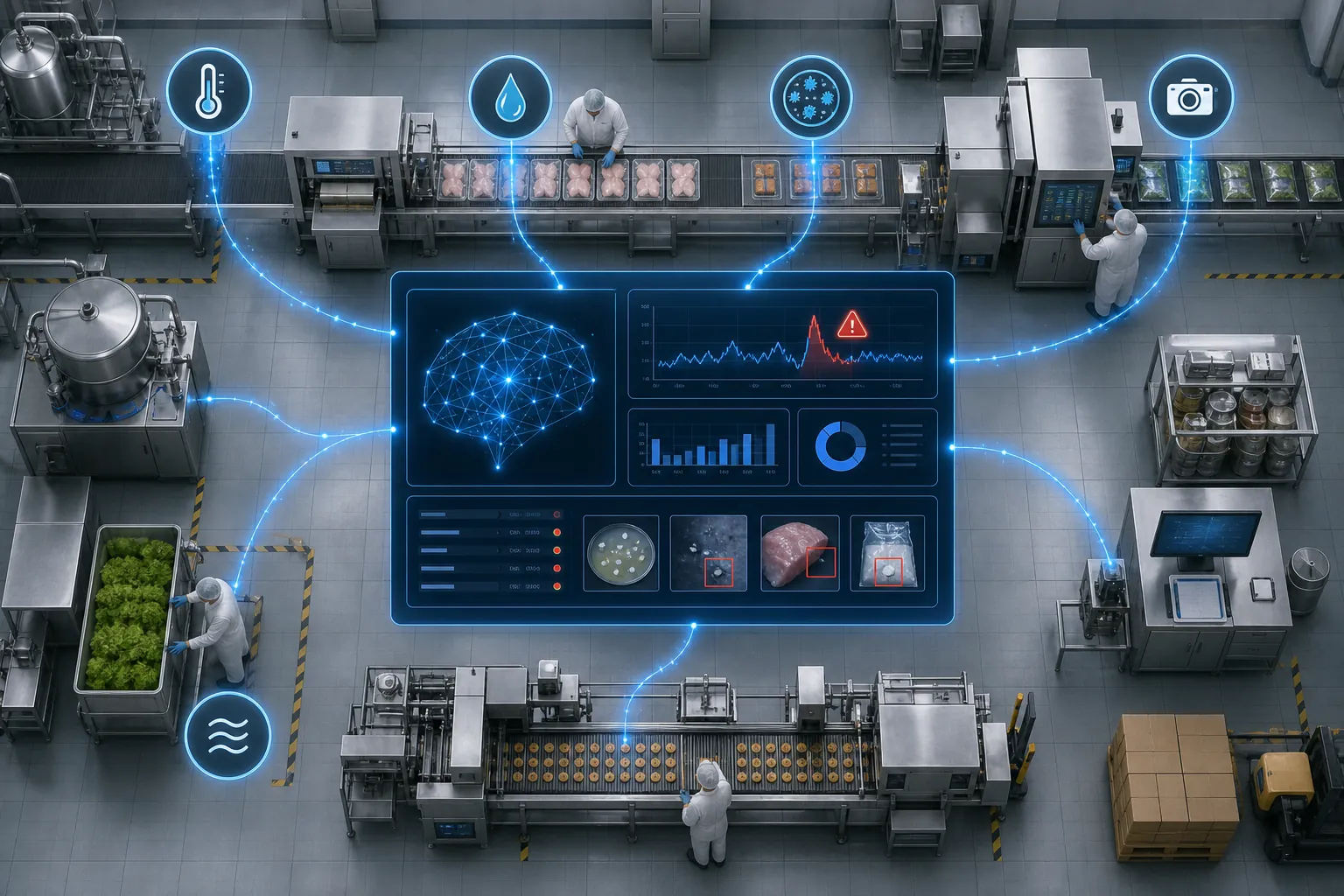
The practical opportunity is to connect weak signals that currently sit in separate places: environmental swabs, temperature deviations, supplier history, sanitation records, receiving data, inline inspection, complaint trends, and lot movement. Food Logistics describes AI-powered platforms pulling from sensors, suppliers, and environmental systems to flag contamination risks before products ship.[1] That is the right frame. The value is not that AI “knows” there will be a recall. The value is that it can notice abnormal combinations quickly enough for humans to hold, test, divert, clean, or investigate before the lot disappears into the network.
| Failure point | AI-driven detection capability | Operational decision it can accelerate |
|---|---|---|
| Microbial risk inside the facility | Environmental monitoring analytics and sensor fusion | Expand sampling, hold exposed lots, investigate zones, or trigger intensified sanitation |
| Supplier contamination before receipt | Machine learning supplier risk scoring and predictive contamination modeling | Tighten receiving checks, require COA review, delay release, or temporarily restrict sourcing |
| Inline quality misses | Computer vision for production-line inspection | Remove suspect product, stop the line, or escalate QA review while production context is still fresh |
| Environmental deviations during handling | IoT anomaly detection across temperature, humidity, dwell time, or equipment behavior | Quarantine affected lots or investigate a cold-chain or process-control break |
| Weak downstream lot isolation | Traceability analytics linked to risk signals | Limit withdrawal to affected lots, customers, or production windows when evidence supports it |
Environmental Monitoring: From Sampling Records To Risk Patterns
Environmental monitoring is one of the places where AI has a credible job because the raw material is already operationally meaningful. A positive swab, a recurring low-level finding, a missed sanitation step, a maintenance event, and unusual room conditions may not each justify a recall decision. Together, they may justify holding product before release.
Traditional programs often rely on scheduled swabs, manual review, and someone experienced enough to remember that a drain, belt, slicer, or traffic route has been troublesome before. AI-driven environmental monitoring analytics can look for repeated spatial and temporal patterns across zones, dates, sanitation cycles, and production runs. FOODAKAI describes AI use in food risk prevention through predictive analytics that identify risk patterns and support earlier action.[5] Yenra’s 2026 discussion of AI food supply chain traceability also identifies environmental and traceability-related AI advances as application areas across the food chain.[6]
The plant-level consequence is straightforward. If an environmental pattern starts to look abnormal on Tuesday night, QA should not have to wait for a Friday spreadsheet review or a Monday corporate meeting. The system should push the pattern into a workflow: affected line, relevant lots, sanitation history, pending release status, and the person authorized to place product on hold.
Sensor Fusion And IoT Anomaly Detection: Watching Conditions While Product Is Still In Motion
Sensor fusion is not magic; it is a way to stop reading facility and logistics signals one at a time. Temperature, humidity, equipment status, dwell time, door openings, cleaning verification, and production timing all mean more when they are evaluated together. A short temperature excursion may not mean much. The same excursion combined with extended staging, a sanitation deviation, and a high-risk ingredient can deserve immediate review.
Food Logistics identifies AI sensor fusion and IoT anomaly detection as ways to flag contamination risk before products ship.[1] In practice, the strongest use case is not a generic “AI alert.” It is exception routing: this lot sat too long in the wrong condition, after this process deviation, on this line, with this supplier input, and it has not yet left the building. That last clause is the difference between prevention and recall administration.
Supplier Risk Scoring: The Upstream Blind Spot
The cucumber cascade is the reason supplier intelligence deserves more than a procurement scorecard. When one supplier-linked event can propagate into hundreds of downstream actions, the receiving dock is too late to be the first serious risk filter. Supplier quality teams need earlier signals from audit history, inspection findings, certificate patterns, prior deviations, commodity risk, geography, seasonality, and external alerts.
Machine learning supplier risk scoring can help prioritize which suppliers, commodities, shipments, or lots need additional scrutiny. The documented application domain exists in current discussions of AI-enabled food risk prevention and traceability, including supplier risk scoring and predictive contamination modeling.[5][6] The judgment still belongs to food safety and supplier quality. The model’s job is to surface risk early enough that people can change release conditions, sampling intensity, or sourcing decisions before contaminated material becomes finished product under multiple brands.
This is also where companies should be careful with claims. A supplier score is not proof of contamination. It is a triage signal. Used well, it asks for more evidence before product moves. Used poorly, it becomes a black-box penalty system that suppliers learn to dispute and QA teams learn to ignore.
Computer Vision: Catching What Inline Checks Miss
Computer vision is most convincing when it is tied to a specific inspection burden: visible foreign material, packaging defects, fill or seal issues, product abnormalities, or label mismatches that can be detected on the line. It can inspect continuously where human checks are periodic and fatigue-prone. That does not make it a full microbial control, and it should not be sold as one.
Current source material documents computer vision for inline quality assurance as an AI application domain in food supply chain traceability and risk prevention.[6] What remains less well documented, at least in the cited sources, are reliable accuracy thresholds across food categories, defect types, lighting conditions, line speeds, and false positive tolerances. That gap matters. A false negative can release risk; too many false positives can shut down trust in the system.
For deployment, the useful question is not “Does the model use AI?” It is: which defect does it detect, at what point in the line, with what escalation rule, and what happens to the suspect unit, case, pallet, or lot when the alert fires?
Earlier Detection Changes The Shape Of The Recall
Recall scope is often a proxy for uncertainty. If the company cannot prove which lots were exposed, it widens the event. If supplier records are late, it widens the event. If environmental data are trapped in paper binders, it widens the event. If distribution visibility is weak, it widens the event. Broad recalls are sometimes the right decision, but they are expensive evidence of missing resolution.
AI-driven detection can narrow recall scope only when it is connected to usable traceability. A risk signal has to map to production time, line, ingredient lot, sanitation state, supplier shipment, finished-goods lot, inventory status, and customer shipment. If that chain is intact, the organization can move from “everything made that week” toward “the lots exposed during this window with this input under these conditions.”
That shift is precision recall. It does not mean smaller recalls by default. It means the scope is based on evidence rather than fear. Sometimes better evidence will enlarge the event because the contamination path is broader than expected. More often, the value is speed: affected product is held, released product is located, unaffected product is not destroyed unnecessarily, and downstream partners receive instructions that match the actual exposure.
A hypothetical example shows the difference. If a ready-to-eat facility receives an AI alert connecting an abnormal environmental pattern to one line, one sanitation cycle, and one production window, QA can place the associated finished-goods lots on hold while investigating. Without that connected data, the same late finding may force the company to review several days of production, multiple shifts, and wider distribution because nobody can defend a narrower boundary.
What Has To Be True Before The Promise Is Credible
The constraints are not side issues. They decide whether AI becomes a control mechanism or a vendor demo. Trustwell’s guide to food supply chain risk management emphasizes data quality and supplier visibility as core requirements, while SafetyChain’s 2026 food safety predictions point to the industry shift from recall response toward prevention and the move away from paper-based processes.[7][8]
The first requirement is clean operational data. Supplier names must match across systems. Ingredient lots must connect to finished-goods lots. Environmental findings must carry location, date, zone, organism, disposition, and corrective action. Sensor data must be time-stamped and tied to equipment, rooms, shipments, or storage areas. If the master data are a mess, AI will mostly accelerate the mess.
The second requirement is workflow integration. QA teams do not need more detached analytics. They need alerts that land where decisions are made: hold-and-release, deviation management, sanitation verification, receiving inspection, supplier corrective action, and recall assessment. An alert should identify the affected material, the reason for escalation, the confidence or evidence behind it, and the decision owner.
The third requirement is a disciplined migration from paper to sensor-driven monitoring. Paper records can satisfy a review requirement while still being too slow for prevention. If environmental monitoring results, sanitation checks, temperature logs, and receiving records are entered days later, the model is learning from yesterday’s risk after today’s product has shipped.
The fourth requirement is honest validation. The cited sources do not provide well-documented model accuracy thresholds for food safety detection across use cases, so leaders should not accept broad claims about recall prevention without asking for validation evidence. For computer vision, that means defect-specific performance. For supplier scoring, it means explainability and review discipline. For environmental analytics, it means evidence that the system detects meaningful patterns early enough to change product disposition.
The Practical Standard For AI-Driven Recall Risk Management
A useful AI program for food recall risk should be judged by the operational time it removes. Did it identify a supplier risk before receipt? Did it connect an environmental pattern before product release? Did it catch an inline defect while the lot was still controlled? Did it isolate the affected lots quickly enough that downstream partners were not asked to withdraw more product than necessary?
That standard keeps the technology in its proper place. AI should not be treated as a recall button, and it should not be credited with preventing recalls when the evidence only shows adoption of analytics. Its strongest role is earlier risk detection across the places where food safety uncertainty is created: suppliers, facilities, production lines, storage conditions, and traceability records.
The case for AI-driven supply chain risk management for food recall is strongest when the goal is not faster paperwork after a failure. It is compressing the delay between contamination risk and containment action. When supplier intelligence, environmental data, inline inspection, IoT signals, and traceability are connected to decisions QA teams can actually execute, food safety moves closer to prevention. Without that connection, the industry will keep discovering contamination after the product has already done the traveling.
References
- How Technology Shapes Food Recall Readiness in 2026, Food Logistics, Dec 2025
- The Anatomy of Failure | FDA Food Recalls 2025, Mergen AI
- Beyond the Label: What 2025's Product Recall Trends Reveal About Emerging Risk, CRC Group
- Food Recalls in 2024: Revealing the Statistics, FSNS
- How can AI boost food risk prevention, FOODAKAI
- AI Food Supply Chain Traceability: 16 Advances (2026), Yenra
- Essential Guide to Food Supply Chain Risk Management, Trustwell
- 2026 Food Safety Trends: From Recall Response to Prevention, SafetyChain
Comments
Join the discussion with an anonymous comment.