
A recurring deviation rarely announces itself as recurring. In the QMS, it arrives with a new batch number, a new timestamp, a new investigator, and just enough local detail to look like a fresh problem. Someone then spends days pulling prior records, checking whether a similar CAPA already failed once, asking maintenance for context, and trying to decide whether “operator error” is a finding or a placeholder.
That is the practical entry point for AI in supply chain quality assurance in pharma: not a general promise that AI will “transform quality,” but a narrower question of whether it can stop quality teams from re-investigating the same failure pattern as if the site had no memory.
Leucine, a pharma quality AI vendor, puts a sharp number on the irritation: roughly 70% of deviations share root causes with previous batches, while conventional QMS workflows still treat each deviation as an isolated event.[1] That figure should be handled as vendor-published benchmark evidence, not settled independent research. Even with that caveat, it describes a familiar operating failure. The information exists somewhere in the organization, but the investigation starts from zero because the system of record stores cases more effectively than it connects them.

The cost of treating every deviation as new
The burden is not only administrative. Entefy cites industry benchmark claims that a typical site may handle more than 200 deviations per month, with investigations costing about $10,000 to $30,000 each.[2] Those figures are not independently verified site averages, and they should not be converted casually into a universal business case. They do show why deviation management attracts AI investment: even modest cycle-time improvement can matter when the queue is that large.
The more important cost is review drag. A weak deviation report can pass from originator to investigator to QA review before anyone formally says what was obvious early: the narrative is incomplete, the chronology is thin, the immediate correction is confused with root cause, or the conclusion leans on “human error” without showing why the behavior occurred. BioProcess International, discussing Moorkoth et al., reports that 85–90% of process deviations are attributed to human factors, while many investigations remain at a “probable” rather than confirmed root-cause level because of superficial attribution.[3]
That is where the best AI use cases are less glamorous than the demos. The useful system does not decide root cause on behalf of QA. It reduces wasted review cycles, retrieves relevant site memory, and flags cross-system patterns that a case-by-case workflow is structurally bad at seeing.
Where AI actually enters the deviation workflow
The strongest current architecture is a layered one. Entefy describes a multi-model framework that combines NLP, clustering, Bayesian networks, retrieval-augmented generation, and anomaly detection across deviation and CAPA workflows.[2] The point is not that every site needs the same vendor stack. It is that different AI methods answer different quality questions, and mixing those questions is how systems become either overclaimed or unusable.
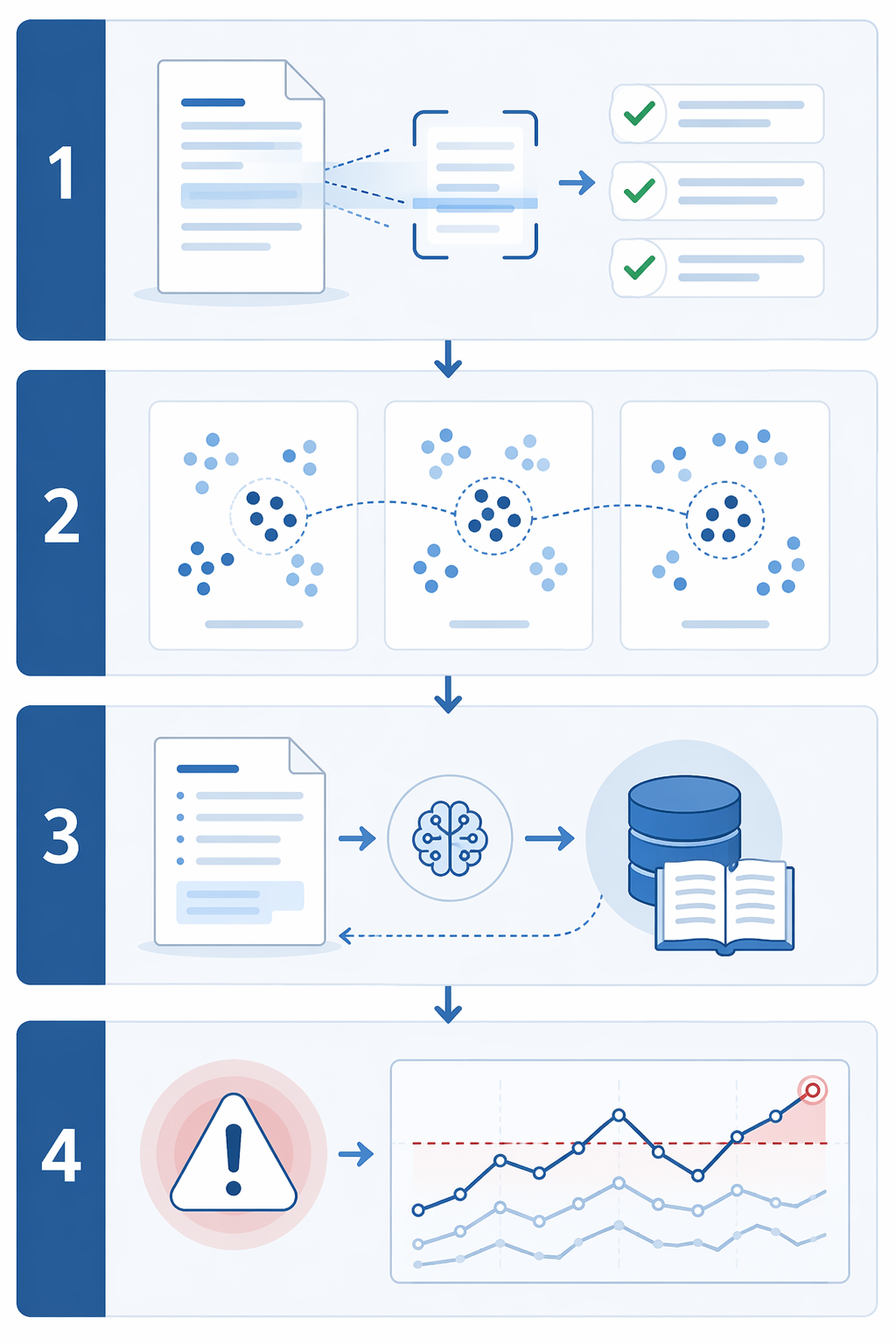
| Layer | What AI does | What a human still owns |
|---|---|---|
| NLP report quality scoring | Flags incomplete narratives, missing chronology, vague impact assessment, or unsupported conclusions before formal investigation work expands | Decides whether the record is adequate, requests clarification, and approves the investigation path |
| Root-cause pattern detection | Clusters semantically similar deviations, CAPAs, batch records, and recurring failure language across historical cases | Determines whether similarity is quality-relevant or merely linguistic |
| RAG-based CAPA support | Retrieves similar prior deviations, implemented CAPAs, effectiveness checks, and closure rationale for review | Selects, rejects, or modifies actions based on process knowledge and GxP judgment |
| Anomaly detection | Finds emerging risk signals across operational data before a single parameter necessarily breaches its limit | Confirms whether the signal is actionable and controls escalation |
Report quality scoring catches bad investigations before they become long investigations
NLP report scoring is one of the least theatrical but most defensible uses. It reads the initial deviation narrative and supporting fields for completeness, specificity, and internal consistency. A model can flag that the event description lacks sequence, that the affected material is not clearly identified, that impact assessment language is copied from another record, or that the proposed root cause appears before evidence is documented.
This matters because review effort compounds. If the originator submits a thin record, the investigator inherits uncertainty. If the investigator builds on that uncertainty, QA receives a closure package that needs another round. Scoring the report at intake does not prove root cause. It simply prevents avoidable archaeology later in the cycle.
For a high-volume site, this is not a minor convenience. A system that catches weak narratives before investigation assignment changes who waits. QA reviewers stop discovering basic gaps near closure. Investigators stop spending Friday afternoon repairing a record that should have been clarified when the deviation was opened.
Pattern detection turns historical deviations into usable site memory
Clustering and semantic search are useful when the same underlying problem is described in different language. One investigator writes “intermittent fill-weight drift.” Another writes “minor dispenser instability.” A third logs a packaging interruption after a short stop. A keyword search may miss the relationship. A model trained across historical deviation narratives, CAPA text, batch context, and equipment references can surface the family resemblance for human review.
The distinction matters: similarity is not proof. A cluster of prior deviations can tell the investigator where to look, which CAPAs were tried, which effectiveness checks failed, and whether the same equipment or supplier appears repeatedly. It cannot, by itself, establish that today’s deviation has the same verified root cause. That decision still needs evidence from the batch, process, equipment, people, materials, and controls involved.
Used well, the model changes the first hour of an investigation. Instead of starting with a blank template and a document hunt, the investigator receives a shortlist of prior cases that look similar enough to examine. Some will be noise. Some will show that the site already tried retraining twice and never addressed a maintenance interval, an alarm configuration, a material handling step, or a procedural ambiguity.
RAG can retrieve prior CAPAs, but it cannot bless the next one
Retrieval-augmented generation is attractive because CAPA writing consumes so much time. In this workflow, RAG does not invent a corrective action from a generic model response. It retrieves semantically similar historical deviations, the CAPAs associated with them, implementation evidence, closure rationale, and effectiveness outcomes. The output is a review packet, not an approval.
That boundary is especially important in pharma. Entefy notes that evidence for RAG-based recommendation draws partly from similar implementations outside pharma, including ceramics manufacturing FMEA, so pharma-specific validation evidence remains thinner than the enthusiasm around the method.[2] The safer claim is that RAG can shorten search and drafting time by retrieving relevant institutional memory. It should not be treated as a substitute for process understanding, impact assessment, or QA approval.
A useful RAG answer is therefore humble. It says, in effect: here are five prior deviations with similar language, equipment, product family, environmental context, or CAPA history; here is what was done; here is whether the effectiveness check held. The investigator still has to decide whether any of that belongs in the current record.
Anomaly detection is where supply chain quality starts to look forward
Deviation management often becomes supply chain quality work when local failures threaten batch release, site capacity, supplier continuity, or recall exposure. A deviation that stays open too long can delay disposition. A repeat contamination signal can become a plant reliability issue. A supplier-related quality pattern can move from complaint handling into planning and allocation.
This is where anomaly detection adds a different kind of value. Rather than waiting for a formal deviation to breach a threshold, models can watch weak signals across environmental monitoring, equipment logs, maintenance records, and QMS history. The output is not a deviation finding; it is an early warning that a combination of small movements deserves attention.
That connects deviation AI to broader supply chain risk work, including plant disruption and recall prevention. A quality signal that prevents a repeat batch failure can also prevent an avoidable release delay. For a wider supply chain view, the same logic appears in recall-risk modeling, where earlier quality signals become inputs to downstream risk decisions in AI-driven drug recall risk prediction.
Why cross-system data matters more than a better dashboard
A QMS-only model can read deviation records. That is useful, but it is also constrained by what investigators already chose to write down. Repeat failures often live in the spaces between systems: the QMS has the deviation, CMMS has the maintenance delay, environmental monitoring has the particulate trend, and equipment logs have the operating context.

The Bayesian network example in Entefy’s framework is a good illustration because it does not rely on one dramatic signal. A model can map dependencies across deviation reports, CAPA records, environmental monitoring, and equipment logs, detecting that rising particulates, delayed HVAC maintenance, and gowning drift jointly increase contamination risk before any single threshold is breached.[2]
Individually, each signal may be explainable. Particulates are still within limit. Maintenance is delayed but not overdue by the site’s escalation rule. Gowning observations are minor and scattered across shifts. Together, they may describe a risk path that no single record owns. That is exactly the kind of pattern a traditional deviation workflow tends to miss, because the workflow begins after an event is classified and assigned.
This is also why elegant dashboards disappoint. A dashboard can display open deviations by age, CAPA status, and root-cause category. It may still leave the investigator manually reconstructing the causal neighborhood around the event. The AI value is not the graphic. It is the joining of evidence that the organization already controls but has not made analytically available.
The readiness work is where many ROI stories get quiet
BioProcess International describes AI-driven deviation management as capable of cutting investigation time by an estimated 50–70% compared with conventional manual investigations.[3] The wording matters. This is an estimated reduction from a hypothetical AI-enabled workflow, not a controlled before-and-after study across comparable pharma sites.
The estimate is plausible enough to deserve attention because the manual workflow contains obvious waste: incomplete intake records, repeated searches for prior deviations, duplicated CAPA drafting, and late discovery of missing context. But a site cannot buy the estimate as software. The estimate depends on whether the data foundation lets the models operate.
- Structured deviation taxonomies: Root-cause categories, event types, impact areas, equipment identifiers, product families, and CAPA classifications need enough consistency for models to compare cases without treating every spelling variation as a new reality.
- Digitized historical records: Pattern detection needs history. The practical threshold in the research brief is at least 2–3 years of searchable deviation and CAPA records, including closure rationale and effectiveness outcomes.
- Cross-system integration: QMS data needs to connect with CMMS, environmental monitoring, equipment logs, and, where relevant, batch and supplier context.
- Governed metadata: Timestamps, asset IDs, room IDs, line names, material identifiers, and shift information need to align well enough for the model to compare events across systems.
- Reviewable outputs: Investigators and QA reviewers need to see why a prior case was retrieved or why a signal was flagged, not just receive a black-box answer.
These prerequisites are not cosmetic. If the historical CAPA record does not distinguish retraining from procedure revision from equipment modification, a recommendation engine will retrieve weak precedents. If environmental data cannot be joined to the room, line, and time window of the deviation, anomaly detection becomes a guessing exercise. If root-cause categories have been used inconsistently for years, clustering may reproduce the site’s old confusion at higher speed.
The organizations most likely to benefit first are not necessarily the ones with the largest dashboards. They are the ones with enough clean history, stable taxonomies, and connected systems for AI to find real recurrence rather than formatting artifacts.
What current AI can do reliably, and what still needs restraint
The reliable uses are bounded. NLP can flag weak documentation. Clustering can surface similar historical deviations. Bayesian and anomaly models can identify combinations of risk signals. RAG can retrieve prior CAPAs and investigation packages for review. These uses support investigation quality and speed because they reduce search effort and make prior evidence harder to ignore.
Autonomous root-cause determination is a different claim. A model can suggest that the current record resembles prior HVAC-related contamination deviations. It cannot know, without confirmed evidence, that HVAC is the root cause in the current case. It can identify that a CAPA resembles one previously judged effective. It cannot decide whether the process, product, room, personnel, and regulatory context make that CAPA appropriate today.
The human-factors attribution problem is a warning here. If a site already overuses “probable human error,” AI can make that habit look more consistent rather than more correct. A model trained on shallow investigations may learn the language of shallow investigations. Validation has to test whether the system improves investigation discipline, not just whether it predicts the site’s historical labels.
Regulators will care about validation, not the AI label
Regulatory pressure makes this less optional and more exacting. QA Resources reports that FDA 483 citations for documentation issues are up about 38% year over year, and also points to EMA’s 2025 AI workplan and FDA’s January 2025 draft guidance on AI credibility as signs that AI use in regulated quality contexts is moving into a validation conversation.[4]
The FDA draft guidance, “Considerations for the Use of Artificial Intelligence To Support Regulatory Decision-Making for Drug and Biological Products,” provides a credibility framework for AI models used to support regulatory decisions involving drugs and biologics.[5] For deviation and CAPA systems, the practical implication is straightforward: the model’s role, data inputs, performance expectations, limitations, monitoring plan, and change-control process need to be defined before the output becomes part of a GxP workflow.
Continuously learning models make this harder. If a model changes as new deviations close, the site needs governance for retraining, drift monitoring, regression testing, access control, audit trails, and periodic review. A static validated model may become stale. A constantly updated model may become uncontrolled. Neither problem is solved by calling the tool an assistant.
The use case is real, but it is not plug-and-play
AI can materially reduce deviation investigation time when it attacks the parts of the workflow that are genuinely repetitive: intake quality checks, historical search, similar-case retrieval, CAPA comparison, and weak-signal detection across connected systems. It can also expose repeat failure patterns that conventional QMS workflows miss because those workflows are built around case handling, not organizational memory.
The strongest business case is not “faster closure” alone. Faster closure without better root-cause discipline just accelerates recurrence. The stronger case is fewer wasted review cycles, better use of prior CAPA evidence, earlier visibility into cross-batch and cross-system patterns, and fewer investigations that end with a familiar but unsupported human-error conclusion.
For sites still running fragmented QMS data, inconsistent taxonomies, paper attachments, disconnected maintenance records, and environmental data that cannot be joined cleanly to the event, the first AI project is probably not a recommendation engine. It is the unglamorous work: standardize classifications, digitize 2–3 years of records, connect QMS with CMMS and monitoring systems, validate the model’s intended use, monitor drift, and put changes through quality governance.
That is where the useful version of this use case ends. AI can shorten investigations and make repeat causes visible, but only after the site has made its own history usable.
References
- Predictive Deviation Intelligence: How AI Agents Eliminate Repeat Quality Failures — Leucine, February 2026
- A Multi-Model AI Framework for a More Robust Deviation Management in Pharma Manufacturing — Entefy
- A Vision for Artificial Intelligence in Biopharmaceutical Quality Management Systems — BioProcess International, July 2025
- AI Deviation Management: A QA Guide for 2026 — QA Resources
- Considerations for the Use of Artificial Intelligence To Support Regulatory Decision-Making for Drug and Biological Products — FDA, January 2025
Comments
Join the discussion with an anonymous comment.