
A cancellation is no longer a single timestamp. Inside a stronger airline operations center, it can become a moving probability several hours before the flight disappears from the schedule. Maintenance data, crew legality, weather, airport flow, aircraft rotation, gate availability, passenger connections, and rebooking options are being pulled into systems that try to decide earlier whether the network should protect, delay, swap, or cancel.
That earlier clock matters. Flight disruptions cost the airline industry about $60 billion annually, 22% of U.S. flights were delayed in 2024, and OAG/Microsoft analysis of DOT data attributes nearly 60% of delays to industry-related causes rather than weather, which makes a meaningful share of disruption at least partly addressable by better operations decisions.[1]
For logistics teams planning around flight cancellations, the question is not whether airlines can make smarter recovery decisions. Increasingly, they can. The harder question is whether the signal reaches the shipment while there is still time to do anything useful with it.

The disruption clock is moving upstream
Airlines used to discover too much of the operating day in sequence: a late inbound aircraft, a crew timing out, a gate conflict, a mechanical issue that would not clear, a cancellation, then a customer recovery scramble. The better AI use cases compress that sequence by turning weak signals into earlier decisions.
An A350 can generate 2.5 TB of sensor data per flight day, and OAG/Microsoft analysis says AI models using this kind of operational and maintenance data can support predictive maintenance that reduces unscheduled events by 30–35%. The same analysis says AI can predict cancellations up to six hours ahead and that AI-supported rebooking engines and crew reassignment can operate more than 60% faster in cited IBM Watson benchmarks.[1]
Those numbers should not be read as a universal airline baseline. Some come from vendor or industry analysis rather than independent public audits. But even with that caveat, they point to an important operational shift: the best disruption systems are trying to decide before the failure becomes visible to everyone else.
SITA frames the same problem around decision latency rather than only delay duration. In that view, the expensive part is not simply that an aircraft is late; it is that the network keeps making decisions as if the aircraft might still operate normally until the remaining options have deteriorated.[2]
A passenger airline can use an earlier cancellation probability to protect crews, avoid illegal pairings, move aircraft, reassign gates, re-accommodate passengers, and limit knock-on delays. American Airlines’ AI gate optimization at DFW, for example, is cited by OAG/Microsoft as saving 10 hours of taxi time daily.[1] That is a real operating gain, but it is still mostly an airline-side gain unless the downstream freight plan can consume the same change in time.
What airline disruption AI is actually deciding
The useful version of airline AI is not a chatbot explaining why a flight is late. It is a set of decision engines trying to reduce the time between a risk appearing and an operating response becoming executable.
| Airline decision layer | What the AI system is trying to improve | Why cargo planners should care |
|---|---|---|
| Prediction | Detect a likely delay or cancellation before the schedule event is final | Creates the earliest possible trigger for shipment exception planning |
| Maintenance | Use sensor and historical data to identify aircraft at risk of unscheduled events | Changes confidence in the aircraft that is supposed to carry belly freight |
| Crew | Find legal crew options faster when rotations break | Determines whether the flight can still operate or whether the cargo needs another path |
| Gate and airport flow | Reduce taxi, connection, and airport bottleneck effects | Affects cutoff times, transfers, and whether cargo makes the planned uplift |
| Recovery | Choose aircraft swaps, cancellations, rebooking, and network repair actions | Can consume scarce alternate capacity before cargo teams receive a usable signal |
The maintenance layer is often the cleanest place to understand the shift. A sensor anomaly does not automatically cancel a flight. It changes the probability distribution around that aircraft, and that probability can be compared against crew limits, airport constraints, spare aircraft availability, and the number of passengers and connections exposed if the flight fails later.
Crew logic is less visible from outside the airline but just as decisive. A flight with an aircraft and passengers still may not operate if the available crew cannot legally complete the duty period. Faster crew reassignment does not merely reduce call-center pressure; it can decide whether a cargo booking remains attached to a viable flight or becomes a missed uplift waiting for someone to notice.
Gate and airport optimization matter for cargo because many freight exceptions begin as small timing losses. A shipment that misses a tender cutoff, a transfer window, or a recovery truck handoff can fail even if the passenger itinerary looks recovered. The flight may still depart. The cargo may not.
Recovery systems then make the most consequential choices: hold, cancel, swap aircraft, prioritize a hub bank, protect high-value passenger connections, or move aircraft to defend tomorrow’s schedule. These choices are rational inside the airline. They also reshape belly capacity, cargo acceptance, and downstream delivery promises.
The cargo signal often arrives after the useful capacity is gone
Air cargo does not wait in a parallel universe. Passenger belly freight carries about half of U.S. air freight, so a passenger network cancellation can quickly become a manufacturing, retail, or last-mile problem.[1] The shipment may be booked through a forwarder, moving under a consolidation, tied to a production line, promised to a store replenishment window, or feeding an e-commerce delivery commitment. Each layer needs time, not just a final status.
The planning gap appears when the airline has an internal probability that a flight is deteriorating, but the cargo chain receives only a late milestone: delayed, canceled, not uplifted, departed without freight, arrived short, or available at destination. By then, the best all-cargo alternative may be full, the trucking recovery may miss the sortation wave, and the inventory planner may have already trusted stock that is not going to arrive.
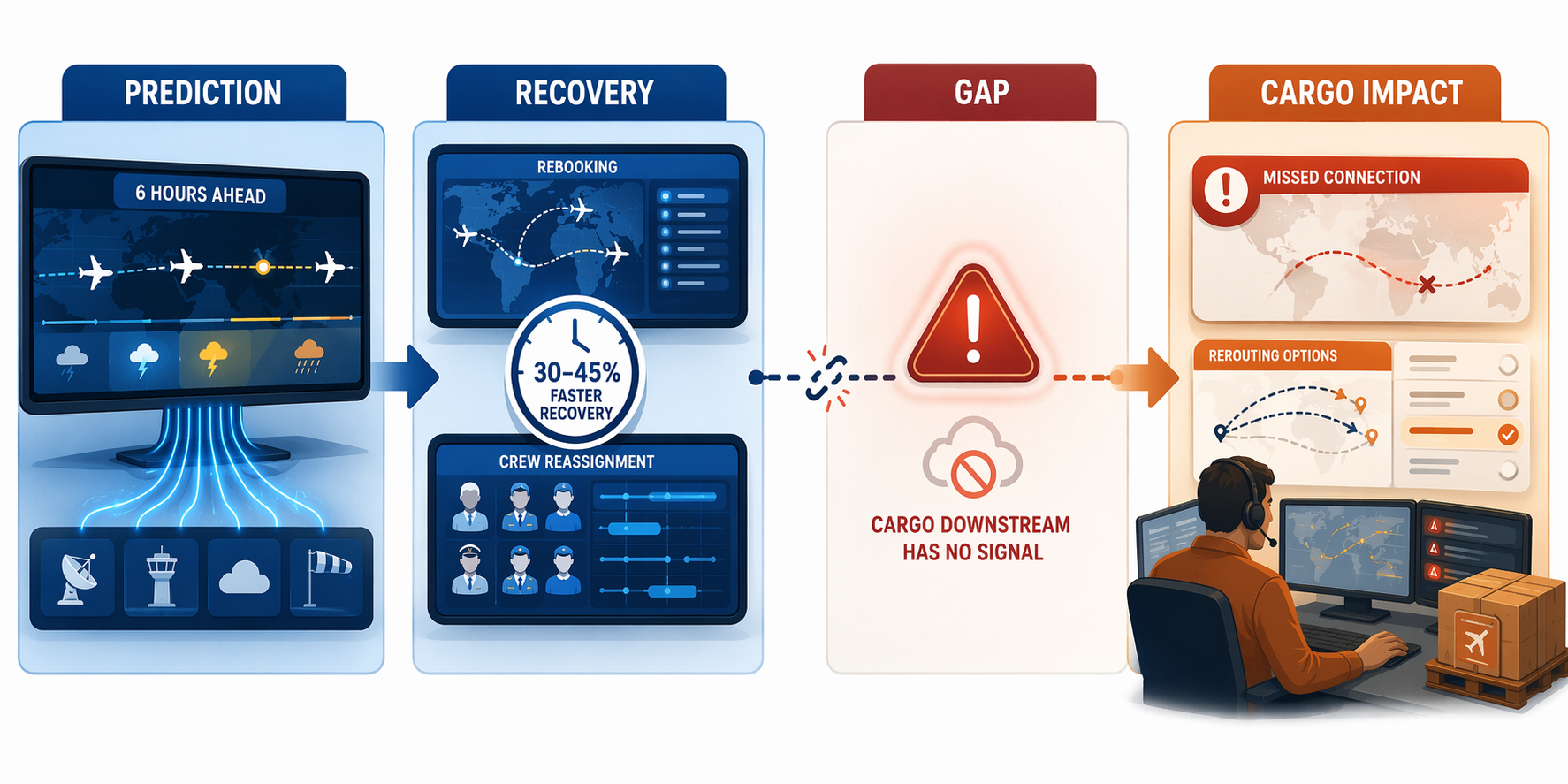
This is where passenger recovery and shipment recovery diverge. A traveler can be rebooked from one itinerary to another and still arrive acceptably late. A shipment may need temperature control, customs timing, dock labor, delivery appointment protection, SKU-level inventory substitution, or a customer escalation before the original flight is formally canceled. The practical recovery window may close before the airline’s public disruption status becomes definitive.
OAG cites about $7,500 in lost belly cargo revenue per disrupted flight using AirHelp and FAA-linked data.[1] That figure is useful, but it measures the airline-side cargo revenue exposure. It does not capture the downstream cost of a stopped line, an expedited replacement, spoiled or delayed product, chargebacks, customer-service labor, or a delivery promise that must be manually unwound.
Capacity cuts show why a late signal is not enough
When capacity is reduced across a network, the distinction between knowing and acting becomes sharper. FreightWaves reported that FAA flight restrictions involving 10% cuts at 40 major airports directly reduce passenger belly cargo capacity, while the effect on all-cargo operators can differ depending on exemptions, routing, and operating conditions.[4] Forbes, citing Everstream analysis, similarly warned that cargo delays tied to FAA flight cuts could persist after a shutdown ends.[5]
For a forwarder, the problem is not just fewer flights. It is the timing of the substitution decision. If the system waits until a passenger flight is canceled publicly, the alternate belly option may already be under passenger-recovery pressure, the freighter option may be priced up or capacity-constrained, and the origin cargo may still be sitting in a process designed around the original cutoff.
A six-hour cancellation prediction does not automatically solve that. Six hours is only useful if it can trigger actions outside the airline: hold tender, re-rate the shipment, search all-cargo alternatives, split a consolidation, move priority freight first, notify the consignee, reserve destination labor, or adjust delivery promises before customer-service teams are left explaining a failure.
The missing connector is not another dashboard
Many cargo teams already have dashboards. They can see flight status, milestones, exception queues, airport congestion, and sometimes weather overlays. The missing piece is often a decision-grade feed that says, early enough, how likely the booked uplift is to fail and what alternatives are still operationally available.
That feed does not need to expose every airline internal variable. It does need to be reliable enough for a logistics system to act on. A probability band, a recovery confidence score, a protected-capacity flag, or an estimated decision deadline can be more valuable than a late binary cancellation notice.
The downstream routing engine then has to treat airline disruption as an input, not an after-the-fact event. If the booked flight is likely to fail, the logistics system should compare the cost and service impact of acting now against waiting. Some shipments can absorb the delay. Some should be moved to an all-cargo option. Some should be trucked to another gateway. Some should trigger inventory substitution rather than transport recovery.
Investment is moving, but cargo automation is still uneven
There is money moving into airline disruption management. Dataintelo estimates the airline disruption management market at $4.8 billion in 2025, growing at a 9.8% CAGR to $11.2 billion by 2034. The same commercial research source estimates cloud deployment growing at a 12.9% CAGR versus 7.1% for on-premises deployment, with cloud expected to dominate by 2028.[3]
Those market figures should be treated as one analyst firm’s estimate, not a measured operating outcome. Still, they describe the direction of travel: disruption management is becoming a software category, and cloud-based deployment makes cross-party integration more plausible than it was when recovery logic sat inside isolated airline systems.
The uneven part is cargo. Dataintelo identifies cargo disruption management as a white-space opportunity and says cargo tools lack the automation sophistication of passenger-focused platforms.[3] That matches what many logistics teams experience: passenger rebooking receives structured recovery logic, while freight recovery still relies heavily on milestone watching, manual escalation, and relationship-based capacity searches.
Vendor examples show the ecosystem forming rather than a finished solution. Amadeus Altea OCC, SITA AvAIR, and Sabre AirVision sit in the airline operations and recovery world. United, Delta, and Air France-KLM have built in-house capabilities. Everstream Analytics says one client saved $10 million over 10 months by tracking cargo cancellations, but that is a vendor-disclosed case, not a general industry benchmark.[6]
The more important point is not which vendor appears in the workflow. It is whether the workflow crosses the airline boundary with enough structure for a cargo owner, forwarder, or 3PL to make its own decision before the exception becomes expensive.
What changes when logistics systems can consume the airline signal
A logistics team does not need to copy an airline operations control center. It needs to translate airline disruption intelligence into cargo actions. The useful unit is not the flight alone; it is the shipment’s recoverability.
A recoverability view would ask practical questions. Is the cargo already tendered? Is it screened? Can it be pulled? Is the shipment consolidated with lower-priority freight? Is there another flight with belly capacity, or only a freighter option through a different gateway? Would trucking to a nearby airport beat waiting? Does the consignee need inventory substitution more than transport acceleration? Does the delivery appointment have labor attached?
Once those questions are machine-readable, an earlier airline signal becomes operational. A routing engine can rank alternatives by cost, service impact, emissions policy, customs risk, temperature constraints, and customer priority. An exception workflow can assign the case to the right team before the shipment misses uplift. Inventory systems can revise available-to-promise assumptions before sales or production teams discover the gap through failure.
- Before tender: hold, rebook, split, or move the shipment to a different gateway while options still exist.
- After tender but before uplift: decide whether pulling the freight is worth the handling cost and operational friction.
- After missed uplift: move from status monitoring to recovery execution, with capacity and customer commitments already evaluated.
- Before destination failure: adjust labor, delivery appointment, replenishment plan, or customer promise instead of waiting for arrival shortfall.
This is also where prediction quality has to be handled carefully. A false alarm can create unnecessary expedite cost. A weak confidence score can train planners to ignore the feed. A signal that arrives without capacity context can create noise rather than action. The logistics value comes from joining airline probability with shipment priority and actual recovery options.
AI-first airlines may gain margin, but silos still decide who benefits
BCG’s 2026 air travel outlook says only one of 36 surveyed airlines met its highest criteria for an “AI-enabled future,” while also projecting that AI-first carriers could gain a 5–6% operating margin advantage by 2030.[7] That contrast is useful: the opportunity is large, but the current maturity is uneven.
Implementation risk is not a footnote. Gartner’s often-cited finding that 60% of AI projects fail and IATA’s finding that 63% of airlines struggle with operational silos both point to the same practical hazard: a model can be technically impressive and still fail to change the handoff that matters.
Airline silos are especially costly for cargo because the freight plan is already outside much of the passenger recovery workflow. The operations center may optimize the network, the commercial team may protect passengers, the cargo team may update capacity, the forwarder may monitor milestones, and the shipper may maintain a separate inventory plan. If the disruption signal does not travel across those seams, each party acts late and locally.
The competitive edge is therefore not simply buying an AI tool. It is reducing the time between an airline’s early disruption knowledge and a logistics decision that changes the outcome. That decision may be a reroute, a split shipment, a customer promise change, an inventory substitution, or a deliberate choice to do nothing because the recovery cost is worse than the delay.
The planning variable logistics leaders can act on
The useful strategic move is to treat airline disruption intelligence as an upstream supply chain signal. That means asking carriers, forwarders, technology providers, and internal teams a different set of questions: How early can risk be shared? Is the signal probabilistic or only final? Can it be consumed by a routing engine? Does it map to shipment priority? Does it trigger a workflow owner? Does anyone measure the cost of waiting?
Some of this will require commercial negotiation because airlines will not expose every internal recovery assumption. Some will require data discipline because stale milestones dressed up in a new interface will not change recovery. Some will require restraint because not every predicted disruption deserves an expensive intervention.
The gap is not that airlines lack AI. The gap is that cargo owners and logistics partners often have not wired airline disruption intelligence into their own planning systems. As cancellation prediction and recovery decisions move earlier inside the airline, decision latency becomes the planning variable logistics leaders can still act on.
References
- AI and Trusted Data: Building Resilient Airline Operations — OAG/Microsoft
- Aviation's disruption cost is a problem created by the clock nobody is watching — SITA
- Airline Disruption Management Market Research Report 2034 — Dataintelo
- Cargo airlines, shippers face mixed impact from FAA flight restrictions — FreightWaves
- FAA Flight Cuts And Cargo Delays To Persist Even After Shutdown Ends — Forbes, November 12, 2025
- U.S. Flight Disruption Likely to Persist — Everstream Analytics
- Air Travel Outlook 2026: Revenues and Costs Are Rising — BCG
Comments
Join the discussion with an anonymous comment.