
A food safety program usually learns too late. A positive environmental result arrives after production has run. A complaint cluster appears after consumers have eaten. A recall begins after product has left the building, and the next few days are spent reconstructing supplier lots, sanitation records, distribution paths, and decisions that would have been easier to make earlier.
For teams evaluating AI for food safety supply chain outbreak detection, the useful question is not whether a model can produce a risk score. It is whether the warning arrives early enough, with enough credibility, to change an action: more sampling on one ingredient, a hold on one lot, a supplier escalation, a sanitation verification, a slower release decision, or a targeted audit before contamination becomes an incident.
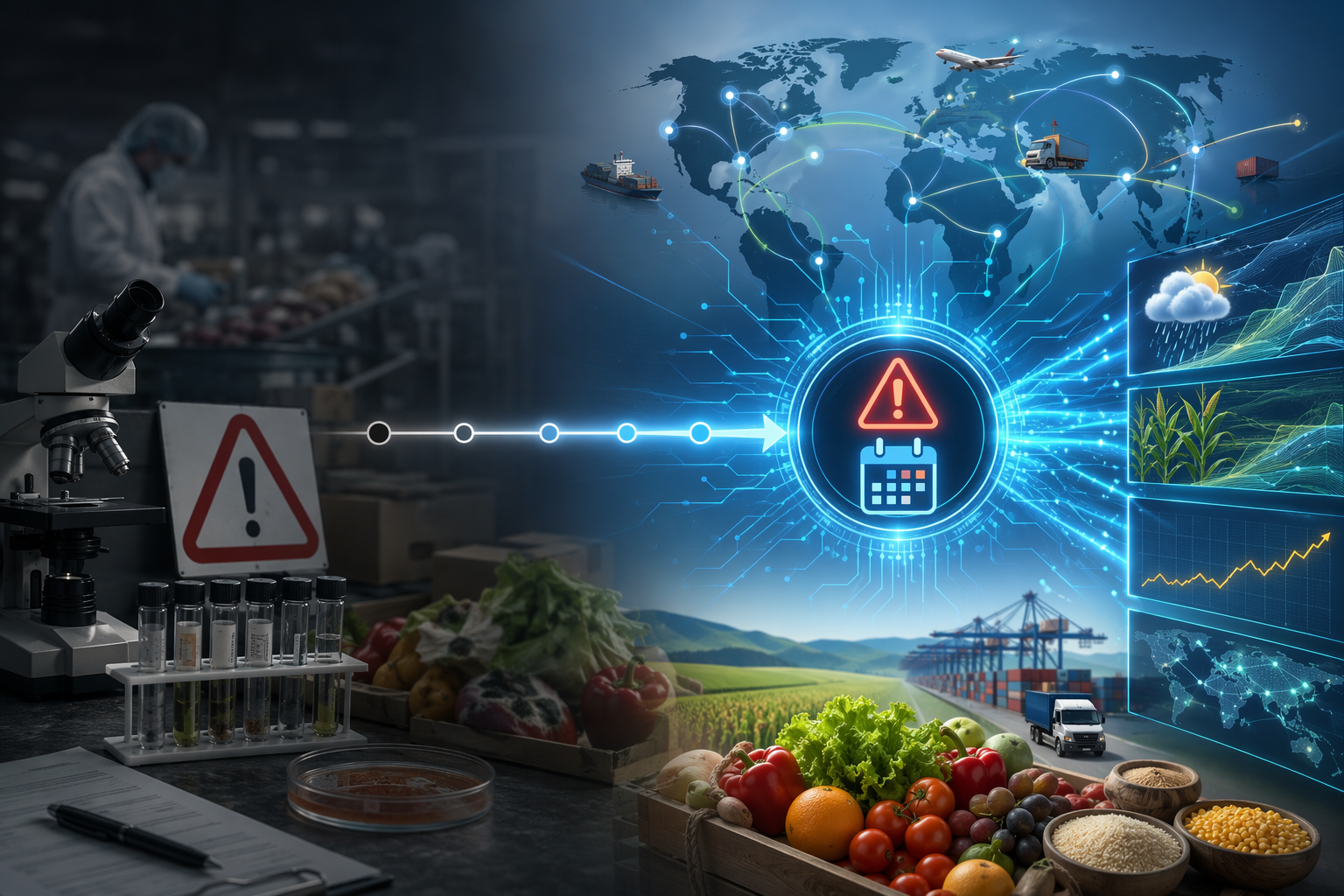
That distinction matters because predictive food safety systems do not usually “see” a pathogen before anyone else does. They infer elevated risk from conditions that tend to precede unsafe outcomes. Some of those conditions are familiar to FSQA teams: prior positives, sanitation records, traffic patterns, temperature deviations, and supplier history. Others sit outside the traditional food safety file: weather anomalies, commodity prices, trade volumes, and broader socioeconomic indicators.
What “predicting an outbreak” really means
In operational terms, prediction should be understood as risk prioritization ahead of conventional confirmation. A model may not say, with useful precision, that a named product from a named plant will cause an outbreak on a named date. A more realistic system flags that a material, supplier, region, facility zone, or process state has moved into a higher-risk condition than normal.
That is still valuable if the receiving team knows what the alert authorizes. A procurement group may need to challenge a certificate of analysis. A plant may need to increase environmental swabbing in a specific zone. A quality manager may need to hold release pending additional verification. A corporate food safety group may need to compare the alert with complaints, inspection findings, or supplier deviations. Without those decision rights, the model has only moved uncertainty from the database to the meeting room.
The strongest evidence for this newer approach comes from studies that connect upstream, non-obvious signals to later contamination risk. Two examples are especially useful because they show both the promise and the limits: a feed-contaminant prediction model from Wageningen University researchers and a dairy supply chain early warning study based on raw milk price anomalies.
External signals can carry food safety information
The Wageningen study, published in npj Science of Food in November 2025, tested a CatBoost machine learning model to predict exceedances across four feed contaminant groups: mycotoxins, heavy metals, dioxins, and pesticides. The model used a broader signal set than many food safety teams would normally assemble, including weather, commodity trade volumes, and socioeconomic indicators. Reported performance reached 83% sensitivity and 73% specificity, but that result must be read with the study’s threshold choice: because of data imbalance, the model used a reduced threshold at half of legal limits rather than only above-legal-limit exceedances.[1]
That caveat does not make the result unimportant. It makes it more operationally precise. The study is not proof that a plant can plug in public data and reliably predict every illegal contaminant event. It is evidence that external drivers can help identify conditions associated with elevated contaminant risk before a traditional testing program would necessarily focus attention there.
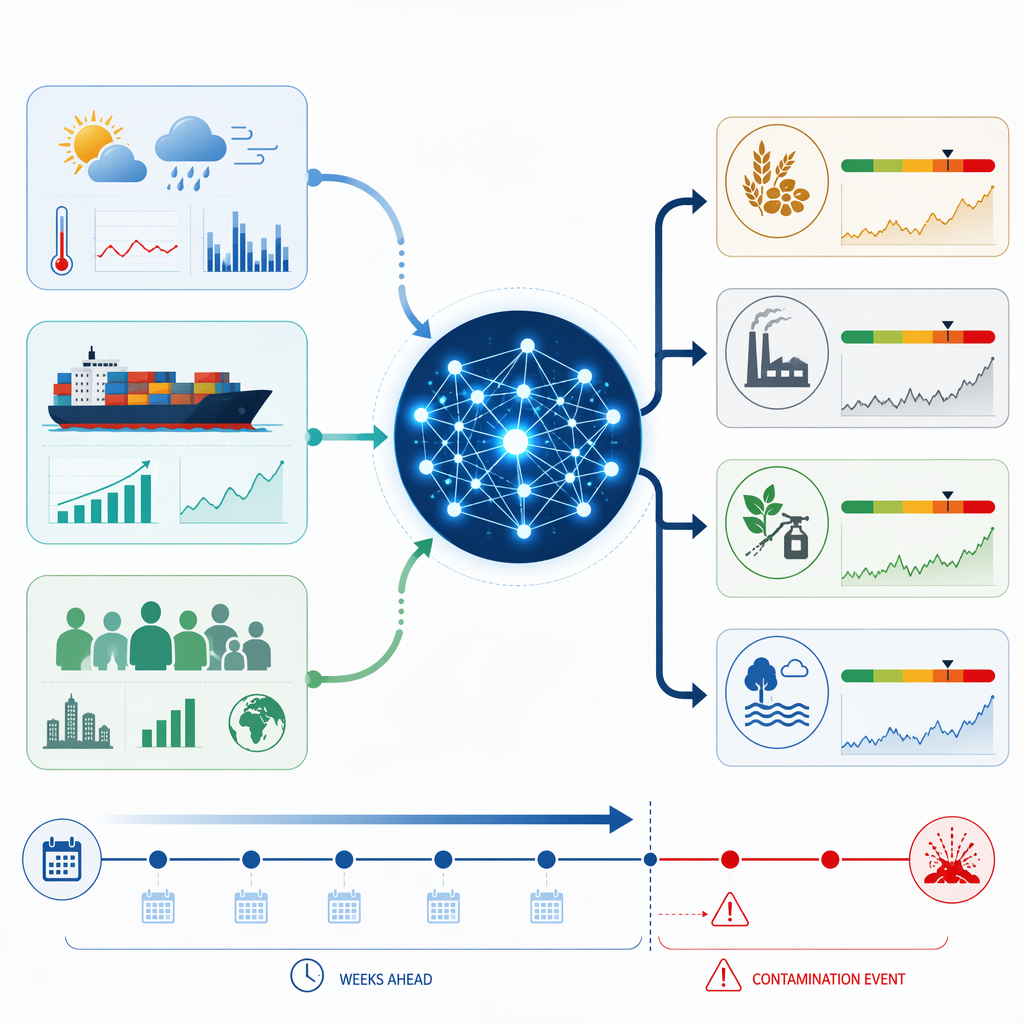
The mechanism is easy to miss if the discussion stays at the level of “AI accuracy.” Mycotoxin risk, for example, is shaped by growing conditions, storage conditions, and movements in agricultural supply. Trade flows can change where materials originate. Weather can alter crop stress and contaminant pressure. Economic variables can affect sourcing patterns and incentives. A model does not need a lab result from every lot to learn that certain combinations deserve earlier scrutiny.
For a supply chain risk manager, the practical value is not that these inputs are exotic. It is that they are available before the final food safety event is visible. Weather, trade, and market data can move before a supplier deviation, a positive test, or a complaint file. That earlier movement is what gives predictive systems their appeal.
The dairy price-anomaly study shows how long the signal window can be
The dairy supply chain study by Liu and coauthors in Food Control is a different kind of proof-of-concept. Instead of beginning with contaminant categories, it examined whether anomalies in raw milk prices preceded food safety issues. The reported lead times varied sharply by country: 5 months for the United Kingdom and 22 months for Italy, using European data from 2008 through 2019.[2]
The finding is striking because price is not a conventional food safety measurement. It is a market signal. Yet market stress can reflect supply imbalance, input cost pressure, sourcing changes, or other disruptions that may eventually affect safety controls. In that sense, commodity pricing can behave like a smoke alarm in a room adjacent to the one where the fire starts.
The limits are just as important. A 5-to-22-month lead time does not transfer automatically to U.S. dairy networks, other commodities, or post-2020 supply conditions. European country-level data from 2008 to 2019 captures particular market structures, regulatory environments, and disruption patterns.[2] The useful lesson is narrower and still powerful: adjacent-domain signals can precede food safety events by enough time to matter, but every supply chain has to validate which signals lead, lag, or simply correlate.
From academic signal to operational alert
A working early warning system has to translate a model output into a response pathway. That translation is where many promising analytics projects weaken. The model may rank a supplier, ingredient, or facility zone as elevated risk, but the food safety team still needs a threshold for action, a playbook for verification, and a record of what changed because the alert fired.
| Model signal | Possible operational response | Governance question |
|---|---|---|
| Weather and crop-stress indicators rise for a sourcing region | Increase incoming material testing or require additional supplier documentation | Who can change sampling intensity, and for how long? |
| Commodity price anomaly appears before expected safety issue window | Review supplier substitutions, contracts, and recent deviations | What evidence is required before escalating a supplier? |
| Environmental monitoring trend worsens without a pathogen positive | Add targeted swabs, verify sanitation inputs, and review traffic controls | Can the plant act before confirmation, or only after a positive? |
| External illness-related text clusters around a food type or venue | Prioritize epidemiological review and compare with traditional surveillance | How is unstructured text weighted against confirmed case data? |
This is why sensitivity and specificity are only part of the evaluation. A false negative can leave a weak signal unattended. A false positive can create cost, fatigue, and supplier friction. Lowering the alert threshold may help catch early risk, but it also increases the number of situations that humans must investigate. The right threshold is partly statistical and partly managerial: it depends on the severity of the hazard, the reversibility of the action, the capacity of the team, and the cost of being wrong.
Government pilots are extending detection into unstructured text
Not every useful AI system forecasts months ahead. Some systems aim to shorten the delay between an emerging illness pattern and an investigation. In March 2025, the UK Health Security Agency described work using AI and natural language processing to scan online restaurant reviews for mentions of symptoms and food types. More than 3,000 reviews were manually annotated by epidemiologists, and UKHSA’s Chief Data Officer said the approach could “help identify the likely source of more foodborne illness outbreaks” when combined with traditional epidemiological methods.[3]
That example belongs in the same conversation, but not in the same maturity bucket as a validated supply chain forecasting model. Review scanning is closer to augmented surveillance and investigation. It mines public, unstructured text for clues that may not enter formal reporting channels quickly. Its value depends on how well it filters noise, how epidemiologists verify the signal, and whether it helps investigators move faster without over-weighting anecdotal posts.
Inside the enterprise, the signal layer is more familiar
Within food companies, early warning often begins with data that already exists but is not analyzed together. In a June 2026 IFT Food Technology expert Q&A, Jeff Varcoe, Vice President of Quality Assurance and Food Safety at The J.M. Smucker Co., described AI as “an early warning indicator” for environmental monitoring. He pointed to trending conditions such as traffic patterns, prior positives, sanitation inputs, and environmental conditions before pathogen detection occurs.[4]
This is less dramatic than a model that watches global trade flows, but it may be closer to what many plants can use first. Environmental monitoring programs already produce time-stamped, location-specific records. Sanitation teams already document chemicals, concentrations, verification steps, and corrective actions. Maintenance, staffing, traffic, humidity, and temperature data may sit in separate systems. The opportunity is to connect those records well enough to notice when a familiar process is drifting toward an unfamiliar risk state.
The evidence here should be treated as directional rather than audited proof of general effectiveness. The IFT source is a practitioner account, not an independent performance study across multiple manufacturers.[4] It still matters because it shows how predictive thinking enters plant routines: not as a replacement for swabbing or sanitation verification, but as a way to decide where attention should move before a positive result forces the issue.
Why adoption is uneven
Food safety AI is not developing evenly. The easier business case is still real-time inspection, foreign material detection, visual quality control, and faster classification of known defects. Those use cases fit existing production decisions: accept, reject, divert, rework, or investigate. Predictive outbreak and contamination-risk forecasting asks for something harder. It asks organizations to act on probability before conventional evidence is complete.
That creates several practical barriers. Data quality has to be good enough across suppliers, plants, laboratories, and enterprise systems. Master data has to identify the same ingredient, lot, supplier, facility, and production window consistently. External data has to be joined at the right geographic and temporal level. A model trained on one period can drift when sourcing, climate conditions, regulations, formulations, testing methods, or consumer reporting behavior changes.
Traceability readiness also matters. A forecast that says a risk is rising in a commodity or region becomes more useful when the company can quickly identify which purchase orders, lots, recipes, facilities, and customers are connected to that exposure. The predictive layer and the traceability layer are different capabilities, but the first loses value when the second cannot narrow the field fast enough.
The governance work is as important as the model
A predictive model should have an owner, an escalation path, and a defined set of permitted responses. If an ingredient risk score rises, procurement, supplier quality, FSQA, and operations need to know whether the response is a document review, a supplier call, added testing, a temporary hold, or an audit. If an environmental risk score rises, the plant needs to know whether the next move is extra swabbing, sanitation verification, traffic control, maintenance review, or production scheduling changes.
The model also needs monitoring after deployment. Drift is not an abstract data science problem in food safety. A new supplier base, a changed sanitation procedure, a different lab method, a new product mix, or a shift in consumer complaint behavior can all change what the model’s signals mean. Thresholds that were reasonable last year may become too quiet or too noisy this year.
Good governance keeps the system from becoming either theater or autopilot. The model should not be a dashboard everyone admires and no one acts on. It also should not automatically stop production, punish suppliers, or trigger costly interventions without human review. The better design is controlled discretion: a clear warning, a defined set of verification steps, and accountable people who can decide whether the risk signal is strong enough to change operations.
Where the technology stands in 2026
The current maturity picture is mixed in a useful way. Academic work has shown that food safety risk can be modeled with external leading indicators, including weather, trade, socioeconomic data, and commodity price anomalies.[1][2] Public-sector teams are testing AI against unstructured sources that can supplement traditional outbreak detection.[3] Industry practitioners are beginning to describe AI as an early warning layer inside environmental monitoring and sanitation systems.[4]
That does not yet add up to a mature, broadly proven category of plug-and-play outbreak forecasting. The strongest published evidence is still bounded by study design, geography, commodity scope, threshold selection, and historical data. The strongest operational examples are still early, uneven, and dependent on company-specific data infrastructure.
For FSQA and supply chain leaders, the right conclusion is neither skepticism nor blind adoption. Predictive machine learning can identify elevated contamination risk before conventional detection in some settings. Its value depends on whether the organization can connect the alert to traceable materials, credible verification steps, monitored thresholds, and people authorized to act.
The most useful system is not the one with the most dramatic forecast window. It is the one that gives a plant, supplier quality team, or supply chain risk group enough credible lead time to prevent a contamination risk from becoming a recall or an outbreak.
References
- Wageningen University study on machine learning prediction of feed contaminant exceedances, npj Science of Food, November 2025.
- Dairy supply chain early warning study, Food Control, 2022.
- AI could help detect and investigate foodborne illness outbreaks, GOV.UK, March 2025.
- AI as an Early Warning System, IFT Food Technology, June 2026.
Comments
Join the discussion with an anonymous comment.