
The clearest evidence for AI in military supply chain logistics is not a drone convoy or a futuristic warehouse. It is a screening problem: the Defense Logistics Agency processes about 1 million bids per day, and the old assumption that human reviewers can reliably catch supplier risk at that volume no longer holds. In May 2025, DLA CIO Adarryl Roberts described a Bid Data Analytics model that had analyzed 43,000 vendors and flagged more than 19,000 as potentially high-risk for counterfeit, non-conformant, or overpriced items.[1]
That is the kind of number that deserves attention because it changed an operational decision. The model did not merely produce a dashboard. DLA reported that the intelligence led directly to a supplier pleading guilty after falsely certifying Turkish-sourced parts as U.S.-made, a case involving False Claims Act and Buy American Act violations.[1] In logistics terms, the point is blunt: the model helped decide who needed scrutiny before suspect parts could keep moving through the system.

That supplier-risk case is a useful starting point because it avoids the usual fog around military AI. It has a named institution, a defined workflow, a stated scale, and a concrete enforcement consequence. It also shows why military logistics AI should be judged less by model novelty than by whether it reduces inspection burden, protects readiness, or keeps supply routes and assets viable when ordinary assumptions fail.
Where Military Logistics AI Is Actually Being Used
The strongest public evidence clusters around four use cases. They are not at the same maturity level, and treating them as equivalent would overstate the case. Supplier risk assessment and demand forecasting are already established inside DLA operations. Predictive maintenance is growing, with strong production indicators in the U.S. Air Force. Contested-logistics route optimization is still emerging, with prototype and investment signals rather than broad production proof.
| Use case | Maturity | Best-supported evidence | Operational decision affected |
|---|---|---|---|
| Supplier risk assessment | Established | DLA Bid Data Analytics reviewed 43,000 vendors and flagged 19,000-plus as potentially high-risk | Which suppliers and bids receive deeper scrutiny |
| Predictive maintenance | Growing | C3 AI is described as the U.S. Air Force predictive-maintenance System of Record, monitoring 3,110 aircraft across 16 platforms | Which aircraft, components, and maintenance actions receive attention |
| Demand forecasting | Established within DLA | DLA reported 55-plus AI models in production and 200-plus use cases under development across areas including demand planning | Where inventory, replenishment, and planning effort are directed |
| Contested-logistics route optimization | Emerging | JTARV and world-model work point toward threat-aware resupply and disruption prediction | Which routes or resupply options remain viable under contested conditions |
DLA’s broader AI program supports that maturity split. In March 2025, the agency said it had more than 55 AI models in production and more than 200 use cases under development across demand planning, supplier risk, inventory optimization, and supply chain visibility. The same DLA account traced the program’s expansion from 26 identified use cases in 2018 and noted that the agency established an AI Center of Excellence in June 2024.[2] Those are internal government figures, and they may present the program in its strongest light. They are still production claims from the logistics agency that actually carries much of the supply burden.
Supplier Risk Assessment: The Most Mature Public Case
Supplier risk is where military logistics AI looks least like procurement theater. The problem is not abstract vendor intelligence. It is the daily collision of bid volume, sourcing opacity, counterfeit risk, domestic-source requirements, and the fact that bad parts can reach systems that are expensive, scarce, or mission-critical.
DLA’s Bid Data Analytics model is designed for that pressure. Roberts described the model as a way to illuminate supply chain risk by analyzing vendor and bid data at a scale manual review cannot handle. The reported review of 43,000 vendors and identification of more than 19,000 potentially high-risk vendors does not mean all flagged vendors committed fraud. It means the model narrowed the inspection field, giving reviewers a much smaller and more defensible set of targets for deeper examination.[1]
That distinction matters. AI supplier risk scoring is often sold as if a score itself is the decision. In a defense logistics setting, the better interpretation is that the model changes the order of human attention. It tells the procurement reviewer which bid deserves friction, which supplier history deserves a closer look, and where a certification may not be enough. Commercial teams use a similar pattern in supplier risk scoring and spend analysis, but the military version is sharpened by mission continuity and statutory compliance rather than only savings leakage.
The prosecution-linked outcome is the reason this case carries more weight than a generic analytics deployment. DLA reported that intelligence from the model led to a supplier guilty plea for falsely certifying Turkish-sourced parts as U.S.-made.[1] That does not prove every future flag will lead to an enforcement action, and it does not establish a false-positive rate. It does prove the model was connected to a real control point in the procurement process.
The same source also points to a wider vulnerability: the Department of Defense lacks data model requirements for 40% of strategic and critical materials, and more than 90% of shortfall materials have zero or one domestic supplier, according to a GAO finding cited in the DLA article.[1] That is not merely a procurement analytics problem. It is a concentration-risk problem. If an item has one domestic supplier, the quality, certification, and survivability of that supplier become part of readiness planning.
- The data problem is cross-domain: bid history, vendor identity, sourcing claims, pricing signals, and material criticality need to be brought into the same review path.
- The operational user is not an AI team; it is the reviewer or investigator deciding where scarce inspection time goes.
- The value is not perfect prediction; it is preventing manual screening from becoming symbolic at million-bid-per-day scale.
- The commercial analogue is strongest in sectors where a counterfeit, falsely certified, or single-source component can stop production or create safety exposure.
For commercial organizations, the practical lesson is not to copy DLA’s model. Most companies do not face the same statutory sourcing regime or bid volume. The transferable design principle is to build supplier AI around the moment of control: before purchase approval, before an alternate source is accepted, before a certification is treated as sufficient, and before a single-source dependency is discovered during a shortage.
Predictive Maintenance: Production Signals, Carefully Scoped
Predictive maintenance is the second strongest military logistics AI case because it reaches the asset-readiness problem directly. A grounded aircraft is not just an accounting variance. It can change sortie planning, spare-part demand, maintenance staffing, and operational availability.

C3 AI describes its predictive maintenance application as the U.S. Air Force System of Record for that function, monitoring 3,110 aircraft across 16 platforms. The same source reports that B-1 bomber maintenance hours were reduced by more than 50% and that fleet uptime improved from about 85% to about 95%.[3]
Those numbers are useful, but they have to stay in their lane. The B-1 maintenance-hours reduction is a single-platform result, not a license to claim that every aircraft fleet will cut maintenance labor in half. The uptime improvement is a strong production signal, but the public material does not provide enough detail to separate model contribution from process changes, maintenance-policy changes, or broader readiness initiatives. The responsible reading is narrower: the Air Force has moved predictive maintenance into a system-of-record posture, and at least one platform has a reported maintenance-hour reduction large enough to matter operationally.[3]
The maintenance use case also differs from supplier risk in the timing of the decision. Supplier risk scoring tries to intercept bad or risky inputs before they enter the supply base. Predictive maintenance tries to anticipate which asset or component needs attention before failure creates a readiness gap. In both cases, AI earns its keep only if it changes the queue: which aircraft gets inspected, which part is pulled forward, which work order becomes urgent, and which maintenance planner avoids being surprised by demand.
That queue discipline is what commercial operators should notice. Airlines, rail networks, energy infrastructure operators, mining fleets, and heavy manufacturers already understand that asset downtime creates second-order supply chain effects. A predictive alert that maintenance teams do not trust, cannot schedule against, or cannot connect to spare-part availability becomes noise. A useful system has to sit close enough to maintenance planning, inventory positioning, and work-order execution to change the next practical action.
- Treat platform-level results as platform-level evidence unless the source shows broader replication.
- Measure impact in maintenance hours, asset availability, avoided emergency work, and spare-part readiness, not only model accuracy.
- Connect predictive maintenance to inventory decisions; a forecasted failure still hurts if the part is unavailable.
- Give planners a ranked intervention queue rather than another dashboard to interpret during a backlog.
Demand Forecasting and Inventory Planning: Less Dramatic, Still Established
Demand forecasting usually gets less attention than supplier fraud or aircraft readiness because it lacks a clean dramatic moment. That does not make it secondary in logistics. DLA’s March 2025 account places demand planning among the areas covered by its 55-plus production AI models and 200-plus use cases under development.[2] For a defense logistics agency, a demand forecast is not just a cost-control exercise. It affects what inventory is positioned, which shortages are tolerated, and which support obligations can be met without emergency workarounds.
The public evidence here is more institutional than outcome-specific. DLA reports production models and a growing pipeline, but the available material does not provide a clean before-and-after accuracy improvement for demand forecasting. That means the right conclusion is modest: demand planning AI is established enough inside DLA to be part of its production model portfolio, but the public record does not support a precise ROI claim for forecasting alone.[2]
In commercial supply chains, demand forecasting is often judged by forecast accuracy, service levels, and inventory turns. Those measures still matter. The military lesson is to add continuity questions earlier: Which item becomes unrecoverable if the forecast is wrong? Which supplier cannot surge? Which material has no domestic depth? Which stockout forces operational compromise instead of an ordinary expedite?
A company evaluating AI demand forecasting in 2026 should therefore avoid a narrow accuracy bake-off if the real risk is disruption exposure. Forecast accuracy can improve while the organization remains blind to a single-source item, a long qualification cycle, or a substitution rule no planner is willing to use. The better test is whether the forecast changes inventory policy where failure is most expensive.
Contested-Logistics Route Optimization Is Still Emerging
Route optimization is the easiest military logistics AI topic to overstate because it sounds like the future people expect: autonomous resupply, contested routes, threat-aware movement, and live adaptation. The public evidence is real, but it is not as mature as supplier screening or predictive maintenance.
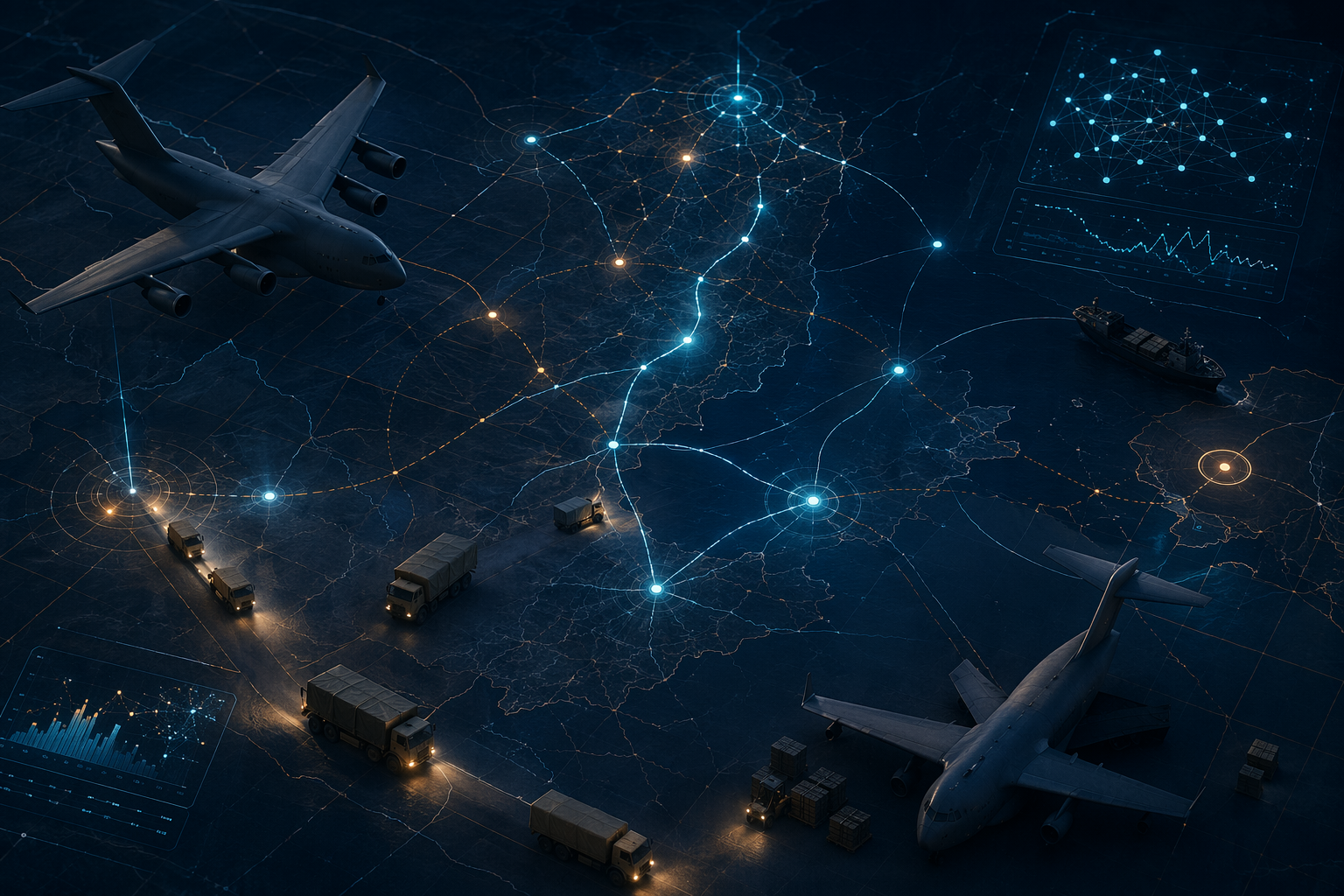
Federal News Network reported in December 2025 on Tagup’s use of world models to predict battlefield supply chain disruptions before they occur.[4] Army material has also discussed the Joint Threat-Aware Resupply Vehicle, or JTARV, as part of the future of Army logistics and the effort to exploit AI while overcoming logistics challenges.[5] These are important investment signals. They do not yet provide the same kind of production-scale outcomes that DLA’s supplier-risk model or the Air Force predictive-maintenance program provide.
The underlying operational question is still worth taking seriously. In a contested environment, the best route is not necessarily the shortest, cheapest, or historically reliable one. A viable route may depend on threat exposure, asset availability, weather, fuel, maintenance condition, communications, and the likelihood that a supply point remains usable by the time the convoy or aircraft arrives. AI can help combine those variables faster than a manual planning cell, but public sources currently support an emerging-maturity label rather than a production-success claim.
For commercial transfer, the closest analogues are not ordinary parcel routing. They are crisis logistics, disaster response, port disruption, cyber-constrained operations, high-value cold chain, and energy or medical supply networks where the route decision carries safety or continuity consequences. The useful question is not whether a company needs battlefield AI. It is whether its routing tools can still make good decisions when normal cost, capacity, and transit-time assumptions fail.
What the Adoption Data Does and Does Not Prove
Defense logistics AI is clearly attracting money and attention. Research and Markets estimated the military logistics AI market at $2.73 billion in 2026 and projected it to reach $5.31 billion by 2030, a compound annual growth rate of 18.1%.[6] That is useful context, not proof of operational maturity. Market definitions vary, forecasts are not deployments, and spending momentum can include experimentation, infrastructure, consulting, and vendor positioning.
The stronger adoption evidence comes from named systems tied to operational workflows. DLA’s 55-plus production models show institutional scale inside a logistics agency.[2] The BDA supplier-risk model shows a high-volume screening workflow with a documented enforcement consequence.[1] The Air Force predictive-maintenance program shows system-of-record status and fleet monitoring at meaningful scale, while still requiring careful scoping around platform-specific outcomes.[3] JTARV and world-model work show where investment is going, not where production evidence is already strongest.[4][5]
| Evidence type | How much weight it should carry | Reason |
|---|---|---|
| Production model count from DLA | Moderate to high | It shows institutional adoption, though not outcome detail for every model |
| Supplier-risk flags and guilty plea connection | High | It links AI screening to a concrete procurement-control outcome |
| Predictive-maintenance system-of-record status | High | It indicates operational embedding, not only experimentation |
| Single-platform B-1 maintenance-hour reduction | Moderate | It is meaningful but should not be generalized across all aircraft |
| Market-size forecast | Low to moderate | It shows momentum, not effectiveness |
| Contested-logistics prototypes and world-model work | Moderate for direction, low for proven production impact | They indicate investment but not broad operational results |
Why These Use Cases Transfer to Commercial High-Reliability Operations
The commercial lesson is not that defense logistics is automatically ahead or that companies should imitate military procurement. The lesson is narrower and more useful: AI performs differently when it is designed around continuity risk instead of marginal efficiency.
In many commercial AI supply chain projects, the first business case is cost reduction: lower inventory, fewer expedites, better labor utilization, cheaper lanes. Those are legitimate goals. But in high-reliability sectors, the failure mode is often not an inefficient supply chain; it is an unavailable asset, an unqualified supplier, a counterfeit component, a route that collapses during disruption, or a planner who sees the risk too late to do anything about it.
- Aerospace and defense suppliers can apply the supplier-risk pattern to certification, country-of-origin claims, counterfeit exposure, and single-source dependencies.
- Airlines, rail, utilities, mining, and industrial fleets can apply the predictive-maintenance pattern where downtime cascades into capacity and service failures.
- Medical, energy, semiconductor, and critical-materials supply chains can apply demand planning AI where shortage consequences exceed carrying-cost concerns.
- Crisis logistics, cold chain, and infrastructure operators can study contested-routing work as an early model for planning under degraded assumptions.
The implementation burden is also transferable. These systems need data readiness before they need elegance. Supplier names have to resolve across systems. Part numbers and certifications have to be trustworthy. Maintenance records have to connect to actual assets and work orders. Forecasts have to be visible to inventory policy. Route recommendations have to account for the constraints operators will not violate. A CSCO reviewing AI options should spend as much time on those control points as on model architecture.
A Practical Evaluation Lens
When evaluating a military-style logistics AI use case for commercial adoption, the first question should be operational rather than technical: whose queue changes if the model works?
- If the user is a procurement reviewer, the model should reduce the inspection field and expose supplier claims that deserve friction.
- If the user is a maintenance planner, the model should rank assets and components by intervention urgency and connect to parts availability.
- If the user is an inventory planner, the model should distinguish ordinary forecast error from continuity-threatening shortage exposure.
- If the user is a logistics coordinator during disruption, the model should preserve viable options rather than optimize for a normal-day route.
That lens also protects buyers from vague maturity claims. A pilot can show analytical promise. A production model should change a decision repeatedly. A system of record should be embedded deeply enough that planners, reviewers, and maintainers rely on it during routine work. The public military evidence is strongest where those decision links are visible.
The Reliability-First Pattern
Across these military logistics use cases, the common thread is not autonomy for its own sake. It is targeted decision support under volume, uncertainty, and consequence. DLA’s supplier-risk model helps reviewers find suspect vendors in a bid stream too large for manual screening. Predictive maintenance helps maintenance teams see readiness risk before an aircraft is unavailable. Demand planning models help the logistics agency manage support obligations at institutional scale. Contested-logistics work points toward route decisions that survive degraded conditions.
Commercial organizations in high-stakes industries should take the pattern, not the mythology. Design AI around continuity, inspection burden, asset readiness, and disruption prevention when failure costs more than inefficiency.
References
- Utilization of artificial intelligence (AI) to illuminate supply chain risk, Defense Logistics Agency, May 2025
- AI to boost efficiency, optimize logistics support as DLA standardizes use of new technology, Defense Logistics Agency, March 2025
- Defense & Intelligence, C3 AI
- AI is stepping into the fight for supply chain resilience and battlefield readiness, Federal News Network, December 2025
- Future of Army logistics: Exploiting AI, overcoming challenges, and charting the course ahead, Army.mil, 2024
- Artificial Intelligence (AI) in Defense, Research and Markets, January 2026
Comments
Join the discussion with an anonymous comment.