
Florida logistics teams do not need another promise that AI will see disruption eventually; they need a warning that lands before the berth, yard, and inland drayage schedule start to slip. Florida's five deepwater ports - Miami, Everglades, Tampa Bay, Jacksonville, and Canaveral - do not fail in the abstract; they back up, close, and reroute under the same storm pressure every year. That is the narrow use case for AI maritime supply chain alerts in Florida: turning hurricane season from a same-day visibility problem into an early decision problem.

Florida hurricane season hits the port clock first
Hurricane Milton showed the pattern plainly. In October 2024, the storm shut all major Florida ports, knocked out about 1.9 million power customers, and left supply chain disruption that lasted for weeks [1][2]. For operators who live with that cycle every season, the issue is not whether a storm can interrupt port flow; it is how early the team can tell whether a vessel pattern, weather track, or carrier signal is turning into a closure or backlog.
One secondary source also repeats a 40% post-disaster business failure figure attributed to U.S. Congress data, but that number should be cross-checked against a primary source before anyone uses it in a deck or procurement memo [3].
What the alert stack is watching
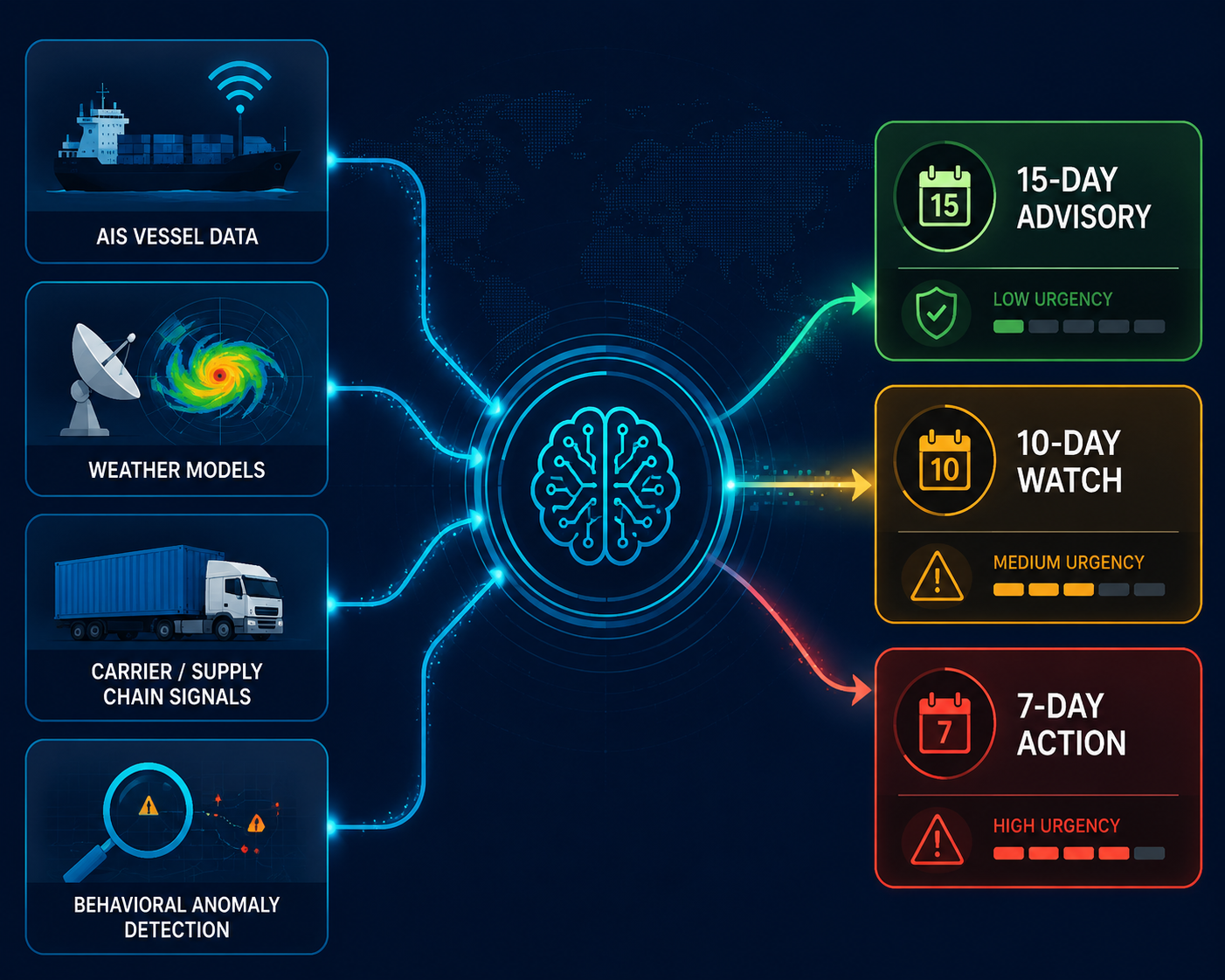
The useful systems in this space are not just weather dashboards with a maritime skin. They fuse AIS vessel behavior, carrier ETAs, weather models, berth intelligence, news, and anomaly detection so the alert can rank what is likely to slip before the terminal makes it obvious. Windward says its early detection platform uses vessel behavioral data and predictive ETA modeling across more than 120 carriers and 1,400 ports, and its model claims to outperform carrier arrival estimates for two-thirds of containers globally while cutting 5-plus day ETA misses by half [4][5].
| Platform | What it emphasizes | Why it matters in Florida |
|---|---|---|
| Windward Early Detection [4][5] | Vessel behavior, predictive ETA, 120+ carriers, 1,400+ ports | Useful when the question is whether a vessel pattern is drifting before the closure is obvious. |
| Project44 Disruption Management Agent and Port Intel [6][7] | 8B+ data sources, 100K+ news posts hourly, 11,800 berths at 20m precision | Useful when teams need broad disruption intake and berth-level port intelligence. |
| Portcast [8] | Real-time visibility for 95%+ of containers across 600+ ports; alerts 3+ days ahead | Useful for reducing shipment follow-up and triggering reroutes. |
| Everstream Analytics [9] | Client-reported risk and service outcomes | Useful when leadership wants the cost and service case tied to disruption response. |
The point of the comparison is not who has the prettiest dashboard. It is how far upstream each system can move a credible alert, and whether that alert arrives with enough context to send work in a different direction instead of just creating another notification.
From alert to action
The useful moment is not the alert itself; it is the handoff. A ranked warning should point a planner toward one of a few concrete moves: reroute freight away from a port that is trending toward closure, pull temperature-sensitive inventory inland before dwell time stretches, reserve alternate inland capacity, or push a customer update while the ETA still has some credibility. If the team needs the broader storm playbook around suppliers, demand shifts, and network planning, this maritime layer pairs well with proactive hurricane supply chain planning.
JAXPORT shows the Florida fit
JAXPORT's own AI and machine-learning example is useful because it keeps the discussion in Florida rather than in a generic vendor demo. The port describes AI and ML as part of a retail logistics transformation, which is the right kind of framing here: not grand automation, just better coordination when cargo, truck appointments, and weather are all moving at once [10].
What the outcome claims can and cannot prove
The outcome claims are promising, but they are not all the same kind of evidence. Portcast reports about an 80% reduction in manual shipment follow-ups [8]. Project44 says its approach identifies disruption impact 75% faster and cuts disruption-related costs by 40% [6]. Everstream cites client-reported 10% better on-time performance, 5% lower expedited freight costs, 30% lower revenue losses from disruption, and more than $2 million in annual savings for temperature-sensitive freight [9]. Those are vendor-published case study results, not independently audited benchmarks, so they are best read as directional proof that the workflow can pay off when the storm window is real.
For Florida ports, the value is practical: a warning window long enough to move freight, protect inventory, and warn customers before the backlog becomes the story.
References
- Top U.S. ports, trade lanes and supply chains most at risk from 2025 hurricanes - Tradlinx
- Hurricane Milton supply chain impacts - Supply Chain Dive
- Temporada huracanes Florida logistica - Hanseatica
- Early Detection - Windward
- Windward's first-of-its-kind AI model creates a new standard of ETA prediction accuracy critical to mitigating supply chain disruptions - Windward
- AI Disruption Navigator - Project44
- Port Intel - Project44
- Impacted by port congestion and shipment rerouting? Here's how AI can help - Portcast
- Artificial intelligence role in supply chain risk management - Everstream Analytics
- Transforming retail logistics with the power of AI and machine learning - JAXPORT
Comments
Join the discussion with an anonymous comment.