
AI for inventory liquidation in discount store closures starts with a less glamorous question than most markdown software pages want to answer: how much cash can be recovered before the doors shut, without leaving store teams to improvise price changes from a spreadsheet at 7 a.m.?
That is not the same problem as a normal end-of-season markdown. In a routine markdown cycle, the retailer is still balancing margin, brand presentation, replenishment assumptions, customer response, and the next selling season. In a closure liquidation, the exit date has already been set. The calendar is no longer a planning input. It is a constraint.
The question has become more immediate because store closures are not rare exceptions. MMCG Invest, citing Coresight data, reported 8,270 U.S. retail store closures in 2025 and projected about 7,900 closures for 2026.[1] That does not mean every closure becomes a chaotic liquidation event, and it does not prove AI will improve the outcome. It does mean more retailers are being forced to make fast, financially material decisions about stranded inventory.
This is the execution layer inside a broader AI-driven store closure framework. Network modeling may help decide which stores close. Demand-transfer modeling may help predict where some customers go next. Markdown optimization has a narrower job: keep price, remaining inventory, sell-through velocity, and remaining days in the same frame until the site is empty enough to exit.

The Objective Function Changes First
Most markdown optimization is built to improve decisions before inventory becomes a problem. It moves retailers from reactive discounting toward planned, data-informed price actions, using demand signals, inventory position, and price response to decide when and how deeply to mark down.[2] R4 frames markdowns similarly as a strategic discipline rather than isolated events.[3]
That logic still matters in a closure, but the target changes. The system is no longer asking, “What discount protects the most margin while clearing enough inventory?” It is asking, “What sequence of discounts recovers the most cash before this store stops operating?”
That shift sounds small until finance, merchandising, and store operations each bring a different requirement. Finance wants cash pulled forward. Merchandising wants to avoid training customers to wait for a giveaway price across the rest of the chain. Store operations needs price files, signage instructions, exception rules, and labor implications early enough to execute. Inventory planning is left to convert those competing pressures into a price path that still clears the building.
| Routine markdown | Store-closure liquidation |
|---|---|
| Optimize margin, sell-through, and inventory position across an ongoing business | Recover maximum cash before a fixed exit date |
| Historical demand is still broadly usable | Closure announcement can distort traffic, urgency, and basket behavior |
| Markdown timing can be adjusted over a season | Markdown timing is compressed into the remaining operating window |
| Unsold inventory may be transferred, held, or reworked into later plans | Residual inventory creates removal, transfer, disposal, or secondary-channel work |
| Store execution matters, but the business continues after the event | Store execution is part of the exit plan itself |
A liquidation model that only recommends deeper discounts faster is not doing the hard part. The hard part is deciding where a deeper discount is necessary, where it destroys cash recovery too early, and where the store cannot realistically execute another price move before the next selling day.

Four AI Capabilities Matter in a Closure Window
A workable AI liquidation setup needs four capabilities working together. They are not decorative analytics modules. Each one maps to a specific failure mode that shows up once a closure date is public.
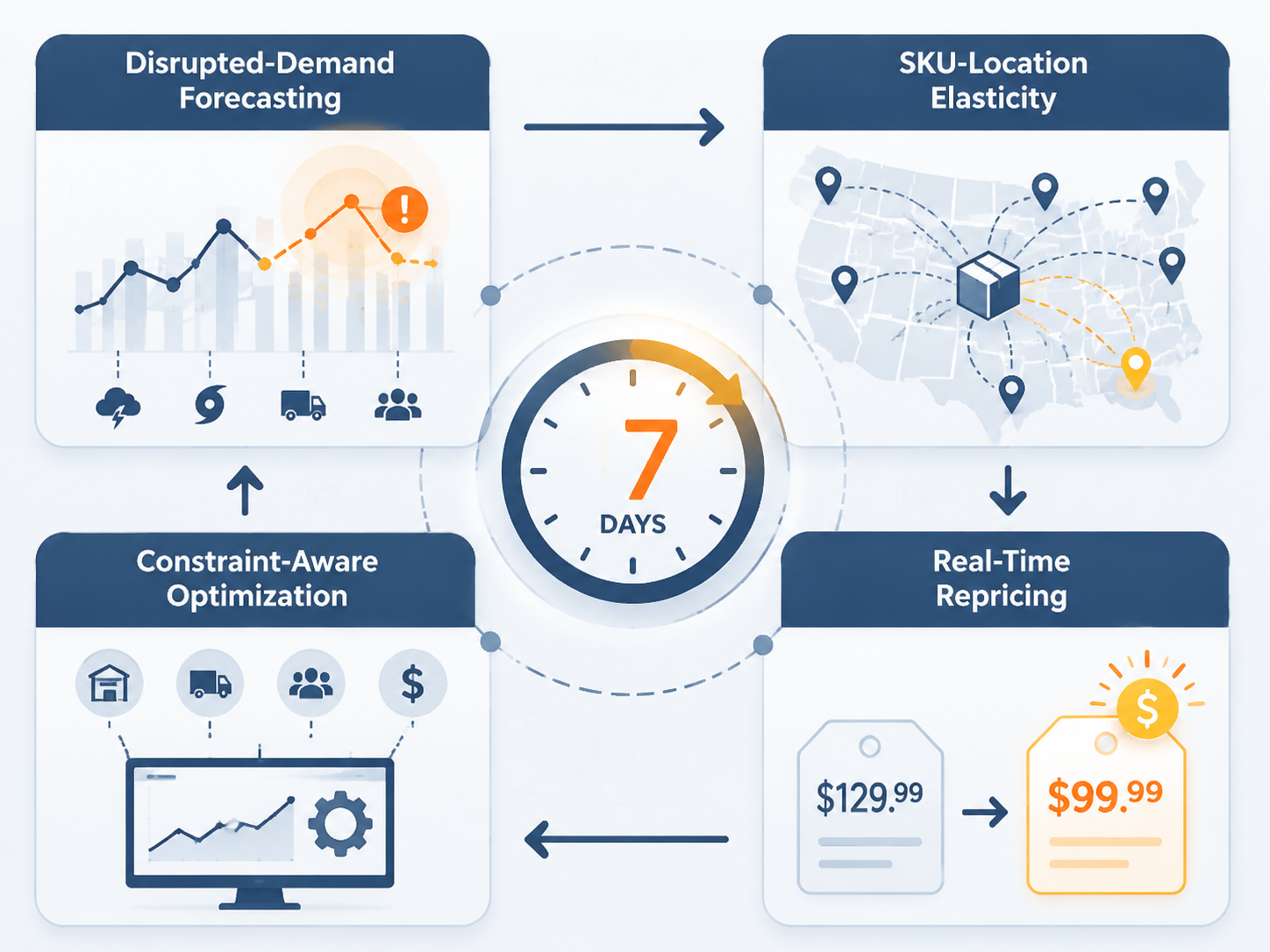
Disrupted-Demand Forecasting
Historical demand is the first thing that gets less trustworthy. A discount store that announces a closure may see bargain hunters arrive earlier than usual, loyal customers stock up, casual customers avoid the location, or traffic collapse after core categories are picked over. Last year’s same-week sales can still be informative, but it is no longer the center of gravity.
The forecasting job is to separate ordinary demand from closure-distorted demand quickly enough to change pricing. If the first liquidation week runs above plan, the model should not automatically assume that pace will continue. If the first week runs below plan, it should distinguish weak customer response from operational friction: late signage, incorrect price files, locked inventory, or a category that has not yet been marked visibly enough.
This is where AI has a practical advantage over a manual spreadsheet team. It can keep ingesting daily or intraday sales, inventory, price, and store-status signals while planners are still arguing over whether the miss was demand, execution, or weather. The value is not clairvoyance. It is a faster reforecast when the old baseline stops behaving.
SKU-Location Elasticity
Liquidation exposes a weakness in category-level markdown rules. A blanket 20%, then 40%, then 60% cadence is easy to communicate, but it treats too many items as if they respond the same way in every store. They do not.
Elasticity has to be local and item-level because the remaining inventory mix is usually uneven. One closing store may be heavy in small appliances, another in seasonal décor, another in basic consumables that would have sold without much help. A national rule may over-discount fast-moving goods in one location while under-discounting slow inventory in another.
For a liquidation planner, the useful question is not whether a platform has “elasticity modeling” in the abstract. It is whether the model can estimate price response at the SKU-location level when inventory is already depleted, price points are changing more often than usual, and customer behavior is being distorted by the closure itself.
A hypothetical example shows the difference. If two closing stores each have the same number of units left in a cookware SKU, a simple rule might assign the same discount. A better model asks whether Store A has already sold through adjacent kitchen categories, whether Store B still has full complementary assortments, whether either store has nearby open locations that can absorb transfers, and whether the current discount is actually moving units at the rate needed before the exit date. The price action may diverge even though the SKU count looks identical.
Constraint-Aware Optimization
This is the capability that separates liquidation optimization from nicer markdown math. A closure plan is full of constraints that do not appear cleanly in promotional planning: a final selling date, labor limits, signage capacity, legal or lease requirements, transfer cutoffs, minimum cash targets, minimum sell-through floors, and categories that may need different handling because they are damaged, regulated, bulky, or brand-sensitive.
A margin-oriented markdown model can recommend a discount that looks profitable on paper and still fail the closure. If too much inventory remains after the last practical repricing window, the retailer has not avoided the cost; it has moved the cost into pack-out, transfer, salvage, disposal, or another channel that may recover less cash and consume more labor.
The optimization layer needs to solve across cash recovery, remaining days, sell-through targets, and operational feasibility at the same time. That usually means the model must be able to accept a changed objective: not “maximize gross margin subject to inventory goals,” but “maximize recovered cash subject to clearing enough units by a hard date.”
The distinction matters most in the middle of the closure window. Early on, there is still time to test response without giving away the store. Late in the window, the algorithm may have no elegant options left. The middle is where constraint-aware optimization can prevent the familiar bad ending: cautious first markdowns, panicked final markdowns, and too much inventory still sitting in back rooms.
Real-Time Repricing Cadence
Liquidation pricing cannot wait for a normal weekly markdown meeting if velocity is missing the plan. The model needs a repricing cadence tight enough to catch a category before the remaining days make recovery impossible.
That does not mean every store should change every price every hour. Store teams still have to print signs, update shelf labels, brief associates, manage customer disputes, and reconcile POS execution. A pricing engine that creates more changes than the store can implement is not optimization; it is noise with a dashboard.
The useful cadence is fast enough to react when sell-through falls behind, but disciplined enough that operations can execute the change cleanly. For many retailers, the buyer question is whether the system can support sub-24-hour repricing decisions where needed, while still batching instructions in a way stores can understand.
What the Evidence Can and Cannot Prove
Published AI markdown results show that the underlying technology can create measurable value in adjacent settings. Peak.ai reported a 3% margin uplift from AI markdown optimization for a luxury fashion brand.[4] wair.ai cites 5–10% gross margin improvement from strategic markdown management.[5] RELEX reports a 133% inventory turnover increase from markdown optimization deployments.[6]
Those figures should not be stretched into liquidation proof. They come from non-liquidation markdown contexts, including fashion retail and broader markdown optimization deployments, not public case studies of discount-store closure liquidations. They support a narrower conclusion: AI markdown systems can improve margin, inventory turn, or markdown execution in ordinary retail settings. They do not prove a specific cash-recovery lift during bankruptcy, emergency closure, or going-out-of-business events.
That caveat is not a technicality. A closure changes customer behavior, store labor, decision rights, and the economic objective. A vendor result from an ongoing chain cannot be pasted onto a liquidation plan and treated as a forecast.
How to Evaluate Vendors for Liquidation Fit
Revionics, Peak.ai, RELEX, o9 Solutions, invent.ai, ClearDemand, and Impact Analytics all publish markdown optimization capabilities that are relevant to this problem.[7][8][6][9][10][11][12] Based on public materials, however, none should be credited here with a confirmed dedicated “liquidation mode.” The practical assessment is whether their architecture can be retargeted for a closure window.
The vendor conversation should start with objective switching. Ask whether the system can move from margin optimization to cash recovery by date, and what inputs control that switch. If the answer stays at the level of “our AI recommends optimal markdowns,” keep pressing. A closure objective needs a hard end date, sell-through floors, and residual-inventory treatment built into the recommendation logic.
The second test is multi-location coordination. Discount chains rarely close one perfectly isolated store with a tidy assortment. A useful system needs to coordinate pricing across closing stores, nearby continuing stores, distribution constraints, and transfer options. Otherwise, one closing location can liquidate inventory that another location could have sold at a better recovery rate, or hold inventory that should have moved earlier.
The third test is repricing speed. A platform may support markdown optimization and still operate on a cadence too slow for a compressed closure. Buyers should ask how quickly the model can ingest yesterday’s or today’s sell-through, approve a new recommendation, push price files, and produce store-ready execution instructions. The approval workflow matters as much as the model run.
The fourth test is secondary-channel integration. When a product is unlikely to sell through in-store by the exit date, the optimization decision is no longer just “what price?” It becomes “sell here, transfer, liquidate through another channel, salvage, or stop spending labor on it.” Public markdown product pages often emphasize in-store or omnichannel price optimization, but a closure plan needs residual inventory options visible before the last week.
- Can the model optimize for recovered cash by a fixed date rather than margin rate?
- Can it set different price paths by SKU, store, and remaining inventory position?
- Can it incorporate sell-through floors, exit dates, transfer cutoffs, and labor constraints?
- Can it reprice inside a sub-24-hour decision cycle when velocity misses the plan?
- Can it compare in-store markdowns against transfer, salvage, or secondary-channel recovery?
Where AI Usually Runs Into the Wall
The binding constraint is often not the algorithm. It is the organization around it.
A liquidation model needs current inventory it can trust. If on-hand counts are stale, back-room inventory is poorly located, damaged goods are still recorded as sellable, or transfers are not reflected quickly, the model will optimize against fiction. The store team then absorbs the consequence in the form of bad signs, customer exceptions, and price changes that do not match what is actually on the floor.
It also needs decision rights that match the clock. If finance approves one rule, merchandising revises it, legal delays a category exception, and store operations receives the final file after signs should have been printed, AI has not accelerated liquidation. It has only produced recommendations faster than the company can use them.
The best use of AI in store-closure liquidation is therefore not a prettier markdown curve. It is a controlled decision loop: update demand, estimate local price response, solve against the closure constraints, push executable repricing, and repeat before the remaining days make the answer irrelevant.
AI can help if the retailer can feed it current inventory data, accept rapid repricing decisions, and coordinate finance, merchandising, and store operations quickly enough. If it cannot, the sophistication of the markdown engine is beside the point. The store still closes on the date in the lease, the labor schedule, or the court-supervised plan.
References
- The Great American Store Closure Tracker, 2026 Edition — MMCG Invest
- Retail Markdown Optimization: From Reactive Markdowns to Proactive — Databricks
- Markdown Software for Retail — R4
- AI Markdown Optimization for Retailers: Maximizing Margin for a Luxury Fashion Brand — Peak.ai
- Markdown Management in Fashion Retail — wair.ai
- Markdown Optimization — RELEX Solutions
- Markdown Optimization — Revionics
- Markdown — Peak.ai
- Effective Markdown Optimization — o9 Solutions
- Markdown Optimization for Retailers: How AI Can Make Millions — invent.ai
- Retail Markdown Optimization — ClearDemand
- Markdown Optimization: Why It's Essential in 2026 — Impact Analytics
Comments
Join the discussion with an anonymous comment.