
A board does not need another generic AI story. It needs to know whether AI for food recall management in supply chain decisions can reduce a loss big enough to matter. The cleanest starting point is still the widely cited industry benchmark: the average direct cost of a food recall is about $10 million per incident, and in 23% of cases the cost exceeds $30 million, before brand damage, retailer delisting, and insurance effects are counted.[1]
That number should not be treated as a freshly audited price tag for every company. It is only a benchmark, but it puts the investment question in the right place. The important financial exposure is not the average number of recall notices in a quarter. It is the size of the blast radius when one event escapes containment.
The first quarter of 2026 made that distinction hard to ignore. Sedgwick Recall Index data reported by Risk & Insurance showed recall events down 10.3% year over year, while units recalled nearly doubled to 57.40 million.[2] Fewer events did not mean a safer P&L. The expensive problem moved from frequency to severity.

The ROI case starts with the recall you do not let spread
A severe recall turns messy because the company cannot prove, quickly enough, where the affected product went and where it did not go. The finance version of that sentence is simpler: every hour of uncertainty expands the population of product, customers, warehouses, stores, and counterparties that must be treated as exposed.
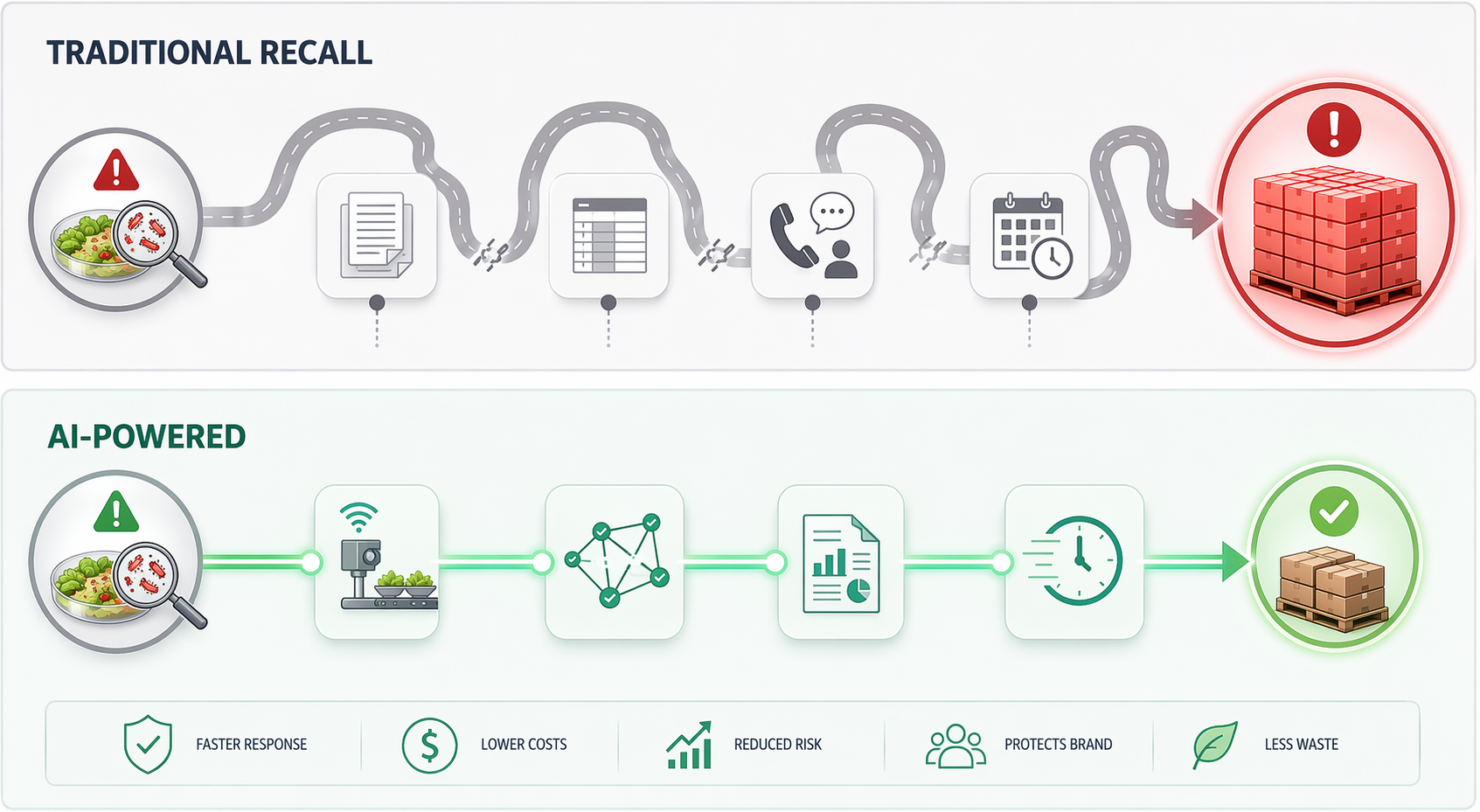
AI does not create recall value by sounding sophisticated in a budget deck. It creates value when it narrows the decision. Which lots share an ingredient? Which supplier batch appears in which finished goods? Which DCs received them? Which stores sold them? Which records are missing or contradictory? A useful system shortens the distance between the contamination signal and a defensible containment boundary.
The industry has already seen the power of trace-time compression, even before current AI recall-management products matured. In the Walmart and IBM Food Trust mango traceability pilot, the time required to trace mangoes reportedly fell from seven days to 2.2 seconds.[3] That was a 2018 proof of concept, not proof that every food company can buy the same result off the shelf today. Its real value is narrower and more durable: it showed what changes financially when traceability stops being a weeklong archaeology project.
The same logic applies to AI-enabled recall management. The payoff is not mainly in predicting every contamination event. It is in cutting the scope of the response once a signal appears. Vendor ROI analyses describe recall-scope reductions in the 60% to 80% range through faster traceability, but those figures should be read as illustrated vendor cases rather than independently validated market averages.[4] They are still useful for modeling scenarios, provided no one mistakes them for guaranteed savings.
What actually pays back
For a CFO, the business case should not start with model accuracy. It should start with loss pathways. AI recall management pays back through four mechanisms that can be mapped to financial exposure:
- Prevented recalls: earlier anomaly detection, supplier-quality signals, and process deviations reduce the chance that compromised product reaches commerce.
- Reduced recall scope: faster lot, ingredient, shipment, and customer tracing prevents a targeted withdrawal from becoming a category-wide action.
- Audit-efficiency gains: automated evidence assembly reduces time spent reconciling records, preparing documentation, and answering auditor questions.
- Lower operational disruption: fewer lines, facilities, carriers, and customer accounts are pulled into emergency response when the affected population is known.
The first mechanism gets the most attention because it sounds clean: prevent the recall and save the loss. It is also the hardest to prove in a board case, because the prevented event does not appear in the ledger. Scope reduction is often the more defensible argument. If the organization can show that faster traceability would have converted a broad recall into a narrower one, the savings model has an operational spine.
Food Industry Executive has framed recall readiness around the practical need to reduce response time, documentation friction, and operational exposure, while vendor ROI examples cite annual audit-efficiency savings of $100,000 to $400,000 and downtime reduction of $300,000 to $1.5 million per year.[4][5] The spread matters. A plant with poor data hygiene, frequent customer documentation requests, and manual lot reconciliation has a different savings profile from a plant that already runs disciplined traceability.
| Value lever | What finance can model | What operations must prove |
|---|---|---|
| Prevented recall | Avoided direct recall cost, using the $10M benchmark as a directional severe-event anchor | Earlier detection signals would have stopped release or distribution |
| Reduced scope | Lower product destruction, logistics, customer credits, labor, and retailer disruption | Affected lots, ingredients, shipments, and accounts can be isolated quickly |
| Audit efficiency | Reduced labor and outside-support costs tied to evidence preparation | Records are structured, searchable, and accepted by reviewers |
| Downtime reduction | Lower lost production and fewer emergency schedule changes | Containment decisions can be made without stopping unrelated lines or facilities |
The payback math is attractive only if the scope is real
Implementation-cost estimates for a mid-size plant range from $150,000 to $500,000, with some analyses suggesting a 4- to 12-month payback from operational savings alone.[4] Because those figures come from vendor-illustrated ROI material, they should not be dropped into an investment memo without adjustment. They are a starting range, not a signed check from the future.
Still, the severe-event math is not subtle. If a company credibly faces a $10 million recall exposure, then even a system costing several hundred thousand dollars does not need to eliminate much risk to justify itself. One prevented severe recall can cover years of AI quality-system spend at a mid-size plant. A reduced-scope recall can also pay back the investment if it prevents a broad withdrawal, emergency freight, customer chargebacks, and days of avoidable production disruption.
The bad version of this business case says: average recall cost is $10 million, our software costs less, therefore buy it. That is not a business case. The defensible version asks three harder questions:
- Which recall scenarios are financially material for this company: allergen, pathogen, foreign material, mislabeling, supplier contamination, or temperature abuse?
- In those scenarios, which systems currently determine the recall boundary: ERP, WMS, MES, supplier portals, spreadsheets, lab systems, carrier data, store systems, or phone calls?
- How long does it take to produce a defensible lot genealogy today, and who is waiting while that work happens?
- What cost is incurred while the organization cannot prove the boundary: product holds, line stoppage, overtime, outside counsel, retailer escalation, freight, and customer credits?
- What portion of that cost would plausibly fall if traceability moved from manual reconciliation to automated exception-driven investigation?
That last question is where boards should spend time. Not because AI lacks value, but because the value depends on whether the company can act on the system’s output. A traceability engine that identifies affected lots in minutes is useful only if quality, legal, operations, customer teams, and trading partners trust the records enough to narrow the action.
Market momentum is real, but it is not realized value
The category is moving quickly. BCC Research projected the AI in food safety and quality control market to grow from $2.7 billion in 2024 to $13.7 billion in 2030, a 30.9% compound annual growth rate.[6] That is useful corroboration that vendors, customers, and investors are not imagining the demand.
It is not proof of ROI. Market size measures spending, not savings. A company can spend into a fast-growing category and still fail to reduce recall exposure if the project stalls in integration, data cleanup, or change management.
That is why the adoption data matters more than the market forecast. Augury’s State of Production Health findings, cited by Consumer Goods, reported that 83% of food and beverage leaders plan to increase AI investments, while only 16% of food and beverage manufacturers have scaled more than half of their AI pilots to production.[7] The gap is the whole story: intent is high, scaled capability is scarce.
The same source reported that 92% of leaders are confident in AI’s potential, while supply chain integration remains the top barrier.[7] That is not a contradiction. It is a warning label. Recall management is an integration problem before it is an algorithm problem.
Where AI helps in the recall room
In an actual recall, the work is not abstract. Someone is matching supplier lots to production runs. Someone is checking whether rework entered later batches. Someone is reconciling what the ERP says shipped with what the warehouse, carrier, broker, distributor, or retailer says arrived. Someone is preparing a regulator-facing timeline while the commercial team asks which customers must be notified.
AI can reduce the strain in that room when it is connected to the records that matter. It can flag inconsistent lot relationships, surface missing documents, link quality events to supplier and production data, prioritize likely affected shipments, and generate evidence packages for review. The human decision does not disappear. The search space gets smaller, and the decision becomes easier to defend.
This is also where AI lot tracking earns its keep. A system that cuts recall response from days to minutes changes who gets pulled into the blast radius, how much product is held, and how long trading partners are left waiting for an answer. For a deeper operational look at that traceability layer, see How AI Lot Tracking Cuts Recall Response from Days to Minutes.
There is a legal dimension as well. Narrowing a recall can reduce unnecessary disruption, but narrowing it without defensible evidence can create its own exposure. The better question is not whether AI tells the company to recall less. It is whether the company can show why the chosen boundary was reasonable at the time. That distinction matters in litigation, insurance review, and regulator conversations. For that angle, see How AI Food Traceability Reduces and Creates Lawsuit Exposure.
Compliance pressure adds urgency, not the main ROI
FSMA 204 deserves attention, but it should not carry the whole investment case. The original compliance deadline was January 20, 2026, and FDA later proposed extending the deadline to July 20, 2028, with congressional non-enforcement direction noted in the regulatory discussion.[8] Companies should verify the current status before making publication-date or board-date decisions.
The practical point is that traceability compliance and recall economics are converging. If a company must improve lot-level recordkeeping anyway, it should not design the project as a minimum-documentation exercise. It should design it so the same records can support faster containment, cleaner audits, and better recall-scope decisions. For a closer look at that compliance-to-operations bridge, see AI Traceability Turns FSMA 204 Compliance into an Operational Advantage.
What AI cannot cover
AI recall management is not insurance against weak supplier quality, incomplete master data, or an organization that refuses to make timely decisions. Inspection tools can miss upstream supplier failures. Traceability tools can expose that a record is missing, but they cannot make the missing record true.
The Ford $570 million recall case discussed in Ford's $570M Recall Shows AI Alone Can't Fix Supplier Quality is a useful counterweight for food companies as well. The lesson is not that AI is ineffective. It is that quality risk travels through suppliers, processes, specifications, incentives, and records. A model in one checkpoint cannot compensate for a supply chain that cannot prove what happened upstream.
This is where many pilots die. They demonstrate a clever detection or traceability function in a limited environment, then collide with plant-level variation, supplier data gaps, ERP customizations, warehouse workarounds, and customer-specific documentation demands. The ROI case should include the cost of getting through that mess, not just the subscription price.
A board-ready investment case
A credible proposal for AI recall management should fit on one page before it expands into technical appendices. It should name the severe recall scenarios, quantify the current traceability delay, show the systems that must be integrated, and separate hard savings from risk reduction.
| Question | Board-level answer |
|---|---|
| What loss are we trying to reduce? | Severe recall exposure, using the $10M average direct-cost benchmark directionally and testing higher-severity scenarios where relevant |
| How does AI reduce that loss? | By shortening traceability windows, reducing recall scope, improving audit evidence, and lowering operational disruption |
| What savings are easier to count? | Audit labor, downtime, emergency response labor, product hold reduction, and avoided manual reconciliation |
| What savings are harder to prove? | Prevented recalls, brand damage avoided, retailer delisting avoided, and insurance effects |
| What can stop payback? | Poor data quality, weak supplier integration, plant-level variation, and pilots that never reach production |
The cleanest financial model has three cases. The base case counts operational savings that do not require a severe recall to occur: audit efficiency, downtime reduction, and less manual investigation. The downside-protection case models one narrowed severe recall over a multi-year horizon. The upside case models one prevented severe recall, but labels it as risk reduction rather than guaranteed annual savings.
That structure keeps the conversation honest. Operational savings can support payback discipline. Severity reduction explains why the project deserves attention from the board. Production-scale readiness determines whether either number survives contact with the plant.
So, does AI for food recall management pay off? Yes, when the business case is built around preventing or shrinking rare, expensive events rather than celebrating AI adoption itself. The investment is easiest to defend when a company can connect the tool to real traceability records, deploy it beyond pilot conditions, and prove that the next 2 a.m. recall decision will be narrower, faster, and better documented than the last one.
References
- GMA/FMI recall cost benchmark, cited by Food Safety Tech and Oxmaint. Food Safety Tech
- Product Recalls Drop in Frequency but Surge in Scale. Risk & Insurance
- Walmart/IBM Food Trust blockchain pilot case study. LF Decentralized Trust
- Recall ROI analysis. Oxmaint
- Recall Readiness. Food Industry Executive
- AI in Food Safety & Quality Control Market. BCC Research, Aug. 2025.
- Where Food & Beverage Manufacturers See Real ROI from AI. Consumer Goods
- FSMA 204 compliance timing and proposed extension. FDA
Comments
Join the discussion with an anonymous comment.