
Walmart’s lettuce traceability test is still the cleanest way to explain why AI in a lettuce outbreak is not mainly a dashboard story. In the IBM Food Trust case study, tracing a package of sliced mangoes back to source took 6 days, 18 hours, and 26 minutes by conventional methods; after blockchain-based traceability was applied to produce, Walmart traced a package of lettuce in 2.2 seconds.[1] The useful part of that number is not the drama of “seconds.” It is what those seconds make possible when investigators are still sorting out which field, harvest crew, cooling facility, processor, distributor, or store actually sits inside the risk boundary.
A slow traceback pushes decision-makers toward blunt recalls. In leafy greens, that can mean pulling an entire category before anyone can prove which lots are implicated. Safe growers lose sales. Retailers dump product that may never have been exposed. Buyers spend days answering anxious calls. Food safety teams are left trying to reconcile supplier records while the public message has already moved faster than the paperwork.
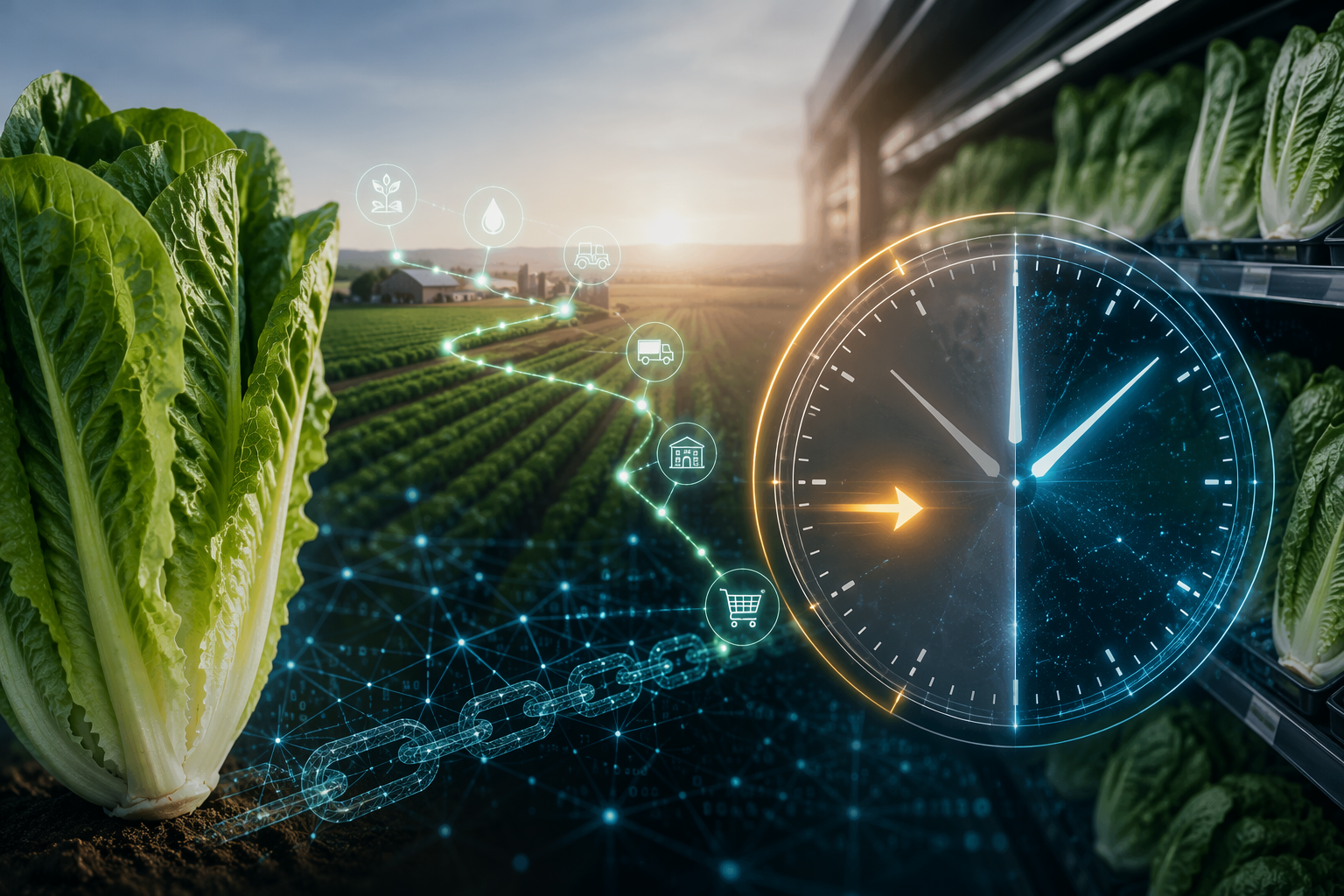
That is the operational case for AI-enabled traceability in lettuce and other leafy greens: compress the time between an outbreak signal and an auditable product path, so the recall can become narrower sooner. The technology matters only if it can survive the ugly part of the job: incomplete records, mixed shipments, inconsistent lot codes, and suppliers that do not all describe the same event in the same way.
The Recall Clock Is the Business Case
Leafy greens have earned their place on the traceability priority list. CDC and FDA data summarized by Agroknow’s FOODAKAI analysis identified more than 40 outbreaks linked to leafy greens from 2009 through 2018.[2] That figure does not say every salad bag is high risk, and it does not prove that traceability alone prevents contamination. It does show why the traceback interval has become a commercial and regulatory pressure point: the category has repeated outbreak exposure, short shelf life, high consumer visibility, and fragmented production networks.
The 2018 romaine crisis showed the cost of uncertainty. When investigators and supply chain partners cannot isolate the problem quickly enough, the industry response widens. A broad pull protects consumers in the near term, but it also punishes uninvolved growers and forces retailers to remove product because the records do not yet support a more precise decision. The economic damage is not just the recalled inventory. It includes replacement buying, freight disruption, store labor, disposal, consumer trust, and the quiet loss borne by suppliers whose product was safe but indistinguishable from product under suspicion.
That is why the Walmart example has stayed in circulation. A change from days to seconds is not a marginal process improvement. It changes what a food safety team can ask during the first hours of a crisis: which lots moved through this facility, which stores received them, which suppliers touched the same product stream, and which adjacent products can be excluded from the recall rather than swept into it.
FSMA 204 Changed the Buying Question
The Food Traceability Rule under FSMA Section 204 is now in effect, with a compliance date of January 20, 2026. It requires additional traceability records for foods on the Food Traceability List, including leafy greens, and it centers those records around Critical Tracking Events and Key Data Elements.[3] For produce buyers, that shifts the conversation. The question is no longer only whether a blockchain or AI traceability pilot can produce a cleaner recall simulation. The question is how to comply with the rule and then use the required records to reduce real operating risk.
The rule’s language can sound abstract until it is mapped onto the dock. A Critical Tracking Event is the kind of event that matters when product changes state, location, ownership, or handling context. A Key Data Element is the specific record that lets someone reconstruct that event later. In leafy greens, that means the traceability plan has to capture the product, lot or traceability lot code, source, receiver, shipper, quantity, dates, and other required details at the points where traceback can otherwise break.
| Operational event | Why it matters in a lettuce traceback |
|---|---|
| Harvest or initial packing | Connects product to the field, harvest lot, crew, date, and initial lot identity. |
| Cooling, processing, or transformation | Shows whether lots were commingled, repacked, chopped, washed, or moved into a new product form. |
| Shipping and receiving | Documents who sent product, who accepted it, when it moved, and which traceability lot code traveled with it. |
| Distribution to stores or foodservice customers | Determines which locations need action and which locations can be excluded. |
The practical value is not that every buyer owns more data. It is that outbreak investigators, suppliers, and retailers can line up the same chain of custody under pressure. If one distributor records a lot code differently from the processor, or one grower’s shipment record cannot be matched to a retailer’s receiving record, the traceback slows down at exactly the point where speed is supposed to justify the investment.
FDA’s Leafy Greens STEC Action Plan had already pointed in this direction before the compliance deadline arrived. Its priority areas include prevention, response, and closing knowledge gaps, and its response work includes faster, technology-enabled traceability alongside tools such as whole-genome sequencing.[4] The 2020 leafy greens traceability pilot, referenced in FDA materials, showed that digital traceability could reduce traceback from days to hours.[4] Walmart’s seconds-level case sits at the sharper end of the same movement: less time spent reconstructing the path, more time spent acting on the path.
What AI Adds Once the Records Exist
Blockchain is often given too much credit in this use case. It can provide a shared, tamper-resistant audit trail across companies that do not share one internal system. That is valuable, especially when growers, shippers, distributors, processors, and retailers all need to rely on the same history. But blockchain does not decide whether a lot code was entered correctly, whether a supplier record is complete, or whether a shipment pattern looks unusual.
AI becomes useful on top of that record layer. Machine learning models can scan shipment histories for irregular supplier behavior, flag missing or inconsistent data, and identify movement patterns that deserve review. IoT sensors can add condition and location signals, such as temperature exposure or route deviations, where those signals are relevant to the product and process. None of this replaces outbreak investigation. It gives investigators and food safety teams a cleaner starting point and a shorter list of places to look.
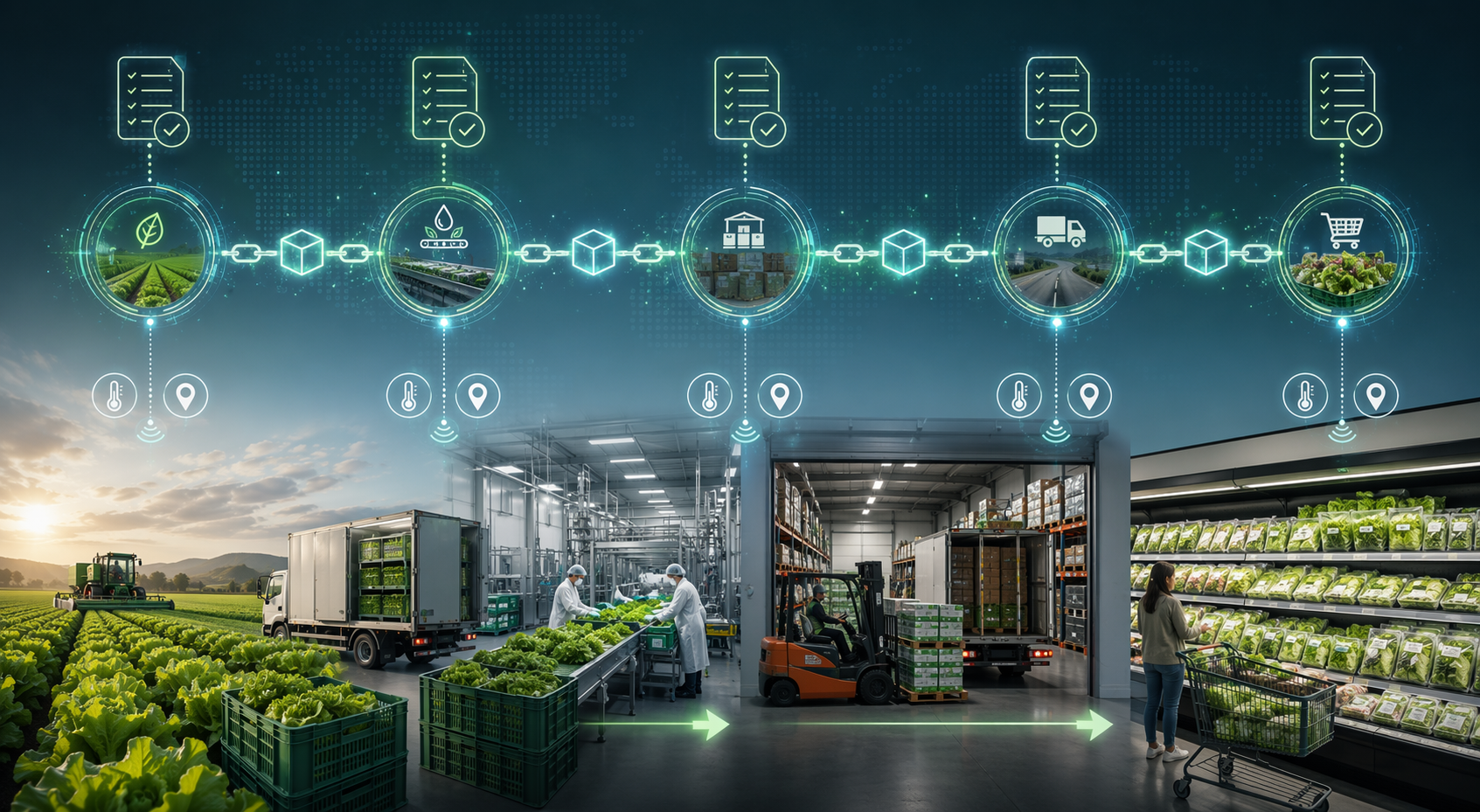
The Institute of Food Technologists described AI’s role in food safety through five functions: Sense, Detect, Predict, Decide, and Prove.[5] For lettuce traceback, those functions are not a neat maturity ladder. They are jobs that appear at different points in the same incident. Sensors may capture location or condition data. Detection models may notice a missing KDE, a supplier’s repeated exception pattern, or an unusual shipment combination. Prediction may help prioritize which routes or nodes deserve closer review. Decision support may help teams choose a recall boundary. Proof is the audit trail that lets a company show why it acted on one lot and not another.
The important sequence is simple: record first, intelligence second. AI cannot infer a trustworthy chain of custody from records that were never captured or cannot be matched. In a good deployment, the model is not treated as an oracle. It is treated as a pressure tool for a traceability network that already knows how to describe product movement.
The Hard Part Is Supplier Standardization
Most produce supply chains do not fail traceability because nobody bought software. They fail because the same lettuce can pass through organizations with different item masters, different lot-code habits, different receiving workflows, and different tolerances for manual fixes. A grower may record the harvest lot one way, a shipper may aggregate product under another identifier, a processor may transform it into a new lot, and a retailer may receive it under a purchase order that was never designed for outbreak reconstruction.
That is why supplier onboarding is not clerical work. It is the deployment. Each trading partner has to know which events it owns, which data elements it must capture, how exceptions are handled, and how quickly bad records are corrected. A retailer that demands traceability from suppliers but accepts incomplete advance ship notices or tolerates inconsistent lot formats is building a recall system that will look modern until the first real traceback test.
The receiving dock deserves special attention because it is where paper compliance often collides with physical reality. Product arrives late, labels are damaged, quantities differ from the purchase order, mixed pallets need to move, and the person scanning product is not thinking about a future epidemiological investigation. If the receiving process cannot capture the required identifiers without slowing the operation to a crawl, employees will work around it. Those workarounds become the blank spaces that AI cannot repair later.
For supply chain leaders, the implementation checklist is less glamorous than the technology pitch:
- Map every Critical Tracking Event for leafy greens from source through customer delivery.
- Confirm which party is responsible for each required Key Data Element.
- Standardize lot-code, location, product, and supplier identifiers before model selection.
- Test traceback with messy records, substitutions, split shipments, and commingled lots.
- Measure the time from outbreak query to auditable recall boundary, not just system uptime.
Market Growth Is Directional, Not Proof
There is plenty of market enthusiasm around AI in food safety. IONI.ai, citing BCC Research, describes the AI food safety market as valued at $2.7 billion to $3.1 billion and projected to reach $13.7 billion by 2030 at a 30.9% compound annual growth rate.[6] Those numbers are useful as a signal that investment is moving into the category. They should not be treated as evidence that every deployment improves recall performance, especially because the figures are presented through a vendor analysis and the underlying methodology is not independently verified here.
Adoption claims also need a clean separation from effectiveness. A company can implement AI tools and still have weak traceability if supplier records are incomplete. A company can comply with FSMA 204 and still fail to extract operational value if it stores required data in a form that is hard to query during an outbreak. The test is not whether a platform exists. The test is whether the platform can produce a narrow, defensible product path while the incident is still active.
Where the Investment Is Easiest to Justify
AI-enabled traceability is easiest to justify where three conditions overlap: meaningful leafy greens exposure, material recall risk, and FSMA 204 record obligations. A national grocer, a fresh-cut processor, a broadline distributor, or a foodservice supplier handling high volumes of lettuce has more to gain from faster traceback than a small buyer with limited exposure. The larger and more fragmented the network, the more valuable it becomes to replace phone calls, spreadsheets, and mismatched records with a shared traceability layer.
The return does not have to come from preventing every outbreak. Traceability is not a kill step, and it should not be sold as one. The return comes from reducing the scope and duration of uncertainty: fewer unaffected lots pulled, fewer unaffected stores disrupted, faster regulator response, and a clearer explanation to customers about what was removed and why. In a category where time, freshness, and trust all decay quickly, that compression has direct value.
There is also a procurement consequence. Buyers now have a stronger reason to evaluate suppliers not only on price, quality, and fill rate, but on traceability readiness. A low-cost supplier that cannot produce compatible digital records may create costs that only appear during the worst week of the year. Conversely, a supplier with disciplined lot management and clean event data can help a retailer avoid widening a recall beyond the implicated product.
The Narrower Recall Is the Point
The strongest case for AI traceability in lettuce is not that it makes the supply chain futuristic. It is that it can make a bad week less indiscriminate. Walmart’s 2.2-second traceback proof point shows what is possible when records are structured and shared well enough for technology to work.[1] FSMA 204 now makes those records a compliance requirement for leafy greens rather than an optional pilot project.[3]
The remaining work is less exciting and more consequential: getting growers, shippers, processors, distributors, and retailers to record the truth in a usable form. Seconds-level traceback is possible. Compliance pressure is real. The value of the system will still be set by the weakest data contributor in the network.
References
- Walmart Case Study, LF Decentralized Trust.
- Food Safety Incidents: Lettuce, Agroknow.
- FSMA Final Rule on Requirements for Additional Traceability Records for Certain Foods, U.S. Food and Drug Administration.
- Leafy Greens STEC Action Plan, U.S. Food and Drug Administration.
- How AI Is Reshaping Food Safety, Institute of Food Technologists, June 2026.
- How AI Is Transforming Food Safety, IONI.ai.
Comments
Join the discussion with an anonymous comment.