
The staffing problem does not start with a recruiting funnel. It starts with a date.
After the Supreme Court's June 25, 2026 decision in Mullin v. Doe, employers can no longer assume that litigation will keep Temporary Protected Status termination dates suspended while challenges move through the courts. Morgan Lewis describes the ruling as holding that 8 U.S.C. § 1252(a)(2)(B)(ii) strips courts of jurisdiction to review TPS terminations, which means termination notices now have to be treated as workforce authorization deadlines unless another lawful extension, administrative action, court development, or legislation changes the calendar.[1]
That is the operational discontinuity behind AI labor planning for supply chains under TPS changes. Annual headcount plans, normal attrition curves, and backfill assumptions were built for leakage. This is a cliff: a group of trained employees may be work-authorized on one side of a date and no longer available to schedule on the other.

The calendar is also staggered. Industry compliance reporting has pointed to roughly 350,000 Haitian TPS holders and several affected country groups with different 2026 timing: Syria, Burma, Somalia, Ethiopia, South Sudan, and Yemen tied to July 10 placeholder dates; El Salvador valid through September 9; and Ukraine through October 19.[2][3] Those dates should not be treated as predictions of final government action. They are planning triggers. If a facility has exposure across more than one country category, the staffing event is not one bad week. It is a rolling set of cliffs.
The Exposure Is Not Just Headcount
A 10% workforce loss can be manageable in one building and crippling in another. The difference is where the people sit in the operation. If the affected employees are spread evenly across light-duty day-shift tasks, a planner has options. If they are concentrated in freezer picking, second-shift replenishment, forklift work, hazmat handling, shipping door coordination, or experienced quality checks, the same percentage becomes a bottleneck.
Available public data does not provide precise government-published counts of TPS holders by warehouse role, certification, shift, or facility. That matters. Any facility-level exposure estimate in the 10% to 40% range should be treated as an internal planning result, not a universal benchmark. Compliance advisors have noted that HR systems already contain authorization category codes such as A(12) and C(19), but using that information for workforce planning requires discipline, legal review, and strict access controls.[2]
The first useful output is therefore not an AI schedule. It is an exposure map: authorization category by facility, shift, supervisor group, role, certification, tenure band, and critical process. If that map cannot tell a DC manager which shift breaks first, it is not ready for scenario planning.
| Planning Question | Why It Matters Operationally |
|---|---|
| Which employees may lose work authorization if the date holds? | Defines the maximum labor pool at risk without assuming policy outcome certainty. |
| Which roles, shifts, and certifications are exposed? | Separates replaceable hours from bottleneck skills. |
| Which demand weeks overlap the authorization dates? | Connects the labor cliff to order volume, promotion calendars, replenishment cycles, and service commitments. |
| Which responses are legally and operationally available? | Prevents the model from recommending overtime, temp labor, or reassignment paths that cannot actually be executed. |
| Who approves the final plan? | Keeps AI output in a documented human decision process. |
Why Manual Planning Runs Out of Room
In a normal labor miss, supervisors borrow people, payroll approves overtime, HR opens reqs, and the building absorbs some pain while the staffing plan catches up. Under TPS-driven loss, the planning team has to compare several bad paths before the date arrives. Waiting for actual attendance loss means the first decision is made on the floor, under volume, by people who are already short.
The arithmetic is not complicated when viewed one variable at a time. The problem is the combinations. A planner has to ask what happens if 18% of second-shift pick labor disappears, forklift coverage falls below the shipping plan, temp agencies can fill only entry-level roles, and demand stays flat for the first week but spikes during a promotion in week three. Then the same planner has to rerun it with different dates, a different country category, a different overtime cap, and a different service promise.
This is where AI labor scenario planning earns its place. Not because it knows what DHS will do next. It does not. Its value is narrower and more practical: it can hold more constraints in one environment, rerun scenarios quickly, and show what each response does to cost, throughput, service risk, and supervisor load.
The Inputs Have to Meet in One Planning Environment
A useful model cannot live only in HR, only in the WMS, or only in finance. TPS exposure is a workforce authorization issue, but the consequences show up as missed cutoff, dwell time, overtime fatigue, unsafe shortcuts, delayed replenishment, and customer allocations. The planning environment has to bring together systems that usually disagree on language and timing.
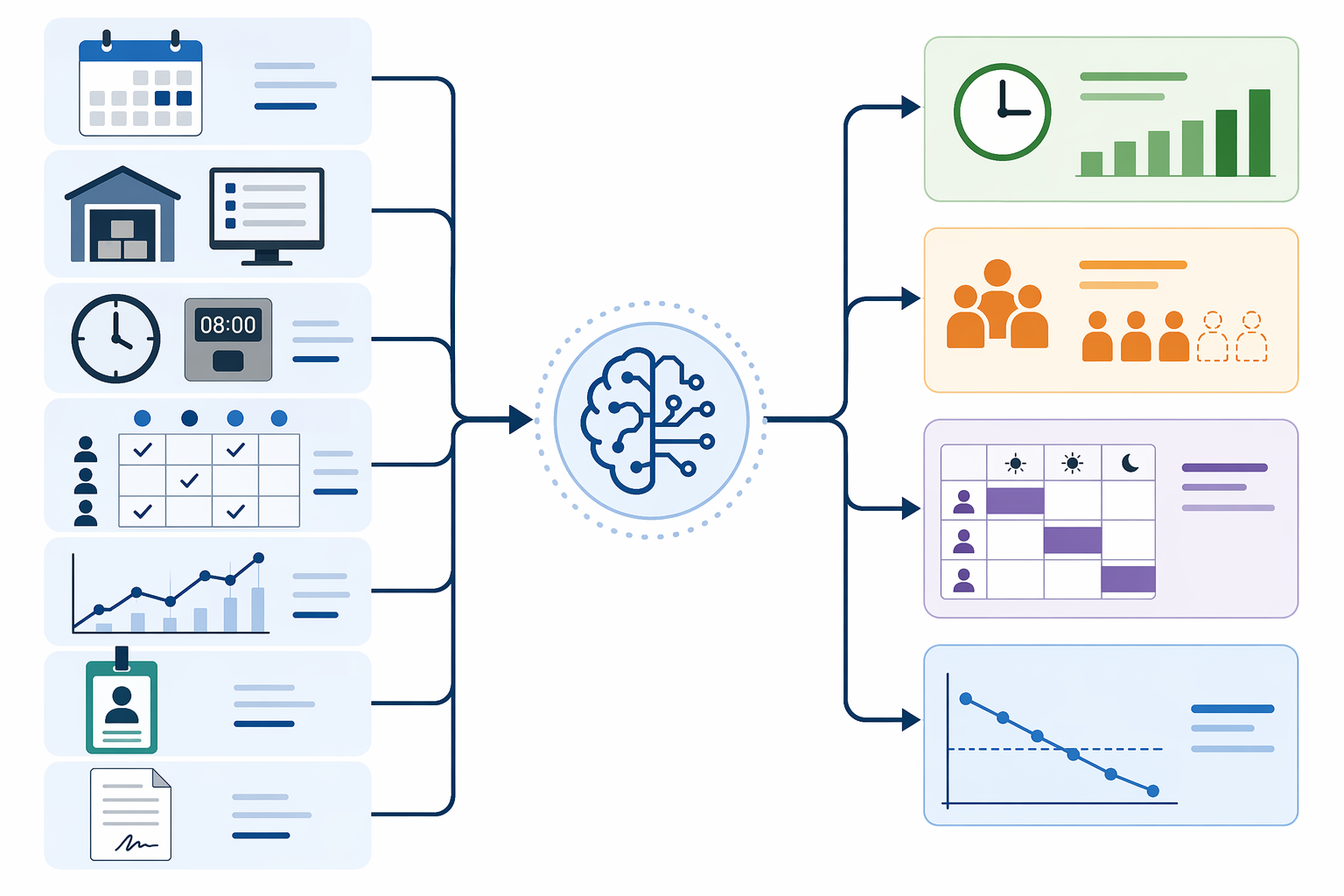
- HR and I-9 data: authorization category, reverification date, work location, job code, and any legally approved aggregation rules.
- WMS and execution data: units, lines, cases, pallets, travel patterns, dock activity, backlog, and cutoff performance.
- Timekeeping data: actual attendance, overtime history, shift start patterns, absence rates, break coverage, and supervisor span.
- Skills matrices: forklift, hazmat, cold chain, inventory control, quality, maintenance adjacency, trainer status, and cross-training eligibility.
- Demand forecasts: order volume, mix, seasonality, promotions, inbound schedules, customer priority, and service-level commitments.
- External labor assumptions: temp agency fill rates, wage premiums, onboarding time, screening requirements, transportation constraints, and local competition.
Vendors already describe pieces of this tooling category. Tompkins Ventures frames AI labor planning around demand sensing and productivity modeling; Manhattan Associates describes labor management systems that use engineered standards, performance data, and scheduling; Epicor describes AI-supported warehouse workforce planning as a move from reactive staffing toward predictive planning.[5][6][7] Those examples are useful evidence that the category exists. They are not proof that any individual deployment can handle TPS exposure without clean data, legal governance, and operating discipline.
What the Model Should Actually Compare
The wrong question is, "What is the optimal staffing plan?" In this situation, there may not be one. The better question is, "Which option fails in the least damaging way, and what do we have to approve now for it to work by the deadline?"
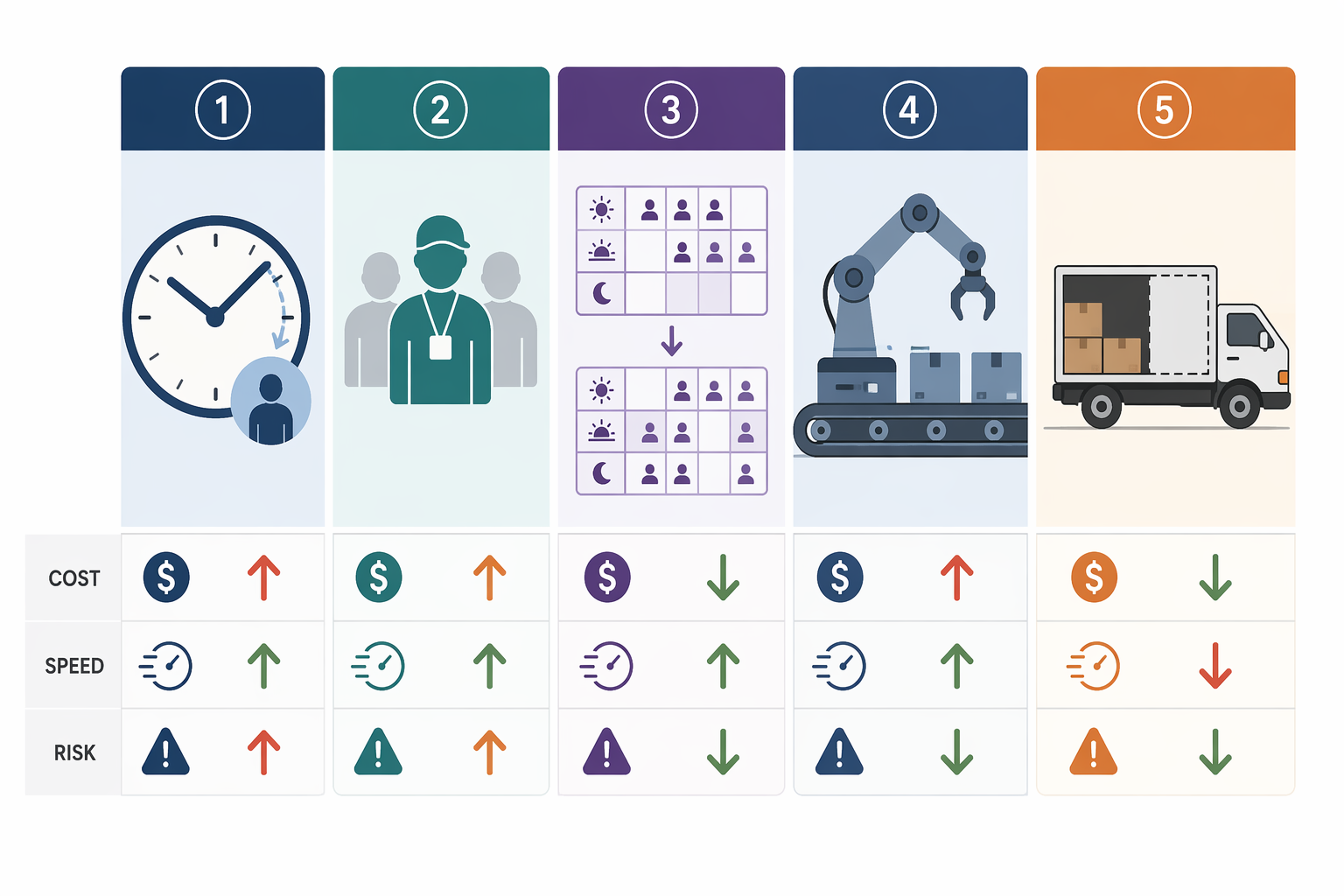
A serious scenario run should compare response paths side by side. Overtime may be fastest, but it increases fatigue and does not create missing certifications. Temp labor may add hours, but not immediately at standard productivity. Shift redesign may protect shipping cutoff while starving replenishment. Automation acceleration may reduce dependence on certain tasks, but implementation time and change management decide whether it helps before the authorization date. Service-level compromise may be the cleanest operational answer, but only if commercial leaders agree which orders, customers, or lanes can absorb delay.
| Response Path | What AI Scenario Planning Should Surface |
|---|---|
| Overtime | How many hours are needed by skill and shift, when fatigue risk rises, and which supervisors carry the load. |
| Temp labor | Which tasks can be filled with new workers, expected ramp time, training load, and the productivity gap before standard output. |
| Shift redesign | Which cutoff windows improve, which upstream tasks lose coverage, and whether transportation or childcare patterns make the redesign unrealistic. |
| Automation acceleration | Which labor dependency decreases before the deadline and which implementation tasks compete for the same supervisors and trainers. |
| Service-level compromise | Which orders, customer groups, lanes, or operating days are protected or deferred, with cost and revenue consequences visible. |
The output should look less like a command and more like a decision packet. For each scenario, leaders need the labor gap by week, shift, role, and certification; expected throughput; service risk; overtime dollars; temp labor dollars; training burden; safety exposure; supervisor load; and the approval steps required. If the plan hides the trade-off, it is not helping the building. It is just moving the spreadsheet war room into a prettier interface.
A Short Diagnostic on Readiness
There is a gap between AI interest and AI readiness. Gartner's 2025 figure, cited by Open Sky Group, says only 23% of supply chain organizations have a formal AI strategy; the same industry roundup cites 85% of executives planning to increase AI spend in 2026.[4] That combination is uncomfortable. Many companies intend to buy or expand AI, but a TPS cliff asks for something more specific than budget intent: connected operational data, governed HR inputs, and decision rights before the date hits.
For a DC manager, readiness can be tested quickly. Can the team identify authorization exposure without exporting sensitive data into uncontrolled spreadsheets? Can it match that exposure to trained roles and shifts? Can the WMS baseline tell the difference between a picker, a lift operator, a receiver, and a trainer in terms of actual throughput? Can finance price overtime and temp labor assumptions fast enough? Can commercial leaders say which service commitments are flexible?
If the answer is no, the first AI project is not an abstract transformation program. It is a data-joining and governance job tied to a workforce-loss calendar.
Use ROI Claims as Directional, Not Guaranteed
There is a business case for better labor planning, but the numbers need to be handled with care. Tompkins Ventures reports 5% to 20% productivity gains from AI labor planning systems.[5] Open Sky Group's AI statistics roundup cites Oracle-linked demand forecasting improvements that reduce forecast errors by 20% to 50%.[4] These figures help frame the opportunity, especially when a facility has to rerun labor plans against changing demand. They should not be read as guaranteed savings under a policy-driven labor shock.
A steady-state productivity gain is not the same thing as absorbing the sudden loss of trained, work-authorized employees. In a TPS scenario, the model may show that every available path costs more than the current plan. That is still valuable. The point is not always to find savings. Sometimes the point is to learn, early, that preserving service on priority accounts requires overtime approval this week, temp labor contracts now, cross-training tomorrow, and a documented decision to slow lower-priority work.
The Legal and Privacy Boundary Is Not Optional
Workforce authorization data is operationally relevant and legally sensitive at the same time. A company may need to understand exposure by TPS category to plan staffing, but broad tagging of workers by immigration status can create privacy risk, employee relations risk, and potential unfair immigration-related employment practice exposure if the data is used improperly. The planning process has to be designed with HR compliance, legal, privacy, and operations in the room.
That usually means role-based access, aggregation where possible, documented purpose limits, audit trails, and a human approval process for any action affecting workers. The model can show that a role group is exposed. It should not become a tool for premature removal, disparate treatment, or informal manager-level decisions based on protected or sensitive status information.
This is also why scenario planning should be framed as conditional. The right phrasing is, "If this date holds, here is the operating plan." It is not, "The system predicts these employees will be gone." Dates may move. Categories may be extended. Litigation or legislation may change the path. The model is there to keep the building from discovering the consequence too late.
The Decision Cadence Before the Cliff
The practical cadence is simple, though the work behind it is not. Start with exposure, translate it into operational capacity, run response scenarios, force executive trade-offs, and revisit the plan whenever the legal calendar or demand forecast changes.
- Lock the planning date set: current TPS-related dates, known placeholders, internal review dates, and the last safe date for staffing actions.
- Build the exposure map: authorization category, facility, shift, role, certification, supervisor group, and critical process.
- Connect demand and productivity: forecasted volume, WMS baselines, engineered standards where available, actual attendance, and training capacity.
- Run constrained scenarios: overtime, temp labor, shift redesign, automation acceleration, service compromise, and combinations of those paths.
- Review trade-offs with decision owners: operations, HR, legal, finance, safety, commercial, and site leadership.
- Document the chosen path and triggers: what changes if the date moves, if temp labor underfills, if demand rises, or if a safety threshold is reached.
The model's best use is in the review meeting, not after it. Leaders should be able to see that Scenario A protects next-day shipping but burns through supervisors, Scenario B saves labor dollars but misses cutoff, Scenario C depends on temp labor that the local market may not supply, and Scenario D requires customer service to reset promises. Those are management decisions. AI can make them visible fast enough to matter.
What Good Looks Like Under TPS-Driven Workforce Loss
A good AI labor scenario planning process does not pretend the disruption is clean. It shows the order pool that misses cutoff, the skill group that becomes the constraint, the shift that needs a different design, the overtime path that becomes unsafe, and the commercial promise that no longer fits the available labor. It also leaves a record of who approved the response and what assumptions were used.
That is the narrower and more credible case for AI here. It does not save the facility from the policy change. It does not predict the government's next move. It gives supply chain leaders a way to compare imperfect staffing paths before the authorization deadline arrives, revise those paths when dates or assumptions change, and make the cost-service trade-offs explicit instead of letting them surface as missed orders and exhausted supervisors.
References
- TPS for Haiti and Syria After Mullin: What Employers Need to Know Now — Morgan Lewis, June 2026
- SCOTUS TPS Ruling: HR & Employers 2026 — i-9 Intelligence
- US Companies to Lose Thousands of Migrant Workers Within Weeks — Newsweek
- Supply Chain AI Statistics — Open Sky Group
- AI Has Come for Labor Demand Planning — Tompkins Ventures
- Labor Management System — Manhattan Associates
- Smart Warehouse Workforce Planning AI — Epicor
Comments
Join the discussion with an anonymous comment.