
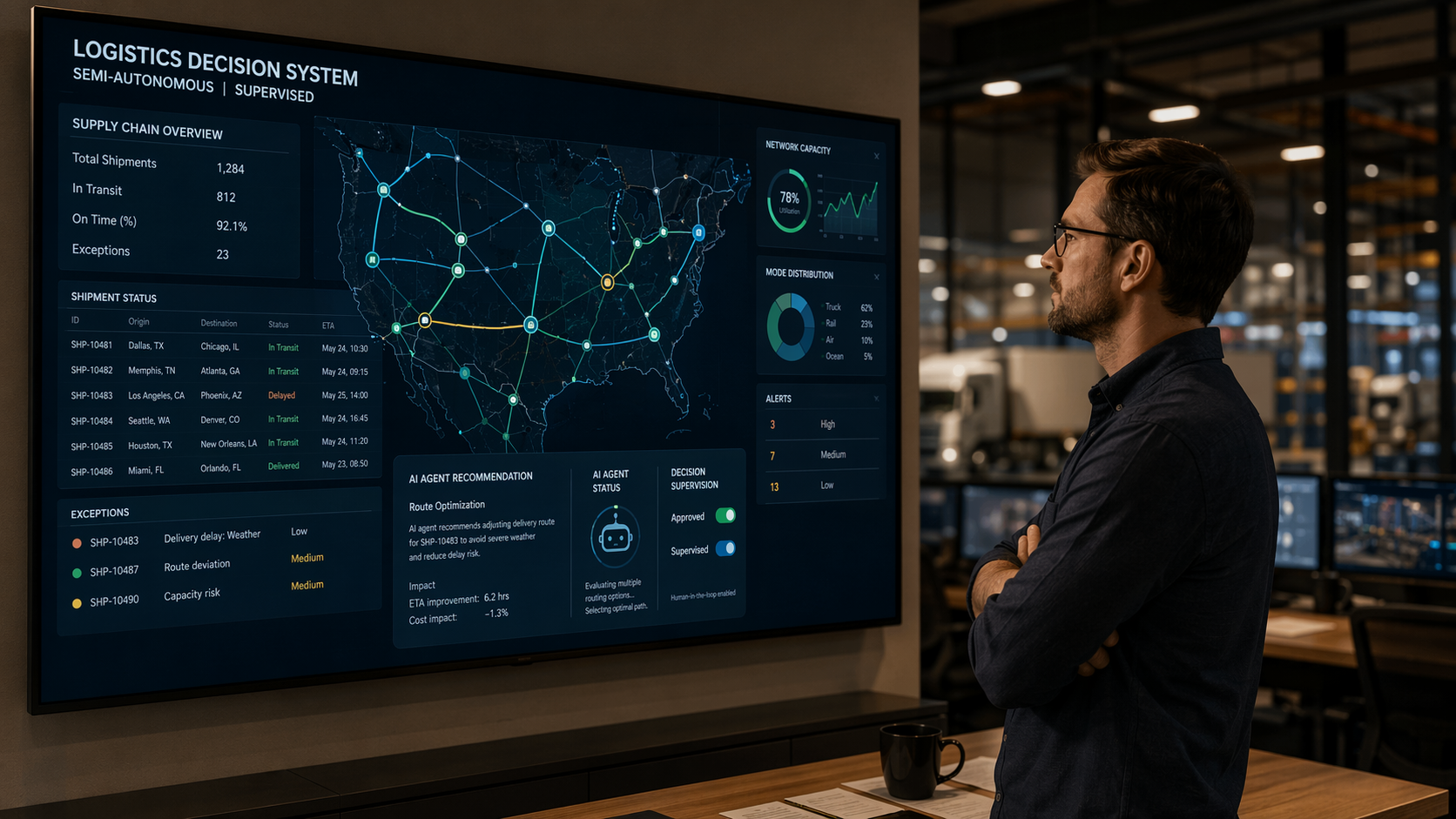
The most useful evidence for artificial intelligence in logistics right now is not a futuristic control tower demo. It is a documentation workflow.
BCG describes a global logistics leader using agentic AI to automate complex documentation work: RFP generation, customs paperwork, and contractual agreements. The deployment reached full ROI within 18 to 24 months, which makes it one of the clearer production examples in a market still crowded with pilots and projection decks.[1]
That matters because documentation is where logistics autonomy stops being abstract. A late customs document can hold a shipment just as effectively as a missing truck. RFPs, contracts, and trade paperwork also carry enough structure for an AI agent to operate inside defined rules, but enough variation to make simple automation brittle. The work is repetitive, consequential, and expensive when it fails. It is exactly the kind of bounded domain where an agent can be judged on output quality, cycle time, escalation behavior, and financial payback.
It is also narrower than the language around “autonomous logistics” often suggests. Automating customs paperwork is not the same as letting an agent reroute freight during a port disruption, rebalance labor across a cross-dock, or decide which customer order absorbs a capacity shortfall. The BCG case shows that agentic AI is commercially real. It does not prove that broad operational autonomy is ready to be switched on across the network.
What Changes When AI Becomes Agentic
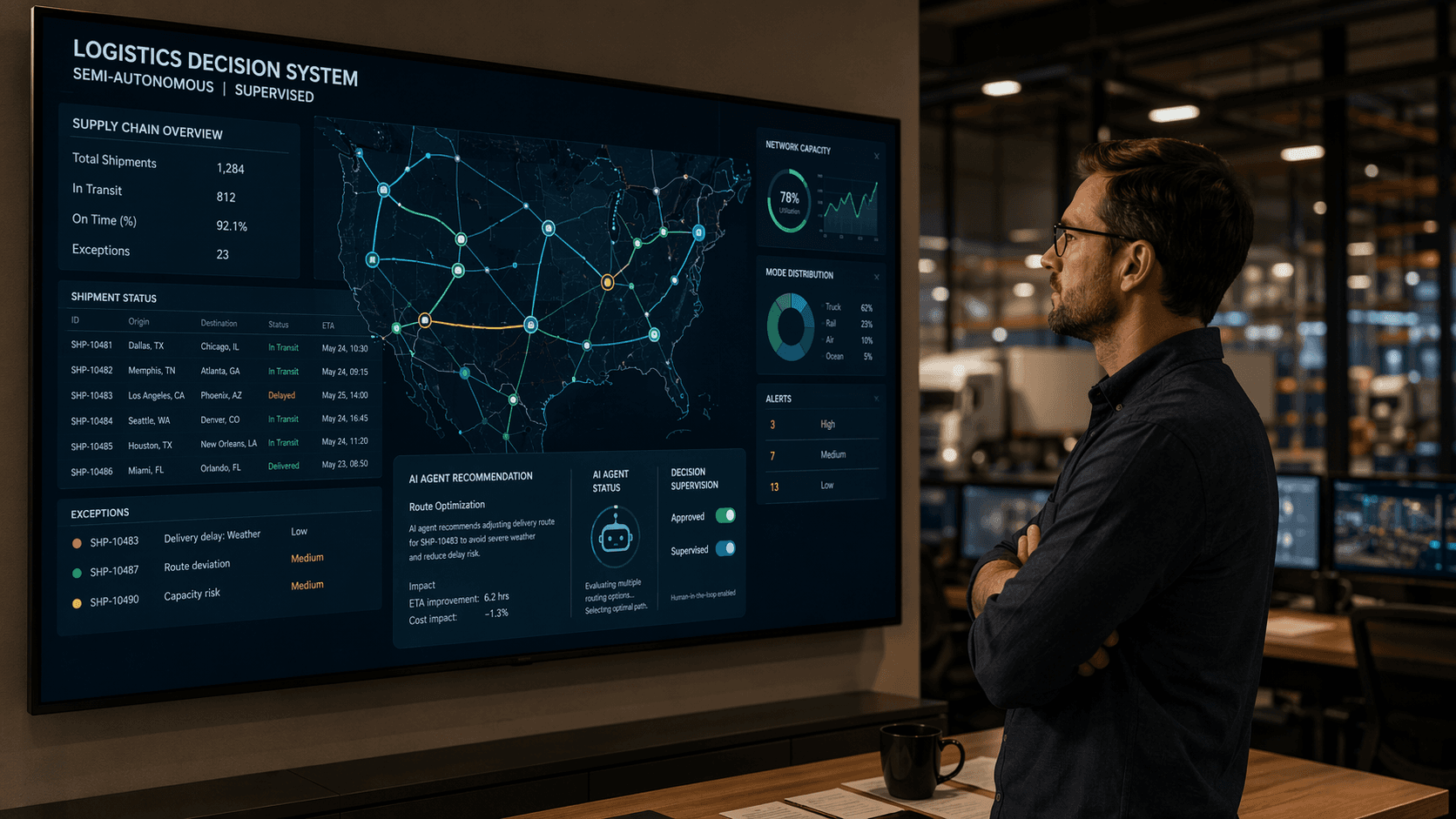
Predictive AI tells a logistics team what may happen: a shipment may miss its delivery appointment, demand may spike in a region, a supplier may fall behind, a route may become more expensive. Agentic AI takes a defined goal, reasons across systems or rules, and executes or initiates actions inside a permitted boundary.
The distinction is operational, not semantic. A predictive model can flag that a container is at risk. An agent might pull shipment data from the TMS, compare customs documentation against requirements, draft the missing paperwork, notify the documentation team, and submit the packet if the workflow allows it. The question is no longer whether the system can generate an answer. The question is whether it has authority to act, what it can touch, and who sees the decision before or after it moves.
The public material in this market does not describe one clean category. BCG emphasizes autonomous execution of defined logistics tasks. Dataiku describes agents that reason through logic chains and query ERP, WMS, and TMS systems. KNAPP applies the idea to self-optimizing warehouse environments. Those are related, but they sit at different points on the autonomy spectrum.[1][2][3]
So the useful screening question is not simply, “Is this agentic?” It is: how much authority has the system been granted, over which workflow, using what data, under whose oversight?
The Market Is Moving Faster Than Full Adoption Suggests
The adoption baseline is still modest. BCG reports that only 10% of logistics companies have fully adopted generative AI, even though more than a third recognize its transformative potential.[1] That gap should sound familiar to anyone who has watched a TMS rollout stall between a strong business case and the messy reality of master data, change management, and exception handling.
At the same time, the direction of investment is clear. BCG projects that agentic systems accounted for 17% of total AI value in 2025 and will reach 29% by 2028.[1] That is not a census of current logistics deployments, and it should not be treated like one. It is a market signal: buyers and vendors are moving from AI that supports analysis toward AI that absorbs pieces of execution.
Gartner’s forecasts, cited through BCG and Dataiku, push the same direction but should be read as forward-looking estimates. Gartner projects that 15% of daily logistics decisions will be made autonomously by AI agents by 2028, and that 60% of supply chain disruptions will be resolved without human intervention by 2031.[1][2] Those figures describe where the market may be heading, not what most logistics organizations can do today.
There is also pressure from the workforce side. Dataiku links the continuing baby boomer retirement cliff through 2026 to interest in agentic AI as companies try to preserve senior planner expertise before it leaves the organization.[2] That framing is easy to overdo. A seasoned planner’s judgment is not a file that can be copied into a model. But the urgency is real: many logistics operations still depend on a small number of people who know which carrier answers after hours, which customer will accept a split shipment, and which customs issue will become tomorrow’s detention charge.
Why Documentation Is a Credible Early Domain
The BCG documentation case deserves more attention than the more dramatic examples because it sits in the right zone for early autonomy. The work touches commercial, compliance, and operational outcomes, but it is still bounded. Documents have known formats. Approval paths can be defined. Exceptions can be routed to specialists. Audit trails are possible. If the agent drafts an RFP response or prepares customs paperwork, a reviewer can evaluate whether the output is complete, compliant, and consistent with policy.
That combination is hard to find in real-time operations. A routing agent working during a disruption may need to weigh carrier capacity, contracted rates, customer promises, driver hours, port congestion, warehouse receiving windows, and inventory availability. The decision space changes quickly, and the cost of a poor action may land somewhere other than the team that approved the automation. Documentation is not risk-free, but its boundaries are easier to see.
The ROI also has to be interpreted inside that boundary. Full payback within 18 to 24 months is meaningful because logistics back offices are often overloaded with manual review, copy-paste work, and exception chasing.[1] It does not follow that every agentic workflow will pay back on the same timeline. A warehouse orchestration agent, for example, may require deeper integration with labor systems, automation equipment, slotting logic, and WMS task management before any comparable return can be measured.
This is where production evidence is both encouraging and limiting. It proves that an agent can create value when the workflow is well chosen. It does not remove the need to grade each next use case by decision authority, reversibility, data dependency, and failure cost.
The Use Cases Are Expanding, But Not Equally Proven
The most commonly discussed agentic logistics use cases now cluster around disruption response, supplier management, warehouse coordination, and documentation. Dataiku points to real-time rerouting during disruptions and automated supplier onboarding and scoring. KNAPP describes AI trends in warehouse logistics, including cross-dock orchestration and self-optimizing warehouse systems. Gartner’s disruption-resolution projection, cited through Dataiku and BCG, sits at the more ambitious end of this spectrum.[1][2][3]
| Workflow | What an agent may do | Evidence posture in the available sources |
|---|---|---|
| Documentation | Generate RFPs, customs paperwork, and contractual documents within defined review paths | Production case with reported 18- to 24-month ROI |
| Disruption response | Identify shipment risk, query operating systems, and initiate rerouting actions | Emerging use case and analyst projection, not broadly evidenced production performance |
| Supplier onboarding and scoring | Collect supplier inputs, compare against rules, and recommend or initiate approval steps | Described as an application area, with less public outcome data |
| Cross-dock and warehouse orchestration | Adjust task priorities, flows, or resource use inside warehouse operations | Discussed in warehouse AI trend material, but dependent on local systems and controls |
The distinction matters because logistics leaders are often asked to approve “AI” investments as if the use cases share the same risk profile. They do not. A documentation agent that drafts paperwork for review has a different operating envelope than an agent that tenders freight, changes a delivery appointment, or reallocates dock doors. One can be wrong and corrected before execution. The other may create a physical consequence before anyone notices.
Dataiku, citing Deloitte, says organizations using agentic AI by 2026 can realize double-digit efficiency gains and reduce decision latency from days to seconds.[2] The latency point is especially relevant in logistics. A slow decision is often a decision by default: the load misses the cutoff, the warehouse works around missing information, the carrier moves on, the customer receives an apology instead of an option. But speed only helps when the action is allowed, accurate, and recoverable.
From Human-in-the-Loop to Human-on-the-Loop
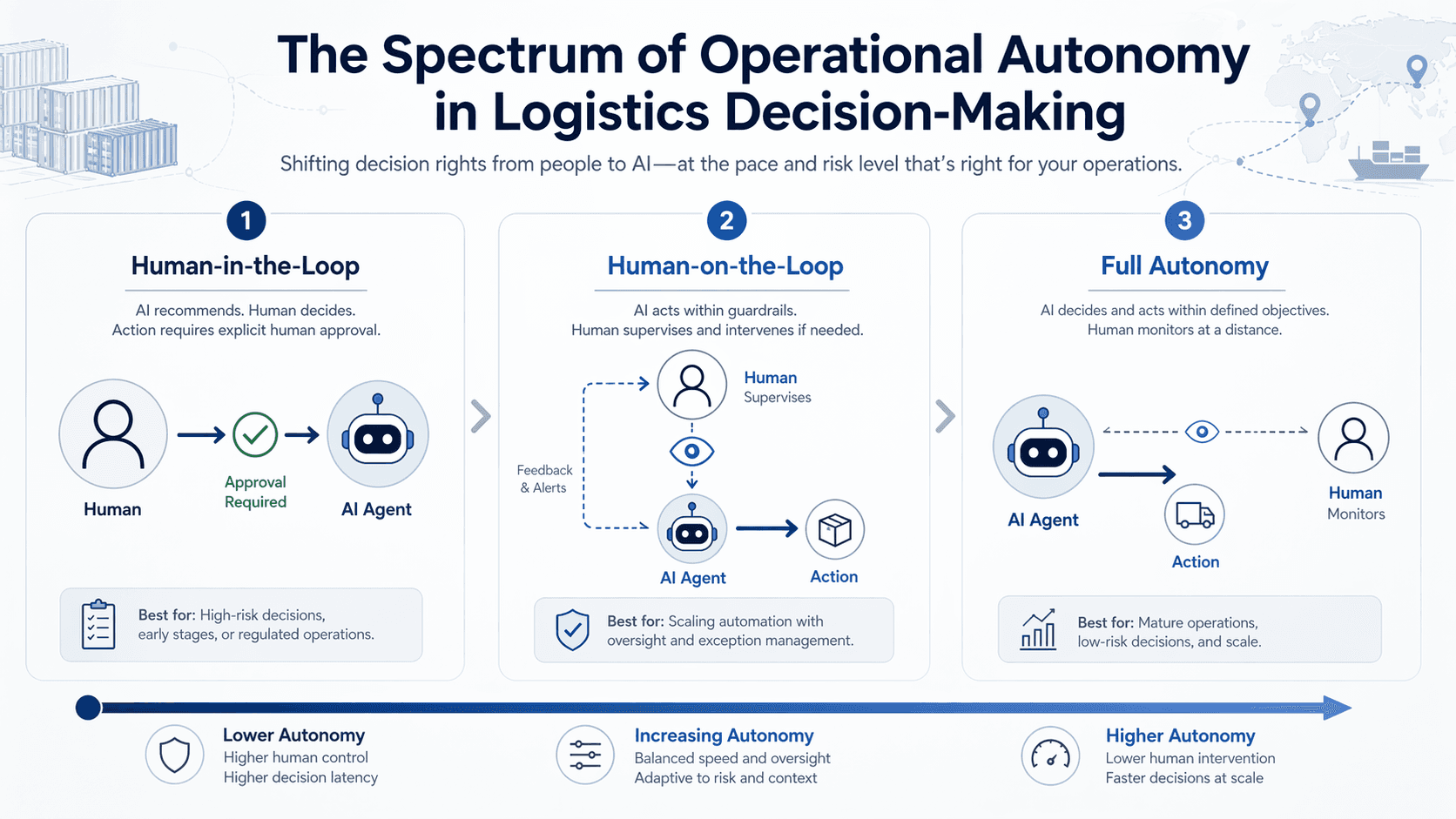
Most logistics AI still lives in a human-in-the-loop model. The system forecasts, scores, drafts, or recommends. A planner, broker, documentation analyst, warehouse lead, or customer service manager approves the next step. This model is slower, but it matches how many operations already manage accountability: people make the final call because people inherit the exception queue.
Human-on-the-loop changes the burden. The agent acts within agreed boundaries while humans supervise performance, intervene on exceptions, and adjust policy. Nuvizz and KNAPP discuss this shift at a high level in logistics and warehouse contexts, but the public material leaves an important governance gap: who is liable when the autonomous action is wrong, late, noncompliant, or commercially damaging?[3][4]
That question gets very practical very quickly. If an agent reroutes a shipment to protect service but increases cost, does transportation own the variance? If it delays a lower-priority order to preserve a strategic account, did the customer rules allow that tradeoff? If it submits customs documentation based on incomplete product data, does the compliance team have an audit trail showing why the action occurred and which source fields were used?
The shift to human-on-the-loop is not mainly a user interface change. It is a control model change. Human approval moves from every transaction to the design of boundaries, thresholds, alerts, and escalation paths. For teams looking for an operational deployment model, ChainSignal’s guide to graduated autonomy in supply chain is the more detailed playbook. The strategic point here is simpler: supervision is only safer than approval when the system is observable, bounded, and interruptible.
The Data Architecture Is the Autonomy Architecture
Every serious public account returns to the same prerequisite: agentic AI needs unified data architecture and high data quality. BCG, Dataiku, and KNAPP each frame data readiness as foundational, not optional.[1][2][3] That may sound like familiar enterprise hygiene, but with agents it becomes a safety condition.
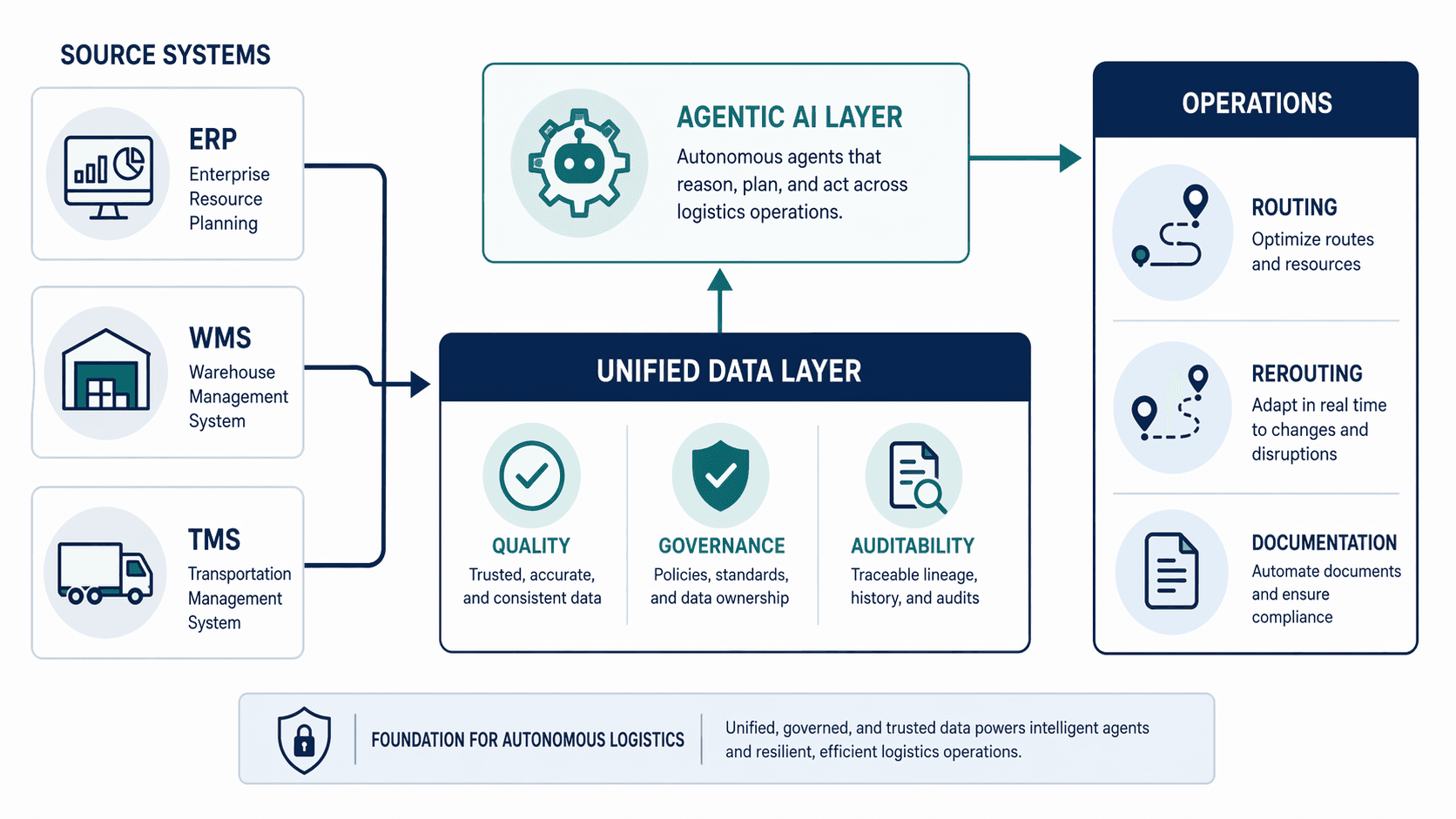
A predictive model can tolerate some fragmentation because its output is advisory. A planner may know that the customer master is messy or that the WMS status lags reality by an hour. An agent that acts on those same signals has less room for informal correction. If the TMS says a carrier is available but procurement knows the contract is suspended, the agent needs a governed way to resolve that conflict before it tenders freight. If the ERP item record is incomplete, the agent should not confidently prepare customs documentation as if the missing fields do not matter.
This is why “connect it to the ERP, WMS, and TMS” is not a complete strategy. The agent needs to know which source is authoritative for which decision, how fresh the data is, what confidence threshold applies, and when uncertainty triggers escalation. It also needs logs that show what it saw, what rule or reasoning path it used, what action it took, and who or what approved the boundary that allowed the action.
In a mature setup, logistics data architecture starts to look less like reporting infrastructure and more like an operating nervous system:
- A unified data layer connects ERP, WMS, TMS, order, carrier, inventory, and customer data without pretending every source is equally reliable.
- Governance rules define which system is authoritative for rates, product attributes, inventory status, shipment milestones, and customer commitments.
- Data quality controls block or escalate actions when required fields are stale, contradictory, or missing.
- Auditability records the agent’s inputs, reasoning path, action, exception status, and human intervention history.
- Escalation rules route uncertain or high-impact decisions to the right operational owner before damage spreads.
This is also where many organizations are underprepared. ChainSignal has covered the AI strategy gap in supply chain before, and agentic AI exposes the same weakness in a sharper form. A company can run useful AI pilots without a fully mature governance model. It should not grant operational authority to agents without one.
How to Judge Whether a Workflow Is Ready
The first candidates for agentic logistics should not be chosen because they sound advanced. They should be chosen because the decision boundary is visible. Documentation is a good example because the input set, output format, review path, and compliance requirements can be mapped. Some supplier onboarding steps may fit the same pattern. Certain appointment scheduling or exception triage workflows may also be candidates if the rules are stable and the cost of reversal is manageable.
A workflow is a poor candidate for higher autonomy when it depends on undocumented human judgment, incomplete master data, or tradeoffs that leadership has never explicitly resolved. Many logistics decisions look routine until the exception appears. A planner may know that a customer’s “must arrive Friday” instruction is flexible if inventory is available at a nearby node. An agent will not know that unless the exception rule exists somewhere it can use.
| Readiness question | Why it matters |
|---|---|
| Can the workflow be bounded clearly? | Agents need a defined action space, not a vague instruction to optimize logistics performance. |
| Is the source data trusted and governed? | Autonomous execution amplifies bad data faster than advisory analytics. |
| Can the action be audited? | Teams need to reconstruct why the agent acted, especially in compliance, cost, and service disputes. |
| Is there a clear escalation path? | Uncertainty should move to the right human owner before the agent improvises. |
| Is the action reversible or containable? | Higher-risk decisions require tighter limits, slower rollout, or continued human approval. |
The practical migration path is usually not from manual work to full autonomy. It is from recommendation, to drafted action, to approved execution, to supervised execution in a narrow lane. The same agent may remain human-in-the-loop for high-value shipments while operating human-on-the-loop for low-risk documentation or routine supplier data collection. That unevenness is not a failure of ambition. It is what responsible autonomy looks like in a network where not every mistake has the same consequence.
The Evidence Is Optimistic by Construction
There is a publication bias problem in the current agentic AI discussion. The available evidence highlights successful deployments, analyst projections, and vendor-adjacent trend narratives. It does not provide much failure data: agents that made poor recommendations, workflows that could not be governed, integrations that broke under exception volume, or pilots that never reached production.
That absence should not lead to cynicism, but it should affect how claims are weighted. A documented production workflow with ROI belongs in a different category from a forecast about autonomous disruption resolution. A warehouse trend article belongs in a different category from a measured cross-site benchmark. A vendor disclosure can still be useful, but it should not be treated as independent proof that the operating model is mature.
The cleanest conclusion is therefore a narrow one. Agentic AI in logistics is already useful and commercially meaningful when the work is bounded, the data is reliable, and the governance model is explicit. The responsible next step is not blanket autonomy. It is deciding which workflows are ready to move from human approval to human supervision, and which ones still need a person in the decision path at 4:40 p.m. when the system is confident but the operation is not.
Comments
Join the discussion with an anonymous comment.