
The worst inventory decision at a small farm stand usually happens after the customers are gone. The table is sticky from peaches, the greens have lost their morning snap, and the person closing up has to decide what gets marked down, what goes home, what gets donated, what can still be processed, and what is simply compost by tomorrow.
That is the practical question behind AI inventory management for small farm stands: can a tool help prevent that end-of-day pile from existing in the first place, or does it just create one more screen to check before loading the truck?
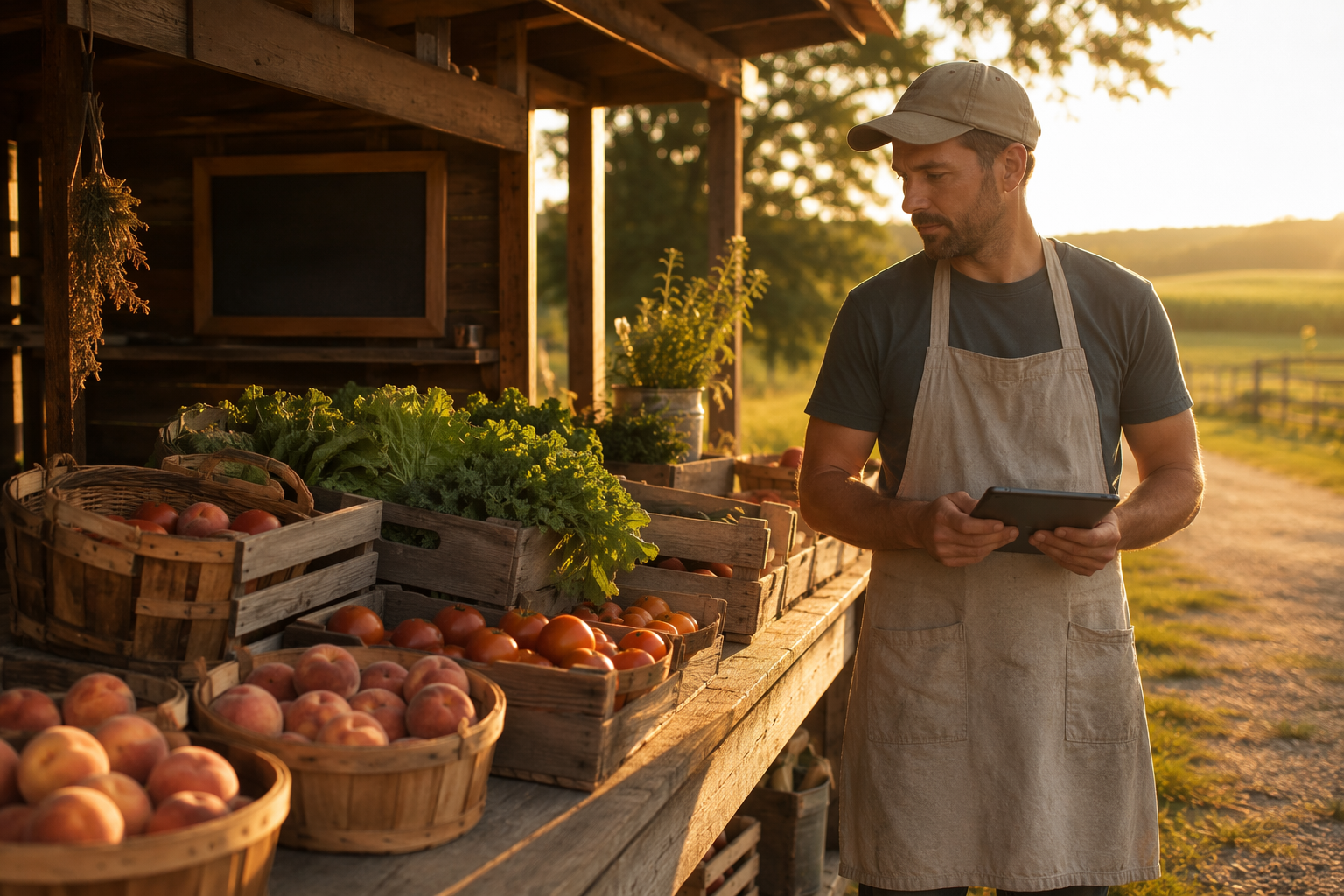
A crate of unsold tomatoes is not an abstract software problem. It already absorbed seed, labor, water, harvest time, packaging, transport, display space, and the attention of whoever kept misting and rotating it through the day. If demand was missed by a little, the loss may be small. If it happens every Saturday, across greens, berries, flowers, eggs, meat cuts, and CSA extras, the pattern becomes expensive enough to measure.
The broader food-waste numbers explain why this deserves attention, but they do not answer the farm-stand question by themselves. USDA says 30% to 40% of the U.S. food supply is wasted, and its food-waste FAQ cites ReFED’s estimate that roughly 14.9 million tons of surplus food originated on U.S. farms in 2022.[1] Those figures set the stage. They do not prove that a two-acre roadside stand should pay monthly software fees.
What AI Forecasting Actually Changes
Useful inventory forecasting does not begin with magic. It begins with cleaner memory. A stand that records what sold, when it sold, how much was stocked, what was left, and what else was happening that day gives a forecasting tool something to work with.
The simple version looks like this: last season’s Saturday tomato sales, this week’s weather, the current harvest window, CSA pickup volume, market-day traffic patterns, and recent sales velocity are turned into a suggested stocking quantity. The recommendation may be wrong, but it is at least wrong in a way that can be compared against actual results the following week.
That is different from digitizing a hunch. If the stand owner already knows that rain hurts tomato sales and heat moves cucumbers, the software has not earned much. It starts to matter when the pattern is too tangled to hold in one person’s head: strawberries and greens sell differently at the roadside stand than at the Saturday market; eggs run out when CSA pickup overlaps with commuter traffic; beef cuts move slowly until a holiday weekend; herbs spoil because they are stocked for visual abundance rather than actual demand.
A decent weekly forecast should reduce at least one decision that normally gets made from memory:
- How much to harvest for the stand versus leave in the field for another day
- How much to pack for market versus hold for CSA or wholesale
- Which products should be displayed in smaller replenished batches instead of all at once
- Which items need an early discount before they become a closing-time problem
- Which crops or prepared inventory are repeatedly overproduced for the channel that receives them
The value is not that AI knows local customers better than the farmer. The value is that it can keep checking the boring arithmetic without getting tired: what sold, what did not, what was available, what the weather did, and whether last week’s assumption deserves to survive another week.
The Evidence Is Useful, but Not Farm-Stand Proof
The strongest published proof points for AI demand forecasting come from larger perishable-food operations, not from one-cooler farm stands. They are still worth looking at, as long as they are not dragged across the scale gap without warning.
TraxTech reports that AI demand forecasting reduced food waste by 49% for an online grocer and cut fresh spoilage by 20% for a regional grocery chain.[2] The mechanism is relevant: matching supply quantity to predicted demand before perishables lose value. The measured outcomes, however, belong to grocery contexts, not a Saturday farm stand.
ThroughPut AI’s Church Brothers Farms case study sits even farther from roadside scale. The company describes Church Brothers Farms as a 40,000-plus-acre vertically integrated agribusiness and reports more than 40% improvement in forecast accuracy using AI demand forecasting.[3] That is not evidence that a two-acre stand will see the same improvement. It is evidence that historical sales, seasonality, weather, and demand signals can improve forecasting in a perishable produce system when there is enough data and enough operating complexity.
That distinction matters. A farm stand should not buy software because a large grocer cut spoilage. It should consider software only if its own operation has enough moving parts for better forecasting to change harvest, stocking, or channel allocation decisions.
The Break-Even Line Is Usually Complexity, Not Farm Size
The dividing line is not whether the farm has two acres or twenty. It is whether the stand has enough products, channels, and recurring waste patterns for forecast accuracy to change money decisions.
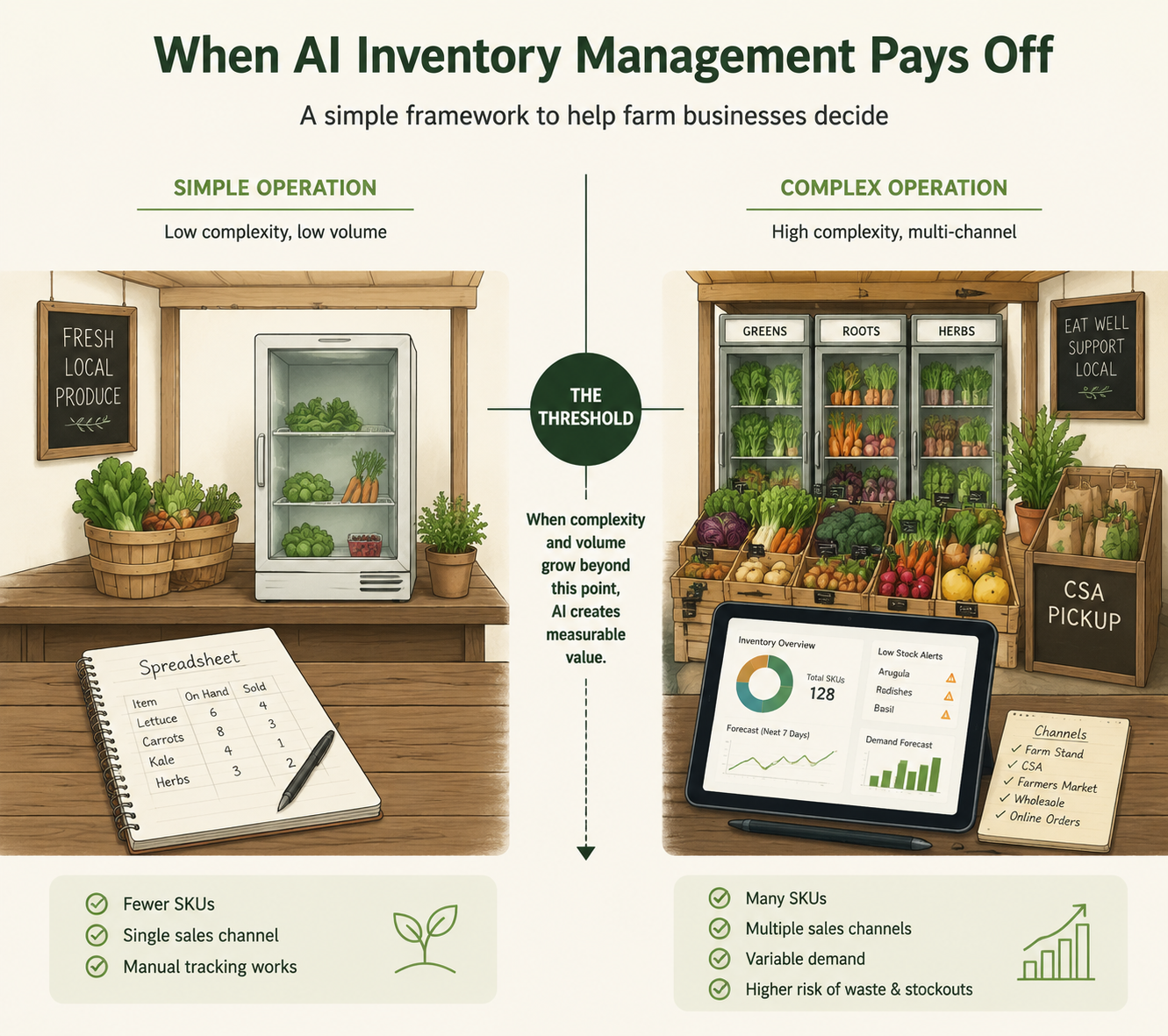
A stand with five to ten items in one cooler usually does not need a paid AI inventory platform. If the same person harvests, stocks, sells, and closes, the feedback loop is short. A notebook or spreadsheet can show that too many greens are cut on hot weekends or that eggs sell out by noon. Paying every month to confirm those patterns is hard to justify.
The calculation changes around 20 or more SKUs, especially when products spoil at different speeds. DJ’s Digital argues that for small retailers and manufacturers with 20-plus SKUs, even a 5% to 10% improvement in forecast accuracy can create meaningful cost recovery on perishable inventory.[4] That does not mean every 20-item farm stand should buy software. It means the possible savings finally become large enough to compare against the subscription cost.
| Stand situation | Best first move | Why |
|---|---|---|
| 5-10 products, one cooler, one sales channel | Spreadsheet plus occasional AI chat analysis | The operator can still see most patterns directly |
| 10-20 products, seasonal surges, some spoilage | Improve tracking before paying for software | Bad data will make paid forecasting look smarter than it is |
| 20+ products or mixed perishability | Consider paid inventory software with forecasting | Small forecast gains can affect harvest, stocking, and markdown timing |
| Stand + CSA + farmers market + wholesale | Paid forecasting becomes more defensible | The same inventory is being pulled in several directions |
Multiple sales channels are often more important than product count. A farm that sells from a roadside stand, fills CSA boxes, attends a Saturday market, and occasionally moves surplus wholesale is no longer making one stocking decision. It is deciding where each harvest has the best chance of selling before quality drops.
That is where forecasting can pay for itself. If last year’s CSA pickup weeks consistently left too few eggs for stand customers, or market tomatoes sold through while stand tomatoes softened, the tool can help rebalance the allocation before the product is packed. The savings do not come from a dashboard. They come from fewer wrong crates going to the wrong place.
The Monthly Fee Has to Face the Compost Bucket
Local Line’s Essential plan was listed at $69 per month when this article was checked and includes AI demand forecasting for farm-specific inventory; Local Line also says it serves about 3,000 North American markets.[5] That price is useful because it gives the decision a floor. Current pricing should be checked before buying, but the question is already clear: can better forecasting prevent at least that much monthly loss, plus enough saved labor to make the workflow worthwhile?
GrazeCart and Barn2Door appear in the same practical category: farm-store and direct-to-consumer platforms that may help connect sales, orders, and inventory rather than leaving each channel in its own notebook or app.[6] They should be treated as starting points, not as proof that software is automatically profitable.
The farm stand should run the fee against its own waste, not against a vendor promise. If a month’s avoidable loss is usually a few heads of lettuce and a basket of soft peaches, a subscription will struggle to earn its keep. If the stand regularly has unsold perishables across several categories, plus occasional stockouts on items customers came specifically to buy, the cost recovery case becomes more realistic.
What to Track Before Trusting Any Forecast
AI inventory management cannot rescue sloppy records. If the system only sees sales, but not what was available, it may mistake a sellout for low demand. If leftovers are never recorded, it cannot distinguish a good stocking decision from an overfull display that looked pretty until closing.
Before paying for a tool, a farm stand should be able to track a few ordinary facts every market day:
- Opening quantity by product
- Quantity sold by product
- Closing quantity by product
- Markdowns, donations, processing, compost, or carryover
- Weather and any unusual traffic factor, such as a holiday, rain, event, or nearby closure
- Sales channel, especially when the same product is split among stand, CSA, market, and wholesale
That tracking does not need to be elegant. A spreadsheet with one row per product per sales day is enough to reveal whether the operation has a forecasting problem or a discipline problem. If no one records leftovers because closing is rushed, a paid platform may simply create a more expensive place to leave blanks.
The first useful forecast is often a weekly recommendation, not a live algorithm running all day. For example, a stand might review the previous four Saturdays, the coming weather, and current crop availability on Thursday evening before harvest planning. The output should be concrete: cut fewer bunches of chard, hold more cherry tomatoes for market, pack eggs differently for CSA pickup, or plan an earlier discount on ripe peaches.
The No-Recurring-Cost Path for Simpler Stands
For a simpler stand, the smarter use of AI is often not a dedicated inventory product. It is a free or already-available AI chat tool reading a season’s worth of spreadsheet data and looking for patterns the operator may have missed. RapidDev’s farmers-market guidance is cautious about where AI helps and what to skip, which fits this use: use AI where it reduces repetitive analysis, not where it interferes with the human core of local selling.[7]
The workflow can stay plain. Export or copy a spreadsheet with product, date, opening quantity, sold quantity, leftover quantity, price, weather note, and channel. Ask the AI to identify products with repeated overstock, repeated stockouts, weather sensitivity, and possible changes for next week. Then compare the answer to what the operator already suspects.
The test is not whether the AI sounds confident. The test is whether it finds a pattern that changes next week’s harvest or packing list. If it only says what the stand already knows, keep the spreadsheet. If it shows that two products are repeatedly overstocked on rainy Fridays while another sells out whenever CSA pickup overlaps with the stand, the farm has learned something without accepting a recurring software bill.
A simple instruction can be enough:
Analyze this farm stand sales spreadsheet. Look for products with repeated overstock, repeated stockouts, weather-sensitive sales, and differences by sales channel. Give me practical stocking or harvest adjustments for next week. Do not invent data that is not in the spreadsheet.That last sentence matters. A farm stand does not need a chatbot inventing a tidy explanation for messy Saturdays. It needs help seeing whether the same waste pattern happened often enough to act on.
When Paid AI Inventory Software Is Worth a Serious Look
Paid AI inventory software becomes more defensible when the stand can answer yes to several of these conditions:
- The stand sells 20 or more products during peak season
- The same inventory is split across roadside sales, CSA, farmers markets, online orders, or wholesale
- Perishable losses repeat by product, week, weather pattern, or channel
- Stockouts are costing sales on products customers specifically come to buy
- At least one season of usable sales and leftover data exists
- The person using the tool will actually review the forecast before harvest, packing, or ordering decisions
That last point is easy to understate. Forecasting only pays when it changes a decision before the loss occurs. A beautiful report reviewed after the produce is already wilting is recordkeeping, not prevention.
The best-fit stand is usually not the smallest or the largest. It is the stand that has outgrown memory but has not yet built a full inventory discipline. It knows waste is happening, but the cause is scattered: too much harvested for one channel, too little saved for another, inconsistent markdown timing, or product mix decisions made from last week’s most annoying problem instead of the season’s pattern.
For that operation, a forecast embedded in ordering, inventory, or POS workflow may be worth more than a separate analytics tool. The fewer extra steps it adds, the better. A farm stand with one or two people does not need another administrative job at the end of market day.
What Not to Buy
Do not buy a platform because it says AI. Buy it only if the forecasting feature sits close to the decision that wastes product: harvest planning, packing, stocking, markdowns, or channel allocation.
A farm stand should be cautious when a tool cannot show how it uses actual sales history, seasonality, weather, product mix, and channel demand. It should be equally cautious when the setup requires more data entry than the operator can maintain during peak season. The most sophisticated forecast is useless if the stand stops feeding it data by July.
The vendor should be able to explain the weekly workflow in plain terms: what the farmer enters, what the system imports automatically, when the forecast appears, and which decision it is meant to improve. If the answer never gets closer than “optimize inventory,” keep walking.
The Practical Decision
For a one-cooler stand with a short product list, use a spreadsheet and a no-recurring-cost AI chat review after you have enough sales history to make the review meaningful. Track what opened, what sold, what was left, and what happened to the leftovers. If that process already tells you what to change, there is no reason to pay monthly to hear it in a dashboard.
For a stand with 20-plus products, multiple channels, or recurring spoilage patterns that no one has time to untangle, paid AI inventory management deserves a trial. The trial should be judged by whether it changes weekly harvest, stocking, allocation, or markdown decisions enough to recover the fee and reduce avoidable waste.
That is the clean line. AI inventory management pays off when the stand has enough complexity for better forecasting to prevent real product from landing in the compost, donation box, or back of the truck. Below that line, the better tool is disciplined tracking, a spreadsheet, and a free second look at the data before next week’s harvest list is written.
References
- USDA Food Waste FAQs — USDA — https://www.usda.gov/about-food/food-safety/food-loss-and-waste/food-waste-faqs
- AI May Slash Food Waste 49% — TraxTech — https://www.traxtech.com/ai-in-supply-chain/ai-may-slash-food-waste-49
- Case Study: How AI Demand Forecasting Software for Agriculture Helped Church Brothers Farms — ThroughPut AI — https://throughput.world/blog/case-study-ai-demand-forecasting-for-agriculture-business/
- How Small Retailers and Manufacturers Can Harness AI for Smarter Inventory Management — DJ's Digital — https://www.djs-digital.com/articles-and-blogs-1/how-small-retailers-and-manufacturers-can-harness-ai-for-smarter-inventory-management
- Farm Inventory Software: 10 Must-Have Features for Farms — Local Line — https://www.localline.co/blog/what-to-look-for-in-farm-inventory-software
- What Is the Best Farm Store POS Software? 3 Top Options — GrazeCart — https://www.grazecart.com/blog/farm-store-pos-software
- AI for a Local Farmers' Market: Vendor Comms, Promotion, and What to Skip — RapidDev — https://www.rapidevelopers.com/ai-implemetation/ai-solution-for-local-farmers-market
Comments
Join the discussion with an anonymous comment.