
A below-normal hurricane season forecast is not a permission slip for a relaxed supply chain plan. For 2026, NOAA expects a 55% chance of below-normal Atlantic activity, with 8–14 named storms, 4–7 hurricanes, and 1–3 major hurricanes.[1] That is the seasonal envelope. It is useful, but it does not answer the operating question: which inventory, lanes, facilities, suppliers, and labor plans should move before a storm track becomes obvious?
The uncomfortable part is that storm count and supply chain loss do not line up neatly. Allianz Commercial points to 2025 as a reminder: the year had the fewest U.S. hurricanes since 2015, yet produced the second-highest number of Category 5 storms on record.[2] A quiet-looking season can still deliver a small number of storms that intensify quickly, hit exposed corridors, and compress the time available to buy, move, reroute, and staff.

That is why supply chain planning for the 2026 hurricane season should not stop at the seasonal outlook. The better use of the outlook is to set the outer frame, then let AI-driven weather intelligence refine risk by place, timing, asset exposure, and likely business impact. The decision is not whether the season will be “bad.” The decision is when a planning team changes safety stock, opens alternate capacity, shifts store and DC allocation, or raises an exception before certainty arrives.
Start With NOAA, But Do Not Stop There
NOAA’s seasonal outlook matters because it gives planning teams a credible baseline. In 2026, the below-normal signal is shaped by competing forces: El Niño conditions that tend to suppress Atlantic activity and warm Atlantic sea surface temperatures that can still support storm development.[1] For a supply chain team, that combination argues against both extremes. It does not justify overbuilding inventory across every coastal market. It also does not justify waiting until a named storm is already threatening a lane, port, plant, or customer region.
The seasonal outlook is best treated as an envelope, not an execution plan. It can influence budget posture, scenario ranges, and executive expectations. It cannot tell a Gulf Coast DC manager whether to pull forward a replenishment cycle, or a transportation lead whether to reserve alternate trucking capacity into Florida before carriers become scarce.
Rapid intensification is the main reason that distinction matters. Research cited in the 2026 outlook discussion found mean maximum intensification rates were 29% higher in 2001–2020 than in 1971–1990, and storms intensifying from Category 1 to major hurricane status within 36 hours have more than doubled.[3] That does not mean every storm becomes an emergency. It means the comfortable planning window can collapse, especially for decisions that require purchase orders, carrier commitments, warehouse labor, or supplier substitutions.
| Forecast Input | What It Tells Planners | What It Does Not Decide |
|---|---|---|
| NOAA seasonal outlook | The expected activity range for the basin | Which SKUs, routes, and facilities need action |
| Rapid-intensification evidence | The response window may shrink once a storm forms | The exact landfall location or commercial impact |
| AI weather and impact models | Probabilistic risk by geography, timing, and exposed assets | Whether the organization is authorized to spend or reroute |
| Internal demand, inventory, and supplier data | Where weather risk becomes revenue, service, or continuity risk | The meteorology itself |
Where AI Changes the Planning Variable
AI is useful here only when it changes a planning variable. A prettier storm dashboard is not enough. The useful output is a probability that can be tied to a facility, supplier, lane, item, service commitment, or customer region. That is the difference between “the Atlantic may be less active this year” and “the probability of disruption to these inbound lanes is now high enough to book alternate capacity.”
Several capability categories matter for 2026 planning. NOAA’s own forecasting work is incorporating more AI-enabled data collection and processing. Reported examples include sUAS drone data improving intensity forecast accuracy by 10% and machine-learning-based tail Doppler radar processing gathering 25% more meteorological data.[4] Those improvements sit upstream of the commercial planning decision, but they matter because intensity errors are often what turn a manageable disruption into an inventory and transportation scramble.
Commercial platforms then translate weather signals into business-specific probabilities. The Weather Company’s GRAF model, ClimateAi’s FICE model, Everstream Analytics, and Resilinc’s EventWatchAI all sit in this category: they are not simply reporting public advisories; they are trying to connect meteorological signals with exposed nodes, routes, suppliers, and demand patterns. The Weather Company reports that 90% of executives say weather affects operations, and that companies using weather intelligence achieve 5–10% revenue improvements.[5] Those figures support the business case for better weather intelligence, but they should not be read as a guaranteed return for every supply chain.
A practical planning team should ask one question of any AI forecast: what decision becomes different today? If the answer is only “watch more closely,” the model has not yet crossed into operations. If the answer is “increase service-level protection for these SKUs in these markets,” “move stock inland before the lane tightens,” or “shift sourcing because this supplier cluster is inside a rising impact zone,” then the forecast has become planning material.
The Hurricane Ian Example Shows the Chain of Action
The most concrete example in the available material is ClimateAi’s vendor-published Hurricane Ian case. A building materials company used ClimateAi’s FICE model ahead of Ian in 2022 to identify demand risk in Florida and pre-position building-code-approved materials. ClimateAi says the company captured $15 million in additional sales as a result.[6] The same storm caused $112.9 billion in economic losses, which gives the case its commercial context without proving that the same outcome is repeatable for other companies.[7]
The case is valuable because it shows the planning chain, not because it should be treated as a universal benchmark. The model output mattered only because someone had authority to act on it. The company needed eligible inventory, knowledge of Florida building-code requirements, available logistics capacity, and enough lead time to move materials before post-storm demand spiked. Without those preconditions, the same forecast could have become an interesting alert and nothing more.
That is the handoff point many hurricane plans miss. Forecast intelligence has to land inside a decision system. For a building materials company, the relevant variables are regional inventory, compliant SKU availability, DC placement, inbound replenishment, and contractor demand after landfall. For a grocer, they may be bottled water, shelf-stable food, generator-related demand, store labor, fuel exposure, and last-mile accessibility. For an industrial manufacturer, the same storm signal may matter more through supplier shutdown risk, port congestion, or a critical resin or component corridor.
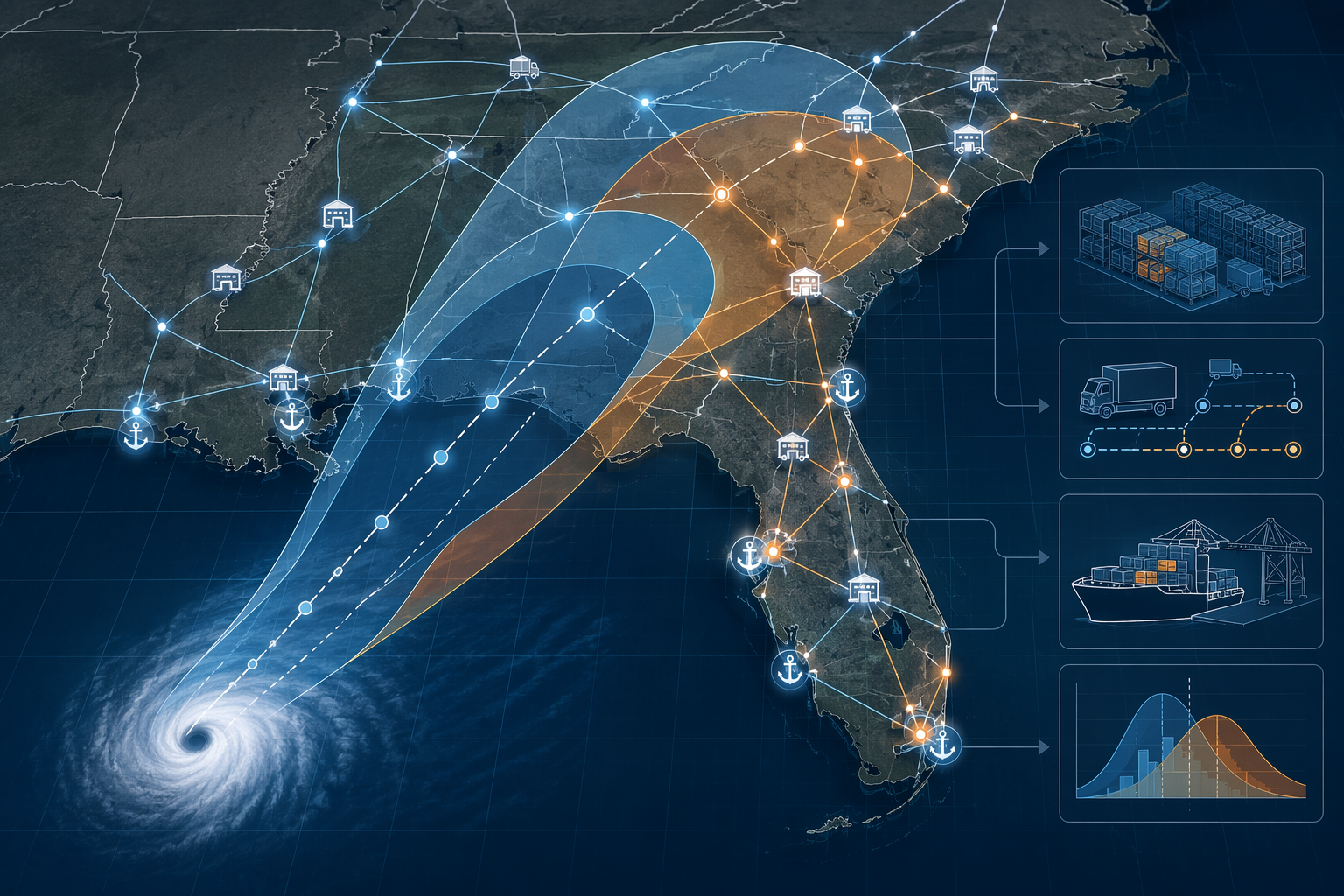
Turn the Forecast Into Staged Decisions
The planning work should be staged because not every decision should wait for the same confidence level. Some decisions are cheap to prepare and expensive to delay. Others tie up working capital or consume scarce capacity. AI helps when it gives planners enough probability and exposure detail to sequence those calls instead of treating every storm update as a meeting trigger.
| Planning Moment | AI-Enhanced Input | Operational Decision |
|---|---|---|
| Pre-season | Seasonal outlook combined with historical exposure, supplier locations, and lane criticality | Set exception thresholds, approve contingency budgets, identify SKUs and nodes eligible for pre-positioning |
| Early storm formation | Probabilistic track, intensity scenarios, and asset exposure by region | Raise monitoring level, check inventory gaps, contact carriers, review alternate ports and lanes |
| Rising regional probability | Business-impact forecast for DCs, stores, suppliers, ports, and transport corridors | Move selected inventory, reserve transportation, adjust allocations, release supplier contingency plans |
| Landfall window compresses | Updated intensity and access-risk probabilities | Freeze nonessential moves, prioritize critical orders, reposition labor, communicate service exceptions |
| Post-event recovery | Observed impacts, access constraints, demand signals, and supplier restart status | Reallocate stock, revise demand forecasts, expedite critical replenishment, retire temporary exceptions |
Inventory Positioning
Inventory planning is where the cost of vague risk language shows up fastest. “Below-normal season” is too broad to change a replenishment plan. A more useful AI output ranks the probability of demand surge or replenishment disruption by market, SKU family, and time window. That lets the inventory lead make narrower exceptions: raise safety stock for storm-relevant items in exposed regions, pre-position only the items with demand and access risk, and avoid spreading working capital across markets that are not currently exposed.
The data requirement is not trivial. Weather intelligence needs to connect with item masters, DC and store locations, open purchase orders, lead times, substitution rules, supplier sites, and service-level policies. Teams still building that foundation should treat data readiness as part of hurricane planning, not as a separate IT exercise. A practical starting point is a structured data readiness assessment for AI inventory optimization, because a model cannot position inventory intelligently if the business cannot tell it where inventory is, how quickly it can move, or which substitutions are acceptable.
Transportation and Routing
Logistics decisions usually have a shorter fuse than inventory policy. Once regional confidence rises, capacity tightens, ports adjust operations, driver availability changes, and fuel or road access can become the constraint. AI risk monitoring helps most when it maps weather probabilities onto actual lanes rather than broad coastal zones.
A transportation manager does not need a perfect landfall prediction to act. They need thresholds. For example, if a modeled probability crosses an agreed level for a high-volume corridor, the team can quote alternate capacity, advance pickup windows, shift freight to a less exposed gateway, or hold noncritical loads out of the region. The same operating logic appears in other disruption domains: AI risk monitoring is valuable when it detects exposure early enough to reroute before everyone else is competing for the same alternatives. That parallel is visible in AI risk monitoring for supply chain threats, where the methodology is less about the threat type than about connecting external signals to routing decisions.
Demand Sensing
Demand sensing during hurricane season is not only about post-landfall spikes. Some demand moves before landfall: preparedness goods, repair materials, fuel-adjacent categories, batteries, medical supplies, and project materials that customers want secured before access tightens. Other demand disappears temporarily when stores close, contractors pause, or customers evacuate. A useful model separates those effects by geography and product family instead of applying a generic storm uplift.
The planner’s job is to decide which demand signals deserve an override and which should remain inside the normal forecast. If every weather alert becomes a manual forecast adjustment, the planning system becomes noisy. If no alert can override the baseline forecast until sales history confirms it, the response arrives late. The better rule is to predefine which product families, regions, and probability levels qualify for temporary forecast intervention.
Supplier and Site Exposure
Supplier-risk monitoring often receives less attention than customer-facing inventory, but it is where a mild seasonal outlook can create a blind spot. A single exposed supplier site, packaging plant, cold-chain node, or port-adjacent operation can become the constraint even if total storm activity is low. AI platforms that connect storm probability to supplier geography give risk owners a way to prioritize outreach before a disruption is already visible in late orders.
- Map tier-one supplier sites, critical subcontractors, ports, and origin warehouses against Atlantic and Gulf Coast exposure.
- Flag single-source items and low-substitutability materials before the season enters its peak operating window.
- Set contact rules for suppliers when a regional probability threshold is crossed, not after a shutdown notice arrives.
- Prepare temporary sourcing or allocation rules for items where supplier recovery time is longer than customer tolerance.
Governance Is the Part the Model Cannot Supply
AI weather intelligence should be probabilistic because weather systems are chaotic. That is a strength for planning if the organization knows how to act on probabilities. It is a weakness if every forecast update becomes a debate about whether the model is certain enough. By the time certainty is high, the options that mattered most may already be expensive, unavailable, or operationally messy.
A useful governance model names the decision owner before the season gets busy. Inventory exceptions should not wait for a steering committee. Carrier commitments should not depend on an executive being pulled into a late call. Supplier outreach should not sit between procurement, risk, and operations with no clear owner. The uncomfortable call has to belong to someone.
| Decision | Owner | Threshold to Define Before the Season |
|---|---|---|
| Pre-position storm-relevant inventory | Inventory planning lead | Probability level, SKU scope, market scope, working-capital limit |
| Reserve alternate transportation | Logistics manager | Lane exposure, service criticality, premium-rate tolerance |
| Activate supplier contingency | Supply risk owner or procurement lead | Supplier exposure, item criticality, recovery-time risk |
| Override demand forecast | Demand planning lead | Product family, regional exposure, override duration |
| Communicate service exceptions | Customer operations or commercial lead | Expected access constraint, allocation rule, customer priority |
This is also where AI investment should be evaluated realistically. Broader AI use cases in supply chain can show strong ROI benchmarks, but hurricane planning has a specific test: did the system shorten the distance between a credible signal and an authorized action? If the answer is no, the organization bought awareness, not resilience.
What to Do With a Below-Normal 2026 Outlook
As of July 18, 2026, the Atlantic season is still in progress. The NOAA outlook has not become an after-action report, and it should not be treated as validated or disproven. Planning teams still have to work inside uncertainty.
The right posture is disciplined, not dramatic. Use NOAA to set the seasonal baseline. Use AI weather intelligence to update probabilities by region, asset, supplier, and lane. Tie those probabilities to inventory positioning, transportation reservations, supplier outreach, labor timing, and demand overrides. Most important, decide the thresholds before a rapidly intensifying storm forces the organization to make capital, capacity, and customer-service decisions in the same compressed window.
Below-normal does not mean low-risk for supply chains. It means the planning team has less justification for broad overreaction and no justification for complacency. AI improves the work only when its forecasts are connected to decisions the business is prepared to execute.
References
- NOAA predicts below-normal 2026 Atlantic hurricane season, NOAA
- Atlantic hurricane season outlook 2026, Allianz Commercial
- Observed increases in North Atlantic tropical cyclone peak intensification rates, Scientific Reports, 2023
- Hurricane season 2026: AI changing future of forecasting, Orlando Sentinel
- Managing Supply Chain Weather Risks with Predictive Analytics, The Weather Company
- Three Ways AI Can Help Companies De-Risk Supply Chains, ClimateAi
- AI Weather Forecasting and Supply Chain Risk Management, TraxTech
Comments
Join the discussion with an anonymous comment.