
Fuel price forecasting becomes a procurement problem the moment a transportation budget has to be defended. In July 2026, that problem is not theoretical. The U.S. Energy Information Administration’s July 7 Short-Term Energy Outlook put Brent crude at about $85 per barrel in June, forecast Brent at $74 per barrel for Q3 2026, projected gasoline around $3.80 per gallon in Q3, and projected diesel around $4.80 per gallon for 2026.[1] Those numbers are useful, but they are also a moving target. A monthly market anchor does not tell a logistics team whether to accelerate a 30-day buy, defer a contract renewal, release terminal inventory, or authorize a carrier surcharge assumption before the next finance review.
That is the real question behind AI for gas price forecasting in supply chain planning: not whether an algorithm can draw a cleaner price curve, but whether it improves the forecast enough to change buying behavior. The early answer is yes, with important limits. AI does not remove fuel volatility, and it does not turn procurement into commodity trading. Its useful promise is narrower: lower forecast error across decision horizons that already exist inside transportation planning.

The Forecast Has To Match The Buying Decision
Many procurement teams already have a forecast. They use EIA releases, carrier fuel surcharge tables, historical averages, broker commentary, and internal consumption history. That stack is not careless; it is just slow in the places where speed matters. Weekly reporting can be accurate enough for explanation and still arrive too late for action.
A diesel forecast that is only useful at the annual budget level cannot help a planner deciding whether to shift freight, change terminal replenishment timing, or approve spot-market fuel exposure this week. A model that predicts Brent but has no line of sight into diesel procurement, regional logistics constraints, or inventory policy may impress a data science team while leaving the fuel buyer with the same operational problem.
The more useful split is by horizon:
| Forecast horizon | Procurement use | What changes if the forecast is better |
|---|---|---|
| 24-72 hours | Operational dispatch, short-term routing, terminal replenishment | Fewer rushed buys and avoidable emergency logistics moves |
| 7-30 days | Tactical purchasing, carrier surcharge assumptions, near-term inventory posture | More defensible timing for buys and replenishment decisions |
| 60-90 days | Contract timing, hedging discussions, budget variance planning | Earlier action before price moves are fully visible in weekly reports |
This is where AI fuel price forecasting either earns its place or becomes another dashboard. The test is not sophistication relative to a spreadsheet; it is whether the forecast narrows uncertainty at the point where procurement still has choices.
What The Main Benchmark Actually Claims
The strongest available benchmark in the research set comes from iFactory, and it should be read as vendor-claimed rather than independently audited. iFactory reports that AI ensemble forecasting reduced forecast error by 61%, moving from legacy forecast error of 23-38% MAPE to under 8% MAPE within 4-7 months.[2] For procurement, the important part is not the elegance of the model. It is the combination of error reduction, time to maturity, and business effects.
MAPE, or mean absolute percentage error, is not a finance outcome by itself. A lower MAPE becomes valuable when it changes how much inventory a terminal carries, how often teams approve emergency logistics, and how early a buyer can act on a likely price move. iFactory reports safety stock reductions of 15-22% per terminal, emergency logistics runs cut by up to 76%, more than $6 million in annual value for a mid-size midstream operator with 3-5 terminals and 1,200-plus pipeline miles, and an 8-11 month payback period.[2]
Those are not universal guarantees. They are vendor-reported deployment outcomes. Still, they are the right kind of evidence to examine because they connect forecast accuracy to consequences procurement and logistics teams recognize: working capital tied up in safety stock, costly exception handling, and the credibility of a budget variance explanation.
The 4-7 month maturity window also matters. It sets expectations closer to an implementation program than an instant automation win. A team should expect data integration, baseline measurement, model tuning, exception review, and operating discipline before the forecast becomes something people trust enough to buy against.
Why Historical Averages Miss The Procurement Signal
Historical fuel averages are comfortable because they are explainable. They also compress too much into one rear-facing number. A procurement team planning diesel exposure in 2026 has to watch crude markets, refined product dynamics, shipping constraints, weather, regional consumption, terminal inventory, carrier capacity, and internal demand changes. Some of those signals move before the weekly report that later explains them.
The ensemble approach described in the available materials uses more than a fuel price history. Relevant inputs include NYMEX and Brent futures, Henry Hub indicators, AIS vessel tracking, geopolitical risk indices, weather, SCADA signals, and ERP feeds.[2] The procurement value comes from combining external market pressure with internal operating reality. A futures curve without demand data can overstate the action a company should take. Internal consumption history without market signals can leave a buyer flat-footed.
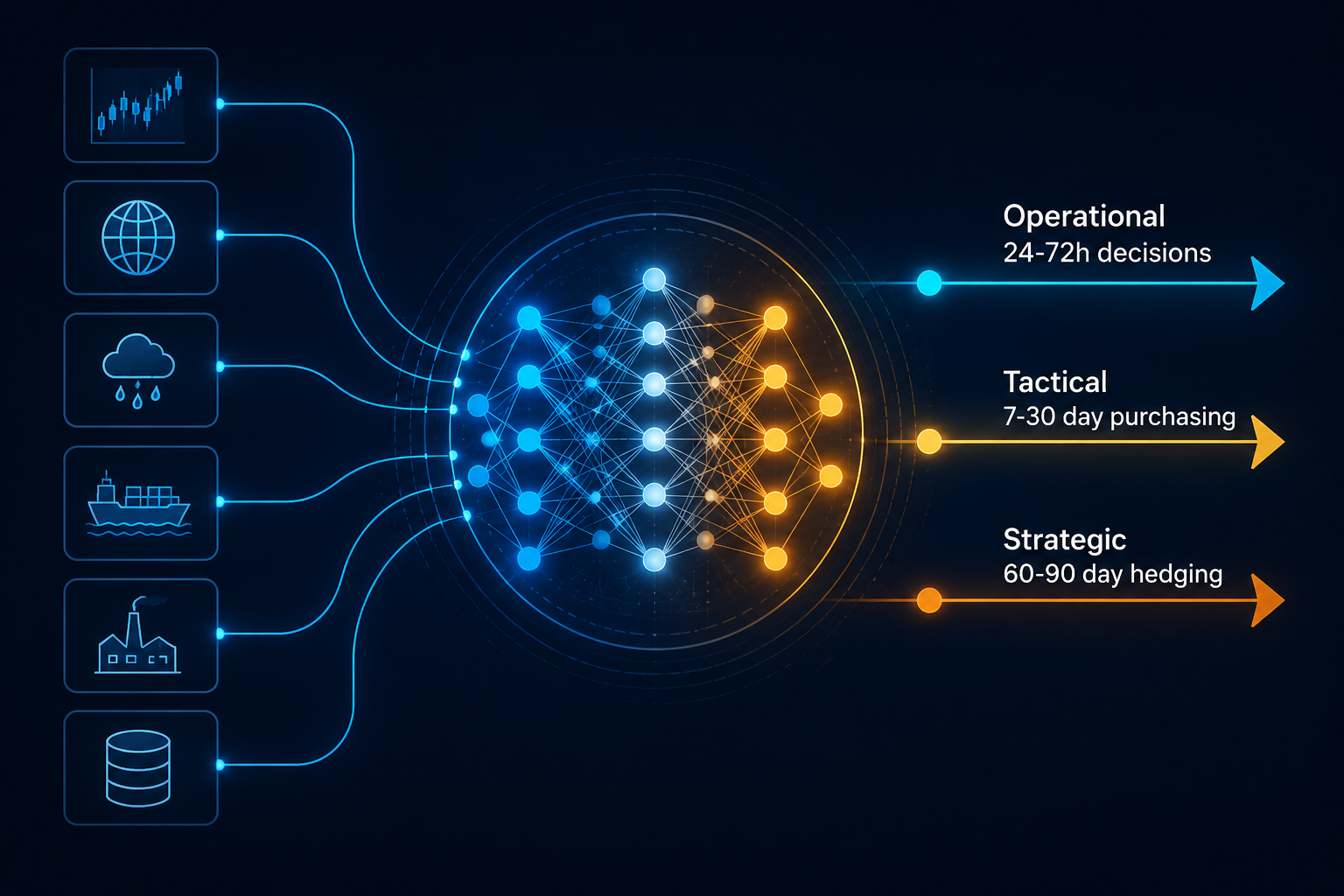
This is also why a procurement-facing fuel forecast should not be evaluated only on a commodity benchmark. If the buying decision is 7-30 days out, the model must be tested at that horizon. If the decision is a 60-90 day contract or hedging discussion, a beautiful 48-hour forecast is not enough. Horizon fit is part of accuracy.
The Role Of LSTM And XGBoost
The LSTM plus XGBoost pairing is useful because the two components do different jobs. LSTM models are designed for sequence patterns, which makes them relevant when past market movement, seasonality, and lagged operational effects matter. XGBoost, a gradient boosting method, is strong at learning structured relationships across many variables, such as weather, inventory, futures signals, and internal procurement data. In an ensemble, the goal is not to crown one model as smarter. The goal is to let different model types capture different parts of the signal and reduce the blind spots that a single statistical method may carry.
For a procurement manager, the practical question is simpler than the architecture: can the vendor show which inputs drive the forecast, how often the forecast refreshes, which horizons are validated, and how forecast error is measured against the company’s actual buying calendar? If those answers are vague, the AI label is not doing much work.
Price Forecasting Is Not The Same As Fuel Optimization
It is easy to blur three different use cases: forecasting fuel prices, optimizing fuel consumption, and managing fleet behavior. They can support the same budget, but they do not answer the same question.
- Fuel price forecasting estimates where market prices may move over a defined buying horizon.
- Fuel consumption optimization reduces how much fuel is burned through routing, driver behavior, idle-time management, and equipment practices.
- Fleet telematics captures vehicle, driver, route, and asset data that can feed either planning or optimization.
Konexial’s AI fuel optimization material, for example, reports 15% or more fuel spend savings and up to 20% idle-time reduction through driver behavior coaching and dynamic fuel-price routing.[3] That is useful adjacent evidence that AI can reduce fuel cost exposure. It is not the same as proving a diesel price forecast is accurate enough for procurement hedging or contract timing.
The distinction matters in budget reviews. If fuel spend fell because drivers idled less, that is an operating efficiency result. If variance fell because procurement bought earlier against a more accurate 30-day forecast, that is a forecasting and purchasing result. Both can be valuable, but mixing them makes ROI claims harder to defend.
Where Predictive Procurement Is Already Showing Up
Soothsayer Analytics describes an AI-driven electricity and gas price forecasting case for predictive procurement across 12 U.S. power generation HUBs, with the stated aim of helping fuel buyers lock favorable contracts ahead of price spikes.[4] Because the accessible case information is gated and does not provide public accuracy metrics, it should be treated as directional context rather than a benchmark. It shows the buying pattern that AI forecasting is trying to support: move from observing price movement after the fact to acting before the procurement window closes.
That same pattern is visible in transportation fuel planning, even when the instrument is different. A buyer does not need a perfect prediction to improve a decision. A forecast that consistently reduces error at the 7-30 day horizon can justify changing purchase timing. A forecast that improves confidence at 60-90 days can support earlier contract discussions or hedging analysis. The decision threshold is not certainty; it is whether the forecast is better than the current planning routine by enough to change exposure.
Volatility Makes Refresh Discipline Part Of The System
Fuel markets in 2026 have given procurement teams enough reminders that assumptions age quickly. Intangles’ discussion of 2026 fuel price volatility points to Hormuz Strait disruption concerns and a U.S.-Iran MOU signed on June 18, 2026 as part of the volatility context for commercial fleets.[5] The EIA’s July 7 outlook is therefore best used as a current market anchor, not as a permanent planning base.[1]
The operating lesson is plain: any AI forecast used for procurement has to refresh with market and operational data. A quarterly budget assumption may still be necessary, but the buying process needs a shorter feedback loop. Otherwise, the organization simply builds a more sophisticated model around stale assumptions.
This is where logistics execution and procurement planning are starting to meet. Logistics Viewpoints’ Q1 2026 supply chain trends coverage described a cost-rising environment in which AI is moving into execution rather than remaining only an analytics layer.[6] Fuel forecasting belongs in that execution category only when the forecast triggers a real workflow: a buy recommendation, a replenishment change, a carrier conversation, or a variance alert that someone owns.
What A Procurement Team Should Ask Before Trusting The Forecast
The most credible AI fuel forecasting programs start with the decision, then work backward to the data and model. A procurement team should not begin by asking whether the vendor uses AI. It should ask what decision the model is supposed to improve and how that improvement will be measured.
- Which horizons are validated: 24-72 hours, 7-30 days, 60-90 days, or a different procurement cadence?
- What is the baseline forecast error today, and is MAPE measured against actual prices relevant to the company’s buying locations?
- Which external data sources are included, such as futures, weather, vessel tracking, and geopolitical indicators?
- Which internal systems feed the model, including ERP, procurement history, terminal inventory, SCADA, and transportation demand?
- What business outcomes are tracked besides forecast error, such as safety stock release, avoided emergency logistics, and reduced budget variance?
- How long does the vendor expect model tuning and adoption to take before procurement should rely on the forecast for buying decisions?
The data requirement is not a formality. A company with fragmented procurement history, inconsistent terminal records, and limited ERP integration may still benefit from better analytics, but it should be careful about expecting under-8% MAPE within a few months. The benchmark depends on enough relevant data to train, test, and adjust the model against the company’s actual operating pattern.
The Defensible Case For AI Fuel Forecasting
AI improves fuel price forecasting for procurement when it does three things at once: it reduces forecast error, it fits the buying horizon, and it produces measurable operating effects. The iFactory benchmark is encouraging because it reports all three: movement from 23-38% MAPE to under 8% MAPE within 4-7 months, safety stock reductions of 15-22% per terminal, emergency logistics cuts of up to 76%, and payback in 8-11 months.[2]
The case is strongest for teams that already have meaningful fuel procurement volume, reliable internal data, and decisions that can be shifted within 24-72 hour, 7-30 day, or 60-90 day windows. It is weaker where the forecast is disconnected from buying authority, where data is too thin to validate results, or where AI is being used as a label for generic reporting.
For 2026 transportation budgets, the practical conclusion is cautious but useful. AI can reduce exposure to fuel price volatility, but the defensible case rests on attributed benchmarks, current EIA context, clear forecast horizons, and an implementation expectation measured in months rather than instant automation.
References
- Short-Term Energy Outlook, U.S. Energy Information Administration, July 7, 2026.
- AI-Powered Demand Forecasting for Oil and Gas Supply Chains, iFactory.
- AI Fuel Optimization, Konexial.
- AI-Driven Electricity and Gas Price Forecasting for Predictive Procurement, Soothsayer Analytics.
- Fuel Price Volatility in 2026: How Commercial Fleets Can Protect Margins, Intangles.
- Q1 2026 Supply Chain Trends: Costs Rise, AI Moves into Execution, Logistics Viewpoints, April 1, 2026.
Comments
Join the discussion with an anonymous comment.