
The hard part of AI-enabled supply chain recall management in food safety is not producing a dashboard after the event. It is finding the weak signal while product is still controllable, tying it to the right lot or sub-lot, and giving QA, operations, and regulatory teams a trail they can defend after the adrenaline has worn off.
That distinction matters because recalls remain operationally common, not theoretical. PIRG’s 2026 food recall analysis reported 320 FDA and USDA recall events in 2025, including 31 cascade recalls. The same report found that undeclared allergens and foreign objects accounted for 48% of recalls, a mix that is especially punishing because it often involves label control, supplier inputs, packaging changeovers, consumer complaints, and distribution spread rather than a single clean failure point. [1]
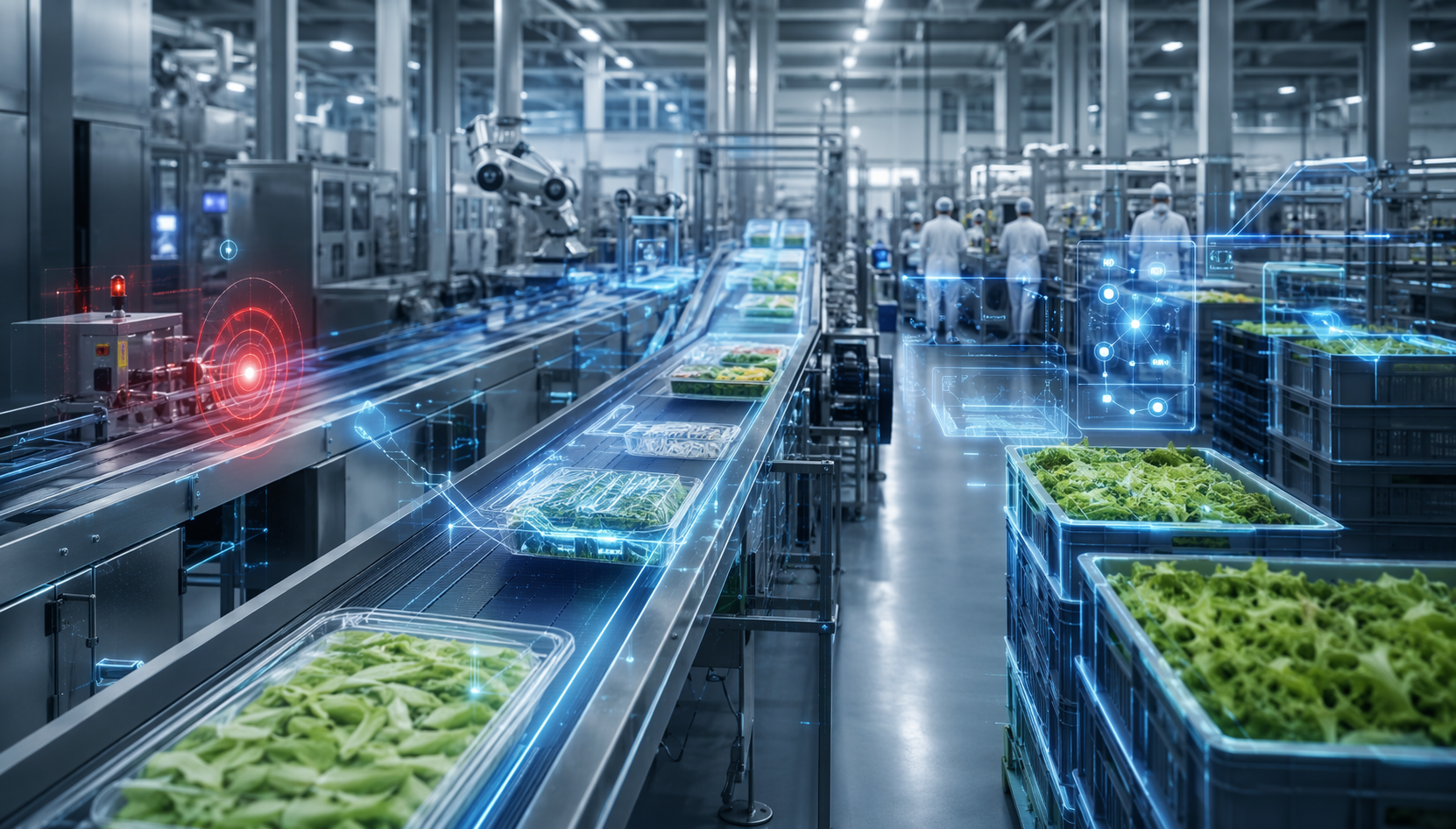
In that setting, the credible promise of AI is narrower than many sales claims and more useful than many skeptics assume. The question is not whether AI “transforms” food safety in the abstract. The question is whether it can detect a contamination, allergen, labeling, or supplier-risk signal early enough to prevent an event from expanding into a full recall, and whether it can localize affected product faster than a team working across ERP exports, QA logs, COAs, warehouse records, and emails.
The recall clock starts before anyone calls it a recall
A conventional recall response usually becomes visible after thresholds are crossed: a positive test, a complaint cluster, a regulatory notification, an internal deviation review, or a customer escalation. By then, the work is damage control. Teams reconstruct movements, identify shipped quantities, find customers, prepare notifications, and try to keep the recall scope wide enough to protect consumers but narrow enough to avoid destroying clean product.
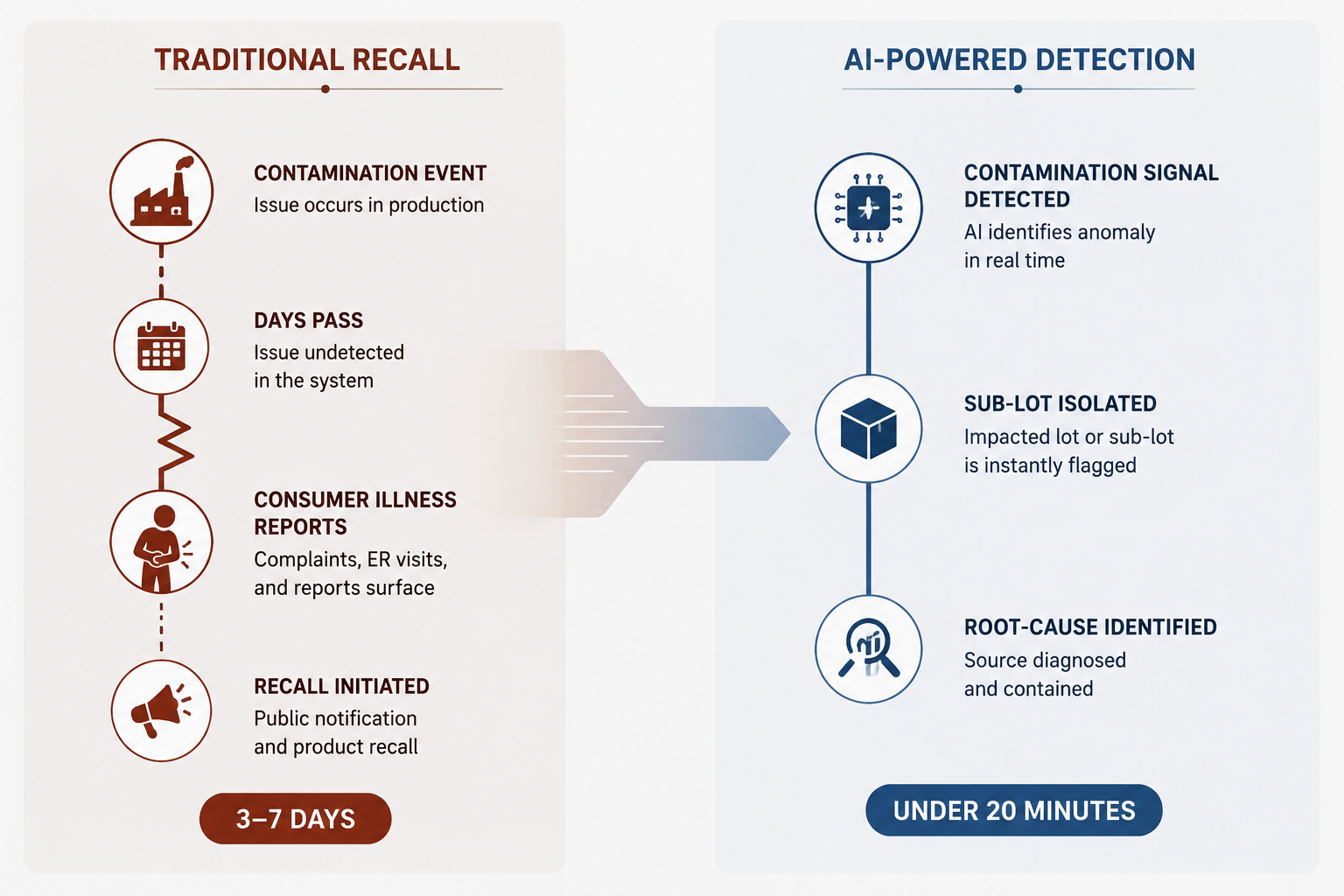
The strongest current evidence for AI in recall prevention sits in the time gap before that threshold. iFactory’s April 2026 vendor-published comparison reports that AI-driven recall prevention systems can detect contamination signals 15–90 minutes before quality thresholds are crossed, identify supplier risk in under 10 minutes compared with 8–48 hours in traditional workflows, compress root-cause identification from 3–7 days to under 20 minutes, and reduce affected product volume by 60–80% through sub-lot traceability precision. Those are not independent industry averages, and they should not be treated as guaranteed implementation outcomes. They are still useful directional benchmarks because they attach AI performance to concrete recall tasks rather than broad productivity language. [2]
| Recall task | Traditional workflow in cited benchmark | AI-enabled workflow in cited benchmark | Why the distinction matters |
|---|---|---|---|
| Contamination signal detection | After quality thresholds are crossed | 15–90 minutes before thresholds are crossed | Product may still be held, redirected, or tested before wider distribution |
| Supplier risk identification | 8–48 hours | Under 10 minutes | Procurement, receiving, QA, and production can converge on the same suspect input sooner |
| Root-cause identification | 3–7 days | Under 20 minutes | The recall room spends less time reconciling records and more time deciding containment |
| Affected product scope | Lot-level or broader holds | 60–80% reduction in affected product volume through sub-lot precision | Clean product is less likely to be swept into the recall perimeter |
The operational value is not magic prediction. It is earlier pattern recognition across data streams that are usually reviewed separately: environmental monitoring, inline inspection, supplier history, lot genealogy, maintenance logs, deviations, temperature excursions, sanitation records, test results, and customer or distributor signals. A human can review those records; the problem is time, fragmentation, and the tendency for the signal to look unremarkable until the second or third related event.
Detection is only useful if it changes containment
Early warning has little value if it merely adds another alert to a plant already living with alarms. For recall prevention, the alert has to point to an action: hold these pallets, retest this sub-lot, check this supplier input, stop this line, review this label run, quarantine this warehouse location, or block this shipment until QA clears it.
That is why sub-lot traceability matters. If a system can only say “something may be wrong with Tuesday’s production,” the safe response is broad. If it can tie the signal to a smaller production window, ingredient batch, line, filler, shift, packaging material, or distribution path, the containment action becomes more proportionate. The cited iFactory benchmark’s 60–80% affected-volume reduction depends on that precision; it is not a generic AI effect. [2]
StackAI’s April 2026 use-case roundup makes the same point from the lot-tracing side. It reports AI-powered lot tracing compression from 3–7 days of manual work to under 5 minutes, and cites a $10 million average direct cost per recall. This is vendor-side use-case material, not a regulator-run trial, but the workflow described is exactly where recall rooms lose time: matching raw materials to finished goods, finished goods to shipments, shipments to customers, and exceptions back to the source record that everyone trusts least until it is checked twice. [3]
Automation also affects the labor burden around the recall, not just the tracing clock. Food Industry Executive reported in June 2025 that automating recall processes can cut recall times in half and yield up to 90% labor and cost savings. The publication was describing automation broadly, not proving that every AI deployment will hit those savings, but the direction is consistent with what plant and QA teams already know: the worst hours are spent copying, comparing, validating, and reformatting information that should have been linked before the incident. [4]
Root-cause compression is where the practical case gets stronger
A recall is not contained when someone finds the first suspect lot. It is contained when the organization can explain why the suspect boundary is credible. That is the difference between a quick answer and a defensible answer.
AI helps when it compresses the comparison work behind that boundary. Instead of assigning teams to manually compare supplier histories, production records, nonconformance reports, maintenance interventions, sanitation events, lab results, and distribution paths, a model can rank likely relationships and expose the records behind them. The useful system does not simply return “probable root cause.” It shows the pattern: which lots share a supplier, which finished goods passed through the same line or storage area, which deviations occurred in the same window, and which shipments are downstream of the suspect material.
The under-20-minute root-cause benchmark reported by iFactory is therefore most credible when read as root-cause isolation or prioritization, not as a final regulatory conclusion. A food safety team still has to validate the finding, preserve records, decide whether to notify customers or regulators, and document why the scope is adequate. AI can shorten the search; it does not remove the accountability. [2]
The June 2026 Food Technology Magazine coverage from IFT adds the broader industry context: AI is being applied across food safety for monitoring, inspection, predictive analytics, and decision support. That does not prove recall prevention by itself, but it does show that the use case is no longer confined to experimental data science teams. It is moving into the operating layer where QA, regulatory, and plant staff have to decide whether model outputs are reliable enough to act on. [5]
Computer vision and manual-check reduction help, but they are not the whole recall system
Inspection AI is often the easiest part to visualize: cameras, defects, reject gates, and clean dashboards. It can still matter materially. IONI’s May 2025 food safety article cites a Nestlé deployment associated with an 80% reduction in manual checks and 700 tonnes of food waste diverted, and a PepsiCo example reporting 95% defect detection accuracy through computer vision. These examples come through vendor-compiled content, so they should be used as illustrations rather than independent proof of category-wide performance. [6]
The recall-management lesson is more specific. Reducing manual checks can free QA capacity, and better defect detection can stop visible or measurable failures earlier. But a recall-prevention system also needs genealogy, supplier context, label and allergen controls, distribution linkage, and exception handling. A vision model that sees a defect is not automatically a traceability system. A traceability graph that finds a lot is not automatically a contamination detector. The value appears when detection, genealogy, and decision workflow are connected tightly enough that the next action is obvious and auditable.
The older traceability benchmark is still useful, if kept in its lane
Long before the current AI wave, the Walmart and IBM Food Trust work showed how dramatically traceability time could change when product movement data was structured for search. The Hyperledger case study reported that Walmart reduced the time needed to trace mangoes from 7 days to 2.2 seconds in its blockchain-era food traceability work. That benchmark came from 2018–2019-era deployments, so it should not be treated as evidence of 2026 AI performance. It remains a useful reminder that traceability speed is not a soft benefit; when records are connected, the recall clock changes. [7]
AI adds a different layer on top of that lesson. Blockchain-style traceability can answer where a product came from and where it went if the data was captured properly. AI is more useful when the question is messier: which of these signals are related, which lot boundary is most plausible, which supplier or process condition deserves immediate review, and which affected inventory should be held before a confirmed failure spreads.
What a credible AI recall workflow actually has to do
A serious shortlist should start with workflow evidence, not model vocabulary. The system has to survive a bad afternoon, not a demo script.
- Ingest the records that actually define recall scope: supplier lots, raw material receiving, production runs, rework, packaging, allergen changeovers, QA holds, sanitation, lab results, warehouse moves, shipments, customer destinations, and returns.
- Detect abnormal patterns early enough to change disposition before product leaves control, with alerts tied to thresholds, trends, and comparable historical conditions.
- Localize product below the broad lot level when the operation’s data supports that precision, and show why the proposed boundary is defensible.
- Rank likely root causes without hiding the underlying records, because QA and regulatory teams need evidence, not just a probability score.
- Produce an audit trail showing who saw the alert, who changed product status, which records were used, and why the final recall or hold scope was chosen.
This is where some AI projects fail quietly. They can classify documents, summarize deviations, or draw impressive relationship maps, but they cannot answer the recall-room questions fast enough: what is still in-house, what shipped, who received it, what else touched the same input, what can be released, and what must stay blocked.
The implementation constraints are not side issues
The performance claims in the current market are most believable when the data foundation is already disciplined. AI cannot compensate cleanly for missing lot links, inconsistent supplier IDs, undocumented rework, paper-only exceptions, delayed lab-result entry, or warehouse movements that are corrected after the fact. Those weaknesses are not cosmetic; they directly affect whether the model can identify the right product boundary.
Model training also needs enough operating history. The research materials identify 18–24 months of historical data as a practical training requirement and 60–90 days of alert calibration before the system’s warnings can be tuned against real plant conditions. Those windows matter because food operations produce recurring noise: seasonal supplier changes, formulation shifts, line startups, sanitation cycles, maintenance events, staffing variation, and normal microbiological or quality variability.
Calibration is where trust is either earned or lost. Too many false positives and production learns to route around the system. Too few alerts and QA will not trust it during a real event. A useful deployment has to review misses, nuisance alerts, threshold settings, escalation paths, and operator feedback before anyone treats the model as a recall-prevention control.
The black-box problem is just as practical. If an algorithm recommends holding a sub-lot, narrowing a recall, or clearing adjacent inventory, the organization must be able to explain the decision under internal review and, when necessary, regulatory scrutiny. A vendor confidence score is not a recall file. The system needs record-level traceability, model-output history, exception logs, and a way for qualified staff to override or confirm the recommendation.
So, can AI make recalls preventable?
Yes, in the operational sense that matters: AI can move recall management upstream by detecting contamination and risk signals before thresholds are crossed, compressing lot tracing and root-cause isolation, and narrowing the product volume that has to be held or recalled. The cited benchmarks are strong enough to justify vendor shortlisting when the use case is tied to specific workflows such as early signal detection, sub-lot traceability, supplier-risk identification, and root-cause compression.
The claim should stop there. AI does not make recalls disappear, and it does not remove the need for QA judgment, preventive controls, sanitation discipline, supplier verification, labeling control, or regulatory documentation. Its value is highest where the organization already has usable data, enough history to train against, calibrated alerts, and transparent records that can be defended after the decision is made.
For a food safety or supply chain team evaluating the category in 2026, that is the line between a credible recall-prevention system and a dashboard with better language. Ask whether it can find the signal before product ships, localize affected inventory without overreaching, show its evidence, and hold up when the room is tired, the phone is ringing, and one clean answer is due.
References
- Food for Thought 2026, PIRG Education Fund, January 2026.
- AI-Driven Recall Prevention Systems Food Manufacturing, iFactory, April 2026.
- The Top AI Agent Use Cases for Food and Bev in 2026, StackAI, April 2026.
- Automating Recalls Dramatically Improves Speed, Accuracy, Traceability, Food Industry Executive, June 2025.
- How AI Is Reshaping Food Safety, Food Technology Magazine, Institute of Food Technologists, June 2026.
- How AI is Transforming Food Safety, IONI, May 2025.
- Walmart Case Study, LF Decentralized Trust.
Comments
Join the discussion with an anonymous comment.