
AI fraud prevention in retail supply chains has to start with the loss ledger, not with the model. In 2025, U.S. retailers processed $706 billion in returns, and Appriss Retail attributed $100 billion of that activity to preventable fraud and abuse: $86 billion in abusive returns and $14 billion in fraudulent returns.[1] That is before the same loss meeting gets to shrink components such as employee theft, inventory errors, operational inefficiencies, organized retail crime, invoice exceptions, and counterfeit exposure.
The operating problem is that those losses do not look alike. A serial returner exploiting a lenient policy, an associate suppressing a transaction, a supplier submitting a duplicate invoice, a cargo theft event, and a counterfeit product entering a marketplace channel do not leave the same evidence. Treating them as one “fraud” bucket may simplify a board slide, but it makes the control design worse.
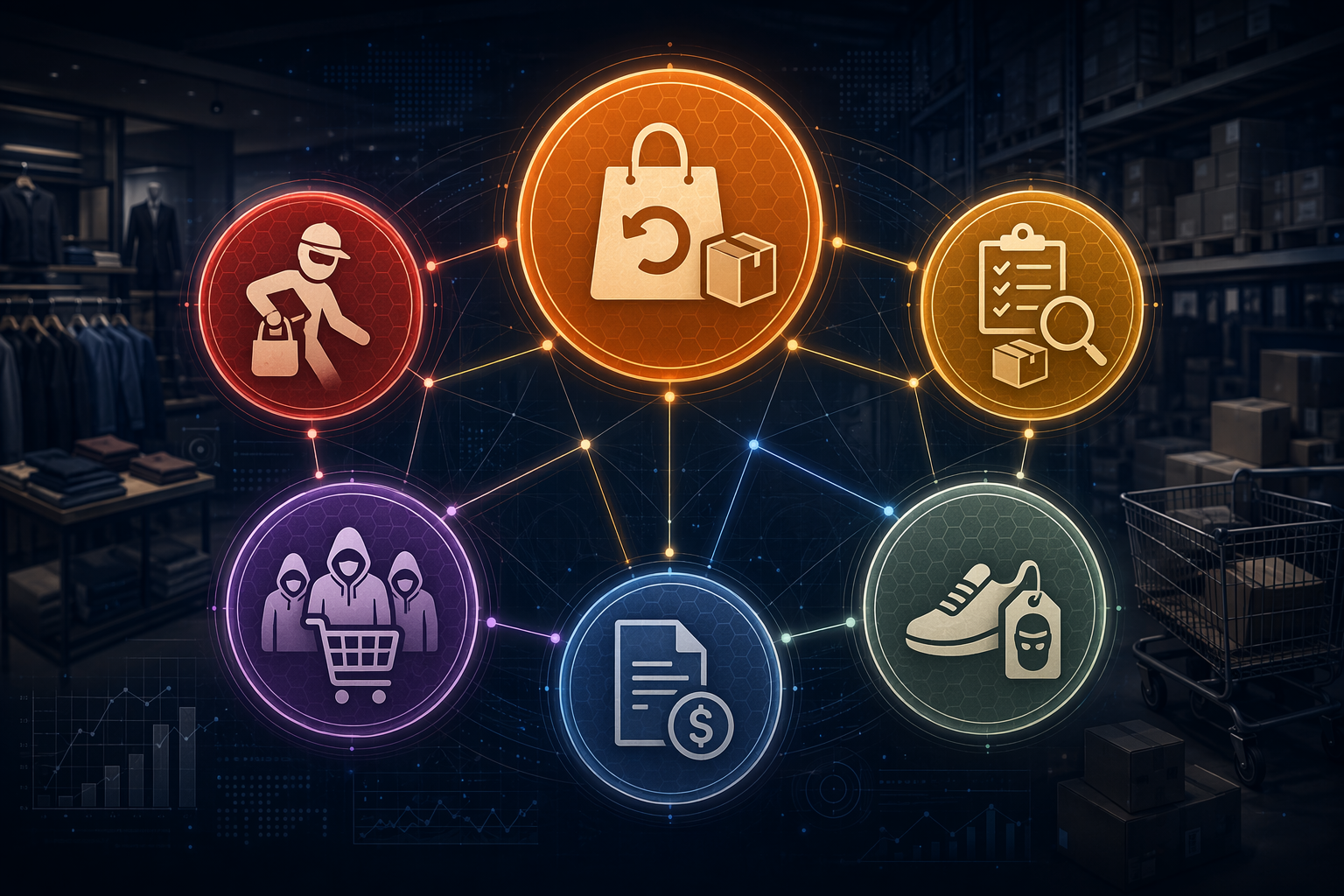
The $100B Problem Is Really Several Problems
The Appriss benchmark matters because it separates loss types that often get blended together. Returns are the largest visible surface: $706 billion in total returns, $100 billion in preventable fraud and abuse, and $211 billion in processing losses, equal to 30% of item value.[1] Processing loss is not a side note. It is the labor, transportation, inspection, markdown, disposal, and reverse-logistics drag that follows the item even when the customer interaction looks clean at the counter.
Shrink brings a different ledger. Appriss put total shrink at $90 billion, including $26 billion from employee theft, $19 billion from inventory errors, $12 billion from operational inefficiencies, and $9 billion from organized retail crime.[1] Those categories overlap operationally, but they do not respond to the same AI signal. Employee theft often depends on access, override behavior, register patterns, and exception timing. Inventory error depends on item movement, receiving accuracy, cycle counts, RFID reads, and system-of-record discipline. ORC depends more on repeat networks, store clusters, resale channels, threat intelligence, and incident linkage.
| Loss pattern | Documented scale or signal | What AI needs to see |
|---|---|---|
| Returns abuse and fraud | $86B abuse and $14B fraud in 2025 returns | Customer identity, order history, item condition, payment signals, return channel, policy exceptions |
| Employee theft | $26B shrink component | Associate access, POS exceptions, refunds, voids, overrides, schedule and store-level patterns |
| Inventory errors | $19B shrink component | Receiving, RFID, cycle counts, transfers, sell-through, replenishment, adjustment history |
| Operational inefficiencies | $12B shrink component | Workflow breaks, exception queues, missed scans, handoffs, unresolved discrepancies |
| Organized retail crime | $9B shrink component | Incident networks, repeat store hits, item concentration, resale indicators, cross-channel linkage |
| Billing and invoice fraud | No retail-wide dollar figure in the provided materials | Vendor master data, purchase orders, invoices, payment approvals, duplicate amounts, bank changes |
| Counterfeit goods | $1.7T–$4.7T global annual counterfeit goods estimate | Product authentication, supplier provenance, marketplace listings, image signals, serialization, inspection outcomes |
That table is not a taxonomy exercise. It is the reason a single fraud engine disappoints. The model that flags abusive returns may be useless against a vendor bank-account change. The system that catches duplicate invoices may never see a counterfeit item. The computer vision tool that verifies a physical handoff will not know whether the same loyalty account is cycling through stores unless the identity graph connects those visits.
Returns Fraud Lives Between Policy, Identity, and Channel
Returns are where AI fraud prevention gets customer-facing fast. The loss is large, the interaction is emotional, and the associate at the desk inherits the policy decision. Appriss reported that warn-and-approve systems produced a 12% drop in in-store returns and a 6.5% decrease online, with an estimated savings potential of about $87 billion.[1] That outcome is specifically about return behavior, not every form of retail supply chain fraud.
The useful AI work here starts with supervised machine learning when there are labeled histories of known abuse: frequent no-receipt returns, returns shortly after high-risk purchases, policy-hopping across stores, item-not-as-described patterns, or account clusters tied to repeated exceptions. The model learns from prior decisions, but the business still has to define what a “bad” decision means. A return that is costly is not automatically fraudulent. A high-return customer is not automatically abusive. A clean implementation keeps those labels tight.
Unsupervised anomaly detection is better when the behavior is new or when the retailer suspects the abuse pattern has moved. It can surface unusual combinations: a spike in returns for a narrow SKU group, a store receiving disproportionate returns from online orders, or a cluster of accounts using similar fulfillment and refund paths. Those alerts need investigation before they become policy, because anomaly is not proof.
The deployment design matters because customers notice. In a December 2025 Appriss survey of 1,020 consumers, 61% of shoppers said they were open to AI-driven return eligibility checks if the decision logic was transparent.[1] That finding supports a narrower point: acceptance depends on how the decision is explained. It does not mean customers will accept opaque denials, inconsistent treatment, or a store associate who cannot say why the system blocked the transaction.
The BORIS Gap Shows Why Omnichannel Fraud Is a Data Problem First
Buy-online-return-in-store is the cleanest example of the failure mode. Appriss identified a $4 billion BORIS gap, created because many retailers still treat digital and physical environments as separate systems.[1] The online order platform may approve a shipment. The store may accept the return. The inventory system may receive the item. The loyalty platform may see only a customer interaction. Each system can be locally reasonable while the loss pattern sits in the handoff.

For AI to prevent that loss, the retailer needs the online order, payment token, loyalty identity, fulfillment path, store return event, associate action, item condition, inventory adjustment, and refund outcome in one analytical view. Without that, the model sees fragments. It may score the order but miss the return. It may score the customer but miss the SKU. It may score the store but miss the cross-channel repetition.
This is why data readiness work belongs in the fraud budget, not in a separate “later” initiative. The same discipline covered in ChainSignal’s data readiness assessment for AI inventory optimization applies here: event definitions, master data, exception ownership, data latency, and governance decide whether the model is learning from reality or from inconsistent system residue.
Shrink Needs Root-Cause AI, Not Just More Alerts
Shrink analytics often collapses into alert volume. That is a familiar trap: more exceptions, more dashboards, more red boxes, and the same weekly argument about whether the number is theft, process, or bad inventory. Forensic AI is useful when it links the exception back to a likely root cause instead of merely ranking stores by loss.
Employee theft signals often sit in POS and labor systems: excessive refunds, unusual voids, manual price changes, gift-card activity, manager overrides, or exception activity concentrated around particular shifts. The right control may be an investigation, a workflow change, or tighter access. It is not always a customer-facing fraud decision.
Inventory errors require a different operating response. An AI system comparing RFID reads, receiving records, sales, transfers, and cycle counts can identify where the book inventory stopped matching the physical item. SDCExec, citing Appriss Retail, describes AI safeguarding retail supply chains by scanning large volumes of data, integrating RFID and computer vision, and detecting patterns across channels.[2] That supports the method category, but the loss-prevention value still depends on whether the retailer fixes the receiving, transfer, or count process that created the mismatch.
Computer vision and RFID matter most when the fraud question is physical verification: did this item move, was this item present, does this package match the scan, does the return contain the expected product, does the shelf activity match the inventory record? These tools do not replace transaction analytics. They give the model evidence from the physical side of the supply chain, which is exactly where pure e-commerce fraud systems are weakest.
ORC Is Urgent, but It Is Not the Whole Portfolio
Organized retail crime deserves attention because the operating tempo has changed. Noggin’s 2026 guide reported a 93% increase in shoplifting since 2019, a 57% year-over-year surge in ORC incidents, and rising related threat categories, including 70% of retailers reporting increased phone scams, 55% reporting increased digital fraud, and 50% reporting increased cargo theft.[3] The guide also reported that 67% of retailers saw transnational theft group involvement.[3]
Those figures sharpen the case for network detection. ORC does not always appear as one large incident. It can appear as repeat store hits, item concentration, linked vehicles or identities, marketplace resale patterns, refund behavior, and threat reports that only make sense when connected. Unsupervised anomaly detection can surface unusual clusters, while graph analytics can connect incidents that a single-store report treats as separate.
Still, ORC should not swallow the entire AI fraud prevention conversation. In the Appriss shrink breakdown, ORC is a $9 billion component, while employee theft and inventory errors are larger at $26 billion and $19 billion, respectively.[1] If the investment case only funds ORC detection, it may miss the less dramatic losses that finance still has to absorb.
Invoice, Voucher, and Counterfeit Signals Need Careful Boundaries
Accounts payable fraud is supply-chain fraud, but it is not the same pattern as returns abuse. Duplicate invoices, inflated charges, unauthorized vendor changes, split payments, and approval circumvention live in procurement, vendor master, invoice, and payment data. Supervised models can work when prior exceptions are labeled. Unsupervised models can flag unusual invoice timing, amount duplication, bank-account changes, or vendor behavior that does not match historical purchasing patterns.
One adjacent case comes from Google Cloud: Delivery Hero reduced voucher fraud by 70% using Google Cloud technology.[4] That is a documented consumer voucher-abuse outcome, not proof that retail invoice manipulation, vendor collusion, or warehouse receiving fraud has been solved. It belongs in the evidence file as an example of pattern detection and automated intervention against abuse at scale, with the scope label left attached.
Counterfeit exposure adds another boundary problem. A Forbes/VerifyMe estimate puts counterfeit goods at $1.7 trillion to $4.7 trillion annually.[5] That range is global and broad; it should not be treated as a direct U.S. retail shrink figure. For retailers, the AI techniques are more specific: product-image comparison, serialization checks, supplier provenance analysis, marketplace listing detection, and inspection workflows that escalate suspect goods before they contaminate inventory or customer trust.
Which AI Technique Fits Which Fraud Pattern
The cleanest way to evaluate AI fraud prevention in retail supply chain operations is to ask what evidence the pattern leaves behind. The model choice follows from that evidence.
| AI technique | Best fit | Where it can fail |
|---|---|---|
| Supervised machine learning | Known returns abuse, known invoice exceptions, labeled POS fraud, repeat policy abuse | Weak labels turn costly but legitimate behavior into false fraud patterns |
| Unsupervised anomaly detection | Emerging ORC clusters, unusual invoice behavior, new return routes, store-level outliers | Anomaly is not proof; analysts still need investigation workflows |
| Computer vision and RFID analytics | Physical item verification, receiving checks, counterfeit screening, shelf and return validation | Coverage gaps, poor scan discipline, or disconnected item records weaken the signal |
| Forensic AI | Root-cause shrink analysis across POS, inventory, labor, receiving, and returns data | It becomes another dashboard if no owner can change the broken process |
| Agentic decisioning | Real-time return eligibility, POS intervention, exception routing, approval workflows | Customer-facing decisions require explainability, audit trails, and override governance |
Agentic AI is the tempting category because it promises action, not just detection. In practice, it should be constrained to well-governed decisions: warn and approve, route to manager review, request additional verification, hold a refund, or open an AP exception. Full automation is not the maturity test. The maturity test is whether the retailer can explain the decision, audit the inputs, measure false positives, and protect associates from being left alone with an unexplained denial.
Documented Outcomes Support Investment, With Scope Labels
The strongest retail-specific outcome in the supplied materials is Appriss’s reported 29% total loss reduction from combined returns and shrink AI, though the available source does not provide detailed methodology or sample size.[1] That caveat does not make the result irrelevant. It means finance should ask what counted as total loss, which stores or channels were included, how long the measurement window lasted, and whether the reduction was net of operating cost.
Appriss also reported that adding a third warn tier reduced abusive returns by 90%.[1] That is a returns-control result, not a universal fraud-prevention rate. It is most useful for retailers deciding how much friction to introduce before denial: a warning can change behavior without forcing every suspicious interaction into a hard stop.
Market context points in the same direction without proving individual ROI. Research and Markets, via SNS Insider, valued the AI-driven retail theft deterrence market at $3.12 billion in 2026 and projected it to reach $6.26 billion by 2030.[6] The same market note linked AI-powered crime detection with a 26% decrease in felony-level shoplifting in New York City.[6] That is useful context for adoption pressure, but retailers should not treat market growth as evidence that their own data, controls, and store workflows are ready.
Broader AI-in-supply-chain investment cases can help frame the budget conversation; ChainSignal’s overview of AI use cases in supply chain by function is a better place for that cross-functional comparison. Fraud prevention needs a narrower hurdle: can the retailer connect enough events to prove that an intervention reduced loss rather than merely moved it to another channel?
The Implementation Standard: Unified Data, Governed Decisions
The minimum data foundation is not glamorous, but it is where the use case wins or fails. Retailers need connected records for online orders, store transactions, loyalty identities, payment tokens, returns, inventory adjustments, RFID or scan events, supplier records, invoices, claims, associate actions, and exception outcomes. They also need timestamps that agree, item identifiers that survive channel movement, and a workflow record showing who reviewed, approved, denied, or overrode the recommendation.
BDO’s retail supply chain fraud guidance emphasizes fraud risk management, controls, and monitoring rather than treating technology as a stand-alone fix.[7] That framing matters. AI can prioritize the exception, connect the pattern, and recommend an action. It cannot compensate for a vendor master file nobody owns, a return policy that changes by district, or an inventory adjustment process that buries loss under generic reason codes.
A workable operating model usually has three layers. First, shared data definitions: what counts as abusive return behavior, invoice exception, inventory error, ORC incident, counterfeit suspicion, and confirmed fraud. Second, intervention rules: when the system warns, blocks, routes, requests evidence, or only monitors. Third, governance: audit trails, bias checks, customer explanation, associate guidance, override review, and periodic measurement against false positives and recovered loss.
That standard is stricter than a pilot dashboard, and it should be. The $4 billion BORIS gap exists because the fraud pattern crosses the seam between systems.[1] A model trained inside one seam will look impressive in a demo and still miss the loss that walks from a mobile checkout into a store return line.
Where AI Fraud Prevention Is Justified
AI fraud prevention is justified where the retailer can match the technique to the loss pattern and feed it cross-channel evidence. Supervised learning belongs where the organization has reliable labels. Anomaly detection belongs where the pattern is moving. Computer vision and RFID belong where physical verification changes the decision. Forensic AI belongs where shrink needs root cause. Agentic decisioning belongs where real-time action is useful and governable.
It should not be sold as a single fraud engine that automatically recovers $100 billion. That number is a portfolio of operating losses, policy gaps, process failures, criminal activity, and customer behavior. Fund the data foundation and the portfolio of techniques together, or expect isolated pilots to miss the fraud that moves between channels.
References
- Appriss Retail 2026 Total Retail Loss Benchmark Report — Appriss Retail, 2026.
- How AI Safeguards Retail Supply Chains from ORC — Supply & Demand Chain Executive.
- 2026 Guide to Combatting Organized Retail Crime — Noggin, 2026.
- Delivery Hero reduces voucher fraud with Google Cloud — Google Cloud.
- Counterfeit goods estimate cited by Forbes/VerifyMe — Forbes / VerifyMe.
- AI-Driven Retail Theft Deterrence Market — Research and Markets / SNS Insider.
- Supply Chain Fraud Risk Management for Retail — BDO.
Comments
Join the discussion with an anonymous comment.