
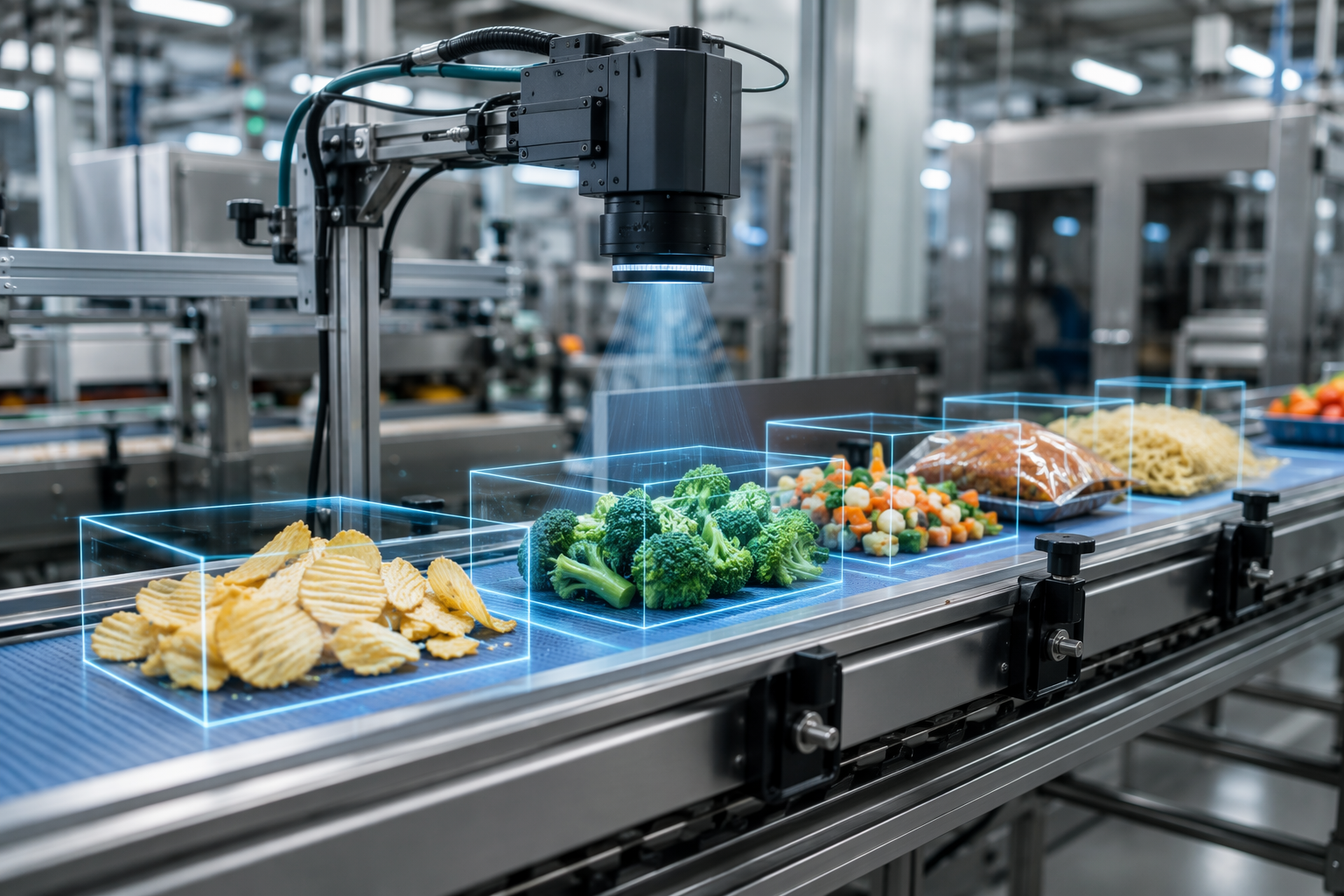
Food quality testing in supply chains is moving away from spot checks and toward inline inspection that watches every unit as it passes the camera. That matters because the real question is not whether a model looks good in a demo cell, but whether it can catch a bad chip, a wrong label, or a failed seal fast enough to stay inside the line without creating a new bottleneck.
Why line-speed inspection is the real shift
Most plants still rely on sampling, not full inspection. That keeps labor manageable, but it also leaves gaps that only show up later, after product has already moved on. The people who feel that gap first are the QA manager signing off on release, the operator watching throughput, and the team that gets stuck sorting a false reject pile when the conveyor keeps moving.
The chip line is still the clearest proof
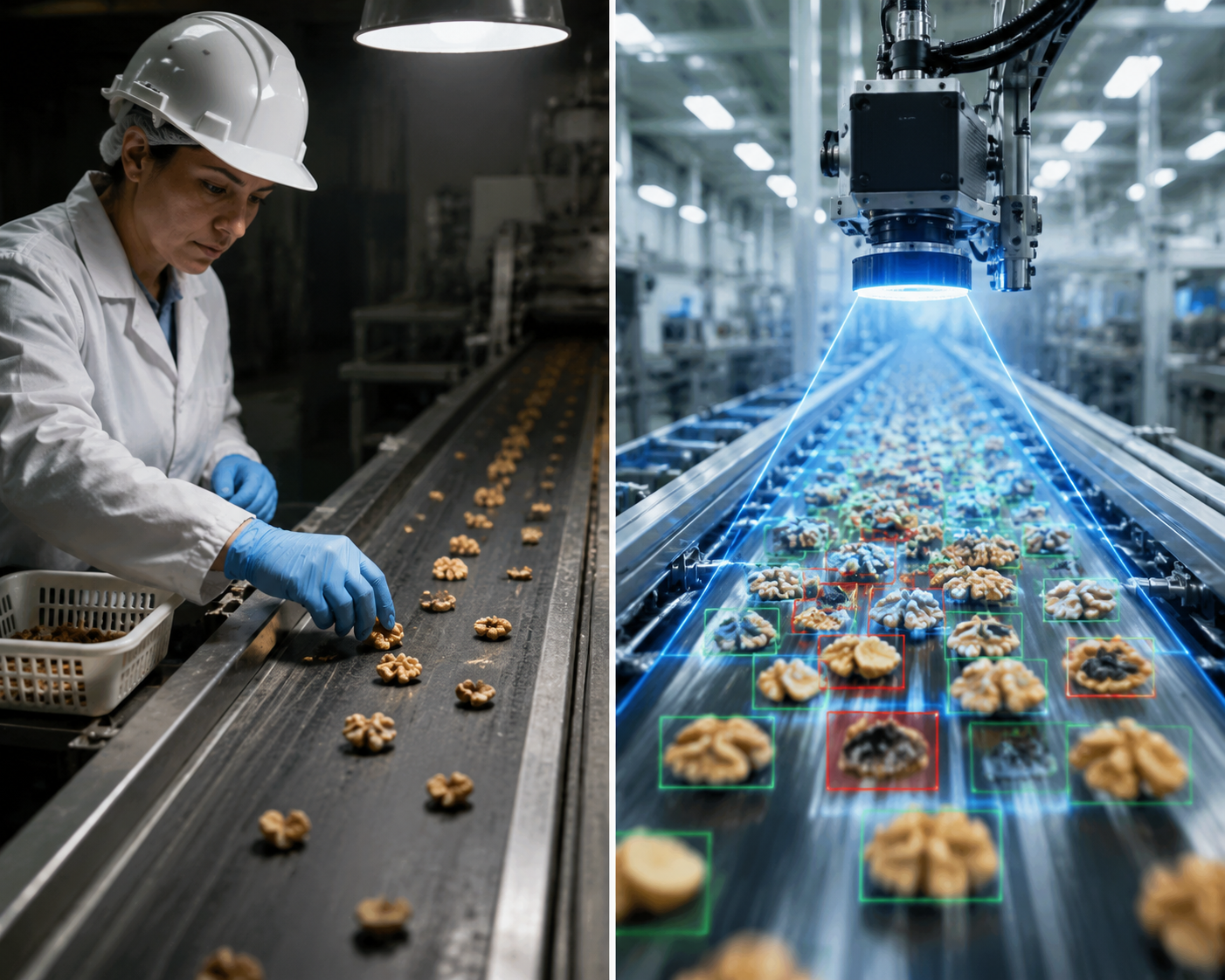
The strongest published example is still Frito-Lay's deep-learning chip-defect deployment. The case study says it reached 98% to 99% defect-detection accuracy and completed inspection in 0.2 seconds per chip, compared with about 3 seconds per bag when done manually [1]. A separate Frito-Lay peeling-optimization deployment is reported to save more than $1 million a year across U.S. lines, which is useful as an ROI marker but still too site-specific to treat as a universal benchmark [2].
Broader reporting suggests the pattern is not limited to snacks. Secondary coverage points to protein and packaged-food settings as well, including Tyson and Kraft Heinz, but those examples are less solid than a primary plant-level report and should be treated as directional rather than definitive [3].
Where vision fits in the supply chain
The deployment pattern changes by stage, but the logic stays the same: catch a defect before it becomes waste, a customer complaint, or a recall question.
| Stage | What the system checks | Why it matters |
|---|---|---|
| Incoming raw materials | Sorts and grades produce; inspects raw protein; verifies supplier quality | Keeps poor inputs from entering the line |
| In-process production | Monitors appearance, size, shape, color, and foreign material during processing | Finds defects while they are still cheap to remove |
| Packaging verification | Checks label accuracy, date and lot code legibility, seal integrity, and lid placement | Reduces release errors at line speed |
| Distribution center quality checks | Applies objective grading to incoming product | Cuts inspector-to-inspector rating variation |
Packaging verification is where the automation story gets most concrete. Rockwell's description of intelligent visual inspection emphasizes no-code configuration and integration with existing controls, which is the kind of detail that matters once the camera has to live beside PLC and SCADA logic instead of sitting in a demo cell [5].
For warehouse-receiving use cases, the inspection question shifts again. A related look at computer vision for autonomous receiving and quality inspection in warehouses shows where distribution-center checks become a separate operational problem from line-side inspection.
What the system is actually doing on the line
Most deployed systems in food quality testing are practical combinations of well-understood techniques. CNNs handle appearance classification, YOLO-style models handle real-time detection, and cloud-edge hybrid architectures keep latency low enough for conveyor speeds while still sending data back to plant systems. A review of machine learning for food quality control also points to hyperspectral imaging for internal quality attributes, including a sweet potato example that exceeded 95% accuracy and used SHAP for explainability [4].
That stack only works if it survives plant reality. Lighting drifts, product orientation changes, SKUs vary, and conveyor speed is not always as stable as the slide deck says. PatSnap's 2026 overview calls out legacy integration complexity as one of the reasons vision projects stall after the pilot, which matches what operations teams usually discover once the system has to fit around existing controls [6].
The constraints that decide whether the pilot survives
- Training data is often thin at the SKU or variety level, so a model that works on one product family may need more labeling before it can be trusted on the next.
- Environmental variation matters more than most demos admit: illumination, reflections, product spacing, and camera angle can all change the result.
- False positives are not a minor nuisance when they clog a conveyor or force needless rework; they are an operating cost.
- Validation has to be tight enough for the plant and the regulator, not just the vendor's slide deck.
That is why false-positive control deserves its own discussion when quality teams start asking where AI helps and where it simply moves the pain elsewhere. A separate look at can AI reduce food false positives without sacrificing safety? goes deeper on that trade-off.
The point is not that every pilot fails. The point is that a good pilot proves one defect class, on one line, under one set of conditions. It does not prove universal readiness. Before anyone treats a model score as a business case, they need to see the validation plan, the rejection logic, the retraining path, and the way the system behaves when product mix changes.
What the ROI claim should be tied to
The ROI story is strongest when it is tied to something a plant already spends money on: labor, waste, rework, or recall exposure. The best reported cases are not about a model being clever; they are about repetitive inspection being removed, inspection time collapsing, or product loss being avoided. That is the standard a quality director can actually use.
Computer vision is the most deployed AI pattern in food quality testing because it matches an operational problem plants already know how to measure: inspect more units without slowing the line. It is useful exactly where the use case is narrow, the data are clean enough, and the controls around validation, integration, and false rejects are disciplined enough to make the system trustworthy.
References
- Food and Beverage Production Quality Control — Enterprise AI Case Studies
- Seeing is Saving: How AI-Based Vision Inspection Boosts ROI — Food Industry Executive, Aug 2025
- How AI is Transforming Food Supply Chains — The Food Institute, 2025
- Machine Learning for Quality Control in the Food Industry: A Review — 2025
- Revolutionizing Food Safety Compliance with Intelligent Visual Inspection — Rockwell Automation / Food Logistics, June 2025
- AI Vision Quality Control in Food Processing — PatSnap Eureka, 2026
Comments
Join the discussion with an anonymous comment.