
The reject decision is where the argument over AI inspection becomes real. At the end of a shift, a false positive is not a dashboard artifact. It is a good pack in the reject bin, a rework decision that has to be staffed, a yield number that moves the wrong way, and sometimes a supervisor asking QA whether the pallet can still ship.
Food plants have lived with the same uncomfortable trade-off for years. Raise sensitivity across the whole inspection system and the line catches more marginal defects, but it also rejects more good product. Lower sensitivity and yield looks better, until a seal gap, foreign object, or other critical defect gets easier to miss. That is the false-positive problem in food supply chain inspection: not whether AI can spot more things, but whether quality teams can stop forcing safety defects and cosmetic deviations through the same rejection logic.
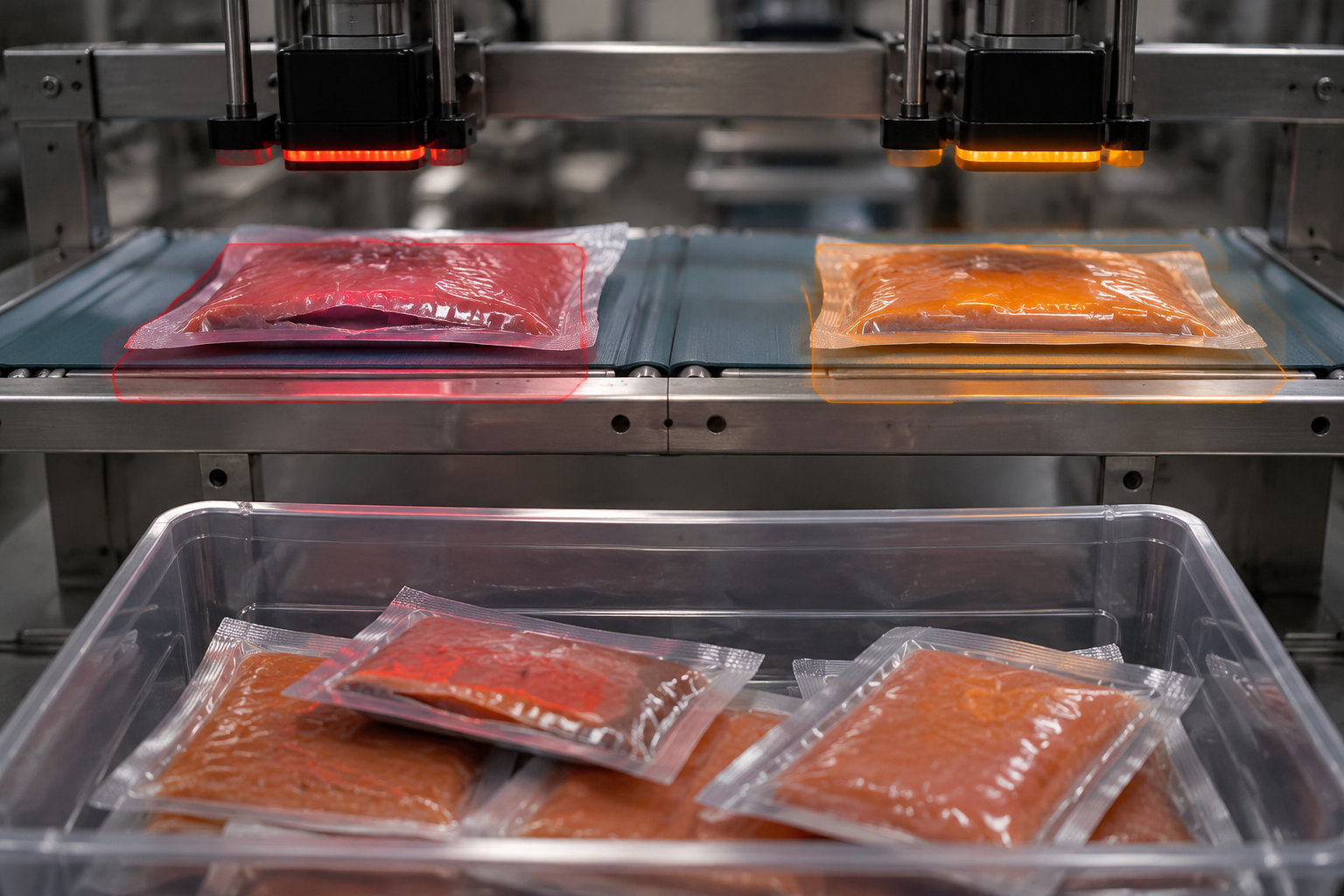
That distinction matters because many older inspection setups behave like one large sensitivity knob. A fixed-threshold vision system can be tuned tighter or looser, but it cannot easily apply a different tolerance philosophy to a probable metal contaminant, a 0.3 mm seal-integrity issue, a shape variation, and a harmless color shift. Human inspectors can use judgment, but fatigue, shift variation, training differences, and production pressure make consistency hard to hold across a full run.
Modern AI inspection changes the control point. The useful capability is not a generic claim that the model is “more accurate.” It is the ability to tune thresholds by defect category: keep high sensitivity for defects that can put consumers or customers at risk, while using calibrated thresholds for lower-risk appearance issues where the business may accept more variation.
The Knob That Quality Teams Actually Need
In practical terms, per-defect threshold tuning means the inspection system does not treat every anomaly as equally important. A seal channel defect can be configured to reject aggressively because the downside of a miss is high. A minor surface blemish on otherwise saleable product can be routed through a more forgiving threshold, a secondary review, or a grade decision instead of an automatic hard reject.
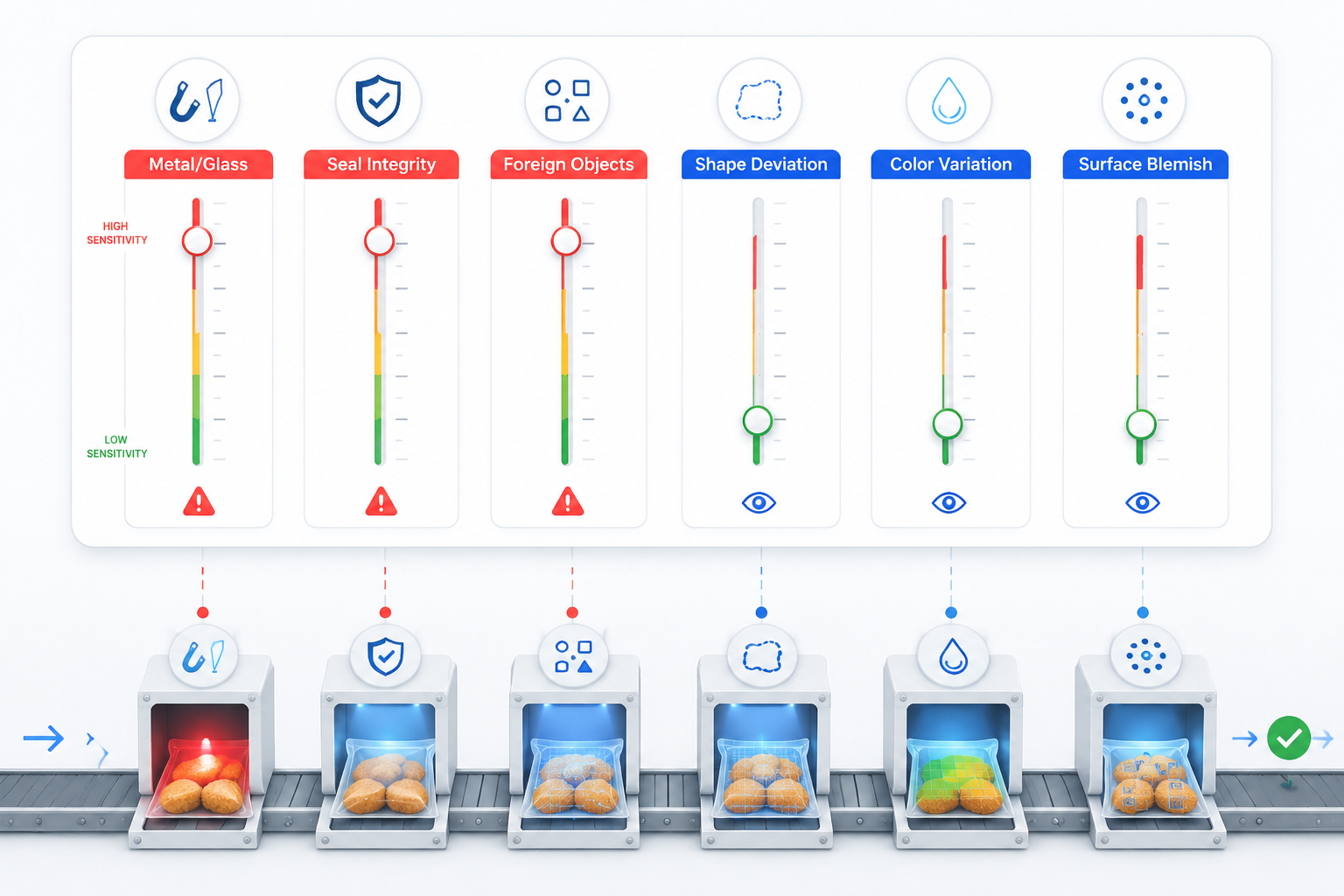
The operating question becomes more specific than “pass or fail.” A quality manager can ask: which defect category triggered the reject, what confidence level did the model assign, what threshold was active for that product and line, and did the operator confirm or overturn the decision? Without that trace, the system may still be useful, but it will be hard to defend when good product is being scrapped or a customer complaint arrives.
| Defect type | Typical plant decision | Threshold posture |
|---|---|---|
| Metal, glass, or hard foreign material | Reject or escalate immediately | High sensitivity; false negatives are the larger risk |
| Seal integrity failure | Reject when the defect threatens package performance | High sensitivity, with measurement-specific controls |
| Shape, color, or surface variation | Grade, review, or accept depending on specification | Calibrated sensitivity; false positives can become avoidable yield loss |
| Ambiguous anomaly | Operator review and feedback loop | Threshold depends on product risk, history, and customer requirements |
This is where configurable AI has a credible opening. It gives QA and operations a way to separate criticality from visibility. A defect can be easy for the camera to see and still not deserve the same reject behavior as a safety defect. Conversely, a small defect can deserve a hard reject if it compromises seal performance or contaminant control.
Why the FreshPak Case Is Worth Studying
The most useful public example in Q3 2026 is iFactory’s FreshPak Foods case study, not because it proves a universal benchmark, but because it reports inspection performance at production scale. Over a 90-day deployment, the system inspected 25.9 million packaged units, reported a 0.12% false rejection rate, detected 99.7% of seal-integrity defects down to 0.3 mm, rejected 41,500 truly defective units, and modeled a simulated $12 million recall prevention outcome.[1]
Those numbers deserve attention for two reasons. First, 25.9 million inspected units is large enough to expose nuisance rejects that a polished demo can hide. Second, seal integrity is the kind of defect category where plants cannot simply relax sensitivity to make yield look better. If the package cannot perform, the downstream cost of a miss can dwarf the cost of a reject.
The 0.12% false rejection rate is especially relevant because it measures the pain operations feels directly: good units removed from flow. At that rate, false rejects are still present; they are not wished away. But they are low enough to change the conversation from “the system is flooding the reject bin” to “which categories still need tuning, review, or root-cause work?”
The 99.7% detection figure also needs to be read narrowly. It applies to seal-integrity defects in this reported deployment, including defects down to 0.3 mm; it should not be casually repeated as proof that the same system will reach the same performance on every product, package material, closure type, lighting condition, or line speed.[1] That limitation does not make the case weak. It makes it plant-relevant. Inspection performance is always tied to the product and process being inspected.
The simulated $12 million recall prevention figure is useful in a different way. It frames the upside of catching real defects before release, but it is still a modeled prevention outcome, not a completed recall that definitely would have happened.[1] Buyers should treat it as a scenario value, not as a guaranteed savings claim.
What the Case Does Not Prove
FreshPak is still a vendor-published single deployment. It does not establish an independent cross-vendor benchmark for AI food inspection. It does not tell a processor whether the same false rejection rate will hold on frozen vegetables, raw proteins, bakery products, transparent clamshells, printed films, steam-heavy washdown environments, or lines with unstable product presentation.
That is why the right lesson is not “AI inspection solves false positives.” The stronger lesson is narrower: when a food inspection deployment defines a specific defect category, tunes rejection behavior around that category, and validates at production volume, very low false rejection can coexist with high detection for a critical package defect.
Optical Sorting Shows the Same Yield Pressure in a Different Form
Packaged seal inspection is not the only place false positives cost money. In optical sorting, a false reject can mean premium-grade product is sent to waste, rework, animal feed, or a lower-value stream. TOMRA has reported false reject rates below 1% for nuts and below 0.5% for individually quick-frozen goods using its 4C optical sorter, which combines machine learning and deep learning.[2]
TOMRA also states that every 0.1% reduction in false rejects can recover up to €150,000 annually per processing line at premium-grade pricing.[2] The exact economics will vary by commodity, grade spread, throughput, and reject stream recovery options. Still, the direction is familiar to anyone who has watched good product leave the main flow: small percentages become serious money when the line runs long enough.
These TOMRA figures should be handled with the same caution as the FreshPak data. They are vendor-reported and not independently audited in the public materials available here. They do, however, broaden the point beyond package seals. False-positive control is not only a QA nuisance; in sorting applications, it is directly tied to recovered saleable value.
Operator Corrections Are Part of the Control System
Thresholds are not a set-once exercise. If operators repeatedly overturn the same reject type, that feedback should become evidence. A useful system captures the correction, connects it to the image and defect category, and gives quality or engineering a controlled way to update the model, threshold, or review rule.
iFactory claims that in its continuous-learning deployments, false positive rates fall below 0.5% within 60 days through learning from operator corrections, compared with 8–12% over-rejection rates in manual inspection.[3] That comparison is vendor-published, so it should not be treated as an industry-wide law. But the mechanism is the right one: the system improves only if operator judgment is captured in a structured way rather than lost at the reject table.
The governance around that feedback matters. Plants should not let every overturned reject automatically weaken the model. Some operator corrections are correct. Some are production-pressure artifacts. Some reveal a bad threshold. Some reveal a lighting problem. The difference should be reviewed, especially for categories tied to safety, regulatory compliance, or customer-critical specifications.
- Require every overridden reject to keep the original image, defect label, confidence score, threshold, product code, line, shift, and operator action.
- Separate cosmetic override review from safety-defect override review; they should not carry the same approval burden.
- Trend overrides by defect category before changing thresholds, because a spike may point to equipment condition rather than model behavior.
- Lock down threshold changes through QA-approved version control so the plant can reconstruct why a unit was rejected or released.
False Positives Often Start Outside the Model
A plant can overtune a model when the real problem is physical. Condensation on a lens, dust on a housing window, scratched conveyor surfaces, loose brackets, shifting lighting, or steam from washed product can all create signals that look like defects. If those conditions are not corrected, lowering sensitivity may make the reject bin quieter while making the inspection program weaker.
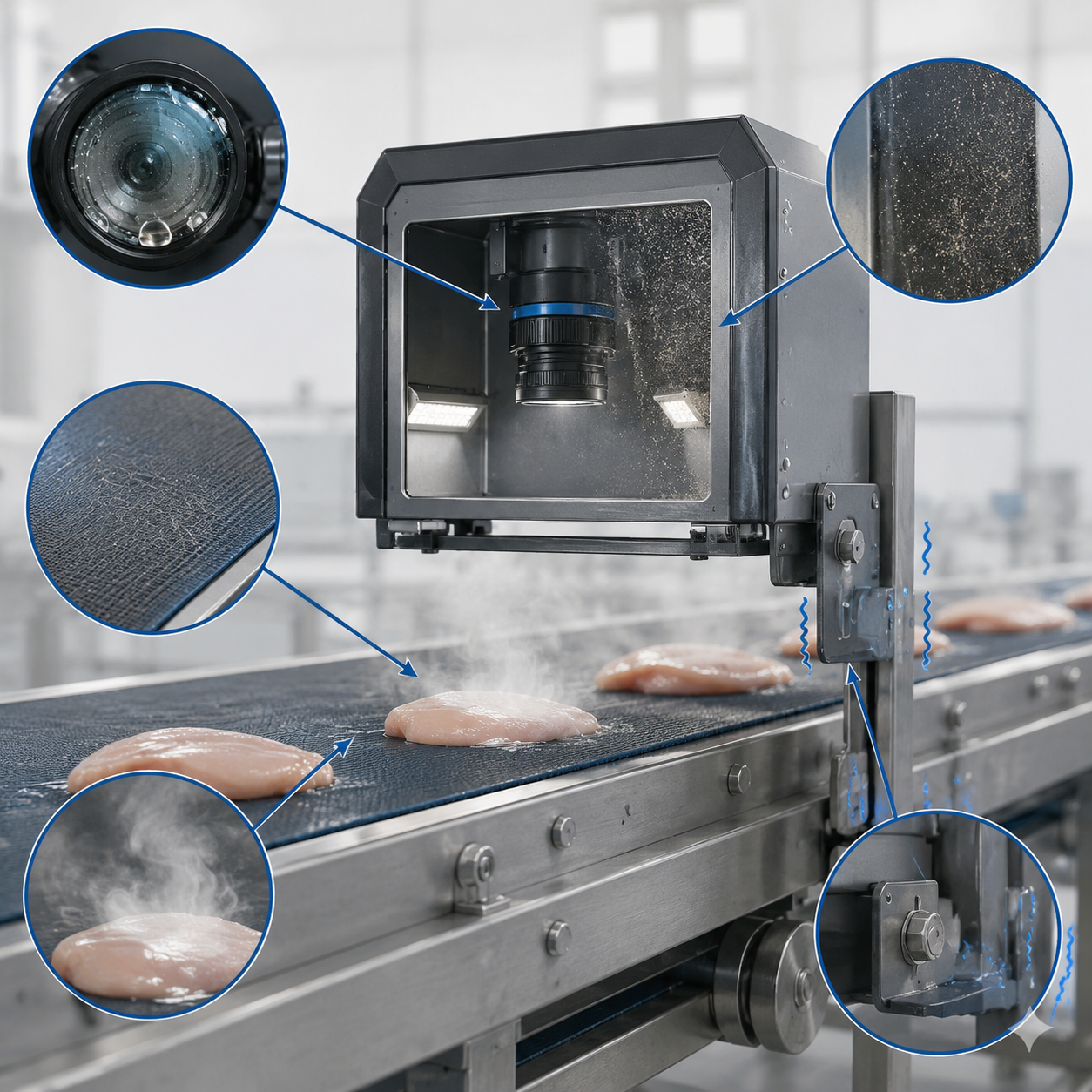
PatSnap reports that 72% of false positives in production AI anomaly-detection deployments originate from identifiable, fixable sources such as condensation on camera lenses or surface scratches on equipment.[4] That statistic is not food-specific, so it should be used carefully. But it matches a basic plant reality: before blaming the algorithm, check whether the inspection station is clean, stable, lit consistently, and protected from the process around it.
This is where AI inspection becomes less glamorous and more useful. The best deployments do not only ask whether the model was right. They ask why a cluster of false rejects appeared on Line 3 after sanitation, why amber reviews rose during the night shift, why one SKU produces more edge detections than another, or why a camera near a washdown zone drifts after startup.
Threshold tuning is not a substitute for equipment hygiene, maintenance discipline, and stable product presentation. It is a control layer on top of them. If the lens is wet, the belt is scratched, or the guide rail is vibrating, the cleanest model in the building is still being fed a dirty signal.
What Buyers Should Validate Before Trusting the Rate
A quoted false rejection rate is only useful if the buyer knows what counted as a reject, what counted as a true defect, and which products were included. A single blended metric can hide the exact problem the plant is trying to control. A system could perform well on obvious defects and still struggle with marginal seals, transparent packaging, wet product, mixed-size pieces, or cosmetic variation that changes by season.
The validation plan should be built around the plant’s own risk categories. For a seal-integrity application, that means collecting enough examples of acceptable seals, marginal seals, confirmed failures, wrinkles, product-in-seal events, film variations, and normal production noise. For sorting, it means separating foreign material, rot, mold, discoloration, size variation, and grade defects instead of letting one reject class absorb everything.
- Ask vendors to report false positives and false negatives by defect category, not only as one aggregate accuracy score.
- Run the trial across normal shift, sanitation, startup, changeover, and product-variation conditions.
- Require traceability from each reject back to image evidence, threshold version, product code, and operator disposition.
- Test whether cosmetic thresholds can be adjusted without weakening safety-defect thresholds.
- Track recovered good product as well as missed defects, because safety and yield are both part of the business case.
The most important demonstration is not a perfect vendor demo set. It is a controlled production trial where QA can see the model behave under ordinary mess: condensation, imperfect orientation, real film lots, lighting variation, operator overrides, and the product mix the plant actually runs.
A Bounded Answer
AI can reduce food false positives without sacrificing safety when the deployment gives quality teams separate controls for separate defect categories. High-risk defects need aggressive detection. Cosmetic or lower-risk deviations need thresholds that reflect specification, customer tolerance, and yield impact. Putting both through one blunt reject rule is how plants end up choosing between avoidable scrap and avoidable risk.
The public evidence available in Q3 2026 supports a promising but bounded conclusion. FreshPak’s reported 90-day deployment shows that very low false rejection and high seal-integrity detection can coexist in one packaged-food application.[1] TOMRA’s reported sorting figures point in the same direction for nuts and IQF goods, with meaningful value attached to small reductions in false rejects.[2] iFactory’s continuous-learning claim shows how operator corrections may reduce nuisance rejects over time.[3] PatSnap’s root-cause data is a reminder that many false positives may be maintenance and environment problems before they are model problems.[4]
That is enough to justify serious trials, not enough to justify blind trust. A plant should validate AI inspection on its own products, line speeds, lighting, sanitation patterns, defect definitions, and release rules. The systems worth buying are the ones that let QA protect the consumer, let operations recover good product, and leave a traceable reason for every unit that leaves the line or lands in the reject bin.
References
- AI Vision Inspection Prevents $12M Recall, iFactory, June 2026
- AI Sorting Pushes Food Industry to Zero Waste: TOMRA 4C Interview, in-food.substack.com
- Computer Vision Quality Control for Food Smart Factory, iFactory
- Reducing False Alarms in AI Anomaly Detection Systems, PatSnap
Comments
Join the discussion with an anonymous comment.