
Air quality does not behave like ordinary weather in a supply chain control tower. A storm cell announces itself with wind, rain, lightning, and a fairly direct set of operating rules. Smoke and pollution are less tidy. A lane can remain technically open while driver hours stretch, visibility drops, outdoor work slows, and a warehouse manager starts losing usable labor capacity shift by shift.
That is why AI for supply chain disruption from air quality alerts deserves to be treated as a distinct use case, not a footnote inside weather monitoring. Conventional weather AI may see wind direction, heat, precipitation, or fire-weather conditions. AQI deterioration also depends on emissions sources, fuel loads, atmospheric chemistry, plume movement, local topography, and regulatory thresholds. Those inputs change the operating question from “Will the weather be bad?” to “Which yard, ramp, route, facility, crop region, or supplier node will lose capacity before the dashboard says disrupted?”
The scale is no longer occasional. More than 115 million Americans faced unhealthy air from Canadian wildfire smoke in July 2026 alone, and per-person exposure to harmful wildfire smoke was four times higher during 2020–2024 than during 2006–2019.[1][2] Those are health and climate facts first, but they become operating facts as soon as they touch cargo flights, road routing, outdoor labor, agricultural harvests, and facility safety rules.
Where air quality disrupts the network
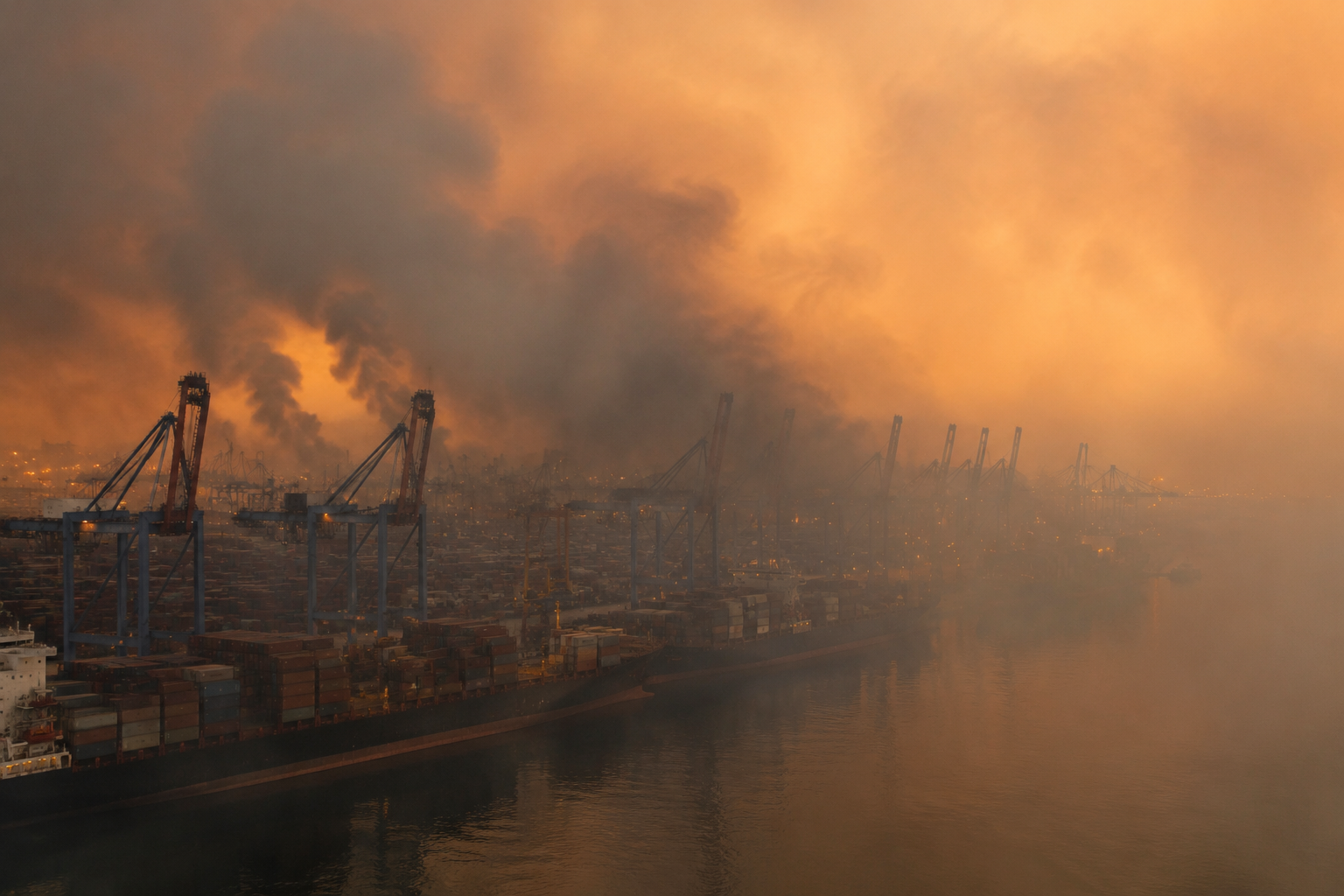
The January 2025 Los Angeles wildfires showed the problem in a way planners recognize: several nodes degraded at once. ASU reported cargo flight delays at LA-area airports, truck rerouting away from Pacific Coast Highway and I-405, and warehouse worker displacement tied to the fires and smoke conditions.[3] That mix matters more than any single delay. If air cargo loses reliability, drayage routes lengthen, and local warehouse labor becomes harder to staff in the same week, the recovery plan cannot sit inside one mode or one facility.
A weather alert might tell a control tower that winds are shifting or heat is climbing. An AQI-aware disruption model has to go further. It should tell the logistics planner whether a particular corridor is likely to move from normal dispatch to restricted driving, whether an airport ramp may see delays from smoke and visibility, whether an outdoor staging yard can run the next shift safely, and whether a supplier region is likely to miss a harvest, inspection, or pickup window.
For wildfire-only treatment, the narrower smoke-detection problem is covered in AI wildfire smoke supply chain disruption. The broader issue here is that smoke, industrial pollution, and AQI-triggered rules all create capacity leakage without always creating a formal closure.
The disruption mechanisms are different by function
The first useful test for any AQI-specific AI system is whether it can separate disruption mechanisms by operating function. A generic “air quality risk high” alert is cheap. A decision that changes tender timing, labor scheduling, routing, or supplier coverage is expensive.
| Function | Air-quality disruption mechanism | Decision the warning should support |
|---|---|---|
| Logistics | Smoke reduces visibility, regulatory no-drive zones constrain routes, airports face cargo flight delays, and drivers lose time around detours or restricted corridors. | Pre-book alternate capacity, change routing rules, move cutoff times, or protect high-priority loads before the lane tightens. |
| Warehousing and yards | Outdoor work becomes unsafe or slower, staffing plans break when employees are displaced, and loading or staging shifts lose productivity. | Adjust shift plans, move work indoors where possible, change dock schedules, or advance critical picks. |
| Procurement | Grower regions, extraction sites, or supplier facilities can lose production time when smoke affects harvests, inspections, field labor, or local transport. | Trigger supplier check-ins, qualify alternate sources, or revise available-to-promise assumptions before purchase orders miss. |
Logistics usually feels the effect first because lanes expose weakness quickly. A port may still be open, but gate velocity can drop if visibility or worker-safety rules slow yard moves. A highway may remain legal, but a routing engine may need to avoid areas where AQI advisories, fire response, or smoke conditions make service unreliable. Air cargo adds another layer because smoke can affect airport operations even when the origin and destination warehouses are ready.
Warehousing is less visible on executive maps and more painful on the floor. Outdoor staging, trailer moves, yard checks, security posts, and maintenance work can all become constrained before inventory systems register a service failure. The warehouse manager does not need a beautiful plume animation; she needs to know whether tomorrow’s first shift can safely work the yard, whether inbound appointments should be pulled forward, and whether labor should be moved to indoor tasks.
Procurement risk is slower but not softer. Smoke and poor air quality can suppress agricultural work, delay harvest activity, or interfere with local movement around supplier regions. The procurement lead’s useful signal is not “bad air nearby.” It is whether a supplier’s promised volume, inspection date, or pickup schedule is becoming less credible. That is where AQI inputs belong beside broader supplier risk scoring, rather than as a safety bulletin that never reaches sourcing decisions. For adjacent methods, see procurement AI supplier risk scoring methods.
How the AI pipeline turns AQI signals into earlier decisions
The strongest systems do not start with a single AQI feed. They combine ground observations, satellite aerosol readings, weather forecasts, chemical transport models, and historical operating outcomes. The model’s job is to connect environmental deterioration to the specific places where the company has freight, labor, inventory, suppliers, and customer commitments.
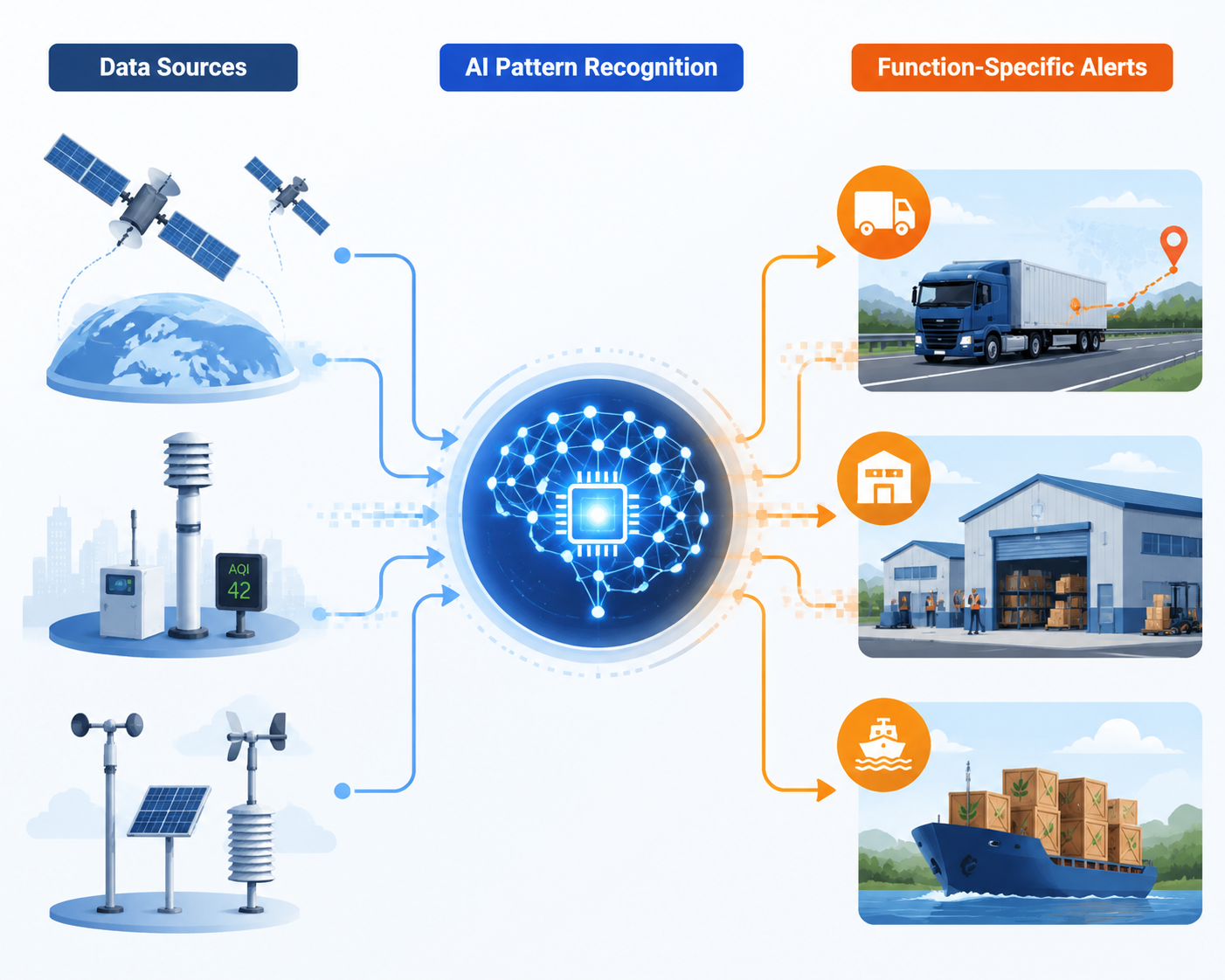
The data layer now has more practical coverage than it did a few years ago. Google’s Air Quality API provides 500-meter resolution coverage across more than 100 countries, while AirNow.gov supplies EPA real-time monitoring in the United States.[4] Satellite aerosol optical depth products help estimate particles in the atmospheric column, and ground IoT sensors can fill gaps around yards, plants, farms, and high-value corridors. Tomorrow.io describes satellite-enabled weather and AQI coverage as especially useful where conventional observation networks are sparse, including ocean and rural transport routes.[5]
The modeling layer is where AQI separates from basic weather alerting. Chemical transport models simulate how pollutants move and react in the atmosphere. Machine learning can then look for patterns in past smoke or pollution events, local terrain, wind shifts, fire behavior, facility exposure, lane performance, and disruption records. A 2023 University of Tennessee Knoxville study reported that combining chemical transport simulation with machine learning pattern recognition improved hazardous-AQI forecast accuracy by 66% compared with chemical transport models alone.[6]
That 66% figure is useful, but it should not be stretched into a universal promise. It comes from one study, and smoke behavior in a new geography, an extreme fire season, or a poorly monitored corridor may not match prior patterns. The right takeaway is narrower: hybrid modeling can improve hazardous-AQI prediction enough to be operationally interesting, especially when the company can validate forecasts against its own lane and facility history.
From plume forecast to operating threshold
A workable AQI disruption model usually moves through four conversions:
- Translate environmental inputs into hyperlocal AQI forecasts for facilities, lanes, supplier regions, ports, and airports.
- Map those forecasts against operating assets: route guides, dock calendars, labor rules, supplier locations, inventory positions, and customer commitments.
- Compare expected AQI and visibility conditions with disruption thresholds, such as outdoor work limits, carrier routing rules, airport delay sensitivity, or regulatory restrictions.
- Trigger function-specific actions instead of generic alerts: alternate freight, adjusted shifts, supplier outreach, safety review, or inventory reallocation.
The advance warning window often discussed for this use case is five to fourteen days. That should be treated as an evaluation benchmark, not a guarantee. Five days may be enough to move a load to a different mode, pull a dock appointment forward, or ask a supplier for a production status check. Fourteen days may be useful for procurement and inventory positioning, but the confidence level needs to be visible because long-range smoke and pollution forecasts can drift.
For control-tower teams, the important design choice is whether the model produces a planning object. A map layer is not enough. The alert should attach to a lane, shipment, facility, supplier, purchase order, or customer promise, with a time window and severity assumption that a planner can accept, reject, or escalate. Related control-tower workflows are covered in AI control towers for wildfire logistics.
What platforms actually contribute
No single vendor cleanly owns the category “AI for supply chain disruption from air quality alerts.” In practice, companies assemble the capability from air-quality data, weather intelligence, risk monitoring, routing integration, and supply chain planning systems.
| Capability layer | Examples from the current market | What to evaluate |
|---|---|---|
| AQI and environmental data | Google Air Quality API, AirNow.gov, satellite aerosol data, local IoT sensors | Resolution, coverage, latency, historical depth, and whether the feed covers the company’s actual lanes and facilities. |
| Forecasting and weather intelligence | Tomorrow.io, chemical transport models, ML-enhanced AQI prediction | Forecast horizon, confidence intervals, rural coverage, and performance during smoke or pollution extremes. |
| Supply chain risk intelligence | Everstream, Interos, Sphera-style risk monitoring and triage layers | Whether environmental alerts are tied to suppliers, lanes, revenue exposure, inventory, and human validation. |
| Planning and routing integration | Routing engines, TMS integrations, Visual Crossing-style AQI API workflows | Whether AQI changes dispatch rules, ETAs, carrier selection, or service commitments rather than sitting in a separate dashboard. |
| Demand and supply scenario modeling | ClimateAi-style climate and supply-risk mapping | Whether the system can model supply suppression and demand movement together for affected products and regions. |
Everstream reports that AI-powered risk platforms reduced time to identify and assess disruption impact by 50–70% in client deployments, along with a 30% reduction in revenue losses from disruption, a 5% reduction in expedited freight costs, and a 10% improvement in on-time performance.[7] Those numbers are operationally meaningful because identification time is the interval in which planners can still do something useful. They are also vendor self-reported, not independently audited, so they belong in an ROI model as a benchmark to test against internal baselines rather than as a forecasted result.
Interos reported that 94.5 million businesses were at risk from extreme weather in 2025, a 48% year-over-year increase.[8] That figure is broader than air quality, but it helps frame why AQI should not be isolated from supplier mapping. Smoke can be the visible event while the actual business risk sits in a tier-two supplier, a regional carrier, or a labor pool that was never tagged as environmentally exposed.
ClimateAi’s FICE platform is relevant because it models weather-driven demand spikes and supply suppressions at the same time.[9] That matters when smoke or pollution affects both sides of the plan: supply slows in one region while customers in another region shift demand for related products. Visual Crossing’s AQI integration guidance points to the more tactical side, where air-quality APIs feed routing engines and delivery planning workflows.[10] For route-specific mechanics, see AI route optimization for wildfire smoke.
What a good alert changes before disruption is visible
A useful AQI alert reaches the people who can still change the plan. That sounds obvious until a company inspects its workflows and finds air-quality warnings sitting with environmental health and safety, wildfire updates sitting with corporate security, and freight decisions sitting in a transportation queue that sees the issue only after appointments start slipping.
For logistics, the early action may be modest: tender earlier, protect scarce carrier capacity, avoid an exposed corridor, or raise the priority of loads that cannot tolerate a one-day slip. The alert should name the lane, the exposure window, the operational reason, and the action owner. If it cannot do that, it is still monitoring rather than disruption planning.
For warehouses and yards, the decision is often a staffing and sequencing problem. Managers may advance outdoor moves, shift tasks indoors, split labor differently, or change appointment density around the worst expected hours. The model does not need to decide safety policy; it needs to give managers enough lead time to apply the policy without breaking the dock schedule.
For procurement, the signal should move into supplier communications and supply plans. If a growing region or production area faces sustained unhealthy air, the procurement team may check labor availability, harvest timing, local transport, and backup supply. A supplier risk score that rises after the shipment is already late is just a postmortem.
The same logic applies to adjacent disruption planning, whether the trigger is smoke, infrastructure failure, cyber impact, or physical attack. The useful system is the one that converts an external signal into a constrained set of operating choices. For a structurally similar planning lens, see AI supply chain disruption planning for infrastructure attacks.
The limits: false confidence, over-alerting, and weak workflow fit
AQI-specific AI can fail in quiet ways. A model may forecast deteriorating air correctly but miss the facility policy that turns that forecast into a labor constraint. It may flag a supplier region without knowing the supplier has inventory buffered elsewhere. It may see a plume moving toward a lane but not know that the carrier already shifted dispatch. Environmental accuracy and operational accuracy are related, not identical.
Over-alerting is the other failure mode. Sphera warns that AI-driven supply chain monitoring can surface hundreds of issues without expert triage, requiring a human validation layer to separate noise from action.[11] That warning lands hard in AQI use cases because smoke maps and sensor feeds can change hourly. If every yellow patch becomes an escalation, planners will mute the feed before the first serious event arrives.
The better operating model keeps humans in the decision loop but does not make them start from scratch. The AI should rank exposure by business consequence, show why an alert matters, and let a planner confirm whether the recommended action fits the day’s constraints. That is different from asking a control tower analyst to stare at another map and infer impact manually.
Maturity is uneven. Companies with exposed logistics lanes, outdoor labor constraints, air cargo sensitivity, agricultural inputs, or facilities in smoke-prone and pollution-prone regions have the clearest reason to test specialized AQI disruption intelligence now. Companies with mostly indoor operations, short local lead times, and low exposure to regulated outdoor work may find that general weather alerts plus safety monitoring are enough for the moment.
The evaluation threshold is practical: specialized AI is justified when air quality can materially alter lead times, capacity, safety rules, or sourcing risk. It has to connect to transportation management, warehouse scheduling, procurement workflows, and control-tower triage. Otherwise it becomes another feed that proves the air was bad after the shift has already slipped.
References
- 115 million Americans faced unhealthy air from Canadian wildfire smoke in July 2026 — Washington Post, July 16, 2026
- Wildfire smoke exposure was four times higher during 2020–2024 than 2006–2019 — Climate Central
- Measuring the supply chain impact of LA fires — ASU News, January 2025
- Air Quality API overview — Google Maps Platform
- Lessening the business impact of wildfires and air quality with weather intelligence — Tomorrow.io
- AI can help forecast air quality freak events like 2023’s summer wildfire smoke, but it requires traditional models too — PreventionWeb / University of Tennessee Knoxville, 2023
- Artificial Intelligence’s Role in Supply Chain Risk Management — Everstream Analytics
- Protecting Your Supply Chain from Extreme Weather: Steps to Minimize Risk — Interos
- Climate Risk and Supply Chain Risk Mapping — ClimateAi
- Air Quality and Logistics: Minimizing Emissions and Optimizing Delivery Routes — Visual Crossing
- Making the Most of AI-Driven Supply Chain Risk Management — Sphera
Comments
Join the discussion with an anonymous comment.