
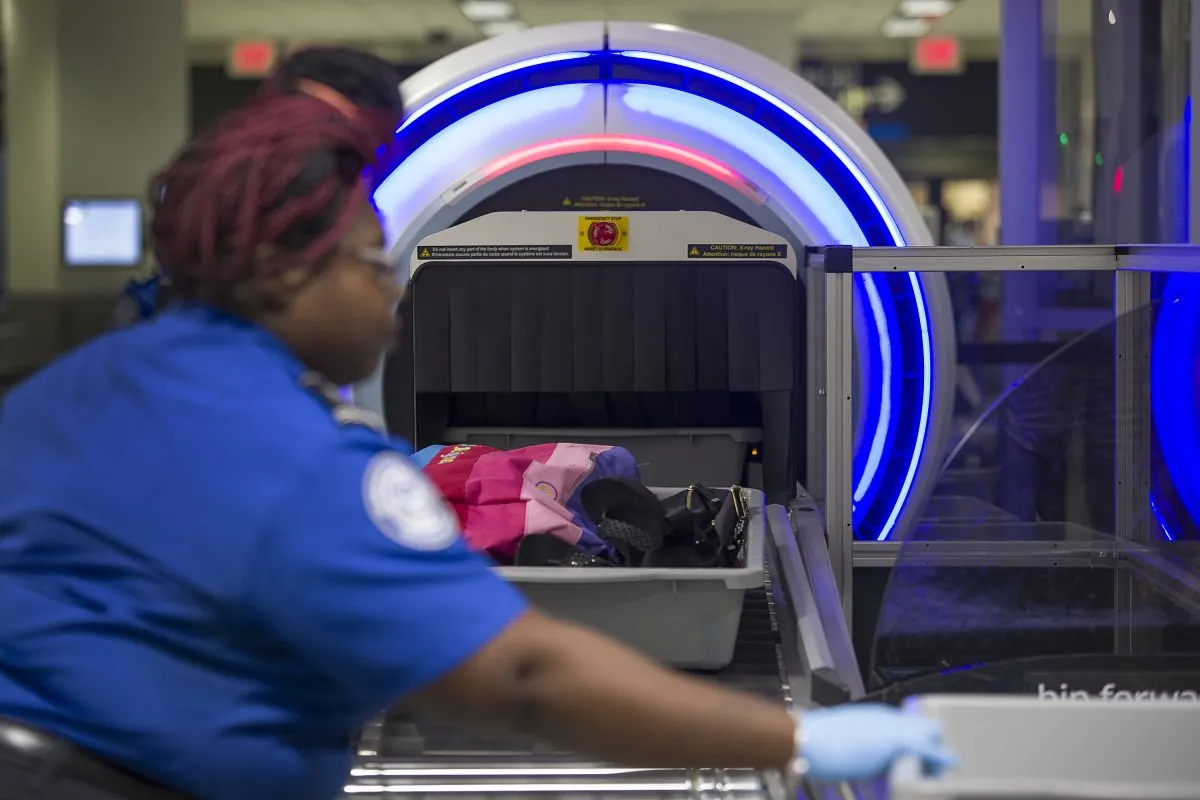
The first airport baggage issue an AI-powered CT scanner has to solve is not an algorithmic one. It is the carry-on sitting at the mouth of the lane, close enough to be screened but too large for the opening. TSA’s newer checkpoint CT scanners can reject bags that would have moved through some older X-ray tunnels, and travelers are being told that oversized carry-ons may need to be checked instead of screened at the checkpoint.[1]
That is an awkward place for a sophisticated system to stumble. The machine may be able to build a 3D view of the bag, rotate the image for the officer, and support automated explosives detection. None of that matters if the bag cannot enter the tunnel. For airport operators, this is the right starting point for judging AI CT scanners in airport security baggage operations: not whether the scanner is smarter in isolation, but whether the entire lane handles more bags with fewer avoidable exceptions.
What CT Changes Inside the Bag
Traditional checkpoint X-ray gives officers a flattened projection. CT screening gives them volumetric data. TSA describes computed tomography as creating a 3D image of a carry-on bag that can be viewed and rotated on screen, helping officers inspect contents without immediately opening the bag.[2]
That extra depth matters. A dense object sitting behind a laptop, a bottle surrounded by clothing, or a battery pressed against another device is easier to reason about when the system is not asking the officer to infer structure from overlapping shadows. Deep-learning algorithms can analyze those 3D scans for explosive threats and reduce some of the ambiguous alarms that slow older lanes. The operational promise is practical: fewer divestment steps, fewer bag pulls, less repacking, and a steadier conveyor.
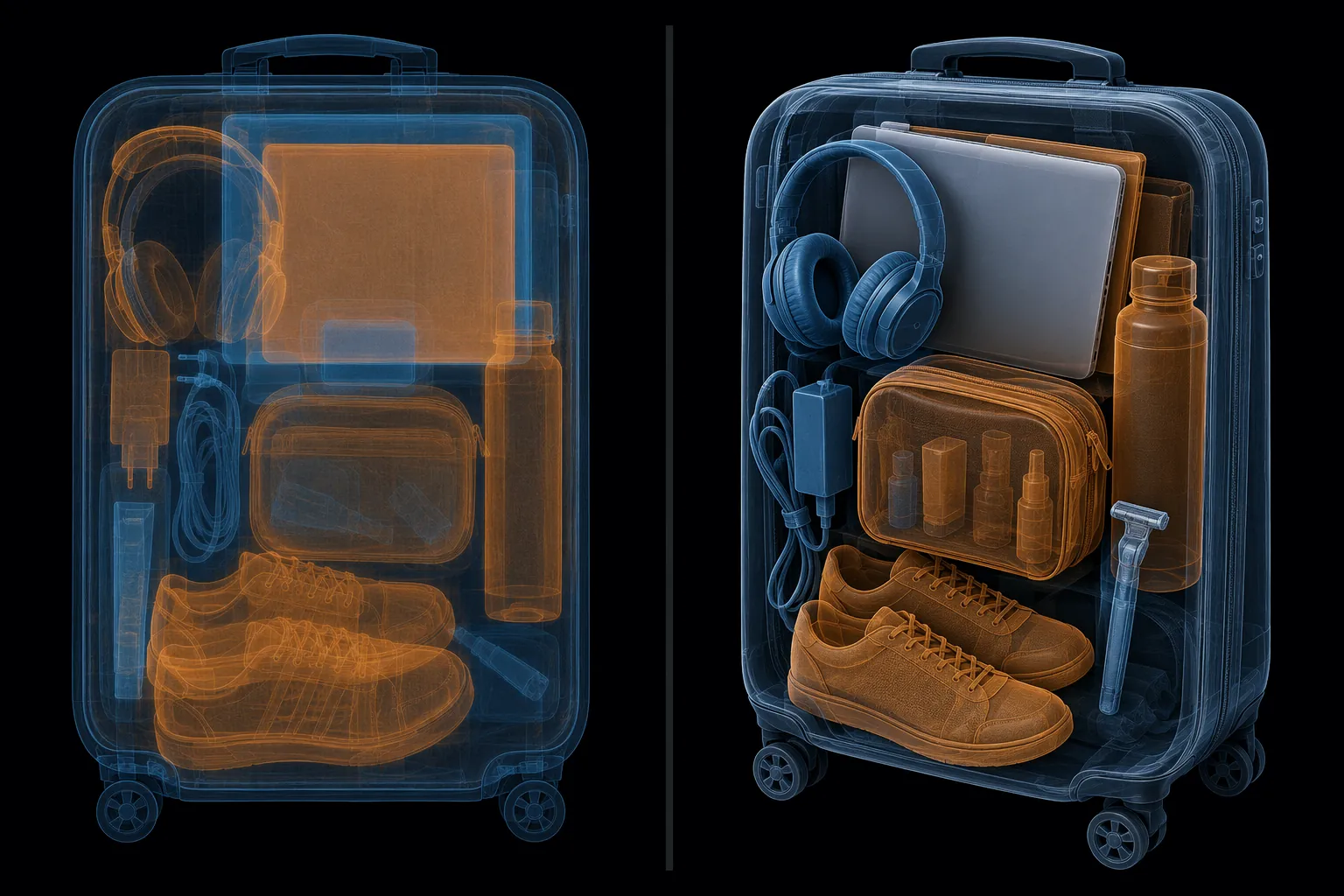
At CT lanes, passengers may be allowed to leave laptops and some liquids inside their carry-ons instead of removing them into separate bins. TSA’s CT guidance frames that as one of the technology’s main passenger-facing benefits, although local instructions still depend on the equipment and procedure in use at that checkpoint.[2]
The distinction is important. CT does not simply “add AI” to the checkpoint. It changes the imaging substrate, then lets software and officers work from a richer representation of the bag. The computer vision layer is more credible because it is looking at volume, density, and object relationships rather than only a flat trace.
This Is No Longer a Pilot
By early July 2026, TSA had deployed 1,162 CT scanners across 296 U.S. airports.[1] The procurement scale is also real: TSA announced a $1.3 billion award in 2023 to procure additional CT X-ray scanners for airport checkpoints, following earlier large contract commitments for the technology.[3]
Those numbers put CT screening in a different category from the more speculative uses of AI in airport operations. Anyone benchmarking it against other supply chain AI deployments should treat it as a mature field rollout, not a lab demo. For a wider maturity comparison, ChainSignal’s guide to machine learning use cases across supply chain functions is a useful adjacent frame.
But deployment is not the same as operational settlement. A terminal can have CT units, legacy X-ray units, automated screening lanes, manual divestment tables, and checkpoint staff giving different instructions by lane. The passenger sees one security checkpoint. The operations team sees a mixed fleet with different rules, capacities, and exception paths.
The Lane Workflow Is Where the Benefits Either Show Up or Disappear
A CT-enabled checkpoint has several handoff points. Each one can either absorb variability or turn it into a queue.
| Checkpoint Moment | What CT Helps With | What Still Creates Baggage Issues |
|---|---|---|
| Bag acceptance | Standardized binning and less pre-scan unpacking | Tunnel opening can reject bags that fit older lanes |
| Scan creation | 3D volumetric image replaces a flat X-ray projection | Dense or cluttered bags can still require officer attention |
| Automated detection | Algorithms support explosives detection and reduce some ambiguous alarms | Non-explosive prohibited-item AI remains narrower than many assume |
| Officer review | Rotatable images can reduce unnecessary bag searches | Residual alarms still require human decision-making |
| Passenger instruction | Some liquids and electronics may stay in bags at CT lanes | Mixed CT and legacy lanes create inconsistent instructions |
The first gain is at divestment. If passengers do not have to remove laptops, tablets, and certain liquids at CT lanes, the pre-scan table becomes less of a sorting exercise. That can reduce abandoned bins, repacking delays, and the steady drip of officer reminders. It also reduces the chance that a traveler sends one item through separately while holding up the rest of the line to find another.
The second gain is in interpretation. CT gives officers more information before they touch the bag. When a suspicious shape can be rotated and examined in three dimensions, some bag checks that would have been triggered by a confusing 2D overlap can be avoided. Airport Council International-North America described AI-based screening algorithms in 2026 as tools that can elevate security screening by helping identify threats and reduce false alarms, but that does not mean the officer disappears from the loop.[4]
The third gain is in lane rhythm. Fewer unnecessary searches mean fewer bags taken off the belt, fewer passengers waiting at the recomposure area, and fewer officers forced to split attention between image review and exception handling. In a checkpoint, the important unit is not just bags per hour on a spec sheet. It is the number of bags that move from passenger hand to cleared exit without a preventable stop.
The AI Scope Is Still Narrower Than the Marketing Shorthand
The most common overstatement is to imply that deployed CT checkpoints already run broad automated detection for all prohibited items. The DHS AI Use Case Inventory lists TSA’s use case for detecting non-explosive prohibited items on CT scanners as “pre-deployment” as of July 2026.[5]
That caveat changes the operational reading. Deployed CT systems use algorithmic detection for explosives, while officers still manually identify other threats. Firearms, knives, and other prohibited categories may be visible in the CT image and may be supported by emerging AI tools, but the full handoff from officer judgment to automated non-explosive prohibited-item detection is not yet an operational fact at scale.
This is not a minor footnote. If an airport plans staffing, training, and lane design around the assumption that AI will clear most categories automatically, it will be designing for a checkpoint that does not yet exist. The safer planning assumption is that CT improves the officer’s view and automates part of the detection problem, while human review remains central to the exception path.
False Alarms Fall, But They Do Not Vanish
False alarms are the checkpoint’s hidden labor bill. Every unnecessary alarm creates a bag pull, a passenger wait, an officer intervention, and sometimes a secondary instruction that slows the next traveler. Earlier CT explosive detection systems had high false-alarm burdens: the European Commission’s Joint Research Centre report cites historical work in which Harding estimated about a 30% false alarm rate in 2004, falling to roughly 15% a decade later.[6]
AI-driven algorithms aim to push that burden lower by recognizing object patterns more accurately in volumetric scans. The direction is credible, but the trade-off remains structural. A system tuned to catch rare, high-consequence threats cannot simply be optimized like a retail image classifier. Reducing false positives is valuable only if it does not create unacceptable false negatives.
That is why throughput claims need careful labeling. Analogic’s ConneCT system has been associated with claims of processing up to 600 bags per hour, described as roughly double traditional X-ray capacity, but the available material does not establish that figure as independently verified performance under mixed, real checkpoint conditions.[7]
A vendor capacity number may describe what the machine can process under favorable assumptions. A checkpoint throughput number has to include divestment, bin return, oversized bags, passenger hesitation, alarm resolution, staffing, recomposure space, and the adjacent lane that still tells people to remove their laptop. Those are not objections to CT. They are the conditions under which CT has to prove itself.
The Tunnel Opening Is a Hard Constraint
The carry-on size issue deserves more attention than it usually gets because it is not a software problem waiting for a better model. The Smiths Detection HI-SCAN 6040 CTiX tunnel opening is about 24.5 inches by 16.5 inches, and reports on the TSA rollout have warned that some bags acceptable in older lanes may not fit the newer CT machines.[1]
That creates a new exception at the very front of the process. Instead of discovering a problem after the scan, the checkpoint discovers it before screening can begin. The passenger may have followed airline carry-on rules and still meet a different constraint at the security lane. The officer then has to redirect the traveler, explain why the bag cannot be screened there, and absorb the frustration caused by a rule that feels new only because the machine changed.
For airport operations teams, this matters because front-of-lane exceptions are contagious. They block the feed point, interrupt instructions, and force staff to decide whether to hold the passenger, move them to another lane, or send them back toward airline check-in. A smaller opening can erase some of the labor saved by fewer downstream searches if the local passenger mix includes many borderline carry-ons.
It is also a reminder that baggage screening is a logistics system with a security purpose. The machine’s detection performance is essential, but the lane still has a physical envelope. No algorithm can process a bag that never enters the scanner.
Mixed Fleets Create Passenger-Facing Inconsistency
During rollout, one of the hardest operational problems is not the CT lane itself. It is the CT lane next to a legacy lane. At one belt, the passenger may be told to keep electronics and some liquids inside the bag. At another, the passenger may still need to remove them. Both instructions can be correct at the same checkpoint.
That inconsistency is expensive because passengers learn checkpoint rules socially and visually. They watch the person ahead of them. They listen to the officer two lanes over. They assume the rule applies across the checkpoint. When the equipment mix breaks that assumption, officers spend more time correcting behavior that is rational from the passenger’s point of view.
Automated screening lanes can help standardize the movement around CT machines. TSA’s 2024 installation of automated screening lanes with computed tomography at Baltimore/Washington International Thurgood Marshall Airport emphasized features such as improved bin flow and checkpoint efficiency.[8] But automation around the scanner does not eliminate the need for clear lane-specific instructions when older and newer equipment operate side by side.
This is where airport AI deployments often resemble broader disruption logistics. The model may be good, but the transition state is messy. ChainSignal’s work on AI in airport disruption logistics planning makes the same point in a different operating context: the value appears when decision support, staffing, passenger movement, and exception handling line up.
Vendor Choices Are Also Architecture Choices
The CT checkpoint market is not a single-machine story. TSA’s 2023 procurement award covered Analogic, IDSS Holdings, and Smiths Detection, and the wider ecosystem includes hardware suppliers such as Smiths Detection, Leidos, Analogic, and IDSS, plus AI-layer companies working on open-architecture detection software.[3]
The architecture question matters because airports and security agencies do not want every algorithmic improvement trapped inside a hardware replacement cycle. BigBear.ai has announced Pangiam Threat Detection certification activity in the Netherlands and separate testing and integration work with Smiths Detection, examples of the industry’s move toward AI layers that can integrate with certified screening systems rather than sit entirely outside them.[9][10]
Still, certification, procurement, and operational acceptance move more slowly than software demos. A detection model that works in testing has to fit the regulatory environment, the officer interface, the alarm-resolution process, and the maintenance model. Open architecture may reduce lock-in over time, but it does not remove the certification burden that makes airport security technology deliberately slow to change.
Small Traveler Impacts Still Matter
Most travelers will notice CT scanners through instructions: leave the laptop in, keep certain liquids packed, put the bag in the bin, wait for the bag check if alarmed. A smaller group will notice edge cases. TSA warns that CT scanners can damage undeveloped film, especially higher-speed film, and advises travelers to request hand inspection for film rather than sending it through the scanner.[2]
That is not a systemwide throughput issue, but it is the kind of exception that passenger-facing staff must handle cleanly. The best checkpoint technology reduces the number of special conversations officers have to conduct under queue pressure. Where special handling remains necessary, the process has to be obvious before the traveler reaches the belt.
So, Can AI CT Scanners Fix Airport Baggage Issues?
They can fix some of the right problems. CT gives officers better images. AI-supported detection can reduce ambiguous alarms. Passengers at CT lanes may unpack less. Large-scale TSA deployment shows that the technology has moved beyond experimentation. These are meaningful gains, especially in a checkpoint environment where every avoided bag search protects capacity for the exceptions that truly need attention.
They do not fix the checkpoint by themselves. A smaller tunnel opening can create a new front-end rejection. False alarms can fall without disappearing. Non-explosive prohibited-item AI remains in pre-deployment status at DHS as of July 2026. Mixed fleets can make two correct instructions sound contradictory to passengers standing ten feet apart.
The fair test is therefore operational rather than promotional: does the checkpoint handle more bags with fewer preventable exceptions? If the answer is yes, the AI-powered CT scanner is doing more than detecting more inside the bag. It is improving the lane around it.
References
- The Hill — CT scanner carry-on bag size issue, The Hill
- TSA computed tomography page, Transportation Security Administration
- TSA $1.3B award press release (2023), Transportation Security Administration, 2023
- ACI-NA — AI-based algorithms elevate airport security screening (March 2026), Airports Council International-North America, March 2026
- DHS AI Use Case Inventory (TSA), Department of Homeland Security
- JRC Report (European Commission) — X-ray baggage screening and AI, European Commission Joint Research Centre
- Copenhagen Optimization — CT scanners: airport security technology of the future, Copenhagen Optimization
- TSA BWI automated screening lanes installation (2024), Transportation Security Administration, 2024
- BigBear.ai — Pangiam Threat Detection receives Dutch certification, BigBear.ai
- BigBear.ai and Smiths Detection complete testing and integration, BigBear.ai
Comments
Join the discussion with an anonymous comment.