
AI for cruise logistics route planning earns its keep only when it changes a voyage decision before the ship pays for the problem. A cruise itinerary is not just a line between ports. It is a sequence of arrival windows, berth commitments, fuel exposure, weather risk, emissions accounting, hotel-load demand, provisioning handoffs, and guest promises made months before the sailing. If the model only draws a prettier track on a chart, it is not doing much. If it helps decide whether to slow steam overnight, adjust a port sequence, avoid a current pattern, recover from congestion, or protect an arrival window without burning unnecessary fuel, then it belongs in the planning discussion.
The practical answer is narrower than the marketing phrase suggests: these systems ingest environmental, vessel, port, fuel, and demand data, then run optimization models that recommend route, speed, timing, or itinerary adjustments. The credible fuel and emissions impact sits in a sourced 5–15% range, but that range is not a universal guarantee. It comes from a mix of projected fleetwide cruise deployment, measured vessel trials, and vendor-reported cruise voyage optimization results. Those distinctions matter.
What the route-planning system is actually deciding
Cruise route planning has always involved weather routing, speed management, port sequencing, and fuel monitoring. The AI layer does not make those operating problems new. Its value is in bringing more of the variables into one decision cycle, updating the recommendation as conditions change, and making the trade-off visible before the operations team is forced into recovery mode.
A useful system is usually working across four decision types. It can recommend a track adjustment to avoid bad weather or unfavorable currents. It can recommend a speed profile that preserves the arrival window with less fuel burn. It can flag timing changes when port congestion or berth availability puts the schedule at risk. It can also support itinerary planning by testing whether a sequence of port calls is robust under fuel, emissions, weather, and guest-demand constraints.
| Input the model needs | Why it matters on a cruise voyage | Decision it can influence |
|---|---|---|
| Weather and sea conditions | Heavy weather can slow the vessel, worsen comfort, and force late-stage schedule recovery. | Route adjustment, speed change, arrival buffer |
| Ocean currents | A small routing change can alter fuel burn materially over a long leg. | Track selection, economical speed profile |
| Port congestion and berth timing | Late arrival or delayed clearance can cascade into guest excursions, provisioning, and the next sailing. | Timing change, port sequence review, contingency planning |
| Fuel consumption and vessel performance | The same itinerary can carry different fuel exposure depending on speed, weather, hull condition, and hotel load. | Speed recommendation, fuel plan, emissions estimate |
| Guest demand and itinerary value | The highest-value itinerary is not always the easiest one to operate reliably. | Itinerary design, port-call prioritization, schedule resilience |
That last input is where cruise differs from a generic maritime routing problem. A container ship can optimize around schedule reliability, bunker cost, cargo commitments, and port rotation. A cruise ship has those operational constraints plus a hotel product sitting on top of them. Moving an arrival time is not just a nautical decision; it affects shore excursions, dining patterns, crew workload, guest communications, and the brand promise wrapped into the itinerary.
The mechanism: one optimization loop, several operating clocks
The clean version of AI route planning looks simple: collect data, predict conditions, optimize the voyage, send a recommendation. The shipboard version is messier because each data stream runs on a different clock. Weather updates move on forecast cycles. Currents shift by route and season. Port conditions can change with berth conflicts, pilotage constraints, or local disruption. Fuel consumption depends on speed, trim, sea state, hotel load, and vessel-specific performance. Guest demand is often known earlier, during itinerary and revenue planning, but it still shapes which port calls are worth protecting.
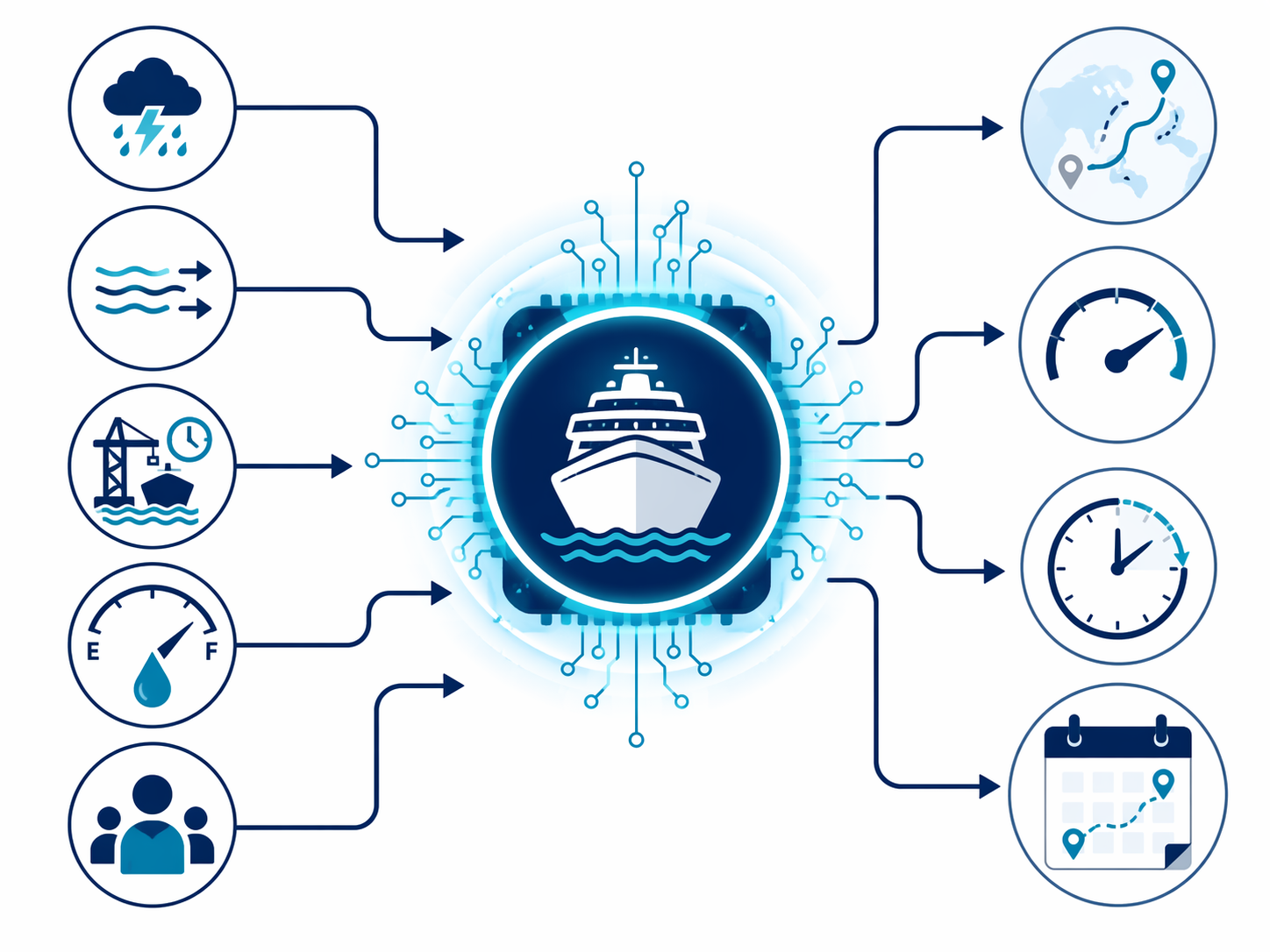
The model’s job is not to find the mathematically shortest route. It is to weigh the cost of each feasible option. A route that saves distance may lose its advantage if it exposes the ship to unfavorable currents. A faster leg may protect the port window but increase fuel burn and emissions. A slower speed profile may be attractive until it reduces the recovery buffer before a congested turnaround port. The useful recommendation is the one that shows the operational trade-off clearly enough for the marine and itinerary teams to act.
In practice, the output usually lands as a recommended voyage plan rather than an autonomous instruction. The system can propose route alternatives, speed bands, estimated fuel effects, timing risk, and emissions implications. The crew and shore-side operations team still have to account for safety, regulatory requirements, port instructions, guest impact, and commercial priorities. That human review is not a weakness in cruise. It is how the optimization result survives contact with a live itinerary.
MSC OptiCruise is the most direct cruise-specific evidence
MSC Cruises’ OptiCruise is the cleanest cruise-specific case because it connects itinerary optimization directly to fleetwide emissions targets. MSC said in August 2024 that the tool, developed with OPTIMeasy and the University of Genoa under the EU-funded CHEK project, is projected to reduce fleetwide emissions by up to 15% by 2026 across 24 ships. The company tested the tool on MSC Bellissima over 12 months before moving toward wider deployment.[1]
The important word is “projected.” The 10–15% MSC figure should not be treated as a completed, audited fleet result. It is a deployment target based on a tested tool and a named rollout path. For a buyer, that is still meaningful: it shows the operator is not merely experimenting with a dashboard, but using optimization in itinerary design and fleet emissions planning. It just does not prove that every vessel in every region will deliver the same reduction once the system is fully live.
OptiCruise also matters because it starts where cruise planning pain often starts: the itinerary itself. A fragile schedule can look attractive when it is sold, then become expensive when the fleet has to defend it with speed, fuel, and operational workarounds. Optimization at the itinerary-design stage gives the operator a chance to avoid building avoidable exposure into the product.
Measured vessel trials support the lower end of the range
The Weathernews and HD Hyundai evidence is not cruise-specific, but it is useful because it reports measured vessel performance rather than only a projection. In 2024 trials of the OSR-OW route-planning system across eight vessels, the companies demonstrated an average 5.3% fuel reduction. The same report described a vendor-guaranteed minimum fuel saving of 3%, equivalent to about $150,000 per 1,000 tons of fuel.[2]
That is a small sample, so it should not be stretched into an industry-wide average. Still, it is the kind of result that voyage operators pay attention to because it sits close to actual fuel consumption. A 5.3% reduction on eight vessels does not settle the cruise business case, but it makes the lower end of the 5–15% benchmark look operationally plausible when the operator has good vessel-performance data and the recommendation is acted on.
Cruise voyage optimization has reported savings, but attribution still needs care
Wärtsilä’s Eniram voyage-optimization work sits closer to cruise operations. The company has reported 8–12% fuel savings per voyage when AI-assisted route and speed optimization is deployed on cruise vessels. Wärtsilä’s Norwegian Cruise Line Holdings case also describes a Voyage Benchmarking+ program implemented over 10 months across the fleet, producing significant fuel savings.[3]
This evidence is commercially relevant, but it is still vendor case-study evidence. The reported savings are not the same as an independently audited, public fleetwide result. They do, however, show the type of operating lever that matters: speed and route optimization at the voyage level, benchmarked against vessel performance. For cruise logistics route planning, that is more probative than a broad statement that AI improves operations.
The distinction between itinerary optimization and voyage optimization is worth keeping. Itinerary optimization asks whether the planned sequence of port calls, sea days, and arrival windows is efficient and resilient before the sailing is sold or finalized. Voyage optimization asks how to operate a specific sailing as conditions develop. The strongest operators will need both, because a weak itinerary cannot always be rescued by a clever speed recommendation.
Carnival shows why data infrastructure comes before optimization
Carnival is useful less as a single route-planning ROI case and more as a reminder of the data environment required. Dataintelo, citing Carnival technology disclosures, describes the Ocean Medallion ecosystem as processing more than 55 million data points per day per ship across about 72,000 sensors, feeding AI used to optimize route planning based on weather, sea conditions, port logistics, and guest demand.[4]
Those sensor and data volumes do not prove a specific fuel-saving percentage. They do show why cruise operators with mature shipboard and guest-data infrastructure have an advantage. Route planning models are only as useful as the data they can trust: actual fuel burn, vessel behavior in sea state, operational constraints, port timing, and demand signals. If those streams sit in disconnected systems, the planner is left stitching together dashboards while the sailing clock keeps moving.
Royal Caribbean is adjacent evidence, not route-planning proof
Royal Caribbean belongs in this discussion only with a boundary around it. A 2025 Klover.ai analysis, citing Royal Caribbean investor materials, reported that the company’s AI yield-management system improved pricing revenue by 8–14% over traditional rule-based approaches. The same analysis said Royal Caribbean’s Perfecta Program targets 20% compound annual growth in adjusted earnings per share by 2027, with AI described as a core enabler.[5]
That is evidence that a major cruise operator is applying AI to commercial and operational planning. It is not evidence that Royal Caribbean’s route-planning algorithms reduced fuel burn by 8–14%. Yield management can influence itinerary economics and demand expectations, which may feed broader planning decisions, but revenue uplift should not be smuggled into a logistics ROI calculation.
Where the 5–15% claim is solid, and where it is not
The 5–15% fuel and emissions impact range is defensible as a benchmark range, not as a procurement promise. The lower end is supported by measured route-planning trials such as the Weathernews and HD Hyundai 5.3% average fuel reduction across eight vessels.[2] The middle of the range is consistent with Wärtsilä’s reported 8–12% cruise-voyage fuel savings from AI-assisted route and speed optimization.[3] The upper end is supported by MSC’s projected up-to-15% fleetwide emissions reduction from OptiCruise by 2026.[1]
Those three pieces of evidence are not interchangeable. One is a measured small-sample vessel trial, one is vendor-reported cruise voyage optimization, and one is a cruise operator’s projected fleetwide emissions reduction after a tested deployment path. A serious internal business case should preserve those labels rather than average them into a single expected saving.
| Evidence | What it supports | What it does not prove |
|---|---|---|
| MSC OptiCruise | Cruise-specific itinerary optimization tied to a 2026 fleetwide emissions-reduction projection. | Completed audited 10–15% savings across all 24 ships. |
| Weathernews + HD Hyundai OSR-OW | Measured fuel reduction in a small eight-vessel trial. | A cruise-specific average or guaranteed 5.3% result for every vessel. |
| Wärtsilä / Eniram and NCLH | Cruise voyage-level route and speed optimization savings reported by a vendor case study. | An independently audited public fleetwide benchmark. |
| Carnival data infrastructure | The scale of shipboard and guest-data inputs that can feed optimization. | A named route-planning fuel ROI percentage. |
| Royal Caribbean AI yield management | Adjacent evidence of AI use in cruise commercial planning. | Direct proof of route-planning fuel or emissions savings. |
The market is growing, but market size is not the business case
There is enough market activity to treat AI route optimization as a growing maritime software category. Research and Markets valued the vessel route optimization AI market at $1.7 billion in 2026 and projected it to reach $2.7 billion by 2030, a 12.2% compound annual growth rate.[6] Dataintelo valued the broader AI in cruise industry market at $1.8 billion in 2025 and forecast it to reach $7.6 billion by 2034, with navigation and route optimization representing 11.2% of 2025 revenues.[4]
Those figures need context. The vessel route optimization market covers more than cruise. The AI in cruise market includes guest-facing technology, personalization, and other systems that do not prove route-planning return on investment. For a cruise logistics buyer, market growth is useful only as a signal that vendors, integrations, and operating maturity are developing. It is not a substitute for vessel-level savings evidence.
Implementation risks that matter on a sailing schedule
The first risk is data quality. A model can optimize only against the vessel, weather, port, and fuel data it receives. If actual fuel consumption is poorly normalized, if port-call constraints are manually maintained, or if itinerary planning and fleet operations use different assumptions, the recommendation may look precise while resting on weak inputs.
The second risk is organizational timing. Route optimization that arrives after itinerary commitments are locked can still improve a voyage, but it cannot remove all the fragility built into the schedule. Conversely, itinerary optimization that never flows into voyage execution becomes a planning exercise rather than an operating tool. The handoff between deployment planning, marine operations, fuel management, and port operations is where many benefits are either captured or lost.
The third risk is over-attribution. Fuel savings can come from route changes, speed policy, hull performance, engine tuning, weather differences, shore-power availability, or itinerary redesign. A buyer evaluating AI for cruise logistics route planning should ask how the vendor separates model-driven savings from other fleet-efficiency programs, and whether the baseline is a historical voyage, a sister ship, a simulated route, or a controlled operational comparison.
The fourth risk is operational acceptance. A recommendation that ignores bridge practice, port authority constraints, hotel operations, or guest-experience trade-offs will not be used consistently. The strongest systems make the trade-off legible: fuel saved, emissions avoided, arrival risk changed, guest impact expected, and recovery buffer preserved or consumed.
What to look for in an evaluation
The procurement question is not whether a vendor “uses AI.” It is whether the system can improve a real voyage decision with enough confidence that marine operations will act on it. That requires evidence at the level of ships, voyages, and planning workflows.
- Ask which decisions the system changes: itinerary design, route selection, speed profile, arrival timing, port sequencing, or fuel planning.
- Separate projected savings from measured savings, and vendor case-study claims from independently verified results.
- Check whether the model uses vessel-specific fuel and performance data rather than generic assumptions.
- Test how port congestion, weather deterioration, and late itinerary changes are reflected in recommendations.
- Confirm who can override the recommendation and how the system records the reason.
- Define the baseline before the pilot begins, because route-planning ROI is easy to blur with broader fleet-efficiency work.
AI for cruise logistics route planning is a growing, evidence-backed use case, strongest where operators already have reliable vessel, weather, port, fuel, and demand data. The realistic impact is not that every sailing becomes optimal. It is that more sailings can be planned and adjusted with the fuel, emissions, timing, and guest consequences visible before the ship is committed to the cost.
References
- MSC Cruises to reduce fleetwide emissions by up to 15 percent with new itinerary optimization tool, MSC Cruises, August 2024
- AI route planning cuts ship fuel use by 5.3%, The Digital Ship, September 2025
- Norwegian Cruise Line Holdings Ltd, Wärtsilä, November 2025
- AI in Cruise Industry Market, Dataintelo, March 2026
- Royal Caribbean Group AI Strategy Analysis of Dominance in Cruise Lines, Klover.ai, 2025
- Vessel Route Optimization AI Market, Research and Markets, January 2026
Comments
Join the discussion with an anonymous comment.