
The chatfishing problem dating apps now have to deal with is not just that people are using ChatGPT to sound smoother. It is that the smoother message arrives inside one of the few digital spaces where tone is treated as evidence. A fast reply can look like interest. A vulnerable sentence can look like trust. A joke that lands can feel like chemistry. When those signals are composed by software, the person on the other side is still doing the old human work of interpretation, but the clues have changed.
That shift is no longer a fringe behavior. Match and the Kinsey Institute reported in the 14th annual Singles in America study that AI use to enhance dating lives jumped 333% year over year, and that 26% of singles now use AI for that purpose.[1] Norton found that six in 10 dating app users believe they have encountered at least one AI-written conversation.[2] Those numbers matter because they put a measurable frame around a private suspicion many daters already recognize: the moment a message feels a little too responsive, a little too polished, a little too emotionally well-lit.

What Chatfishing Is, and What It Is Not
Chatfishing is narrower than the panic around “AI dating” sometimes makes it sound. It usually means a real person is using an AI tool such as ChatGPT, Claude, or a dating-specific assistant to write, rewrite, or suggest messages to matches. The photos may be real. The name may be real. The person may genuinely want a date. The substitution happens in the voice.
That makes it different from catfishing, where someone presents a false identity, and different again from romance scams, where emotional attention is used as a route to financial fraud. The distinctions are important because they keep ordinary awkwardness from being treated like organized deception. A shy person asking an AI tool to make a first message less wooden is not the same as a scammer building a fake relationship to extract money.
The boundaries blur in practice because dating apps do not run on identity facts alone. They run on inferred presence. If someone outsources the banter, the apology, the late-night tenderness, or the carefully timed follow-up, the recipient may still be matching with a real person, but not necessarily with that person’s actual attention. The result can feel less like a writing aid and more like emotional impersonation.
The Data Shows Adoption; the Stories Show the Damage
The Guardian’s first-person reporting on chatfishing is useful because it stays close to the small betrayals that adoption statistics flatten. One dater described realizing she had been “ChatGPT-ed into bed” and then ghosted, a phrase that catches why the issue lands so sharply: the AI-written conversation did not merely help someone get a reply; it helped create enough apparent intimacy for an offline encounter.[3]
The same reporting also describes the “intimate paradox” on the user side: people who turn to AI to help them converse can become less prepared for the in-person conversation the app is supposed to lead toward.[3] That is the gap dating apps cannot hide with better copy. A person can arrive at the table and suddenly be asked to stand behind a rhythm, confidence, humor, and attentiveness that were partly generated somewhere else.
There is an easy version of this story in which every AI-assisted dater is a manipulator. It is also the least interesting version. Dating apps reward speed, charm, and low-friction self-presentation; they punish the hesitant opener and the overexplained thought. It is not surprising that people reach for tools that make them sound more fluent. The harder question is where fluency stops being help and starts becoming a borrowed personality.
That line is not clean. Asking an AI tool to fix a typo is different from asking it to generate a flirtatious version of yourself. Rephrasing a clumsy sentence is different from letting a model decide how vulnerable to sound. But the recipient rarely sees the production process. They see only the finished message and have to decide whether it means what it appears to mean.
Most People Are Not Good Enough at Spotting It
This is where the problem becomes larger than etiquette. Scientific American has framed AI chatfishing as a modern Turing test for online dating, and the results are not reassuring. Humans detect AI-generated text at roughly 57% accuracy, according to research summarized in that reporting; a 2025 preprint cited there found GPT-4.5 fooled judges 73% of the time.[4] In ordinary app life, that means “I can tell” is usually more confidence than method.
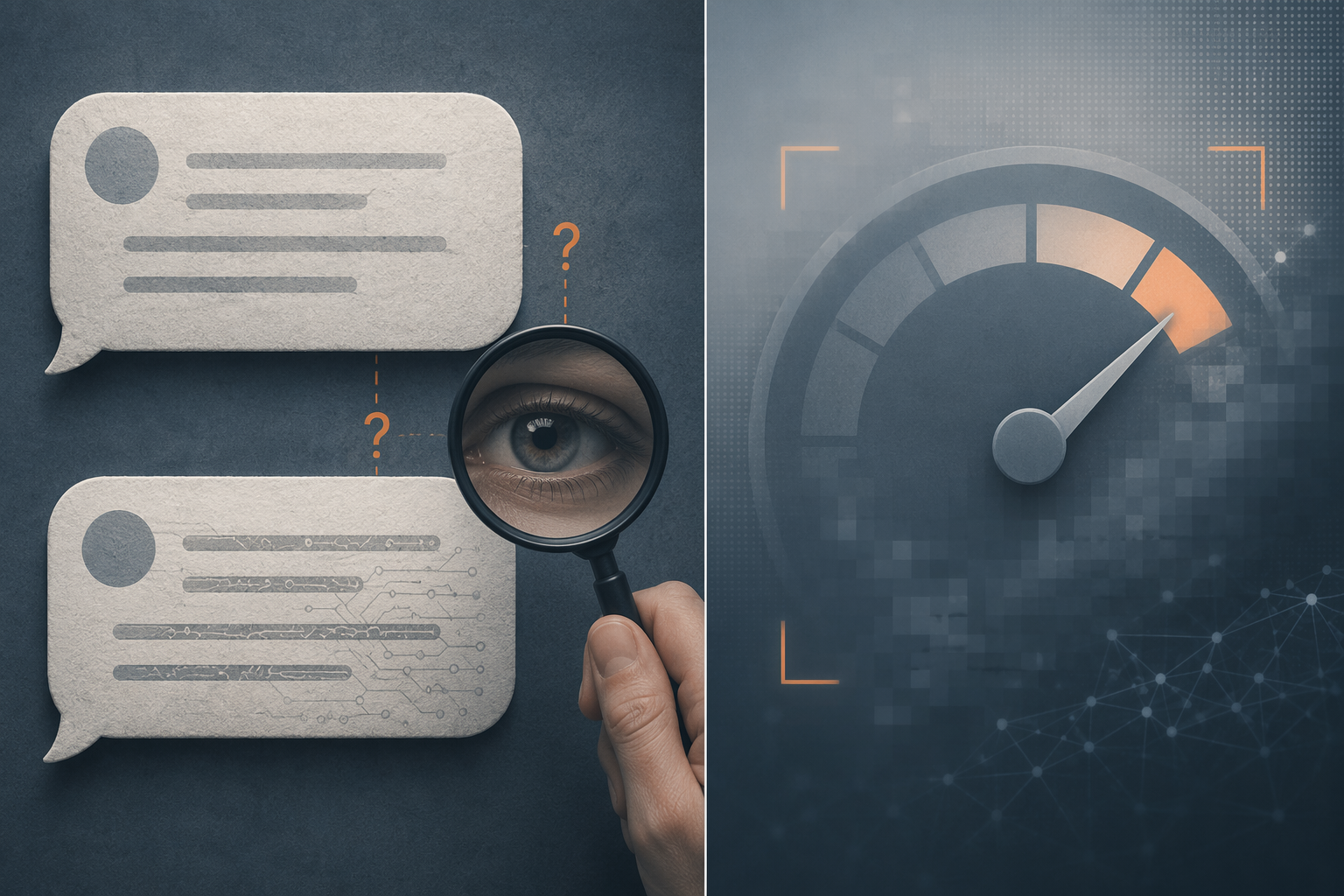
Detection failure changes the social bargain. If a match sends a message that is unusually articulate or emotionally tuned, there is no reliable way to know whether it came from thoughtfulness, practice, a friend’s advice, an outside suggestion, or a dating assistant trained to make the sender sound more desirable. The old tells are weak: polished grammar is not proof of automation; awkwardness is not proof of humanity; warmth can be generated; weirdness can be human.
That uncertainty creates a tax on the person receiving the message. They must decide whether to respond to the apparent emotional bid, whether to be more guarded, whether to move off-app, whether to meet, whether to ask directly. A person using AI may experience the tool as a private confidence boost. The person receiving the output experiences it as part of the evidence on which trust is built.
It also means survey data probably captures only the visible edge of the behavior. If users can identify AI-written text only a little better than chance in many contexts, then self-reports and suspicions will both miss something. Some people who are being chatfished will not know. Some people who think they have been chatfished will be wrong. The most honest conclusion is not that every charming message is suspect, but that the real scale is unusually hard to measure.
AI Wingmanship Has Been Normalized
The market around the behavior has grown beyond improvised ChatGPT prompts. Business Insider reported that Rizz, a leading AI wingman app, has reached 15 million global users.[5] The size of that audience does not prove every user is deceiving matches, and it does not measure how often AI-written messages lead to dates. It does show that automated romantic assistance has become a consumer product rather than a private hack.
Reuters described the trade-off as “perfection without connection,” a phrase that fits the app experience neatly: AI can make a reply smoother, but smoothness is not the same as mutual recognition.[6] A better opener may increase the chance of a response. A better comeback may keep a thread alive. But the person eventually has to cross from optimized text into an unoptimized body, voice, mood, and memory.
That is why the most revealing failure is not always getting caught. It is succeeding. If AI-written charm works well enough to produce a date, the user inherits the expectations their tool created. The recipient expects the same attentiveness, cadence, humor, or confidence to continue. The first in-person silence then has an extra meaning: it is not only awkward; it exposes the distance between the conversation and the conversationalist.
| Behavior | What is being misrepresented | Why it matters |
|---|---|---|
| Light editing | Usually presentation, such as grammar or clarity | Low risk when the underlying thought remains the sender’s |
| AI-generated banter | Timing, humor, flirtation, and conversational rhythm | The match may respond to chemistry the sender did not create |
| AI-composed vulnerability | Emotional openness and apparent intimacy | The recipient may make trust decisions based on borrowed feeling |
| Fake identity or scam use | Identity, intent, and sometimes financial motive | This moves beyond chatfishing into catfishing or fraud |
Where Scams Enter the Picture
Romance scams should not be treated as the same thing as chatfishing, but they belong in the same conversation because both exploit the trust users place in intimate text. The Federal Trade Commission reported that Americans lost $1.16 billion to romance scams in the first nine months of 2025, with a median loss of $2,218 and a scam report every seven minutes.[7] Those are reported losses, not a full measure of harm; many victims never report at all.
AI makes that environment harder to read. Barclays reported in 2026 that 66% of UK adults said AI makes romance scams harder to detect, and that 56% of Gen Z now prioritize meeting in person over app-based dating.[8] Those figures are about attitudes and stated priorities, not proof that AI has caused a measurable exodus from apps. Still, they capture a rational response to uncertainty: when text becomes easier to fake, some users put more value on the parts of dating that are harder to automate.
App companies have tried to answer adjacent trust problems with verification, face checks, and safety prompts. Those tools can help with identity and certain kinds of fraud. They do not fully solve chatfishing, because the problem is not always whether the person exists. It is whether the message expresses that person’s attention. Company-published safety metrics may be useful signals, but they should not be read as audited proof that the trust problem has been contained.
The Consent Problem Hiding in the Message Thread
Consent in dating is usually discussed around physical boundaries, explicit agreements, and safety. Chatfishing raises a quieter version of the issue before anyone meets. A person deciding whether to keep talking is making choices based on perceived qualities: responsiveness, emotional availability, humor, seriousness, patience. If those qualities are substantially machine-composed, the recipient’s expectations are being shaped by something they were not told was present.
There is no need to make this mystical. People have always edited themselves in courtship. Friends have always suggested lines. Dating profiles have always been curated. The difference is scale, speed, and opacity. An AI assistant can generate endless versions of a more appealing self, instantly and privately, while the match receives the output as if it were conversational evidence.
Disclosure is the obvious remedy, but it is not a simple one. A message that says “AI helped me write this” may be honest and socially fatal. A platform label may be difficult to enforce, especially when users can paste generated text from outside the app. A ban on AI-written messages would be hard to define, since editing, translation, accessibility support, and anxiety management can all involve legitimate assistance.
That does not make the issue imaginary. It means the cleanest rules are unlikely to match the messiness of actual use. Dating apps can ask for authenticity, but their own design often rewards performance. Users can ask for honesty, but many will still prefer the better-written version of themselves until the bill comes due in person.
Why the 333% Jump Is Probably an Undercount of the Feeling
The Match/Kinsey number is one of the clearest adoption signals available, but it should be read carefully. The study is funded by Match Group, while the Kinsey Institute is an independent academic organization.[1] That does not make the finding useless. It does mean the number should sit alongside independent reporting, user accounts, and detection research rather than carry the whole argument by itself.
The Norton finding is also a perception measure: six in 10 dating app users believe they have encountered at least one AI-written conversation.[2] Belief is not proof. But in dating, belief has consequences. If enough users think the person on the other side may be outsourcing the emotional work, they will change how they read everyone. Suspicion spreads even when individual accusations are uncertain.
That is the part a narrow fraud framework misses. Chatfishing can damage trust even when no money is stolen, no fake photos are used, and no formal rule is broken. It can make sincerity less legible. It can make ordinary eloquence suspicious. It can leave people feeling foolish for having responded to warmth that was engineered for them rather than offered to them.
DatingNews has argued that chatfishing is a problem apps cannot ignore, and that framing is persuasive because the risk sits inside the product’s core promise.[9] A dating app is not merely a database of nearby singles. It is a system that asks users to treat messages as traces of another person’s interest. If that trace becomes too easy to synthesize, the app has not just gained a new etiquette headache. It has a credibility problem.
The Trust Model Is the Real Test
The visible data already supports a restrained conclusion: AI-assisted dating messages are rising quickly, many users think they have encountered them, and people are poor at reliably identifying them. The first-person accounts explain why the experience feels corrosive. Being helped by a tool is one thing. Discovering that the intimacy you interpreted was partly manufactured is another.
The full universe of chatfishing cannot be measured cleanly from current surveys or anecdotes. Some use is harmless editing. Some is strategic impersonation. Some is scam infrastructure. Much of it is invisible to the person receiving the message. That uncertainty is not a reason to dismiss the problem; it is part of the problem.
Dating apps depend on a fragile belief: that behind the profile is another person offering some version of their actual attention. Chatfishing pressures that belief at exactly the point where app-mediated intimacy begins, in the message thread before anyone has enough evidence to know what is real. In 2026, the question is not whether AI can help someone get unstuck. It clearly can. The question is how much borrowed warmth a dating market can absorb before the conversation stops feeling believable.
References
- Match and The Kinsey Institute Unveil 14th Annual Singles in America Study, Match Group, June 10, 2025
- Norton 2025 dating app AI survey, Norton, 2025
- I realised I’d been ChatGPT-ed into bed, The Guardian, October 12, 2025
- The Rise of AI Chatfishing in Online Dating Poses a Modern Turing Test, Scientific American
- The Rise of the AI Wingman, Business Insider
- Perfection without connection: how AI is becoming a digital wingman, Reuters, October 4, 2025
- FTC romance scam loss data, Federal Trade Commission, 2025
- AI deepfake concerns see Gen Z ‘swiping left’ on dating apps, Barclays, February 2026
- Opinion: Chatfishing Is a Problem Apps Can’t Ignore, DatingNews
Comments
Join the discussion with an anonymous comment.