
Healthcare supply chain fraud is not one problem with one detector. Phantom vendors, kickbacks, invoice manipulation, product substitution, and bid rigging each leave different evidence trails, which is why AI for healthcare supply chain fraud detection only works when the model matches the fraud pattern instead of treating everything as generic payment abuse [1][2].

Where the five patterns differ
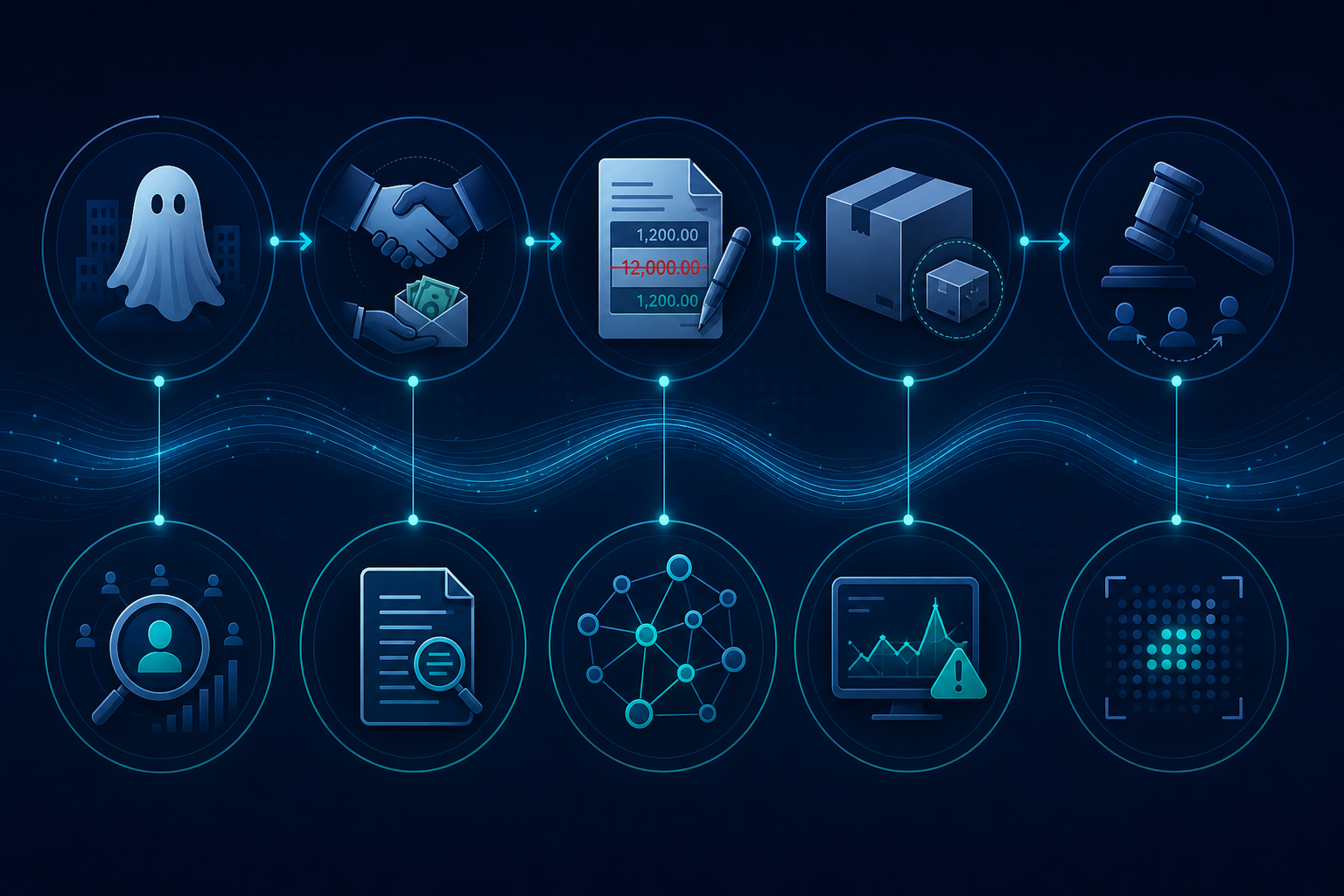
The five-part typology below draws on procurement fraud frameworks and occupational fraud reporting, then translates each fraud type into the AI technique most likely to catch its trace. The point is not that every case fits neatly into one box; it is that the suspicious signal changes depending on whether the failure sits in the vendor master, the invoice, the award process, or the goods that actually arrived [1][2][3][4].
| Fraud type | Where it usually shows up | Best-fit AI detection |
|---|---|---|
| Phantom vendors | Vendor master records, payment setup, and bank-account changes | ML behavioral analytics and real-time anomaly detection |
| Kickbacks | Supplier selection, purchase approvals, and repeat awards to the same parties | Graph network analysis |
| Invoice manipulation | Invoice text, duplicate billing, split invoices, and amount changes | NLP document review plus anomaly detection |
| Product substitution | Item descriptions, packing slips, lot numbers, and received goods | NLP comparison and pattern recognition |
| Bid rigging | Tender patterns, winner rotation, and coordinated supplier behavior | Graph analysis and behavioral analytics |
That mapping matters operationally because the model has to look where the evidence is. Behavioral analytics is useful when the suspicious pattern is a repeated deviation from normal ordering or payment behavior. NLP helps when the problem is buried in free text, invoice language, or supporting documents. Graph analysis is stronger when the bad behavior lives in relationships among buyers, approvers, suppliers, and shared identifiers. Real-time anomaly detection matters when the risk is a payment or master-data change that needs to be interrupted before money leaves the organization [3][4].
What the tools catch
Phantom vendors and invoice manipulation are often the most straightforward fit for machine learning because the data leaves a transaction trail. A vendor that appears suddenly, changes banking details, invoices repeatedly outside normal cycles, or generates payments without a matching operational footprint gives a detector enough structure to compare current behavior with historical patterns. That is where anomaly scoring and behavioral baselines do their best work [3][4].
Kickbacks and bid rigging are less about a single bad document and more about a contaminated relationship. If awards cluster around a small set of suppliers, if a buyer repeatedly steers business toward related parties, or if the same suppliers appear in suspiciously coordinated bidding patterns, graph network analysis is the more relevant tool. It can surface the link structure that a transaction-by-transaction review may miss [3][4].
Product substitution sits in a different place again. The issue may only become visible when the order description, item master, invoice language, and receiving record are compared side by side. NLP helps search those unstructured or semi-structured records at scale, while pattern detection can flag recurring mismatches between what was requested and what was billed or delivered [3][4].
Even then, the models are not acting as judges. They are triage tools that shrink the review queue and rank the cases that deserve analyst attention. Published case material still points to false positives that remain high enough to require human-in-the-loop review, rather than a fully automated decision path [3][4].
What early deployments changed
The best evidence for AI for healthcare supply chain fraud detection is not a promise of perfect classification. It is the change in day-to-day work: fewer fraudulent payments getting through, faster investigation cycles, and less manual digging before an analyst can decide whether a case is real [5][6][7][8].
- CMS reported $14 returned for every $1 spent and more than $2B saved over five years through automated stop-payment controls, which is the clearest example here of detection linked to prevented loss rather than just case counting [5].
- Brillio's case study reported a 50x reduction in investigative effort and $17K in monthly fraud savings per customer, showing how automation can compress the time spent chasing a lead before the analyst even reaches a conclusion [6].
- ICF reported investigations that ran 80% faster, with key analytic steps completed 6x faster, which is the kind of improvement procurement and finance teams usually feel first: less waiting, faster escalation, and a shorter path from alert to action [7].
- Highmark's public results, at $260M a year and $850M over five years, are organization-specific rather than universal, but they show that the use case can matter at enterprise scale when the controls, data, and review process are already mature [8].
That is also why ROI should be treated as a local calculation, not a universal promise. The outcomes depend on data quality, how much of the vendor and invoice stack is already standardized, how noisy the baseline is, and whether analysts can validate the model's output quickly enough to keep the workflow usable. Published results still leave room for false positives in the 15-30% range, so the most practical deployments keep the model inside a review process instead of pretending the model is the process [3][4][7].
What the market context does and does not say
The larger market numbers explain why this topic is getting more attention, but they do not solve the operational problem. Research and Markets sized the healthcare fraud analytics market at $5.93B in 2026 and projected $15.37B by 2030, but that market covers claims, billing, and payment fraud broadly rather than supply-chain-only fraud [9]. NHCAA has also cited $54B in annual fraud losses, while other estimates in the field run much higher, so those numbers are best read as scope markers, not precise counts [10].
A broader supply-chain figure from Patsnap Eureka puts global supply chain fraud losses above $40B, but that is not healthcare-specific and should not be used as a healthcare estimate. The distinction matters because a health system screening phantom vendors or rigged bids needs a detection strategy that fits its own payment, contracting, and master-data controls, not a market-size headline [11].
The practical question is narrower than the market forecast. Can the organization point the right model at the right evidence trail, give analysts enough context to confirm or reject the alert, and keep procurement, finance, and vendor-master controls aligned after the model flags something? If the answer is yes, the tool is doing real work. If the answer is no, it is only adding another queue.
References
- 1. Occupational Fraud 2024: A Report to the Nations — ACFE — 2024
- 2. Procurement/vendor fraud detection framework — MSN Forenzix
- 3. AI tools for healthcare provider fraud detection — Insurance Thought Leadership
- 4. Fraud detection AI methods — Master of Code
- 5. FY2024 data on automated stop-payment and fraud prevention — Centers for Medicare & Medicaid Services
- 6. Healthcare fraud detection case study — Brillio
- 7. AI pilot for investigations workflow — ICF
- 8. Public fraud analytics results — Highmark
- 9. Healthcare Fraud Analytics Market Report 2026 — Research and Markets
- 10. Fraud loss estimate — National Health Care Anti-Fraud Association
- 11. Supply chain fraud report — Patsnap Eureka
Comments
Join the discussion with an anonymous comment.