
For importers already in the CBAM compliance path, Q3 2026 is an awkward place to be. The Authorized CBAM Declarant application deadline of March 31 has passed, annual declarations now depend on verified actual emissions data, and the first certificate surrender date is September 30, 2027 — roughly 14 months away.[1] The European Commission estimate cited by EcoVadis that a 50-tonne de minimis threshold could exempt about 90% of importers while keeping roughly 99% of emissions in scope is useful context, but it should be treated carefully because it may reflect pre-Omnibus assumptions.[2] For companies still in scope, CBAM compliance supply chain data is no longer a reporting side project. It is becoming an input to product cost, certificate exposure, and legal risk.
That is where the operating problem gets real. A buyer can ask for a supplier’s installation-level emissions data; that does not mean the supplier knows which CN codes are covered, which production route applies, whether indirect emissions are in scope, or how EU methodology treats its electricity and process inputs. Procurement owns the supplier relationship. Sustainability owns methodology. Finance sees the certificate liability. IT gets asked, late, to connect the portal, ERP, carbon tool, and document archive. The spreadsheet-and-email version of this process breaks at exactly the point where defensibility matters.

The supplier-data workflow that has to hold up
CBAM data collection is not one form. It is a chain of evidence. The importer has to know which goods are in scope, which suppliers and installations produced them, what emissions methodology was used, what assumptions were made, whether the data is complete enough for declaration, and how the record will survive verification and the next reporting cycle.
| Workflow point | What has to be controlled |
|---|---|
| Identify scoped goods and CN codes | Map imported products to covered CBAM categories and keep the classification current. |
| Request supplier-specific installation data | Reach the right supplier contact, installation, and production route instead of collecting generic corporate emissions. |
| Validate methodology and completeness | Check whether the response follows the required logic, includes mandatory fields, and flags gaps before declaration. |
| Calculate and report embedded emissions | Turn supplier inputs into reportable embedded emissions without losing source traceability. |
| Prepare verified annual declarations | Package the record so an accredited verifier and the importer can see how the number was produced. |
| Reuse the resulting data asset | Carry supplier, product, installation, and methodology records into future CBAM cycles and adjacent reporting needs. |
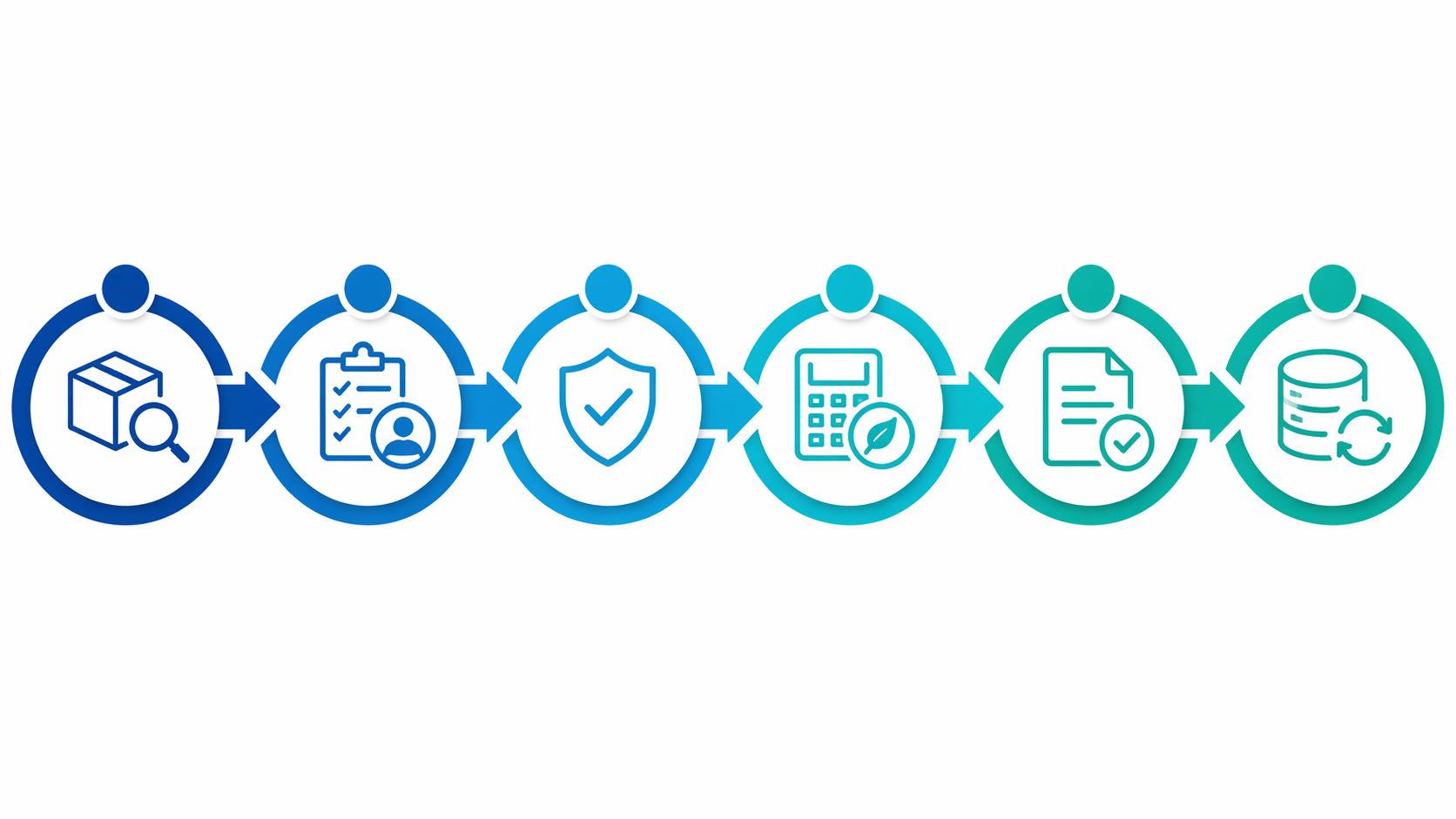
The difference between a tolerable process and a brittle one is not whether the importer owns a supplier portal. It is whether the portal can help distinguish a missing emissions factor from a wrong production route, a supplier-wide estimate from installation-level data, and a reusable verified record from a one-cycle attachment.
Where AI changes the work, and where it does not
AI is most useful in CBAM when it removes the coordination drag around supplier data. It is less useful when it is presented as a substitute for methodology, accountability, or verification. A verified emissions factor is not just another blank field in a procurement questionnaire. It is the end product of a controlled data path.
Supplier engagement at scale
The first bottleneck is usually not calculation. It is getting a usable answer from the right supplier contact, in the right format, with enough context that the supplier understands what is being requested. This is where AI-assisted supplier engagement has a practical role: routing requests, tailoring request language by supplier segment or commodity, detecting incomplete responses, sending reminders, and preserving the communication trail.
Assent positions its CBAM solution around an AI-native chatbot for supplier engagement and reports 2–3x productivity gains over manual compliance workflows.[4] That figure is vendor-reported, not an independently verified benchmark, so it should not be treated as a universal ROI number. The more defensible takeaway is narrower: supplier-facing automation can reduce the amount of manual chasing and triage that otherwise sits with procurement and sustainability teams.
Data structuring and enrichment
Supplier responses rarely arrive as clean, comparable records. One supplier may send a spreadsheet, another a PDF, another a partial portal response, and another a plant-level value that does not match the product being imported. AI-supported structuring is useful when it extracts, normalizes, and links that information to suppliers, materials, purchase orders, CN codes, and existing procurement master data.
SupplyOn describes AI-supported data structuring and enrichment for supplier emissions data, with integration into procurement systems.[5] That matters because CBAM data cannot live only in a sustainability worksheet. The importer needs to connect product classification, supplier identity, purchasing volume, and emissions methodology. If those links are recreated manually every quarter or year, the organization never really builds a CBAM data layer; it just repeats a collection exercise.
CN-code scoping and report automation
CN-code scoping is one of the less glamorous parts of CBAM, and one of the easiest places to make a downstream mess. If the importer scopes too broadly, teams collect unnecessary data and suppliers receive confusing requests. If the importer scopes too narrowly, covered goods can fall outside the process until declaration pressure exposes the gap.
IntegrityNext highlights intelligent CN-code scoping and automated XML report generation as part of its CBAM compliance approach.[6] The XML point is not cosmetic. As reporting formats mature, the operational question becomes whether the company can generate structured outputs from governed source data rather than manually assembling a report from attachments and late-stage calculations.
Methodology validation before the verifier sees it
Validation is where automation needs discipline. A system can flag missing fields, inconsistent units, mismatched product categories, incomplete production-route data, or an answer that does not line up with Annex IV logic. It can also guide suppliers through a step-by-step collection flow so the importer is not interpreting every response from scratch.
Coolset describes a TÜV-certified compliance logic and a step-by-step supplier emissions collection methodology for CBAM.[7] Certification of tool logic is not the same thing as verification of each supplier’s emissions data, but it is relevant when an importer is choosing how much methodology guidance to embed into the collection process itself. The better question is not whether the software says “CBAM-ready”; it is whether the system can show why a supplier response passed, failed, or required follow-up.
Integration with carbon management systems
CBAM records need to travel. A procurement team may collect them, but sustainability and finance need them for emissions reporting, assurance, carbon-cost modeling, and supplier comparison. Sphera frames CBAM from the supply chain angle and emphasizes integration with existing carbon management systems.[8] That bridge is important because an importer that keeps CBAM separate from its broader carbon data estate creates another reconciliation job later.
The pattern across these vendors is more useful than a ranking. Assent points to AI-assisted engagement. SupplyOn focuses on structuring and procurement enrichment. IntegrityNext emphasizes CN-code scoping and XML outputs. Coolset foregrounds methodology-guided collection. Sphera connects CBAM data to carbon management infrastructure. A mature operating model may need several of these capabilities, whether bought from one platform or assembled across systems.
Why default values are a costly fallback, not a data strategy
Default values are sometimes discussed as if they are a convenient safety net. That is the wrong posture for the definitive phase. PwC notes that CBAM makes data quality a direct commercial issue: inaccurate data can affect product pricing, legal exposure, supplier dependency, assurance work, and broader sustainability integration.[3] The penalty exposure is not abstract either; PwC cites penalties up to €100 per tonne of CO₂ in the definitive phase.[3]
The mechanism is straightforward. If actual supplier-specific data is missing or not defensible, the importer may have to rely on regulatory fallback values. PwC describes default values under Regulation 2025/2621 as intentionally conservative, which means they can increase CBAM certificate exposure compared with verified actual data.[3] The exact certificate cost will move with the EU ETS-linked pricing mechanism, but the data-quality problem remains: weak supplier data can turn into a higher carbon-cost assumption.
Verified actuals are worth pursuing because they create options. They let finance estimate certificate liabilities with less dependence on conservative assumptions. They let procurement see which suppliers are creating exposure and which suppliers can support defensible reporting. They give sustainability teams a record that can be reused for CSRD, Scope 3 reporting, and supplier benchmarking rather than rebuilt for each disclosure calendar.[3]
There is also a supplier-knowledge dependency that procurement teams feel quickly. A supplier may have emissions data for a corporate sustainability report but not for the installation and product route needed by CBAM. A supplier may serve multiple subsidiaries of the same group and receive duplicate requests. A supplier may answer in good faith but use a boundary that does not match the importer’s reporting obligation. Automation helps only if it reduces these mismatches before they become declaration defects.
Sector scope changes the questionnaire
The same supplier workflow does not mean the same data model for every product. BSI notes that iron, steel, and aluminum require direct emissions only, while cement and fertilizers require both direct and indirect emissions.[1] That difference should show up in the tool configuration, supplier questionnaire, validation rules, and calculation support.
For iron and steel, the process has to pay close attention to the product route and direct process emissions attached to the relevant installation. For aluminum, direct emissions treatment shapes the supplier request differently than a broader product carbon footprint questionnaire would. For cement and fertilizers, indirect emissions bring electricity-related data into the collection burden. If a platform treats every CBAM category as the same generic emissions survey, the importer is likely to spend the next cycle cleaning avoidable errors.
This is also where classification and supplier engagement intersect. CN-code scoping determines who gets asked. Sector methodology determines what they get asked. Verification determines whether the answer can be used. Those are separate controls, and they should not be collapsed into one “supplier data received” status.
What a defensible AI-enabled process looks like
A workable CBAM automation design starts before the supplier email goes out. The importer should connect customs classification, supplier master data, purchasing records, and material data so the request is scoped to the right goods and counterparties. AI can help identify patterns and likely gaps, but the source systems still need accountable owners.
- Scope imported goods by CN code and CBAM category before launching supplier outreach.
- Route requests to the supplier contacts most likely to know installation-level production and emissions data.
- Use category-specific questionnaires so direct and indirect emissions requirements are not mixed.
- Validate units, boundaries, methodology, completeness, and supporting evidence before annual declaration preparation.
- Preserve source records, supplier correspondence, calculation logic, and reviewer decisions for verification.
- Push approved records into carbon management, procurement analytics, and finance workflows instead of leaving them in attachments.
The strongest automation case is not that AI calculates everything. It is that AI shortens the distance between supplier outreach and a reviewable record. A supplier uploads a file; the system identifies the installation, extracts relevant fields, compares them against the required data structure, flags missing indirect emissions if the product category requires them, links the record to the relevant CN code, and creates an audit trail for human review. The reviewer is still responsible for judgment, but the reviewer is not starting from an inbox.
For importers that missed the March 31 ACD application deadline, the immediate situation is different and may require separate legal and regulatory handling. For on-time applicants, the practical question is now execution quality: can the company collect enough supplier-specific, verifier-ready data before certificate surrender pressure turns every missing field into a finance problem?
Regulatory movement is a reason to govern data, not wait
CBAM is still moving. The Omnibus Simplification Package and remaining delegated acts may change implementation details, and verification methodology remains an area to watch.[1] Certificate prices will also fluctuate because CBAM certificate pricing follows EU ETS auction-price dynamics.[3] Those uncertainties are real, but they do not argue for delaying supplier data architecture. They argue against hard-coding a fragile process.
A governed data layer can absorb rule changes better than a folder of supplier spreadsheets. If a delegated act changes a reporting field, the importer can update a data model and validation rule. If a supplier changes a production route, the importer can version the record. If a verifier questions a value, the importer can trace the request, response, calculation, and review decision. That is the operational value AI should support.
AI does not make CBAM compliance automatic, and it does not replace accredited verification. It can, however, turn a brittle spreadsheet-and-email process into a governed supplier emissions data layer. The strategic value is not just saving compliance labor in 2026. It is building reusable supply chain data before certificate costs, verification pressure, and cross-regulation reporting demands compound.
References
- Preparing for EU CBAM: The 2026–2027 Transition Explained, BSI
- CBAM Explained, EcoVadis
- The EU CBAM: Implications for supply chains, PwC
- CBAM, Assent
- Carbon Border Adjustment Mechanism (CBAM), SupplyOn
- Mastering CBAM Compliance in 2026: Latest Updates and How Companies Should Prepare, IntegrityNext
- How to collect supplier emissions data for CBAM compliance: step-by-step guide, Coolset
- Understanding CBAM From a Supply Chain Angle, Sphera
Comments
Join the discussion with an anonymous comment.