
A recall does not become a supply chain problem when the regulator posts the campaign. By then, the hardest work has often already been compressed into a few ugly weeks: engineering is still validating scope, legal is calibrating language, dealers are asking when parts will arrive, and regional planners are trying to protect normal service demand while replacement parts are pulled toward a campaign.
That pressure is not theoretical. Supply Chain Management Review described 2025 as a year in which vehicle recalls again tested supply chain resilience, including a first-half surge, a 58% scope increase in Q3, and disruption from parts diversion across Ford, GM, and Toyota campaigns. The useful detail in that account is not just that recalls were large; it is that they interfered with the ordinary flow of service parts and dealer readiness, which is where customer inconvenience becomes an operations metric.[1]
This is where AI-enabled recall management deserves a more practical reading. The question is not whether a model can notice a pattern before a formal campaign. The question is whether that notice arrives early enough, and cleanly enough, to become a VIN population, a parts order, a regional stocking decision, and a dealer capacity plan before the public recall work begins.

The evidence for an earlier recall signal
The strongest current evidence comes from Upstream's 2025 analysis of 5,189 U.S. recall campaigns from 2020 through 2025 and more than 30,000 NHTSA complaints. Upstream reported that 70% of U.S. vehicle recalls in that period had detectable signals before the official NHTSA campaign began, with a reported early detection window of 4 to 12 weeks.[2]
The EV results are even more striking, though they need to be read with the shorter EV history in mind. Upstream reported that 89% of EV recalls had earlier detectable signals and that 49% of EV recalls could be identified through diagnostic trouble code monitoring alone, compared with 37% for all vehicles. The same analysis said the share of recalls with detectable signals rose from 69% in 2020 to 75% in 2025, while EV recall share grew from about 2.5% to more than 14% over that period.[2]
Those figures are useful because they are tied to actual recall records and complaint data, not to a generic claim that connected cars generate more data. They are also vendor-originated. Upstream analyzed the data with its own AI tools, and the public materials do not provide a fully independent audit of the methodology. That does not make the findings unusable; it means executives should treat them as a strong screening signal, not as proof that every OEM can reproduce the same lead time on its own fleet tomorrow.
The signal types matter. Upstream points to diagnostic trouble codes, telemetry patterns, and natural language processing of consumer complaints as the inputs that can surface early defect clusters.[2] A DTC spike may be the cleanest operational input because it already has a component and vehicle-system orientation. Telemetry can catch behavior that has not yet become a hard fault. Complaint NLP is messier, but it can identify repeated language around symptoms, warning lights, loss of function, charging behavior, or drivability before a campaign name exists.
| Signal source | What it can reveal | Supply chain value |
|---|---|---|
| Diagnostic trouble codes | Repeated fault codes across a vehicle population | Earlier component focus for replacement-part planning |
| Connected vehicle telemetry | Abnormal operating patterns before failure or complaint escalation | Regional and usage-based clustering for inventory staging |
| Consumer complaint NLP | Recurring symptom language across NHTSA complaints or customer channels | Additional evidence for scope review and dealer communication preparation |
The translation layer: from signal to parts
An early signal is only the first handoff. The supply chain benefit appears when a quality or connected-vehicle analytics team can pass a suspected defect population into after-sales planning without turning it into a premature public alarm. That requires a working layer between detection and campaign execution.
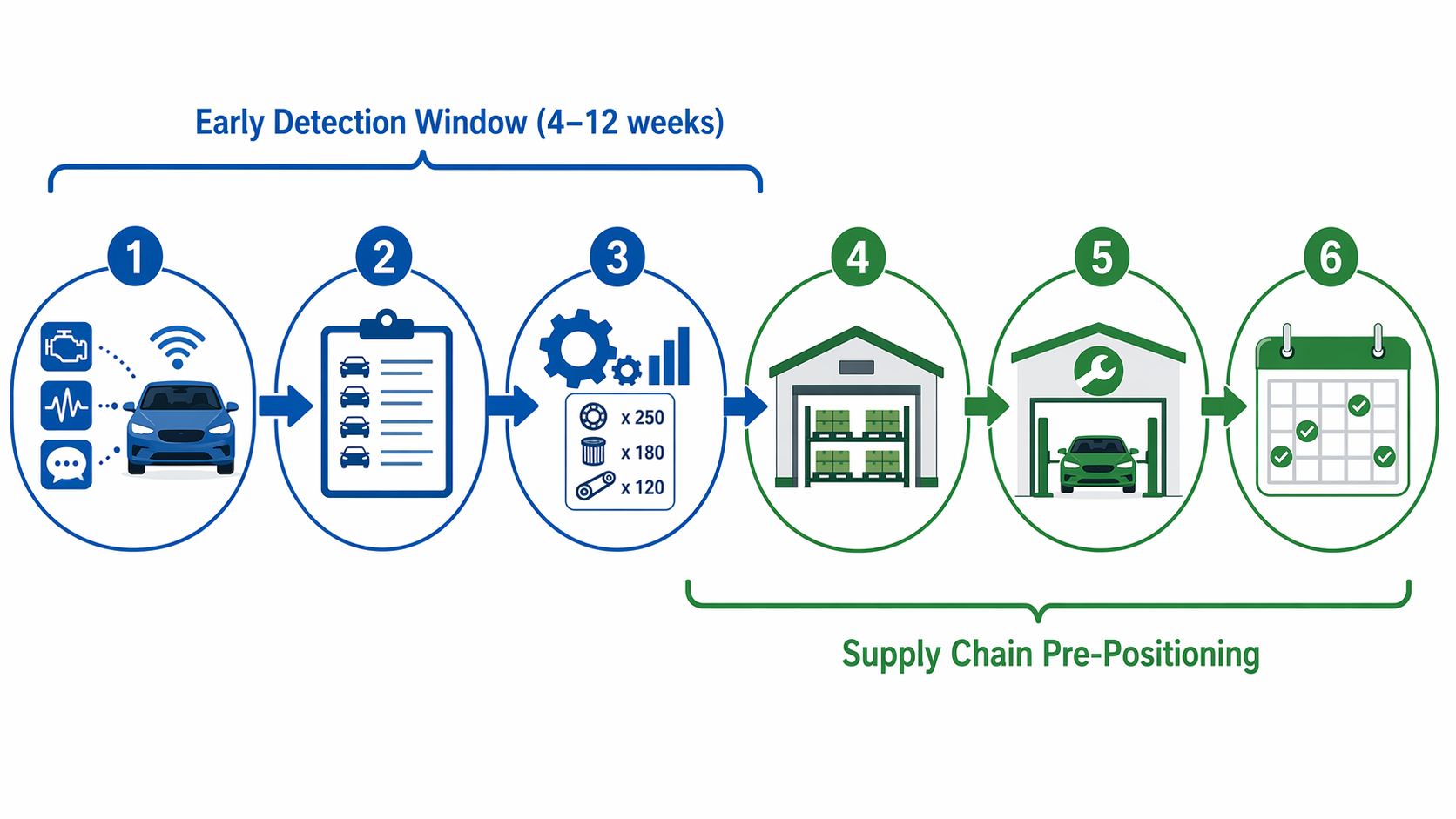
The first useful output is not a headline number saying a defect may exist. It is a candidate VIN list: vehicles sharing the software version, build range, supplier lot, component variant, battery module configuration, casting batch, calibration, or production plant exposure that makes the signal plausible. Without that population logic, planners can only prepare at the model-line level, which is how recall inventory turns into a blunt allocation fight.
Once the VIN population is narrowed, the next output is service-part demand. That estimate should separate likely inspection-only visits from likely replacement visits, because the wrong assumption changes everything: part quantities, packaging, labor hours, dealer bay loading, field technician needs, and customer appointment windows. A suspected battery module issue creates a very different logistics problem from a small sensor replacement or a software-only remedy.
Regional distribution centers then need time to stage inventory before dealers are flooded by owner notifications. If the early window is four weeks, the practical move may be to protect supply, reserve emergency stock, and place constrained parts closer to the highest-risk regions. If the window is closer to twelve weeks, teams may have enough time to increase service-part production, adjust supplier schedules, build packaging capacity, or rebalance stock that would otherwise be consumed by normal maintenance.
Dealer pre-allocation is where the difference becomes visible on Monday morning. A dealer parts manager does not need a beautiful anomaly dashboard; she needs to know whether the first wave of appointments can be supported, whether backorders will be centrally controlled, and whether parts are being pushed by VIN exposure rather than by who shouts loudest. Early detection helps only if allocation rules are ready before the campaign traffic arrives.
A practical operating sequence
- Detect a recurring DTC, telemetry, or complaint pattern and hold it as a suspected defect signal, not a confirmed recall.
- Map the signal to candidate VINs using build data, supplier traceability, software version, geography, and usage profile.
- Estimate service-part demand under several scope assumptions instead of waiting for one final campaign count.
- Stage constrained inventory at regional DCs and protect it from normal channel consumption where the risk justifies it.
- Prepare dealer allocation and appointment capacity for the most likely first-wave VINs.
- Reconcile all action with engineering, legal, and regulatory confirmation before customer-facing recall execution.
Why VIN-level traceability decides the business case
The difference between an interesting model and an investable recall-management capability is VIN-level traceability. If the organization can connect a signal to the vehicles that received a specific part, supplier lot, module, software release, or production process, the early window can reduce waste. If it cannot, the window mostly creates a longer period of uncertainty.
A broad model-line assumption over-orders parts and pushes inventory into dealers that may not need it. A VIN-specific exposure list lets the after-sales organization pre-position against the likely first wave while keeping normal service channels alive. It also helps planners avoid one of the most expensive recall habits: treating every potentially affected vehicle as if it will require the same part at the same time.
This is especially important for EVs and software-defined vehicles because more signals may be visible earlier, but the parts are not necessarily easier to move. Battery modules, power electronics, high-voltage components, and certain electronic control units can be expensive, constrained, hazardous to handle, or dependent on technician certification. The Upstream EV detection figures point to a larger opportunity, but they also make the planning discipline less optional.[2]
The better use of AI here is not mass replacement at higher speed. It is more selective preparation: which VINs are likely in scope, which parts are most likely to be consumed, which regions should receive buffer stock, and which dealers need capacity before owner communications begin.
The window can fail
A 4-to-12-week detection window sounds generous until it meets real constraints. Older vehicles may not generate connected data. OBD-II availability and detail vary by make and model. OEM data is often fragmented across connected services, warranty, quality, manufacturing, supplier, dealer, and parts systems. Even when the analytics team sees a pattern, the after-sales team may not yet have a validated part number, a final remedy, or authority to move inventory.
There is also a governance boundary that supply chain teams cannot shortcut. Early detection of a potential defect is not the same as confirmation of a systemic safety issue. NHTSA processes, engineering validation, safety analysis, and legal review still govern formal recall action. Acting too early can create false alarms, unnecessary part holds, and dealer confusion. Acting too late preserves process discipline but wastes the operational lead time the signal created.
The workable middle ground is controlled preparation. Planners can reserve capacity, model demand scenarios, protect constrained parts, and prepare regional allocation logic while the formal scope is still under review. They do not need to announce a recall to build a better internal view of what the first service wave might require.
Recall volume is unlikely to make this easier
The long-range backdrop is not a calm service environment. Recall Recon, using machine learning models trained on historical NHTSA data, forecasted 40 million to 50 million annual recalls through 2034.[3] That is a forecast, not a guaranteed count, and it should not be treated as a procurement plan. But it is enough to make recall readiness a standing supply chain resilience topic rather than an exception-handling exercise.
Supplier-risk analytics can reduce some problems before they become field failures, but that is a complementary use case rather than a substitute for recall detection. Talan reported a predictive supplier risk case with a 30% reduction in late or faulty deliveries and 15% cost savings on emergency shipping.[4] Those are useful prevention-side results. They do not remove the need for downstream visibility once vehicles are already in customer hands.
Dealer communication platforms make the same point from the other end of the chain. Vendor-reported completion rates or timeline improvements can be helpful signals, but they tend to reflect the deployments and customers included in the vendor's own base. The broader lesson is simpler: even excellent early detection still has to pass through dealer outreach, appointment availability, parts arrival, technician readiness, and customer follow-through before it becomes a completed repair.
What supply chain leaders should validate before investing
The first validation question is coverage. What share of the active vehicle parc can actually provide usable connected data, DTC streams, telemetry, or complaint linkage? A model trained on rich connected-vehicle populations may perform well where data exists and provide little help for older or less-connected nameplates.
The second is traceability. Can the organization move from a suspected failure mode to affected VINs, installed part numbers, supplier lots, plant records, software versions, and service-part supersessions quickly enough to influence stocking decisions? If that mapping takes longer than the detection window, the model is early only in a technical sense.
The third is inventory flexibility. Early warning has limited value if all constrained parts are locked into normal replenishment, if regional DCs cannot hold campaign buffers, or if emergency orders require the same approvals after the signal as before it. The operating model must allow conditional holds, scenario-based purchase orders, and clear release rules.
The fourth is organizational handoff. Quality, connected-vehicle analytics, after-sales, parts logistics, dealer operations, legal, and regulatory affairs need a shared status language. A suspected defect signal, an engineering-confirmed issue, a safety-relevant defect, and a filed recall campaign are different states. Confusing them creates either paralysis or overreaction.
| Capability to test | Why it matters | Failure mode if missing |
|---|---|---|
| Connected data coverage | Determines where early detection is possible | The model sees only a partial fleet |
| VIN-level part traceability | Turns a signal into a target population | Planners prepare at model-line level and overstock |
| Demand scenario planning | Separates inspection, software remedy, and replacement demand | Parts orders are based on one fragile scope assumption |
| Regional buffer rules | Moves parts closer to likely first-wave repairs | Dealers wait for allocation after notifications begin |
| Regulatory governance | Keeps internal preparation aligned with formal recall confirmation | Teams either act prematurely or waste the early window |
The investment judgment
AI-enabled recall detection is a credible automotive supply chain visibility use case, particularly as EV and software-defined vehicle fleets expand. The evidence is strong enough to justify pilots and vendor evaluation, especially where an OEM already has connected-vehicle data, complaint analytics, and after-sales planning teams close enough to act on the signal.
The value is not detection by itself. Early signals create time. VIN-level traceability turns that time into targeted demand. Flexible inventory and service capacity turn targeted demand into fewer dealer bottlenecks, less emergency expediting, and a recall launch that does not cannibalize the entire service-parts network.
References
- Turning vehicle recalls into a test of supply chain resilience, Supply Chain Management Review, scmr.com/article/turning-vehicle-recalls-into-a-test-of-supply-chain-resilience-lessons-from-2025
- 70% of US Vehicle Recalls Could Have Been Detected Earlier, Upstream, 2025, upstream.auto/press-releases/vehicle-recalls-detection-by-using-connected-vehicle-data/
- Forecasting Automotive Safety: How Recall Recon Uses AI to Predict Vehicle Recalls, Medium, medium.com/@preethunath/forecasting-automotive-safety-how-recall-recon-uses-ai-to-predict-vehicle-recalls
- Predictive AI revolutionises supplier risk management in the automotive industry, Talan, talan.com/global/en/predictive-ai-revolutionises-supplier-risk-management-automotive-industry
Comments
Join the discussion with an anonymous comment.