
The hard part of airline fuel buying in 2026 is not simply that fuel is expensive. It is that the old margin-protection instrument has largely disappeared while the invoice still arrives every day. Fuel is projected at $350 billion globally in 2026, up from $252 billion in 2025, and IATA puts it at 31.4% of airline operating expenses. Industry profits, meanwhile, are projected to fall to $23 billion.[1] In the U.S. market, BTS reported March 2026 aviation fuel cost up 56.4% year over year, with consumption up only 1.9% and cost per gallon at $3.09.[2]
That is the setting in which AI for airline fuel cost optimization and supply chain planning has become a procurement question rather than a technology slogan. If a carrier is no longer financially hedged, the fuel desk cannot wait for a derivative book to absorb volatility. The next scalable lever is the quality and timing of the sourcing-to-burn decision loop: forecast the price path more tightly, decide when to buy, select the supplier window, match the lift schedule to expected burn, and avoid cleaning up mismatches after the fact.

Why Hedging No Longer Carries the Fuel Desk
For years, executives could talk about fuel exposure and hedging in the same breath. That habit has outlasted the tool. DWU Consulting reported that no major U.S. carrier maintained financial fuel hedges as of Q2 2025.[3] Southwest, long the industry reference point for fuel hedging, terminated its remaining hedge book in Q2 2025 after roughly $157 million in annual premiums produced negative net benefit over a 10- to 15-year period, according to the company’s FY2025 10-K.[4]
That changes the standard for cost control. A hedge can be judged on financial protection after prices move. A procurement system has to help before the purchase is made: which index exposure to accept, which supplier quote to favor, whether to pull forward a spot buy, whether to wait for a better window, and how much inventory risk the network can carry at a given station.
This is why the most useful AI work is not a general promise to “optimize fuel.” It is narrower and more testable: reduce forecast error enough that fuel buyers can change buying behavior with more confidence.
Forecast Error Is Now the Control Point
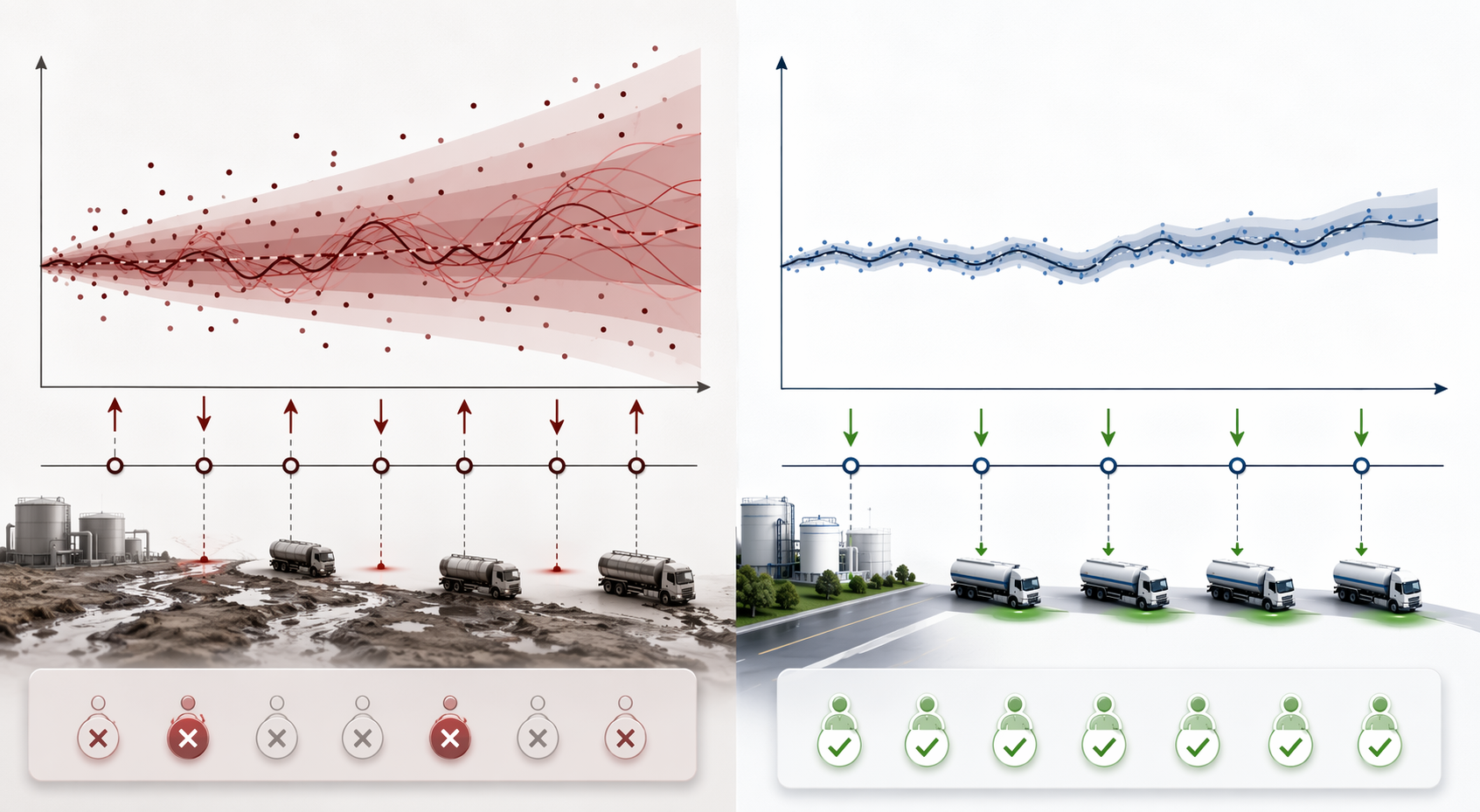
Logicraft’s January 2026 airline case is the clearest available example because it connects the model output to a procurement action. The company reported that an unnamed major international airline reduced fuel forecast error from 7.2% to 1.8% and saved roughly $12 million annually through optimized spot purchasing timing. Logicraft also states that industry-wide fuel forecast errors commonly exceed 10% to 15%, and that its procurement optimization can reduce total fuel spend by 2% to 3%.[5]
That evidence needs to be read carefully. It is vendor-attributed, the airline is not named, and the result should not be treated as an independently audited industry average. Still, the mechanism is plausible in a way many aviation AI claims are not. Moving from a 7.2% forecast error to 1.8% does not magically lower the market price of jet fuel. It changes the number of bad buying days, late spot decisions, misread supplier windows, and avoidable variance explanations that follow the purchase.
At airline scale, a modest percentage matters. For a mid-size carrier spending more than $1 billion annually on fuel, a 2% to 3% reduction on that base represents $20 million to $30 million in addressable savings. The point is not that every carrier should expect the same number. The point is that a savings range that looks small in percentage terms is large enough to justify serious procurement-system work when fuel is the largest operating cost line.
What AI Actually Changes in the Fuel Buying Cycle
The useful distinction is between prediction, procurement decision support, and inventory optimization. They touch each other, but they are not the same job.
| Capability | What it answers | Procurement consequence |
|---|---|---|
| AI fuel price prediction | Where prices are likely to move over the relevant buying window | Improves confidence in whether to buy now, wait, or split volume |
| AI procurement decision support | Which supplier, contract timing, index exposure, and spot window best fit the forecast and schedule | Turns the forecast into sourcing actions and quote comparisons |
| AI fuel inventory optimization | How purchase timing and available supply align with expected burn, uplift, and station constraints | Reduces mismatches between purchased fuel, loaded fuel, and operational demand |
A price forecast by itself is not a buying decision. Fuel desks still need to translate it into station-level commitments, supplier nominations, and timing choices. If the model shows a tighter probability band for the next buying window, the team can decide whether to lock more volume against current supplier quotes, leave room for spot exposure, or stagger purchases instead of placing one large order into a noisy market.
Supplier selection changes as well. In a low-confidence forecast environment, buyers may overvalue the cheapest visible quote and undervalue delivery reliability, index basis, payment terms, or station constraints. A better forecast does not remove those trade-offs, but it gives the team a cleaner view of which supplier offer is cheap because it fits the expected market window and which one is cheap only before variance, logistics friction, or operational exceptions are counted.
Contract timing is where the difference shows up most directly. If the fuel desk can narrow the likely price path for the relevant period, it can time term negotiations and spot purchases around supplier windows rather than reacting after the market has moved. This is also where an internal workflow matters: the forecast has to reach the people who approve purchases before the lift schedule and supplier nominations have already locked in the practical options.
Readers who need the forecasting layer in more detail can start with AI fuel price forecasting for procurement. The airline-specific issue is that the forecast must be tied to burn, uplift, station supply, and contract execution, not left as a market dashboard that procurement checks after the buying window has passed.
The Logicraft Result Is a Procurement Mechanism, Not Just a Model Score
The most important part of the Logicraft example is not the absolute forecast error number. It is the chain from lower error to different purchasing behavior. A forecast that moves from 7.2% error to 1.8% gives the fuel desk a narrower operating band. That can support earlier supplier comparison, more disciplined spot timing, and fewer emergency buys made because the previous forecast left too much uncertainty in the schedule.[5]
In practical terms, the work would usually look less like an executive dashboard and more like a decision queue. Which stations have material exposure in the next buying period? Which volumes are already covered by contract? Which expected uplift is sensitive to schedule changes? Which supplier offers are still open? Which market feed moved enough to change the recommendation? The value is in ranking those decisions before the desk has to commit.
That is also why spot purchasing timing deserves more attention than it usually gets. Spot fuel can look like a residual category: the volume left after term contracts, operational changes, and local supply constraints have had their say. In a volatile market, however, the residual category can become the place where forecast error is most expensive. A better model helps decide whether spot exposure is a deliberate choice or merely the consequence of late information.
Inventory choices sit close to that decision, though they should not be collapsed into it. Fuel inventory optimization can help align purchase timing with expected burn, tank capacity, station constraints, and uplift plans. It can also connect procurement to operational fuel savings, including the flight-planning work covered separately in AI flight planning for fuel savings. But procurement savings and operational burn reduction should not be counted twice. Buying fuel better and burning less fuel are complementary levers, not one blended AI benefit.
Why the 2-3% Benchmark Is Credible but Conditional
A 2% to 3% fuel spend reduction is not an extravagant claim in procurement terms. Roland Berger’s CostIQ commodity benchmark, referenced in ChainSignal’s commodity forecasting coverage, points to 3% to 5% savings from timing optimization and a 4% improvement over normal ordering in commodity procurement.[6] That does not prove the same result for every airline fuel program, but it supports the broader idea that timing decisions can produce measurable savings when models are connected to purchasing workflows.
The airline case is still different. Jet fuel buying depends on station-level supply, uplift timing, supplier windows, index exposure, airport logistics, and operational burn. A commodity benchmark can validate the pattern; it cannot replace airline-specific purchase history and execution data. For that reason, the Logicraft airline example remains the spine of the argument, while cross-industry evidence is useful only as supporting context.
For readers comparing airline fuel procurement with other commodity programs, AI commodity price forecasting for procurement gives the broader timing-optimization pattern. The airline version adds a tighter operational dependency: the buyer’s decision has to survive the realities of the schedule, the airport, and the supplier’s delivery window.
The Data Conditions That Decide Whether Savings Survive
The fastest way to overstate AI savings is to assume the model can compensate for weak procurement data. It cannot. A carrier needs clean historical purchase data: supplier, station, volume, contract type, index basis, purchase date, lift date, fees, taxes, and variance between expected and actual uplift. Without that, the model may learn a distorted version of cost.
Market feeds matter too. Integrated Platts and OPIS data, or equivalent market inputs, have to be available at the cadence fuel buyers actually use. A weekly data load will not support a daily spot decision. A feed that is visible to analytics but not to the procurement workflow will produce recommendations after the buyer has already acted.
Operational burn data is the third requirement. Procurement cannot optimize in isolation from planned consumption. Schedule changes, aircraft assignment, route mix, disruptions, and station-specific uplift rules all affect how much fuel should be bought, where it should be available, and how much optionality the desk really has. Broader airline fuel optimization is covered in five AI applications for airline fuel logistics, but procurement teams should treat those operational feeds as inputs to buying decisions, not as a separate innovation track.
The internal process has to be ready as well. Someone must own exception handling when the model recommendation conflicts with a supplier relationship, airport constraint, or finance preference. Someone must review whether savings are measured against market movement, baseline ordering behavior, or budget. And someone must decide when a forecast is good enough to act on, rather than using every model output as a reason to delay the purchase.
Where This Leaves SAF and Broader Aviation AI
The broader aviation AI market is large enough to attract attention on its own. Fortune Business Insights projects AI in aviation at $8.83 billion in 2026, growing to $36.68 billion by 2034.[7] That is useful context, but it should not distract from the narrower fuel procurement question. Market size does not buy a gallon of fuel at a better time.
Sustainable aviation fuel will also complicate future fuel-mix strategy, especially as procurement teams manage availability, pricing, mandates, and supplier commitments. But SAF procurement is not the main mechanism behind the 2% to 3% conventional fuel spend reduction discussed here. For Q3 2026, the verified procurement lever is tighter forecasting and better timing across conventional jet fuel buying.
The practical judgment is firm but conditional. With major U.S. carriers effectively unhedged, AI-driven fuel procurement optimization is the most scalable verified lever now available for reducing fuel spend. The 2% to 3% savings benchmark is achievable for carriers with clean purchase history, integrated market feeds, and operational burn data. It is not a plug-and-play guarantee, and it should be judged by whether it changes actual supplier, timing, contract, and inventory decisions before the invoice variance appears.
References
- IATA press release, 7 June 2026, IATA, 7 June 2026.
- U.S. airlines March 2026 aviation fuel cost data, Bureau of Transportation Statistics, March 2026.
- DWU Consulting fuel hedging analysis, DWU Consulting, February 2026, updated July 2026.
- Southwest Airlines FY2025 Form 10-K, Southwest Airlines, FY2025.
- Logicraft predictive analytics results, Logicraft, 24 January 2026.
- AI Commodity Price Forecasting Delivers Measurable Procurement Savings, ChainSignal.
- AI in Aviation Market Size, Share & Industry Analysis, Fortune Business Insights.
Comments
Join the discussion with an anonymous comment.