
A fuel-saving opportunity in flight planning usually appears in a narrow window: a route opens, winds shift, a step climb becomes worth asking for, or an arrival can be flown with less level-off time. The hard part is not noticing that fuel matters. The hard part is deciding, before the opportunity disappears, whether a recommendation is flyable under weather, aircraft performance, ATC, crew workload, and the operating rules that sit around every dispatch release.
That is the more useful way to judge AI aviation fuel optimization in flight planning. The credible story is not that a model replaces cost-index planning, dispatch judgment, or the flight management system. It is that a data-rich system keeps refreshing the operating picture around them, then surfaces lateral, vertical, and approach changes that a dispatcher or pilot can accept, reject, or modify.
Alaska Airlines gives the idea a concrete operating surface. In its work with Flyways AI from Air Space Intelligence, the airline reported 3–5% fuel savings on flights longer than 4 hours, 1.2 million gallons saved in 2023, and 11,958 metric tons of CO2 emissions avoided. It also said that more than 55% of flights offered to the system received optimization opportunities, which matters because the denominator is not “every flight magically improved,” but the subset where the system found something actionable enough to put in front of operations teams. [1]

From Cost Index to a Moving Operating Picture
Traditional flight planning already optimizes. A dispatcher is not starting from a blank map. Cost index, planned payload, forecast winds, route availability, alternates, airspace restrictions, and company fuel policy all shape the plan before the aircraft leaves the gate. The weakness is that much of this structure is comparatively static. Aircraft performance factors may be updated periodically; planning assumptions can lag actual airframe behavior; and once a flight is airborne, a better path may depend on rapidly changing constraints.
AI-enabled systems change the rhythm. They ingest operational data from sources such as QAR or FDR records, weather feeds, aircraft performance data, and ATC-related constraints; train models on historical flights; combine machine-learning estimates with physics-based aircraft performance logic; and deliver recommendations through dispatcher-facing tools or electronic flight bag applications. OpenAirlines describes this as a pipeline from raw flight data to operational recommendations, with performance factors refreshed daily rather than on the 1–3 month cycle associated with traditional methods. [2]
That daily or continuous refresh is not a cosmetic difference. Fuel planning is sensitive to small errors that compound: a drag assumption that is stale, a wind field that no longer matches the route, an altitude that looked efficient before the final payload was known, or an arrival path that trades predictability for level flight. A model does not need to be glamorous to be useful here. It needs to shorten the distance between what the operation just learned and what the next crew or dispatcher can safely act on.
| Layer | What the system looks for | Who still has to make it usable |
|---|---|---|
| Lateral route optimization | Directs, shortcuts, route changes, and airspace-aware path improvements | Dispatchers, pilots, and ATC |
| Vertical profile optimization | Cruise altitude changes, step climbs, and weather- or weight-sensitive profiles | Dispatchers, pilots, performance teams, and ATC |
| Approach optimization | Lower-fuel descent and arrival profiles, including reduced level-off opportunities | Pilots, ATC, flight operations, and safety teams |
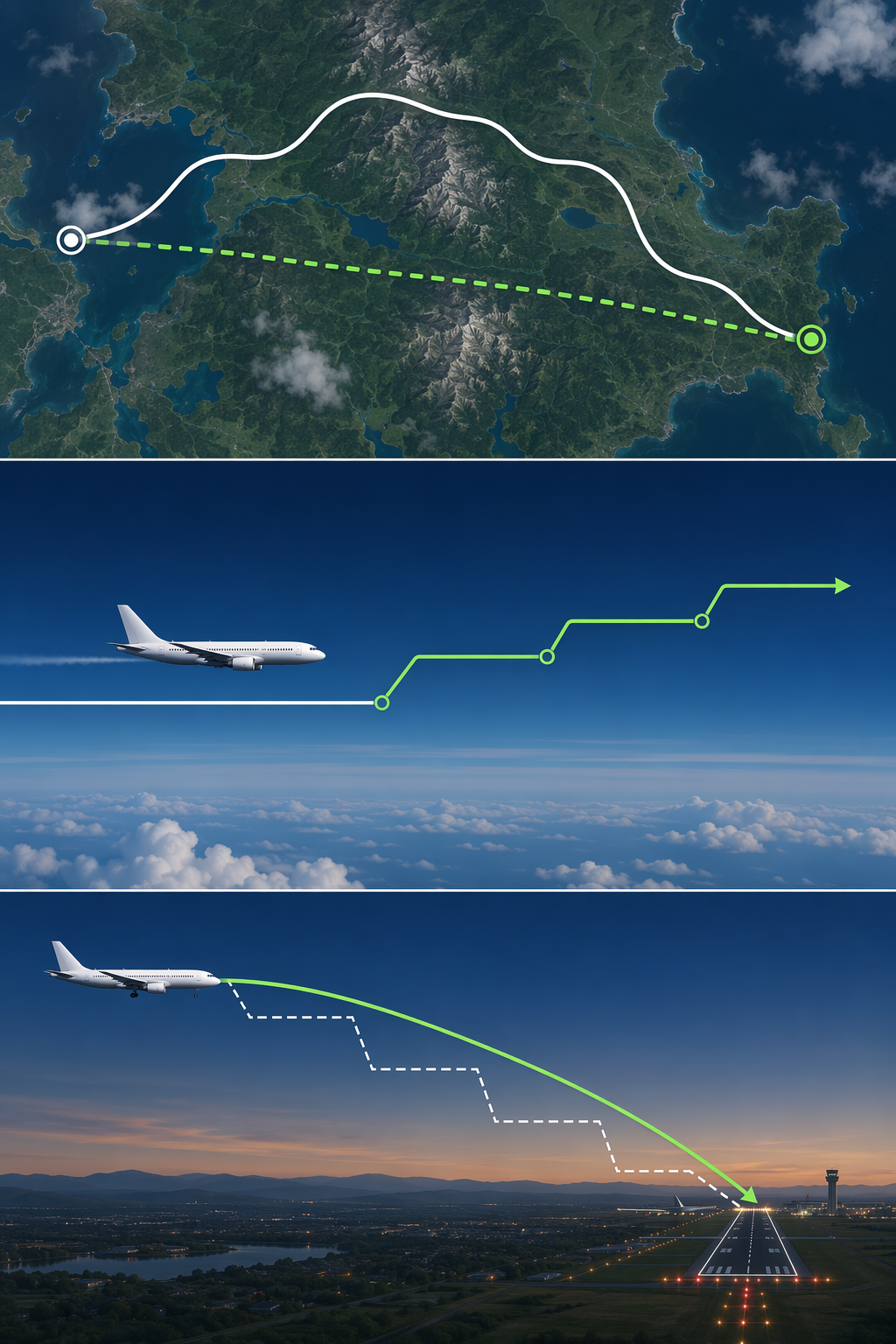
The Fuel Savings Come in Layers
The easiest mistake is to talk about “the AI” as if one optimization pass finds one perfect answer. In practice, the savings are layered. Some come from the side view of the flight. Some come from the top-down map. Some come near arrival, where a good descent can be lost to sequencing or weather. None of these layers is new to aviation; the difference is the speed, scale, and timing with which software can keep looking for feasible improvements.
Lateral: Shortcuts Are Valuable Only When They Are Actually Available
Lateral optimization is the most visible layer because it looks like the classic airline fuel-saving story: fly fewer miles. A system watches route structure, weather, congestion, and operating constraints, then identifies direct routings or shortcuts that may beat the filed path. If the recommendation reaches the dispatcher or crew while the aircraft can still use it, the benefit can be real.
This is also where numbers can become slippery. OpenAirlines says AI can identify up to 30% additional fuel savings through shortcut recommendations compared with standard airline operations. That figure should be read as applying to the shortcut opportunity, not as a claim that total flight fuel falls by 30%. It is a context-specific improvement inside one optimization layer, and it depends on whether ATC, weather, route structure, and the flight’s remaining profile make the shortcut usable. [3]
Alaska’s reported experience fits this operating reality better than a blanket savings claim. The useful detail is not only the 3–5% savings reported on longer flights, but the fact that more than 55% of offered flights received optimization opportunities. That suggests a screening process: the system is not claiming every aircraft needs a new route; it is finding flights where a change is worth presenting. [1]
Vertical: The Best Altitude Changes as the Flight Changes
Vertical optimization is less photogenic and often more operationally interesting. The best cruise altitude is not fixed at release. Aircraft weight changes as fuel burns. Winds and temperature vary by altitude. Turbulence, convective weather, restricted airspace, and traffic flows can make a theoretically efficient level impractical. A step climb that was not worth requesting earlier may become worthwhile later; a planned altitude may no longer be the least-bad option once the actual aircraft and actual atmosphere show up.
AI systems help by evaluating more combinations than a human team can reasonably keep current across a live network. That does not mean the model owns the clearance. It means the model can keep generating candidate profiles, rank them by expected fuel effect and operational feasibility, and push the few that deserve human attention into the tools dispatchers and pilots already use.
The difference from a static planning table is especially important for aging or individually variable aircraft. If performance factors are updated daily from recent flight data, the system can notice that one tail is not behaving like the generic aircraft model. OpenAirlines describes this kind of frequent performance-factor update as part of the move from data collection to operational decision support. [2]
Approach: Small Descent Decisions Add Up Across a Network
Approach optimization has a different character. By the time the aircraft is descending, the fuel remaining to be saved is smaller than at cruise, and ATC sequencing may dominate what is possible. But inefficient descents are common enough in real operations to deserve attention: level-offs, late descents, speed changes, and vectoring all turn a clean profile into something more fuel-intensive.
Continuous descent operations are not an AI invention. The role of AI is to help identify where the airline is losing descent efficiency, which airports or procedures produce the biggest pattern of avoidable burn, and where a crew-facing or dispatcher-facing recommendation can be made without adding workload at the wrong moment. For a fuel manager, this layer often looks less like a single spectacular save and more like a repeatable reduction in unnecessary level flight.
What the Data-to-Decision Pipeline Has to Do
The operational promise depends on a plain, unforgiving sequence. First, the airline has to collect reliable flight data. Then it has to clean and align that data so the model can distinguish aircraft behavior from noise, missing records, configuration differences, and environmental effects. Then the system has to turn historical learning into recommendations that still respect today’s route, weather, payload, aircraft condition, and airspace.
- Ingest QAR or FDR data, flight plans, actual trajectories, weather, fuel burn, aircraft configuration, and operating constraints.
- Preprocess the data so tail-specific performance, environmental conditions, and operational events are not mixed into one unreliable average.
- Train models on historical flights while retaining physics-based aircraft performance logic where regulatory and engineering discipline require it.
- Refresh performance factors and forecasts often enough that recommendations reflect the current fleet and current operating day.
- Deliver recommendations through dispatcher tools or EFB apps with enough explanation for crews and operations teams to decide whether to act.
The hybrid part matters. Aviation fuel optimization is not a good place for a generic language model guessing from text patterns. The useful systems are domain-trained and purpose-built, with aircraft performance constraints, flight data, weather, and operational rules built into the modeling environment. The more safety-critical the recommendation becomes, the less acceptable it is for the answer to arrive without traceability or a way for trained staff to challenge it.
Data quality is the implementation constraint that rarely looks exciting in a demo. Poor input data can make the model confident in the wrong direction: a tail appears inefficient because of bad sensor records, a route appears superior because the weather normalization was weak, or an airport pattern looks controllable when ATC sequencing was the real driver. No airline should treat algorithm sophistication as a substitute for preprocessing, validation, and performance-team review.
A More Cautious Rollout Looks Like Flair
Flair Airlines’ StorkJet deployment is useful because the reported savings are smaller and the rollout path is more recognizable. In an Aircraft IT case study published in Q1 2025, Flair reported about a 0.9% fuel reduction per flight after AI integration, around 50 kg of fuel saved per flight, and 3,200 tons of CO2 avoided annually. The case describes a phased movement from aircraft performance monitoring toward a real-time flight profile optimization app. [4]
That sequence is worth more attention than the headline percentage. Performance monitoring first gives the airline a way to understand its fleet, validate data, and build trust in the model’s view of actual aircraft behavior. Only after that does the real-time optimization layer become credible. A carrier that jumps straight to live recommendations without knowing whether its performance baseline is sound is asking dispatchers and pilots to absorb uncertainty that should have been handled upstream.
The Flair number also keeps expectations grounded. A 0.9% per-flight reduction is not a dashboard miracle, but across an airline operation it is not trivial. It suggests the kind of early gain an airline might see when better performance data and profile optimization start changing decisions flight by flight. Full-year 2026 results were not available in the supplied material, so the case should be treated as an early reported deployment result rather than a mature long-term benchmark. [4]
Where Dispatchers and Pilots Fit
A recommendation that cannot be accepted in the operation is not an optimization; it is clutter. The system has to fit into the dispatch release process, inflight monitoring, crew communication, and post-flight review. If it sends too many weak suggestions, people stop listening. If it hides assumptions, performance teams cannot validate it. If it ignores ATC practicality, the cockpit becomes the filter for a problem that should have been screened earlier.
The strongest deployments make the model an additional layer of operational awareness. Dispatchers can see why a route change is being proposed. Pilots can judge whether a requested altitude or direct routing is compatible with the aircraft and the flight environment. Fuel managers can review accepted and rejected recommendations after the fact, separating missed opportunity from impossible opportunity.
This is where adoption and effectiveness part ways. An airline can install an EFB app or dashboard and still capture little value if the recommendations are late, noisy, or poorly trusted. Conversely, a narrow tool that reliably improves one decision point may be more valuable than a broad platform that produces impressive but operationally thin suggestions.
How to Read the Savings Claims
The reported results are meaningful, but they are not interchangeable. Alaska’s 3–5% figure applies to flights longer than 4 hours in its reported deployment, while Flair’s approximately 0.9% reduction is presented as a per-flight result from a different airline, vendor, network, and rollout stage. OpenAirlines’ shortcut figure refers to additional savings through shortcut recommendations, not total trip fuel. [1][3][4]
Source attribution also matters. The available deployment stories are vendor-originated, airline-published, or co-authored case material. That does not make them unusable; aviation operations often become visible through vendor and airline disclosures first. It does mean the figures should be read as reported outcomes from named implementations, not as independent proof that every carrier will achieve the same percentage.
For an airline evaluating vendors, the better questions are practical. Which data sources does the model require? How are aircraft performance factors updated? What is the review process for bad recommendations? Can dispatchers see the assumptions behind a proposed reroute or altitude change? How often are recommendations accepted, rejected, or overridden, and why? Does the system measure opportunities that were impossible because of ATC or weather separately from opportunities the airline simply missed?
AI flight planning is credible when it is domain-trained, data-rich, and embedded in the decisions that dispatchers and pilots already have to make. The savings come from accumulated improvements across route, altitude, descent, and aircraft performance understanding. They should be treated as operational results to validate, not as guaranteed per-flight outcomes to paste into a business case without the denominator, the opportunity context, and the airline’s data readiness.
References
- How AI is helping Alaska Airlines plan better flight routes and lower emissions, Alaska Airlines newsroom
- From Data to Decision: How AI Transforms Raw Data into Fuel Savings, OpenAirlines
- How AI is Revolutionizing Fuel Efficiency in Aviation, OpenAirlines
- Case Study: AI-powered solutions as the key to operational efficiency and sustainability at Flair Airlines, Aircraft IT, Q1 2025
Comments
Join the discussion with an anonymous comment.