
For a commodity buyer, the useful question is not whether AI can “predict the market.” It is whether AI commodity price forecasting procurement teams can use in production changes a buying decision early enough to matter: pull forward a polyethylene order, delay a copper buy, adjust a natural gas hedge, challenge an index formula, or defend a should-cost position before the next supplier negotiation.
That narrower claim now has evidence behind it. Roland Berger’s CostIQ work back-tested AI-driven timing optimization across aluminum, copper, nickel, natural gas, crude oil, methanol, polyethylene, corn, and soybeans, and reported a 3–5% average purchase price reduction with minimized risk.[1] The important part is the boundary: this is not a broad procurement transformation number. It is a timing optimization result across defined commodity classes, tied to a buying decision.
A second useful proof point comes from a peer-reviewed Procedia CIRP study of an LSTM-based procurement system. Over a defined period from November 2022 to October 2024, the AI-based ordering approach outperformed normal ordering by 4%.[2] That does not prove every commodity team should expect the same result. It does show that, under a bounded operating comparison, AI-assisted ordering can beat the existing ordering routine.

That is enough to treat AI commodity price forecasting as a serious procurement use case. It is not enough to treat it as insurance against volatility. Copper forecasting examples still show quarterly swings of 20–30%, a reminder that even a better signal can leave a buyer operating inside a wide band of uncertainty.[3] In categories exposed to energy shocks, weather, crop conditions, geopolitics, freight disruption, or policy moves, the practical value sits in probability-weighted decisions, not certainty.
The measurable value is in timing, not clairvoyance
Commodity buying already involves a forecast, even when no model is present. A category manager chooses whether to buy now or later, whether to lock a contract price or float against an index, whether to use spot exposure or futures coverage, and whether to carry more inventory when prices are likely to rise. AI changes the quality and speed of that forecast, but it does not remove the decision owner.
The clearest procurement levers are:
- When to buy: advancing, delaying, or staging purchases when the forecast distribution shifts.
- How much to buy: adjusting order quantities when carrying cost, stockout risk, and expected price movement justify a change.
- Which exposure to hold: balancing spot, fixed-price, indexed, and futures-linked instruments where the organization is allowed to use them.
- How to negotiate: using forecast ranges and should-cost targets to challenge supplier price increases or reset contract indexation.
Roland Berger’s 3–5% result is credible because it sits close to these levers. It does not ask the reader to accept that AI will redesign the full source-to-pay function, rewrite specifications, benchmark every supplier, clean spend taxonomies, and forecast demand all at once. It asks whether better timing across nine commodity classes can reduce average purchase price while controlling risk.[1]
That distinction matters when comparing ROI claims. Broader procurement AI programs may include demand planning, supplier-price benchmarking, spend classification, specification rationalization, automated negotiation support, and workflow productivity. Those are valid workstreams, but they are not the same measurement as commodity price forecasting. Readers who want the broader evidence base can compare it separately in AI Procurement Tools: What the ROI Data Actually Shows.
What the model is actually doing
A production forecasting workflow starts with procurement’s own record of behavior: purchase orders, order dates, supplier records, contract terms, index formulas, volumes, delivery windows, inventory constraints, and realized prices. That internal data is then joined with external drivers: market prices, macro indicators, weather, geopolitical signals, satellite imagery, crop or production indicators, and energy inputs where relevant.
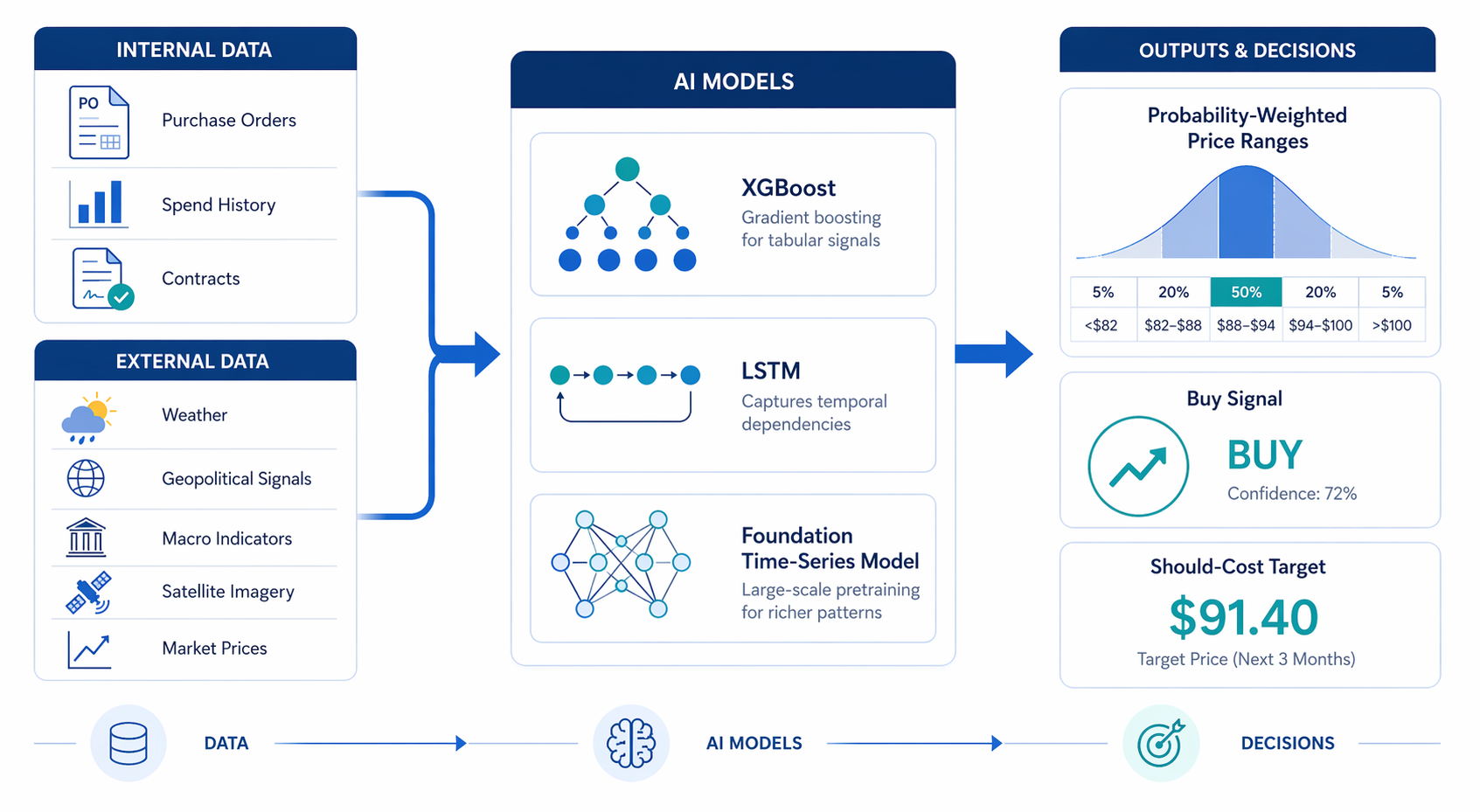
The modeling layer can vary. In current procurement and commodity forecasting discussions, the methods range from tree-based machine learning such as XGBoost to recurrent neural networks such as LSTM, and newer foundation time-series models such as Chronos-2, released in 2025. The LSTM study is useful here because it does not merely show a price chart; it connects the model output to ordering and inventory decisions over a two-year window.[2]
The output is usually not a single number that says copper will be a specific price on a specific date. Commodity forecasting tools increasingly present probabilistic ranges, confidence bands, and scenario-weighted signals. Agiboo describes this distinction directly: AI forecasting in commodity trading is more useful when it produces probabilistic price ranges rather than pretending to remove uncertainty.[4]
| Input | What it helps explain | Procurement decision affected |
|---|---|---|
| Purchase order and spend history | Actual buying cadence, supplier exposure, realized price | Timing and order quantity |
| Contracts and index formulas | How market movement flows into paid price | Indexation and renegotiation |
| Market price feeds | Recent price trend and volatility | Spot versus fixed-price decisions |
| Weather and crop indicators | Supply risk in agriculture and some energy-linked categories | Forward buys and inventory buffers |
| Macro and geopolitical signals | Demand shocks, sanctions, tariffs, production disruption | Scenario planning and hedge review |
| Satellite imagery or production indicators | Physical supply signals where available | Should-cost and supply risk review |
For the buyer, the dashboard should translate those signals into a decision frame: expected price range, upside and downside risk, recommended buy window, confidence level, and the cost of being wrong. A signal that says “buy now” without showing the baseline, range, and sensitivity is hard to defend in a sourcing review. A signal that says the near-term upside risk has widened, the downside is limited, and the recommendation is to cover a defined share of expected demand is easier to put in front of finance.
This is also where commodity price forecasting differs from general spend analytics, though it depends on the same foundation. If P.O. history is fragmented, supplier names are duplicated, price units are inconsistent, or contract terms are missing, the model may spend more effort learning data noise than market behavior. Teams still building that foundation should treat machine learning in spend analytics as a prerequisite, not a separate nice-to-have.
The evidence is promising, but the scopes do not match
There are three different evidence types in this market, and they should not be blended into one savings claim.
| Evidence type | What it supports | What it does not prove |
|---|---|---|
| Roland Berger CostIQ back-tests | 3–5% average purchase price reduction from timing optimization across nine commodity classes | A guaranteed result for every buyer or every commodity |
| Procedia CIRP LSTM procurement study | 4% improvement over normal ordering from November 2022 to October 2024 | General performance across all materials, time periods, or organizations |
| Vendor client claims | Possible capabilities, implementation patterns, and commercial language | Independent market-wide effectiveness |
| Broad procurement AI research | The wider potential of analytics and automation across procurement | A commodity forecasting-specific ROI benchmark |
McKinsey’s June 2024 procurement AI work, for example, says predictive analytics can lower procurement costs by up to 15% and improve spend visibility by 35%.[5] Those figures are useful for understanding the broader procurement analytics opportunity. They should not be used as a direct substitute for a commodity price forecasting business case unless the organization is also funding the wider data and operating-model changes behind them.
Vendor claims deserve the same labeling. Aranca describes client outcomes including 5–30% savings through contract negotiation and 90–95% budget accuracy.[6] Thinklytics frames broader AI procurement programs around material-cost reduction, with reported implementation costs of $220,000–$480,000 for the first three use cases and supplier-price benchmarking as a fastest-payback use case in 90 days.[7] Pacemaker.ai has made a 97–99% forecast accuracy claim in a Handelsblatt interview.[8] These may be relevant inputs for a market scan, but they are vendor-sourced and not independent head-to-head benchmarks.
That does not make vendor material useless. It often explains data requirements, workflow design, integration patterns, and how tools are packaged. It just belongs in the supporting evidence layer. If a sourcing director is comparing build, buy, and specialist-tool options, the right frame is a market taxonomy and requirements fit, not a search for a universal accuracy percentage. A separate view of procurement AI tools in 2026 is more useful for that exercise.
Where the forecast enters procurement work
The best implementation designs do not ask category teams to admire a forecast. They place the forecast where a decision already happens.
- Monthly category review: compare expected price ranges against open demand, contract coverage, and inventory position.
- Sourcing event preparation: use forecast ranges to set negotiation targets and test supplier escalation logic.
- Hedge committee or risk review: document the model signal, human decision, exposure level, and downside scenario.
- Budget cycle: translate commodity scenarios into price assumptions rather than relying on a single annual estimate.
- Contract renewal: decide whether index formulas, reset frequency, collar structures, or pass-through clauses need to change.
The workflow is strongest when it records both the model recommendation and the human override. If a buyer rejects a buy signal because a plant has storage constraints, because finance has hedge limits, or because a supplier cannot deliver earlier, that context should be captured. Otherwise the next performance review will confuse a bad forecast with a good forecast that could not be acted on.
This is why commodity forecasting belongs among the higher-impact AI use cases in procurement, but only for organizations with meaningful exposure. A 3% timing improvement is material when the spend base is large, volatile, and contractually responsive. It is not worth the same implementation effort in a low-volatility tail category where price movement barely affects margin.
The hard part is not the demo forecast
The implementation constraints are ordinary, which makes them easy to underestimate. Gartner’s 2025 warning, cited in Art of Procurement’s State of AI in Procurement 2026, says 74% of procurement leaders report that their data is not AI-ready.[9] For commodity price forecasting, that problem shows up quickly: missing unit conversions, incomplete P.O. history, inconsistent supplier identifiers, unlinked contract terms, and market price feeds that do not match the actual buying basis.
The MIT 2025 finding that 95% of enterprise AI pilots fail is broader than procurement and broader than commodity forecasting, but the warning is still relevant.[10] A working model in a sandbox is not the same as a decision process that survives budget review, legal constraints, finance oversight, and category-manager turnover.
Hackett’s 2025 CPO Agenda Report shows the same gap from a procurement angle: 49% of organizations had piloted AI, while only 4% had reached large-scale deployment.[11] That spread is the difference between a convincing proof of concept and a governed operating capability. Teams trying to close it usually need a phased implementation path, not another dashboard; a practical roadmap is covered in AI in Procurement Implementation: A Phased Roadmap.
A procurement team evaluating this use case should press for four answers before buying or building anything:
- Baseline: Is the claimed saving measured against normal ordering, budget price, market index, last paid price, or a simulated strategy?
- Decision scope: Does the model influence timing, quantity, hedging, contract indexation, negotiation targets, or all of them?
- Commodity fit: Has the model been tested on the same commodity, geography, contract basis, and volatility regime?
- Governance: Who can act on the signal, who can override it, and how are missed calls reviewed?
- Monitoring: How often is performance compared with the baseline, and what triggers retraining or withdrawal of the model?
Data readiness should be assessed before the business case is locked, not after the contract is signed. If the organization cannot connect demand, P.O.s, contracts, supplier records, and external price series at the right grain, the first investment is likely to be data plumbing. A formal data readiness assessment for AI procurement automation is more valuable than a high-accuracy claim that depends on data the company does not actually have.
What to expect from the next generation
The frontier is moving from forecast assistance toward more autonomous category workflows. McKinsey has described agentic AI in procurement as offering 25–40% efficiency improvement, but that is an operating-efficiency outlook, not a commodity price forecasting accuracy benchmark.[5] For commodity categories, the near-term practical step is still supervised decision support: forecast, recommend, document, review.
Autonomous agents may eventually assemble market briefs, monitor contract triggers, draft hedge committee memos, or propose index changes. They should not quietly commit a company to a major metals, energy, chemicals, or agribusiness exposure without accountable human approval. Readers evaluating that adjacent frontier should separate it from the forecasting question and look at agentic AI in procurement on its own terms.
The decision standard
AI commodity price forecasting is worth evaluating when three conditions are present: commodity exposure is large enough for a few percentage points of timing improvement to matter, historical and external data are clean enough to train and monitor a model, and procurement governance can keep humans accountable for buy, hedge, and contract decisions.
It is a weaker fit when the category has little volatility, limited spend, no ability to change timing or contract structure, or data so fragmented that the model cannot be audited. It is also a poor fit when leadership wants a clean savings headline without accepting that forecasts can miss shocks.
The honest conclusion is narrower and stronger than the marketing version. AI commodity price forecasting has crossed into measurable production value for specific commodity-heavy categories. It can improve timing, ordering, exposure review, and negotiation support. It cannot guarantee protection against volatile markets, and it will not compensate for unusable procurement data or absent decision governance.
References
- AI-driven commodity price optimization — Roland Berger
- AI-based Procurement System: Optimization of Material Ordering and Inventory Management in Volatile Markets — ScienceDirect / Procedia CIRP — 2025
- Forecasting Copper Prices: How AI Is Changing Cost Analysis — Mashik
- AI in commodity price forecasting: how it transforms trading — Agiboo — April 2025
- Revolutionizing procurement: Leveraging data and AI for strategic advantage — McKinsey — June 2024
- Commodity Price Intelligence and Price Forecasting — Aranca
- AI Procurement Cuts Material Cost 15-45% — Thinklytics
- Handelsblatt interview — Pacemaker.ai
- State of AI in Procurement 2026 — Art of Procurement — 2026
- The GenAI Divide: State of AI in Business 2025 — MIT — 2025
- 2025 CPO Agenda Report — The Hackett Group — 2025
Comments
Join the discussion with an anonymous comment.