
A winter storm does not become an airline crisis the moment snow reaches the runway. It becomes one when the first workable aircraft decision creates a crew legality problem, the crew fix breaks passenger connections, and the passenger reaccommodation plan consumes gates that the aircraft recovery plan assumed would be free. That is the operating problem behind AI airline disruption management: not whether software can produce a nicer alert, but whether the airline can stop solving the same disruption in separate queues.
Winter Storm Fern in January 2026, with more than 11,400 cancellations, was a useful pressure test because it exposed recovery design rather than just weather severity.[1] In a large irregular operation, the first delay is rarely the only expensive one. The cost accumulates in handoffs: aircraft control waits for crew scheduling; crew scheduling waits for legality checks; airport teams wait for gate assignments; customer teams wait for a reaccommodation answer they can safely send.
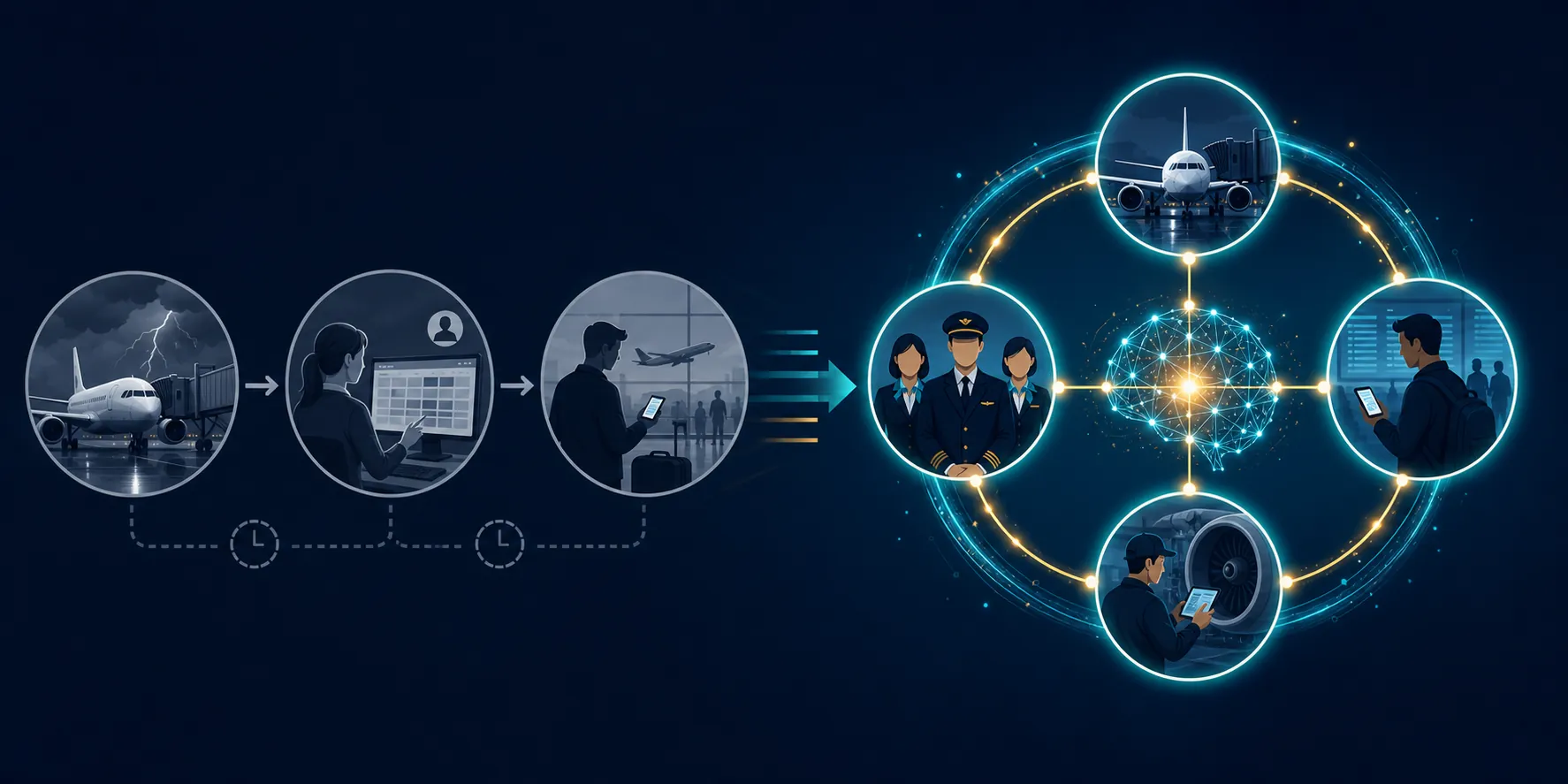
The Old Recovery Sequence Creates Its Own Rework
The familiar disruption sequence is orderly on paper. First, recover the aircraft. Then find legal crew. Then protect passengers. Then update stations, contact centers, and digital channels. In normal operations, that sequencing keeps accountability clear. Under network stress, it can turn accountability into latency.
An aircraft swap that looks efficient from a tail-assignment view may strand a crew that times out before the replacement aircraft arrives. A crew solution may preserve the departing flight but pull reserves from a later bank. A passenger rebooking push may protect high-volume connections but flood a hub gate area that was already constrained by deicing, ground staffing, or late inbound aircraft. Each team is making defensible decisions with the slice of the operation it can see.
That is why the relevant shift is not from human judgment to machine judgment. It is from serial constraint checking to parallel constraint optimization. The difference matters because the recovery clock is not just the time required to compute a plan. It is the time required for that plan to survive contact with aircraft routing, duty clocks, maintenance limits, passenger itineraries, station capacity, and the communication channels that tell people what to do next.
What Parallel Optimization Changes
In a parallel model, the disruption engine does not wait for aircraft recovery to finish before crew and passenger effects are evaluated. It considers linked variables at the same time: which aircraft can operate which legs, which crews remain legal after reassignment, which maintenance requirements cannot be violated, which passenger flows have the highest misconnection exposure, which airports have gate or staffing constraints, and which messages can be sent without being contradicted ten minutes later.
| Recovery Question | Sequential Model | Parallel Optimization Model |
|---|---|---|
| Aircraft | Find a replacement tail or reroute aircraft first | Evaluate tail options against crew, maintenance, gate, and passenger consequences |
| Crew | Check legality after the aircraft plan changes | Screen duty limits, reserve availability, and fatigue exposure while aircraft options are still being compared |
| Passengers | Rebook after flight decisions are finalized | Estimate misconnection and reaccommodation impact before the recovery plan is locked |
| Stations and gates | React to the chosen operating plan | Treat local capacity as a constraint in the recovery calculation |
| Communication | Send updates once teams confirm the answer | Trigger customer and staff messages from a plan that has already passed cross-functional checks |
The practical gain is not that every decision becomes automatic. Many should not. Controllers still need to choose between protecting the last flight of the night, preserving an international connection bank, or canceling early enough to keep crews and aircraft in position for the morning. AI earns its keep when it shortens the interval between seeing the tradeoff and acting on a plan that will not be immediately invalidated by another desk.
Predictive inputs change the timing as well. Weather impact modeling can move the recovery discussion ahead of the airport closure. Maintenance prediction can keep an apparently available aircraft from being assigned into a route it is unlikely to complete. Crew fatigue models can show that a legal assignment may still create fragility later in the day. Passenger reaccommodation data can reveal whether one cancellation protects more itineraries than a set of rolling delays that leave people missing the same downstream bank.
For operations leaders, the important word is “together.” A better dashboard may display more conditions. A parallel optimizer tests whether the candidate solution remains usable when those conditions interact.
Delta Shows the Customer Impact of Earlier Recovery Decisions
Delta is the clearest operating example in the available evidence, though the provenance matters. A 2025 MetaLumna article citing Delta describes an operation of 5,400 daily flights, a 99.85% completion factor, and 80% of disrupted passengers auto-rebooked before they contacted an agent.[2] Those are not neutral audited industry benchmarks; they are source-labeled outcome figures. They are still operationally useful because the 80% figure describes an action taken before the queue forms.
That distinction matters in a disruption room. A passenger who is auto-rebooked before calling does not disappear from the operation, but the passenger no longer needs the same manual intervention at the same moment as everyone else. Contact-center load, airport-service-desk pressure, and gate-agent exception handling all change when the recovery system reaches the traveler first.
The same source describes Delta’s Operations Control Center using predictive disruption management that includes weather impact modeling, maintenance prediction, and crew fatigue models.[2] That combination is the point. Weather alone says where the network will be stressed. Maintenance and crew models help decide which recovery options will still be usable after the first move. Passenger automation shows whether the operating plan has reached the people who otherwise join the angry queue.
United Frames the Race Around Decision Speed
United’s public framing is sharper and more competitive. CIO Jason Birnbaum told CIO.com that “the airline that makes complex decisions fastest wins,” a line that sounds like technology strategy but lands squarely in operations control.[3] During disruption recovery, speed is not cosmetic. A slow correct answer can become wrong while it waits for confirmation.
United also scaled AI-powered customer messaging from 5% to 35% of disruption communications, according to CIO.com in April 2025.[3] The communications number should not be mistaken for full recovery effectiveness. It does not prove that aircraft or crew plans improved by the same proportion. What it does show is that automated disruption response is moving out of the control room and into the passenger-facing execution layer.
That layer has to be tied to the operating truth. Sending faster messages is valuable only if the answer behind the message can survive the next crew legality check, gate change, or aircraft substitution. Otherwise, automation merely accelerates contradiction.
Air France-KLM Points to a Shared Production Layer
Air France-KLM’s generative AI factory model points to another part of the operating shift: the move toward a cloud-based shared production layer for disruption response.[4] The phrase sounds less dramatic than an optimizer cutting through a storm day, but it addresses a stubborn airline problem. If each function builds its own tools on separate data, the airline may digitize the handoff problem rather than remove it.
A shared layer does not, by itself, recover an aircraft or protect a crew pairing. Its value is that disruption products can draw from common operational context instead of rebuilding assumptions desk by desk. For a multi-airline group, that matters because the production burden is not only analytical. It is governance, reuse, security, and getting useful tools into the hands of operational teams without creating a new stack of disconnected experiments.
SITA’s OCCam Move Commercializes the Parallel Model
SITA’s June 2026 acquisition of Big Blue Analytics brought OCCam into the center of the airline technology market. SITA described OCCam as a parallel optimization platform and said it can cut disruption costs by up to 30%.[5] For a mid-size carrier with about 100 aircraft and annual disruption costs of $70 million to $80 million, SITA estimated savings of $20 million to $30 million.[5]
Those are vendor claims, and they should be read that way. The press release does not provide named airline deployments, operating durations, or baseline definitions in the material available here. “Up to 30%” is a signal, not a guarantee. Still, the acquisition is important because it shows the model being packaged as a commercial operating platform rather than a bespoke analytics project.
The best use of the SITA figure is to frame the size of the prize, not to close the case. If an airline can reduce total disruption cost by 25% to 30%, the impact reaches well beyond a technology budget. It touches crew utilization, hotel and meal costs, aircraft positioning, station overtime, reaccommodation expense, and the revenue damage that follows unreliable recovery.
The Financial Case Is Directional, Not Self-Proving
Several industry estimates point in the same direction, but they are not interchangeable. Microsoft’s cloud blog cited Worldmetrics in saying AI-powered decision-making can reduce underlying drivers of flight delays by up to 35%.[6] That is useful as a directional benchmark from a technology provider, not as an independent audit of airline recovery performance.
BCG’s 2025 Build for the Future study found that only 1 of 36 surveyed airlines met its “AI-future built” criteria and projected that AI-first airlines could have operating margins 5 to 6 percentage points higher than peers by 2030.[7] The sample size is part of the claim: this is a survey-based strategic view of readiness and projected advantage, not evidence that most airlines have already crossed the implementation line.
The broader cost pool is large enough to explain the urgency. INFORM Software, citing Wipro estimates, has put global disruption cost at $60 billion, or 8% of industry revenue.[8] Because that figure is routed through vendor marketing content, it should not carry more weight than it can bear. It does, however, put a scale around why disruption recovery is now a board-level efficiency and reliability question rather than a narrow operations-control problem.
The Integration Barrier Separates Tools From Operating Capability
The bottleneck is not whether airlines can find AI products. It is whether the optimizer can act on reality. Legacy reservation systems, crew management tools, maintenance platforms, departure-control systems, airport resource systems, and customer messaging tools were not designed as one living model of the airline. Many were built to protect their own domain, and in daily operations that separation can look manageable. During disruption recovery, it becomes the delay.

That is why the reported barrier that 25% to 35% of deployments exceed timelines is not a side caveat.[9] It is the practical divider between airlines that can use AI as an operating capability and airlines that will keep it as a planning-room demonstration. If the aircraft picture updates faster than the crew picture, or passenger reaccommodation cannot be triggered from the same decision state, the airline is back to coordinating partial truths.
Good integration work is unglamorous: data definitions, latency targets, exception ownership, audit trails, fallback procedures, and clear rules for when a controller overrides the recommendation. These are not bureaucratic leftovers. They are the conditions that let an optimizer recommend an action that crews, stations, maintenance, revenue, and customer teams can actually execute.
What Changes When the Recovery Window Shrinks
The strongest claim for AI disruption recovery is not that airlines become disruption-proof. They do not. Weather will still close airports, aircraft will still break, crews will still time out, and passenger itineraries will still be fragile when a hub bank slips. The claim is narrower and more operationally meaningful: when aircraft, crew, passengers, maintenance, and communications are evaluated together, the airline can reduce rework inside the recovery window.
The evidence available here supports a move from roughly 4.5 hours of disruption recovery time toward about 1.8 hours for AI-enabled parallel optimization, with early-adopter and vendor-reported cost reductions in the 25% to 30% range.[5][9] The exact result for any carrier will depend on network structure, fleet complexity, labor rules, hub exposure, data quality, and how much authority the recovery engine has to trigger operational action.
That is enough to change the competitive question. AI airline disruption management is no longer just an efficiency tool if it lets a carrier protect cost, completion, crew utilization, and passenger trust in the same compressed recovery cycle. The advantage will not go to the airline with the most impressive demo. It will go to the airline whose old systems are connected well enough for the optimizer to see the real operation, recommend a survivable plan, and move that plan into execution before the next bank of flights inherits the mess.
References
- Winter Storm Fern flight cancellation data, FlightAware, January 2026.
- Delta Air Lines AI disruption management coverage, MetaLumna, 2025.
- United Airlines CIO Jason Birnbaum on AI and disruption communications, CIO.com, April 2025.
- Air France-KLM generative AI factory model, Air France-KLM.
- SITA acquires Big Blue Analytics to transform airline disruption management, SITA, June 2026.
- How AI is helping airlines reduce flight delays, Microsoft Cloud Blog, October 2024.
- Build for the Future 2025, Boston Consulting Group, 2025.
- Airline disruption management cost estimates citing Wipro, INFORM Software.
- AI airline deployment timeline and recovery benchmark data, SITA.
Comments
Join the discussion with an anonymous comment.