
Disruption is already a planning problem
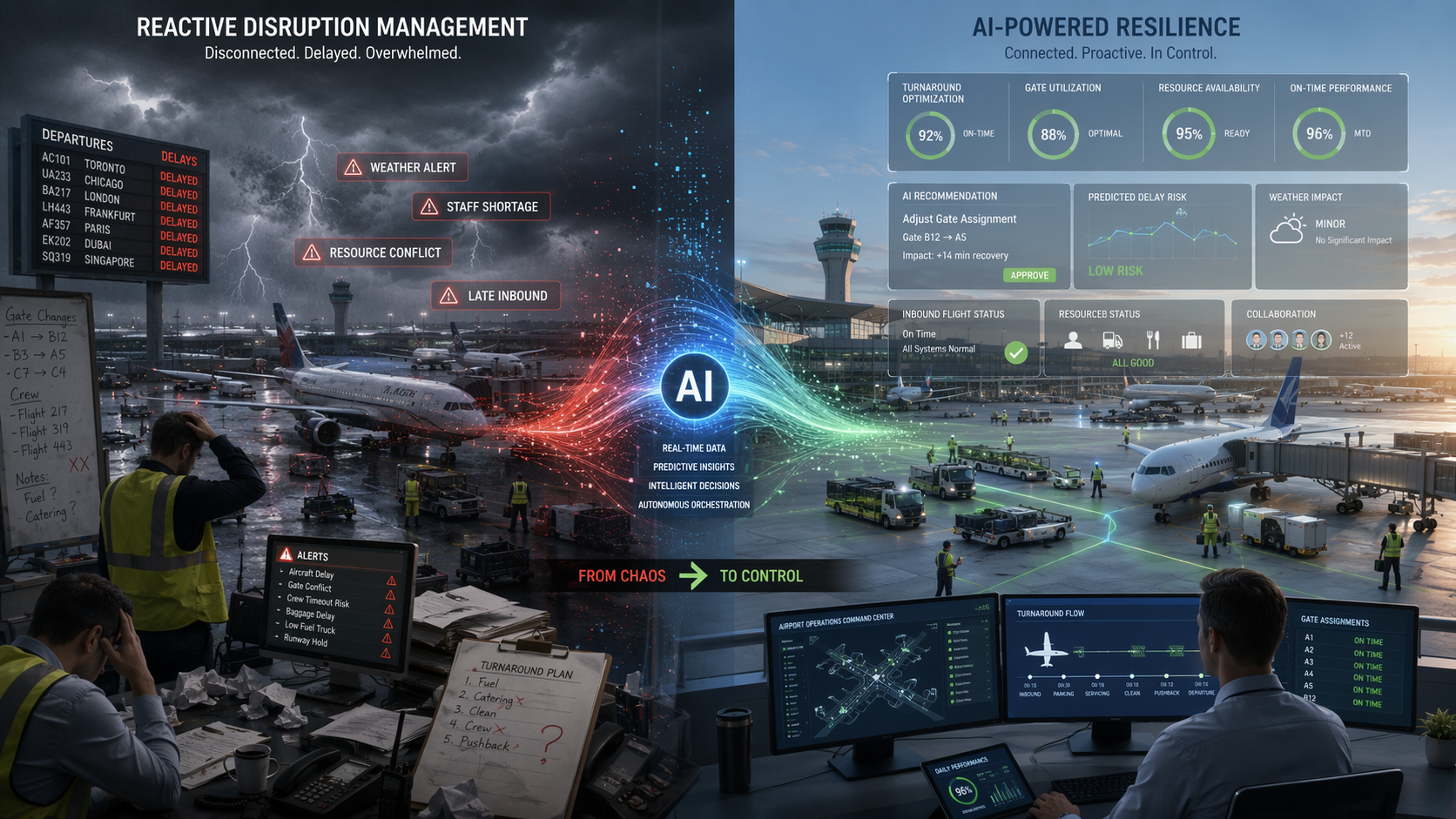
Nearly 60% of flight delays come from causes airlines and airports can influence rather than weather, which is why airport disruption logistics planning begins as a handoff problem long before it becomes an emergency response [1]. A delayed inbound turns into a stand conflict, the conflict forces gate changes, the gate change tightens crew and servicing windows, and the missed turnaround pushes the next departure bank into the same corner. The broader anticipation layer sits upstream of that chain and is covered in How AI Anticipates Airport Logistics Disruptions Before They Cascade, but the operational test here is whether the signal reaches the people who can still move aircraft, stands, crews, and passengers in time.
Forecasting matters only if it reaches the planner early
That is where predictive delay forecasting earns its place. A 2026 MarketIntelo report puts machine-learning models at 82–88% accuracy for forecasting disruptions 24 hours ahead, compared with 45–50% for traditional statistical methods [2]. The point is not that the model predicts every event perfectly. The point is that airport teams get a usable head start often enough to change what happens next: reserve a stand, pre-position towing or servicing, keep a crew reassignment from becoming last-minute scramble, or hold a gate for an inbound that would otherwise get pushed into a bad corner.
MarketIntelo’s same estimate also puts the airline disruption management AI market at $3.2 billion in 2025, rising to $12.8 billion by 2034 at a 16.8% CAGR [2]. That is one forecast, not a consensus. Still, it fits what airport operators are already buying: earlier warning, cleaner prioritization, and fewer cases where the recovery desk learns about the problem only after the next departure sequence has already started to slip.
Stand and gate optimization is where prediction becomes action
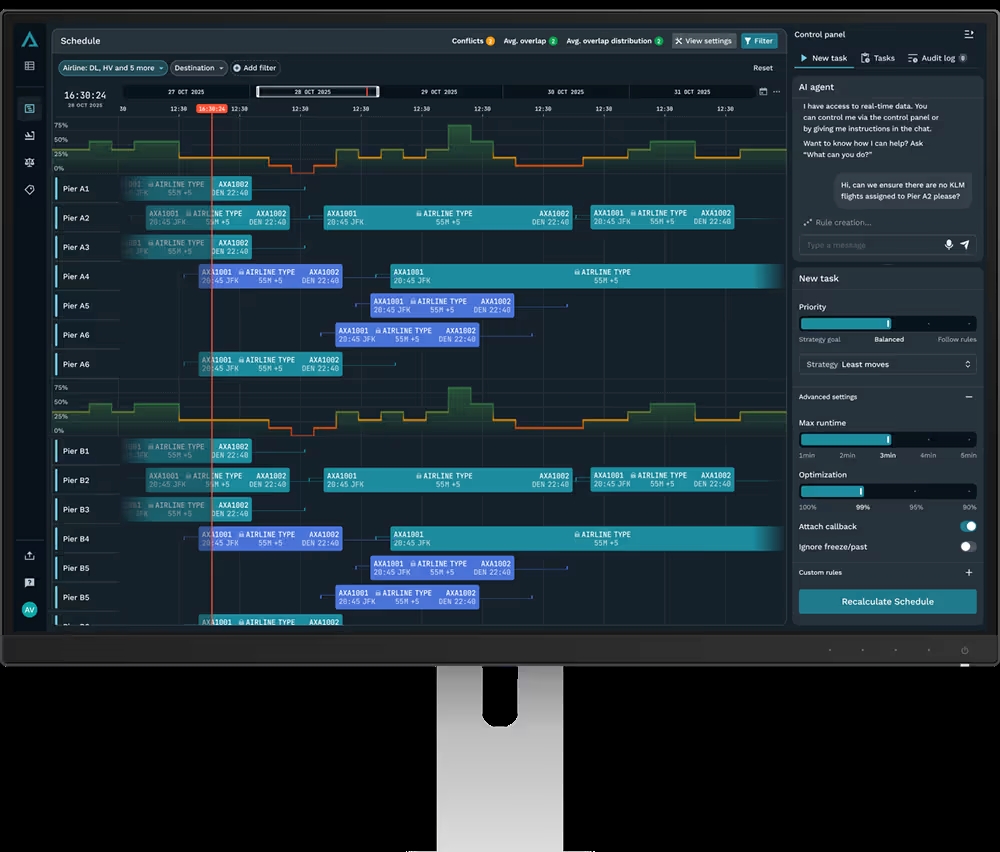
The strongest operational gains show up when the forecast is tied to live stand and gate allocation. Assaia’s StandManager is designed around dynamic predictive buffers, and the company says it can raise effective capacity by up to 5% without new infrastructure [3]. That matters because a stand is not just a parking spot; it is a constraint on the rest of the departure chain. If the stand is wrong, the ramp team waits, the gate team absorbs the delay, and the turnaround loses margin before the aircraft has even reached the box.
Assaia also reported that an AI gating system for American Airlines at Dallas Fort Worth saved 870,000 gallons of fuel annually [3]. That kind of outcome is easy to misread if it is presented as an AI triumph in the abstract. What it actually shows is a scheduling discipline effect: less taxiing around the apron, fewer unnecessary moves, and less time spent idling while the next decision is being made. For airport ops teams, those are not cosmetic improvements. They are delay minutes, fuel burn, and stand pressure coming off the board.
Recovery planning has to coordinate aircraft, crew, and passengers together
Once the disruption has widened beyond a single gate change, the useful question becomes whether recovery is being planned in pieces or as one connected problem. SITA’s OCCam platform is built to optimize aircraft, crew, and passenger recovery at the same time, and the company says it can cut disruption costs by up to 30% [4]. On the basis SITA gives, that would translate to roughly $20 million to $30 million in annual savings for a 100-aircraft carrier with a $70 million to $80 million disruption-cost baseline [4].
That estimate is useful because it keeps the conversation where airport recovery work actually lives: not in a single isolated optimization, but in the trade-offs between aircraft rotations, crew legality, passenger reaccommodation, and the timing of the next wave of departures. A gate-only fix can still leave the rest of the operation in pieces. Integrated recovery planning is the step that tries to stop one disruption from becoming three.
Digital twins test failure chains before the day they happen
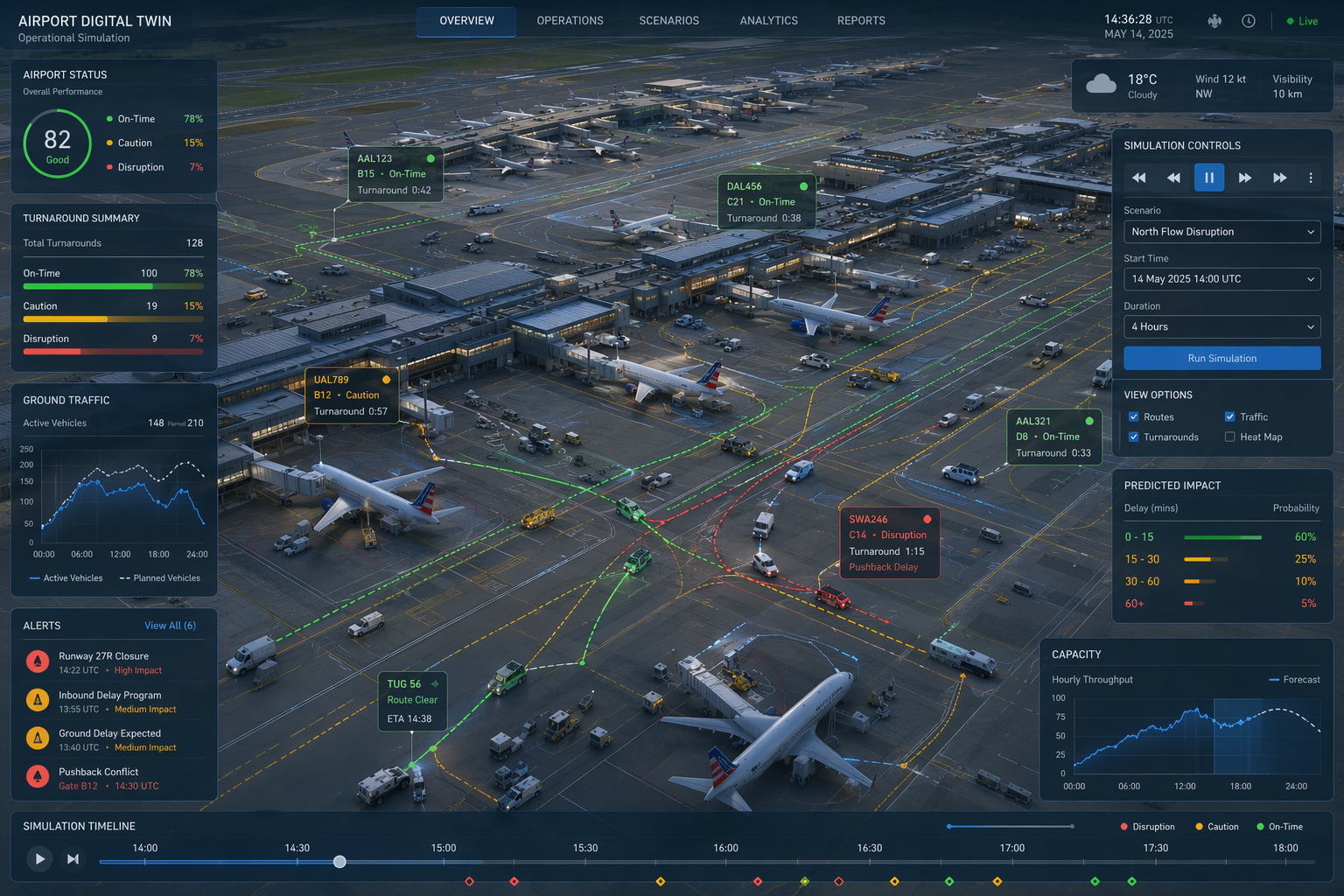
The next layer down is simulation. The UF SPEAR project, funded by the NSF and reported in June 2026, is modeling cascading disruption effects at Dallas Fort Worth International Airport, which handles 86 million passengers a year [5]. It is an academic effort, not a deployed commercial control system, and it should be read that way. Its value is that it shows how digital-twin-style methods can expose where a delay chain is likely to break, where it will back up, and which local constraint turns into the next operational bottleneck.
That distinction matters. A digital twin is not a promise that the airport can eliminate disruption. It is a way to test scenarios, compare recovery options, and see the hidden dependencies that a live day can conceal until the pressure is already there. For leaders deciding where AI belongs in disruption logistics, that is enough to make it relevant. For leaders looking for a substitute for clean data and disciplined operating rules, it is not.
The constraint is no longer model sophistication
Taken together, these systems point in the same direction: airport disruption logistics is moving from reactive recovery toward proactive operational resilience. Forecasting improves the input to the day-of-ops desk. Stand and gate optimization turns that signal into a better allocation decision. Integrated recovery planning keeps the response from fragmenting across silos. Digital twins let teams test the chain before the real chain fails. The architecture is becoming more connected, not more magical.
The remaining bottleneck is not whether the model is sophisticated enough. It is whether the underlying data is clean, connected, and timely enough for the system to trust: flight status, stand inventory, crew availability, turnaround milestones, ground-handling updates, and the handoffs between them. That is the hard plumbing the airport has to build or already have in place. When it is there, the gains are measurable. When it is not, AI only adds another layer of noise.
References
- OAG report citing US DOT data on controllable flight delays.
- MarketIntelo report (2026) on AI forecasting accuracy and the airline disruption management AI market.
- Assaia press release (March 2026) on StandManager and AI gating fuel savings.
- SITA press release (June 2026) on OCCam and coordinated disruption recovery.
- UF SPEAR NSF-funded study (June 2026) on cascading disruption effects at Dallas Fort Worth International Airport.
Comments
Join the discussion with an anonymous comment.