
The AI Skills Gap in Supply Chain: 387% Demand Growth, 1.6% Posting Mention
The numbers are stark. According to Gartner research published in June 2026, demand for supply chain roles requiring AI skills surged 387% between the first quarter of 2023 and the first quarter of 2026. That figure is based on an analysis of over 35 million job postings, including nearly 600,000 supply chain-specific roles. Mid-senior level positions account for 58% of all supply chain jobs that now list AI as a required competency.
Yet here is the contradiction that should concern every L&D manager and supply chain leader: only 1.6% of supply chain job postings explicitly mention AI skills. The demand is real and accelerating, but the market has not yet translated that need into clear hiring signals. Organizations cannot simply hire their way out of this gap — the talent pool is too shallow and the skill requirements are evolving too quickly.
The implication for anyone evaluating an AI in supply chain course is clear: the credential matters far less than whether the program actually builds the capabilities your teams will need on the job. Most courses, however, are not designed for that outcome.
Why Most Courses Fail: The Theory Trap
The prevailing approach to AI education in supply chain follows a predictable pattern: start with the history of artificial intelligence, explain neural networks at a conceptual level, walk through a few high-profile case studies, and end with a generic framework for "AI strategy." The problem is not that this content is wrong — it is that it leaves learners unprepared for the specific, technical, and judgment-heavy work that AI adoption actually requires.
Research from SCOPE Recruiting, published in December 2025, found that skills in AI-adjacent supply chain roles are changing 25% faster than in jobs less affected by AI. A course designed around static theory cannot keep pace. The shelf life of a generic AI literacy module is measured in months, not years.
The result is a mismatch between training spend and operational readiness. Organizations invest in courses that produce certificates but not competence. Learners complete programs feeling informed about AI in the abstract but unable to validate a forecast output, write a useful prompt for demand sensing, or manage an exception flagged by an autonomous planning system.
The Three-Layer Capability Framework for AI in Supply Chain
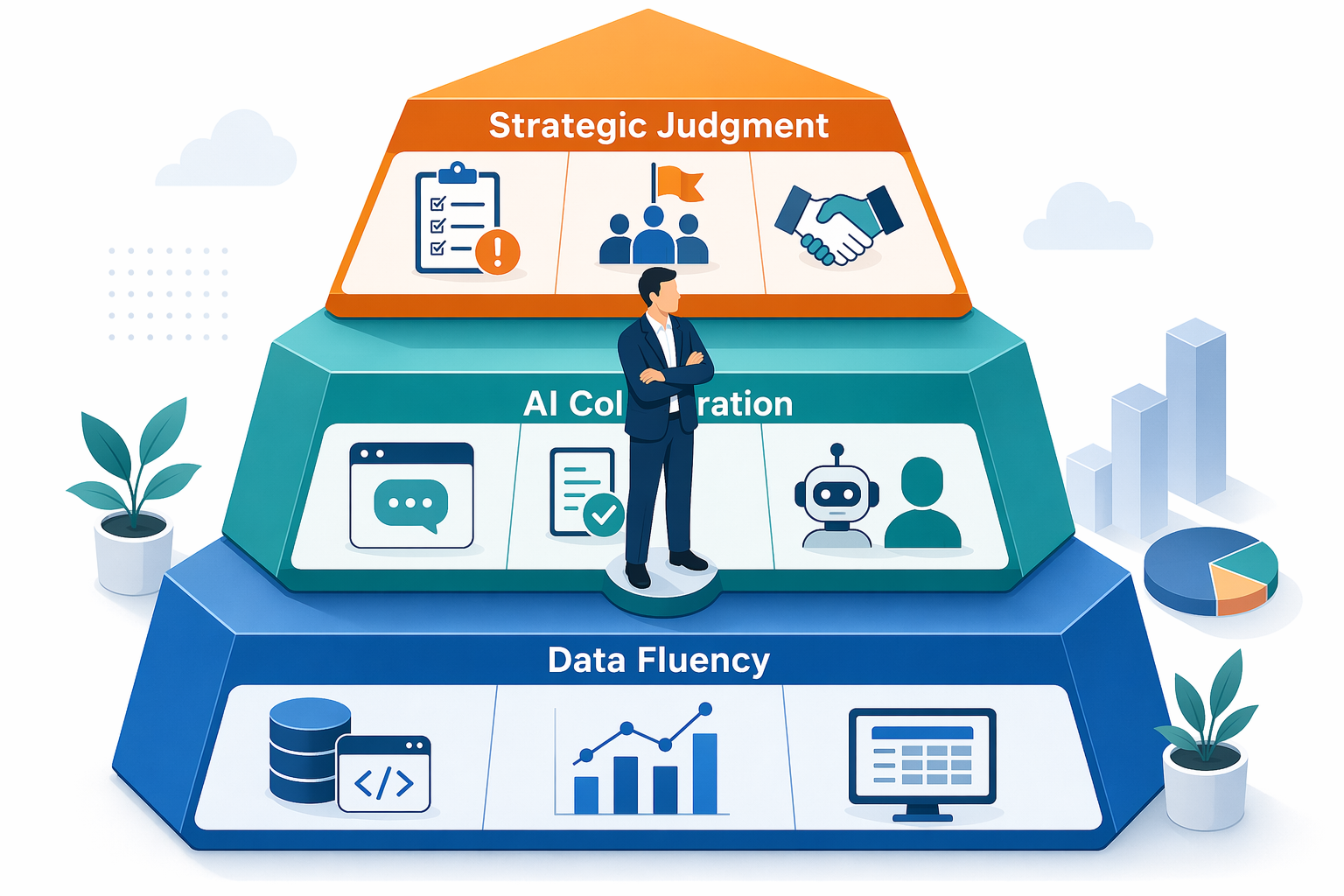
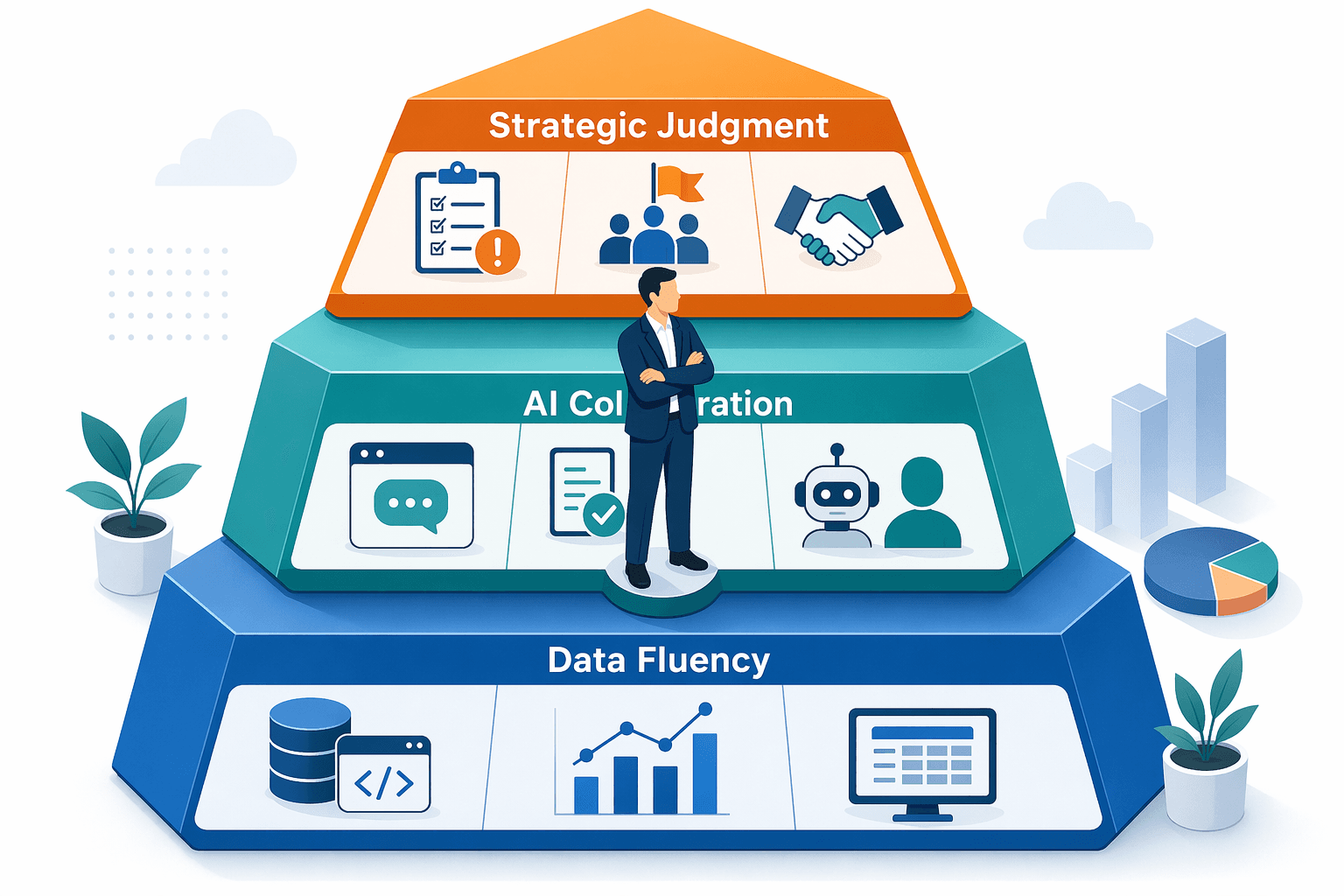
A more useful way to evaluate courses is through a capability framework grounded in what supply chain professionals actually do when AI tools are in production. The three-layer model, drawn from SCOPE Recruiting's analysis of hiring data and role evolution, defines the skill stack in order of operational priority.
Layer 1: Foundational Technical Fluency
This is the non-negotiable base layer. It includes ERP system mastery, SQL for data querying, data visualization literacy, and increasingly, basic Python. Without these skills, a supply chain professional cannot independently access the data that feeds AI models, cannot verify the inputs, and cannot interpret the outputs in the context of their specific operational environment.
Most courses skip this layer entirely, assuming learners either already have these skills or do not need them. Both assumptions are wrong. A demand planner who cannot write a basic SQL join cannot validate whether the forecast model is pulling the correct historical data. A procurement manager who cannot build a simple dashboard cannot monitor supplier risk scores in real time.
Layer 2: AI Collaboration Skills
This middle layer covers the skills needed to work alongside AI systems effectively. Prompt engineering is the most visible example, but the capability set is broader: output validation (knowing when a model's recommendation is plausible versus spurious), working with autonomous systems that make routine decisions without human intervention, and understanding model confidence intervals and uncertainty.
These are not data science skills. They are operational skills adapted to a human-AI collaborative environment. A logistics coordinator using an AI-powered routing tool needs to know when to override the recommendation based on local knowledge the model cannot capture. A procurement analyst using generative AI for contract review needs to recognize hallucinated clauses.
Layer 3: Strategic Judgment
The top layer is where human judgment becomes the differentiator. Exception management — deciding which AI-flagged anomalies require escalation and which can be handled automatically — is a strategic skill, not a technical one. Change leadership, cross-functional communication, and supplier relationship management become more important as AI handles more of the routine analytical work.
Gartner has warned that 60% of supply chain digital adoption efforts will fail by 2028 due to underinvestment in human judgment skills. This layer is where that failure originates. Organizations that train only on technical AI skills while neglecting strategic judgment are building teams that can operate AI tools but cannot govern them.
Mapping Courses to the Capability Framework
Not all courses are created equal, and the three-layer framework provides a practical way to differentiate them. The table below maps several prominent programs to the capability layers they address, based on publicly available curriculum information.
| Course / Provider | Layer 1: Technical Fluency | Layer 2: AI Collaboration | Layer 3: Strategic Judgment | Key Strength |
|---|---|---|---|---|
| ELVTR — AI in Supply Chain Management (Jason Gillespie, DHL) | Partial (data cleaning with ChatGPT) | Strong (prompt engineering, chatbot building, demand forecasting demos) | Partial (final project pitch deck, risk mitigation) | Applied, practitioner-led curriculum with real-world demos |
| MIT CTL — The AI-Driven Supply Chain ($6k, 1 week) | Strong (Python, time series, deep learning, computer vision) | Strong (LLM fine-tuning, RAG, multi-agent orchestration) | Limited (focus is technical depth, not change management) | Advanced technical skills for leaders managing AI teams |
| Georgia Tech — Generative AI for Supply Chain (LOG 1010P) | Moderate (data literacy prerequisite, no coding required) | Strong (prompt engineering, GenAI use cases) | Moderate (maturity continuum, roadmap development) | Accessible entry point for non-technical professionals |
| Coursera / AI CERTs — AI in Supply Chain | Moderate (data analysis for decisions) | Moderate (ML, generative AI applications) | Limited (focus on process improvement, not leadership) | Structured, self-paced with multiple format options |
| GSDC — Certified Generative AI for Supply Chain ($150-$300) | Moderate (TensorFlow, PyTorch, Hugging Face overview) | Strong (GANs, VAEs, transformers, agentic AI) | Limited (ethics and compliance module, but no change leadership) | Broad technical coverage at a low price point |
| LinkedIn Learning / CSCMP — Generative AI for Supply Chain Certificate | Weak (no hands-on technical skills) | Moderate (GenAI in supply chains module) | Moderate (digital transformation, business strategy) | Quick, accessible overview for busy professionals |
| SCMDOJO — AI in Procurement Basics ($16.60) | Weak (introductory, no coding) | Weak (basic AI concepts) | Weak (focused on procurement process, not judgment) | Low-cost entry point for procurement-specific AI awareness |
For readers who want detailed pricing, credential information, and enrollment logistics, the comprehensive certification comparison on this site provides that data. The framework above is intended to complement that resource by answering a different question: not "which course costs less," but "which course builds the capabilities my team actually needs."
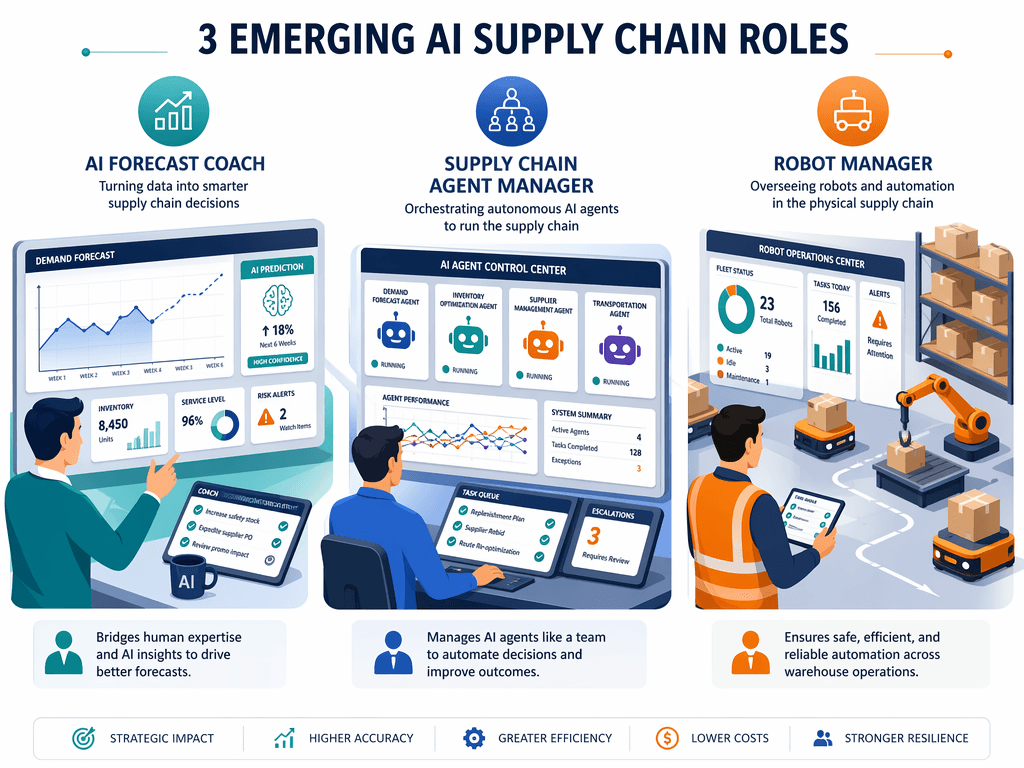
Skills for Emerging Roles: AI Forecast Coach, Supply Chain Agent Manager, Robot Manager
The three-layer framework is not static. As AI adoption matures, entirely new roles are emerging that blend technical fluency, AI collaboration, and strategic judgment in novel combinations. SCOPE Recruiting has identified several of these roles in its 2025-2026 labor market analysis.
AI Forecast Coach
This role does not build forecast models — it supervises them. The AI Forecast Coach monitors model performance, identifies drift, adjusts input parameters, and decides when to retrain. The skill requirements map directly to the framework: technical fluency to understand model inputs and outputs, AI collaboration to interpret confidence intervals and uncertainty, and strategic judgment to determine when human override is warranted.
Supply Chain Agent Manager
As agentic AI systems become capable of executing multi-step tasks — negotiating with suppliers, adjusting inventory targets, rerouting shipments — organizations will need professionals who manage these agents. The Supply Chain Agent Manager defines the boundaries within which agents operate, audits their decisions, and handles escalations. This role requires strong AI collaboration skills (understanding agent behavior and failure modes) and strategic judgment (defining governance rules and exception protocols).
Robot Manager
Warehouse robotics and autonomous guided vehicles are already common in large-scale operations. The Robot Manager role coordinates fleets of physical AI systems, optimizing their deployment, monitoring their performance, and intervening when exceptions occur. Technical fluency with automation systems and data analysis is essential, but so is the strategic judgment to balance automation throughput against safety, maintenance schedules, and labor relations.
These roles are not hypothetical. SCOPE Recruiting's analysis shows that entry-level transactional roles face a 90-95% likelihood of reduction by 2035. The professionals who will remain — and thrive — are those who can supervise, collaborate with, and govern AI systems. L&D buyers evaluating courses today should ask whether the curriculum prepares learners for these emerging roles, not just for current job descriptions.
Build vs. Buy: What Enterprise Upskilling Investments Tell Us
The largest employers in the world have already made their bet. Amazon invested $1.2 billion in upskilling more than 300,000 employees. Walmart committed nearly $1 billion and partnered with OpenAI to offer free AI certifications to its workforce. These are not charitable programs — they are strategic responses to a labor market that cannot supply the talent these companies need.
The message for mid-market and enterprise supply chain organizations is clear: build, do not buy. The external hiring market for AI-skilled supply chain professionals is thin and expensive. SCOPE Recruiting data shows that AI-related supply chain roles earn 25-30% more than peers in identical roles without the AI skill requirement. Even if you can find the talent, the premium is substantial.
The enterprise upskilling investments also reveal something about which skills matter most. Amazon and Walmart are not funding generic AI literacy programs. They are investing in role-specific training that builds the exact capabilities their operations need — data analysis for warehouse managers, prompt engineering for procurement teams, automation oversight for logistics coordinators. The three-layer framework aligns with this approach: train for the capability, not for the certificate.
L&D Buyer Checklist: How to Evaluate an AI Supply Chain Course
For L&D managers and supply chain leaders evaluating training investments, the three-layer framework provides a structured evaluation tool. Use the following criteria when assessing any AI in supply chain course.
- Does the course require or build foundational technical fluency? Look for hands-on work with data — SQL queries, dashboard creation, or basic Python. If the course promises "no coding required" and delivers only conceptual content, it is not building Layer 1 skills.
- Does the course teach AI collaboration skills explicitly? Prompt engineering is the most common example, but also look for output validation exercises, model confidence interpretation, and scenarios where learners must decide whether to accept or override an AI recommendation.
- Does the course address strategic judgment? Change management, exception handling, and governance are the key indicators. If the curriculum is purely technical, it is incomplete.
- Does the course use real data and real tools? Courses that rely on toy datasets or hypothetical scenarios do not prepare learners for the messiness of production environments. Look for courses that use actual ERP extracts, real demand histories, or live API interactions.
- Who teaches the course? Practitioner-led courses — like ELVTR's program taught by DHL's Jason Gillespie — tend to emphasize applied skills over theory. Academic programs may offer deeper technical foundations but often lack operational context.
- Does the course map to emerging roles? If the curriculum only covers current job descriptions, it may have a short shelf life. Programs that address agentic AI, model governance, or multi-system orchestration are preparing learners for the next wave of roles.
For a step-by-step process that walks through vendor selection, needs assessment, and ROI calculation, see the decision framework for choosing an AI supply chain course. That guide complements the capability framework here by addressing the procurement and evaluation process itself.
| Evaluation Criterion | Red Flag (Avoid) | Green Flag (Consider) |
|---|---|---|
| Technical fluency | "No technical background required" with no hands-on component | Includes SQL, Python, or data visualization exercises |
| AI collaboration | Only covers AI history and concepts | Includes prompt engineering, output validation, and agent oversight |
| Strategic judgment | No mention of change management or governance | Dedicated module on exception handling, ethics, or leadership |
| Real-world application | Uses only hypothetical examples | Uses real datasets, case studies, or live tool demonstrations |
| Instructor background | Academic-only with no industry experience | Current or recent practitioner in supply chain AI |
| Future readiness | Covers only current tools and roles | Addresses agentic AI, model governance, or emerging roles |
The Bottom Line: Invest in Skills, Not Certificates
The credential on a certificate matters far less than whether the person holding it can do the work. A course that produces a certificate but leaves the learner unable to validate a forecast, write an effective prompt, or manage an AI system exception has failed — regardless of the institution's brand name.
The three-layer capability framework — foundational technical fluency, AI collaboration skills, and strategic judgment — provides a practical lens for evaluating training investments. It is grounded in labor market data, aligned with how enterprise upskillers like Amazon and Walmart are spending their training dollars, and designed to prepare professionals for the roles that are emerging, not just the ones that exist today.
Gartner's warning that 60% of supply chain digital adoption efforts will fail by 2028 due to underinvestment in human judgment skills is not a prediction — it is a challenge. Organizations that treat AI training as a checkbox exercise will produce teams that can operate AI tools but cannot govern them. Organizations that invest in a layered capability stack will build teams that can collaborate with AI, challenge it when necessary, and make the strategic decisions that machines cannot.
For a deeper look at what happens when organizations underinvest in these human skills, the analysis of why most AI supply chain projects fail provides case-level evidence of the consequences. And for L&D buyers who want to understand what specific AI applications their teams need to support, the AI use case library maps the operational contexts where AI skills will be applied.
Comments
Join the discussion with an anonymous comment.