
Why 'One Course Fits All' Fails Supply Chain Professionals
The market for AI-in-supply-chain education has exploded. A supply chain professional in 2026 can choose from a $49 Coursera module completed over a long weekend, a $1,500 three-day intensive at Georgia Tech, or a $6,000 five-day executive program at MIT. The cost range spans roughly 120x, and the time commitment varies from five hours to six weeks. Yet most professionals select courses the same way they select conference sessions — by brand recognition or colleague recommendation — without systematically matching the program to their own role, technical baseline, or career trajectory.
This mismatch has real consequences. A demand planner who needs hands-on Python experience with forecasting models will get little value from a conceptual executive overview. A VP of supply chain who needs to evaluate agentic AI vendors will find a beginner-level platform certificate frustratingly shallow. And an operations manager seeking employer sponsorship for a $6,000 program needs a business case that connects training investment to measurable outcomes — not just a course catalog link.
The stakes are rising. According to Scope Recruiting, AI-related supply chain roles now command a 25-30% salary premium over identical positions without AI responsibilities, and job postings requiring AI skills grew 86% from December 2022 to December 2024. Yet only 1.6% of supply chain job postings explicitly mention AI skills — meaning the professionals who invest in structured AI education today are positioning themselves in a thin, high-demand segment of the labor market. The wrong course choice delays that positioning. The right one accelerates it.
Self-Assessment: Where Do You Stand?
Before evaluating any course, you need a clear picture of your starting point. Three factors determine which program will serve you best: your current role, your AI literacy level, and your employer's AI maturity.
Role-Based Self-Diagnostic
| Role | Typical AI Exposure Today | Primary Learning Need | Best Course Format |
|---|---|---|---|
| Supply Chain Planner / Analyst | Low — uses Excel or ERP forecasting modules | Hands-on ML forecasting, demand sensing, Python basics | Self-paced certificate with coding labs |
| Operations / Warehouse Manager | Medium — oversees WMS or TMS with basic analytics | AI use-case evaluation, implementation planning, vendor assessment | Practitioner workshop with real case studies |
| Procurement / Sourcing Specialist | Low to Medium — uses spend analytics tools | AI in supplier scoring, contract analysis, spend classification | Platform certificate + domain-specific module |
| Supply Chain Director / VP | Medium to High — sponsors AI initiatives | Strategic AI roadmap, governance, ROI business case, agentic AI | University executive program |
| IT / Data Leader in Supply Chain | High — manages data pipelines or analytics teams | ML architecture, model deployment, MLOps, integration patterns | Advanced technical program or university intensive |
AI Literacy Levels
Beyond role, your current comfort with AI concepts determines how much foundational material you need. Use this quick classification:
- Level 1 — AI Aware: You understand what machine learning and generative AI are at a conceptual level but have never used an AI tool or written a prompt for a supply chain task.
- Level 2 — AI Conversant: You have experimented with ChatGPT or Copilot for supply chain tasks, can interpret a forecast accuracy metric, and understand the difference between supervised and unsupervised learning.
- Level 3 — AI Practitioner: You have built or deployed a simple model (e.g., a demand forecast using Python or a low-code platform), understand feature engineering basics, and can evaluate model output critically.
- Level 4 — AI Leader: You have overseen an AI deployment in production, understand model governance and drift monitoring, and can communicate AI strategy to both technical teams and executive stakeholders.
Employer AI Maturity Context
Your employer's adoption stage matters because it determines whether you will have opportunities to apply what you learn. A professional at a company with limited AI deployment may benefit more from a broad survey course that builds foundational literacy. Someone at an organization running pilot AI projects needs implementation-focused training. According to the Prologis 2026 report, 70% of companies now report advanced or transformational AI usage in their supply chains — but that also means 30% are still in early stages. Check your organization's AI maturity against the MHI 2024 Annual Industry Report benchmarks to calibrate your context.
Five Criteria for Evaluating Any AI-in-Supply-Chain Course
Once you know where you stand, the next step is evaluating individual courses against a consistent set of criteria. These five dimensions apply across all course types — from a $49 self-paced module to a $6,000 executive intensive.
1. Curriculum Depth vs. Breadth
A course that covers "AI in demand forecasting, inventory management, logistics, and supplier coordination" in three weeks is necessarily broad. A course that spends three days on generative AI for supply chain use cases alone is deeper in one area. Neither is inherently better — the right choice depends on whether you need foundational coverage or specialized depth. Look at the syllabus and count how many hours are allocated to each topic. If you cannot identify at least two modules that directly address your day-to-day work, the course is likely too broad for your needs. For a reference on the AI/ML terms and architectures you should expect to see in a quality curriculum, consult the AI/ML Technologies in Supply Chain glossary.
2. Hands-On vs. Conceptual
Supply chain AI is an applied field. A course that only presents slides and case studies will not prepare you to evaluate a vendor's forecast accuracy claims or build a simple demand sensing model. Look for programs that include: working with real or realistic datasets, using AI tools (even low-code or no-code platforms), completing a project that produces something you can show an employer, and graded assignments that require application, not just recall. The Georgia Tech generative AI course, for example, includes prompt engineering exercises and automated inventory system simulations. The MIT CTL advanced program covers ML, deep learning, and reinforcement learning with industry fireside chats and a site visit. These hands-on components are not optional extras — they are the primary mechanism through which learning transfers to practice.
3. Instructor Pedigree and Practitioner Credibility
Who teaches the course matters as much as what is taught. An instructor who has deployed AI in a supply chain context brings credibility that a purely academic instructor cannot match. For example, the ELVTR course is taught by Jason Gillespie, Senior Director of Continuous Improvement, Innovations, and Engineering at DHL Supply Chain — a practitioner who works inside a global logistics operation. The MIT xPRO program features Dr. Maria Jesús Saénz, Executive Director of MIT's SCM Master Programs. Check whether the instructor has held an operational supply chain role, led an AI implementation, or published peer-reviewed research on supply chain AI. If the instructor's biography is generic or absent, treat that as a red flag.
4. Certification Recognition in the Supply Chain Industry
Not all certificates carry equal weight. A certificate from MIT xPRO or Georgia Tech's Supply Chain & Logistics Institute signals to employers that you have completed a rigorous, institutionally vetted program. A certificate from Coursera or LinkedIn Learning signals self-directed learning but may not carry the same weight in a hiring decision. The CSCMP Generative AI certificate on LinkedIn Learning, which takes approximately five hours to complete, is useful for building baseline literacy but is unlikely to differentiate you in a competitive job market. If your goal is career advancement, prioritize programs whose credentials are recognized by the organizations you want to work for or by professional bodies like ASCM, CSCMP, or ISM. For a detailed comparison of Coursera's specific AI-in-supply-chain offerings, see our Coursera AI Supply Chain Course Comparison.
5. Cost-to-ROI Ratio
Cost is not a proxy for quality, but it is a real constraint — especially if you are self-funding. The decision framework should weigh the total cost (tuition, materials, travel if in-person, time away from work) against the expected return. For a $49 Coursera course, the ROI threshold is low: even a single new concept that improves your work is likely worth the investment. For a $6,000 MIT program, the ROI must be clear: a promotion, a salary increase, or a new role that would not have been accessible without the credential. The salary premium data from Scope Recruiting — 25-30% higher pay for AI-related supply chain roles — provides a useful benchmark. If a $6,000 program helps you move into an AI-adjacent role, the pay increase alone could justify the investment within a year. If you are in a role where AI skills are not yet valued, a lower-cost option may be more appropriate.
Landscape Map: Major Course Categories
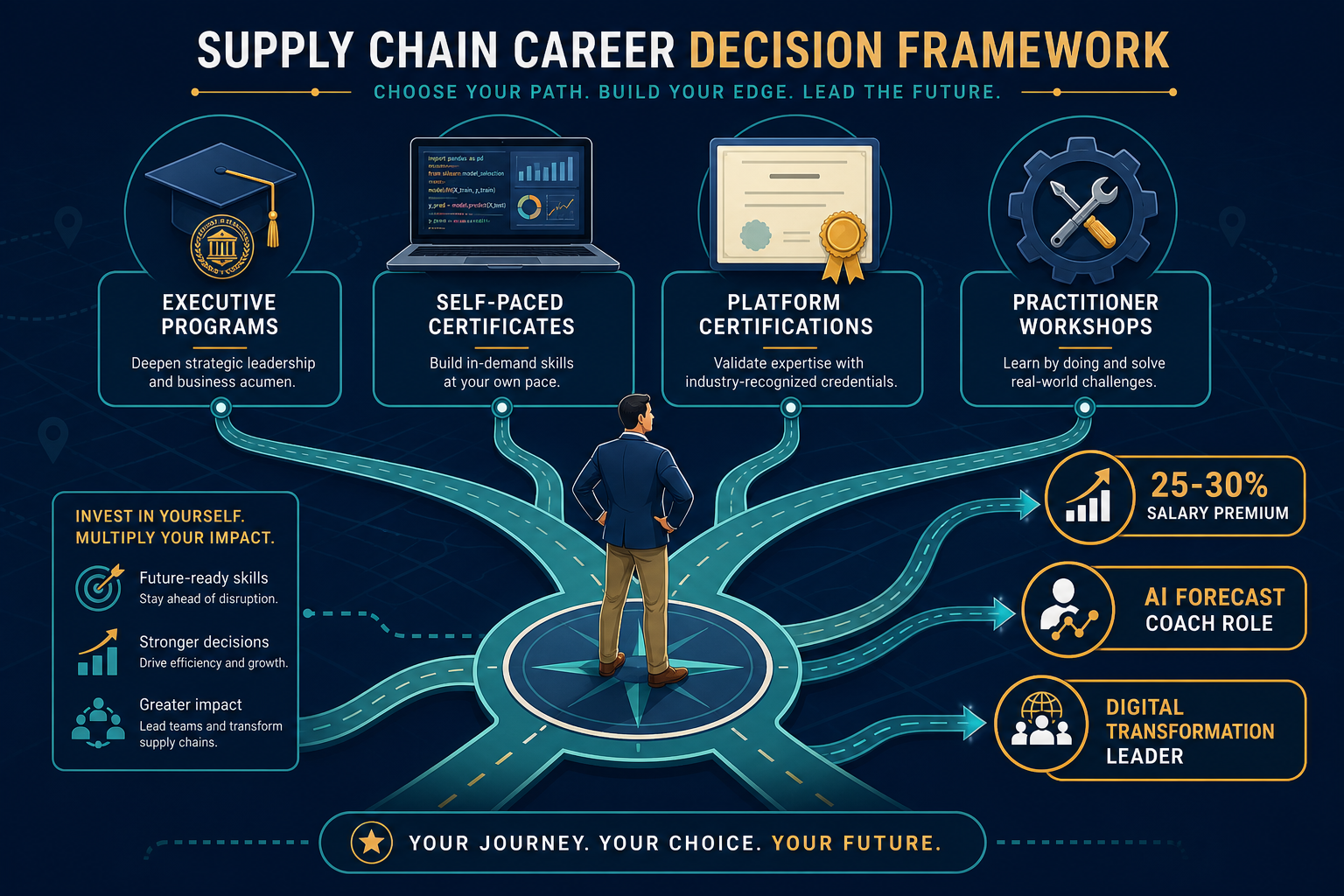
The AI-in-supply-chain education market falls into four broad categories. Each serves a different learner profile and career stage. Understanding the category structure helps you narrow your options before applying the five criteria.
| Category | Typical Cost Range | Time Commitment | Depth Level | Recognition | Ideal Learner |
|---|---|---|---|---|---|
| University Executive Programs | $1,500 – $6,000 | 3–5 days (in-person) or 6 weeks (online) | Advanced to Expert | High — institutional brand matters | Directors, VPs, senior managers leading AI initiatives |
| Platform Certificates | $49 – $79 | 3–10 hours (self-paced) | Beginner to Intermediate | Moderate — signals self-directed learning | Analysts, planners, procurement specialists building baseline literacy |
| Practitioner Workshops | $500 – $2,000 | 4–7 weeks (live online) | Intermediate to Advanced | Moderate to High — practitioner credibility | Operations managers, team leads implementing AI projects |
| Self-Paced Certifications | $200 – $1,000 | Varies widely | Beginner to Intermediate | Variable — depends on certifying body | Entry-level professionals, career changers |
Comments
Join the discussion with an anonymous comment.