
Why “MIT Supply Chain AI Certificate” Is a Misleading Search Term
If you searched for an “MIT Supply Chain AI Certificate” expecting to find a single, well-defined program, you are not alone. The reality is more complicated — and more expensive to get wrong. MIT runs at least four distinct educational offerings that sit at the intersection of supply chain management and artificial intelligence. They range from a $2,600, six-week online course to an $18,000, nine-month leadership program. None of them is called exactly what you typed into the search bar.
This fragmentation creates real confusion for supply chain directors, operations managers, and logistics heads who are trying to upskill without wasting time or budget. The programs differ not only in price and duration but in technical depth, delivery format, faculty, and the type of credential you walk away with. One explicitly states it does not provide a professional supply chain certificate. Another is a general AI program with a single supply chain capstone. A third requires you to be in Cambridge, Massachusetts for five days in July 2026.
This article maps all four programs side by side — curriculum, cost, format, audience fit, and what real learners say — so you can decide which investment actually matches your career stage and technical appetite.
Program A: MIT xPRO – Supply Chain Management: Leading with AI and Digital Transformation
This is the most targeted supply-chain-plus-AI program MIT offers in terms of price and focus. It is a six-week, fully online course priced at $2,600, requiring 4–6 hours per week. The faculty lead is Dr. Maria Jesús Saénz, Executive Director of MIT’s Supply Chain Management Master Programs and Director of the MIT Digital Supply Chain Transformation Lab.
Curriculum and Format
The curriculum covers resilience in global supply chains, a framework for digital transformation, end-to-end visibility, analytics and machine learning, AI applications, and emerging trends. It uses real-world case studies from companies like Cisco and Tetra Pak. Participant testimonials on the program page come from Coty Inc., Hershey, Johnson & Johnson, SAP, and Agthia Group.
The program is graded pass/fail with a 75% threshold. Completers receive a digital certificate of completion from MIT xPRO and 3.6 Continuing Education Units (CEUs).
Who It Is For
- Supply chain professionals who want a strategic overview of AI and digital transformation without deep technical coding.
- Managers in operations, logistics, strategy, and consulting roles who need a framework to lead digital change internally.
- Professionals with a limited budget and time window — $2,600 and six weeks is the lowest-cost, shortest SC+AI option from MIT.
Program B: MIT CTL – The AI-Driven Supply Chain: Advanced Training for Next-Gen Leaders
If Program A is the strategic overview, Program B is the technical deep dive. Offered by the MIT Center for Transportation and Logistics (CTL), this is a five-day, on-campus intensive running July 20–24, 2026, in Cambridge, Massachusetts. Tuition is $6,000, and there is no online or distance option.
Curriculum Depth
The program covers 13 technical modules, including:
- Introduction to machine learning
- Time series forecasting
- Deep learning
- Computer vision
- Reinforcement learning
- NLP for international trade and large-scale retail
- LLMs end-to-end (fine-tuning, RAG, safety mechanisms)
- State-space models for time series prediction
- Tool-enabled LLM agents and orchestration of multi-agent systems
The schedule also includes a “vibe coding” workshop, daily fireside chats with industry leaders, and a site visit to a local AI-innovating company on the final day. Faculty include Elenna Dugundji (Director of the Deep Knowledge Lab), Thomas Koch, and MIT PhD researchers.
Who It Is For
- Mid-career managers and leaders overseeing global operations who want hands-on exposure to the latest AI techniques.
- Professionals who can commit to a full week on campus and have a technical appetite — this is not a high-level overview.
- Those who value in-person networking with MIT faculty and industry peers over a remote, self-paced format.
Program C: MIT Professional Education – No Code AI and Agentic AI Certificate
This 14-week online program costs $2,850 and is delivered in collaboration with Great Learning. It has a 4.71 out of 5 rating from 5,331 ratings on the program page. Despite the strong numbers, it is important to understand what this program is — and what it is not.
Curriculum and Supply Chain Relevance
The curriculum covers large language models, prompt engineering, retrieval-augmented generation (RAG), and single and multi-agent systems. It uses no-code tools like KNIME and n8n, making it accessible to non-programmers. The program includes a capstone project titled “Autonomous Inventory Replenishment Agent,” where learners develop an AI agent that monitors stock levels, forecasts demand, identifies optimal suppliers, and automates purchase order creation.
Completers receive a Certificate of Completion from MIT Professional Education and 10 CEUs. Applications for the current cohort close June 18, 2026.
Who It Is For
- Technical and non-technical professionals who want to build practical AI skills without writing code.
- Supply chain professionals who want to understand agentic AI and LLMs through a relevant capstone project.
- Learners who prefer a longer, self-paced online format (14 weeks) over a compressed intensive.
Program D: MIT xPRO – Global Manufacturing and Supply Chain Leadership: AI-Driven Transformation
This is the most expensive and longest program on the list: a nine-month online program priced at $18,000, requiring 3–5 hours per week. It is designed by MIT Leaders for Global Operations (LGO) faculty and MIT Sloan. It targets professionals with at least 10 years of experience.
Curriculum and Structure
The program includes core modules on system design, AI and digital transformation, and leadership. It also includes two short courses — rapid prototyping and supply chain management with AI — plus a capstone project. An optional two-day in-person networking event at the MIT campus is available.
Who It Is For
- Senior supply chain leaders, directors, and VPs with a decade or more of experience who need an executive-level credential.
- Professionals whose organizations will sponsor the $18,000 tuition — this is a significant personal investment.
- Those who want a comprehensive, cohort-based program that covers leadership and system design alongside AI.
Side-by-Side Comparison: Which Program for Which Professional?
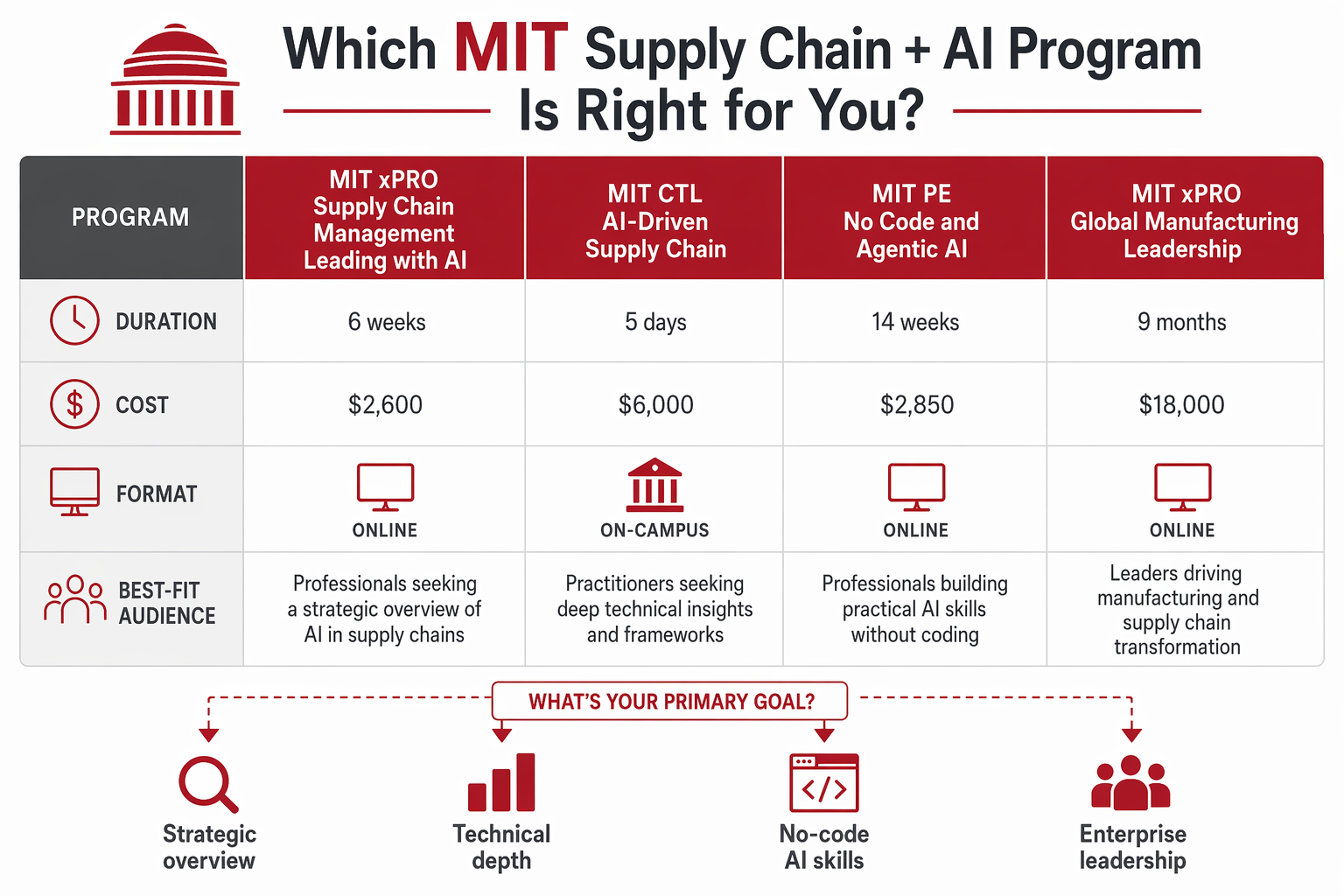
The table below summarizes the four programs across the dimensions that matter most for decision-making: duration, cost, format, technical depth, target audience, and credential type.
| Program | Duration | Cost | Format | Technical Depth | Target Audience | Credential |
|---|---|---|---|---|---|---|
| MIT xPRO – SC Mgmt: Leading with AI | 6 weeks | $2,600 | Online, self-paced | Strategic / moderate | Ops, logistics, strategy managers | Digital certificate, 3.6 CEUs |
| MIT CTL – AI-Driven Supply Chain | 5 days | $6,000 | On-campus (Cambridge, MA) | Deep technical (LLMs, RL, multi-agent) | Mid-career global ops leaders | Certificate of completion |
| MIT PE – No Code AI & Agentic AI | 14 weeks | $2,850 | Online, self-paced | Practical / no-code | Technical & non-technical professionals | Certificate, 10 CEUs |
| MIT xPRO – Global Mfg & SC Leadership | 9 months | $18,000 | Online + optional in-person | Strategic / leadership | Senior leaders (10+ yrs exp) | Digital certificate |
The key takeaway: no single program is universally “best.” The right choice depends on your budget, time availability, career stage, and whether you want strategic breadth or technical depth.
What Learners Actually Say: Reviews and Sentiment
Independent learner feedback is available for some programs but not all. Here is what the data shows.
MIT xPRO Programs (Course Report)
MIT xPRO bootcamps overall have an average rating of 4.68 out of 5 across 251 reviews on Course Report. A May 2026 reviewer, Maryam Baniasadi, praised the “balance between strong academic foundations and hands-on projects.” A January–May 2026 cohort participant described it as “a challenging, rewarding journey into data science.” These ratings cover multiple xPRO programs, not exclusively the supply chain course, but they indicate generally high satisfaction with MIT xPRO’s delivery model.
Ryan Pollack’s LinkedIn Review (Proxy for GenAI Concerns)
Ryan Pollack, a product leader, reviewed MIT xPRO’s “Designing and Building AI Products and Services” course on LinkedIn, rating it “60/40 in favor.” He praised the business strategy material — network externalities, cost structure analysis — and the Python walkthroughs for ML model tuning. However, he critiqued that the content “feels dated (likely mid-to-late 2022) and only lightly touches on GenAI.” He noted the course “oscillates between too technical and too abstract” and suggested adding modern modules on prompt design, rapid prototyping, and deploying GenAI solutions.
Kevin Power’s Career Transition (MITx MicroMasters)
Kevin Power transitioned from manufacturing engineering to supply chain through the MITx MicroMasters Program in Supply Chain Management, then completed the MIT SCM Blended Master’s Program. His research included simulation modeling in port shipping and generative-AI-driven projects for supply chain resilience. He noted that every student from the MIT SCM residential program Class of 2025 secured a job within six months of graduation.
This is relevant context: the MIT SCM master’s program has strong career outcomes. However, the certificate programs reviewed here do not grant alumni status or the same placement support.
Decision Framework: How to Choose Your MIT SC+AI Program
Use the following questions and mapping to narrow your options.
Key Questions to Ask Yourself
- What is my budget? $2,600–$2,850 (Programs A or C), $6,000 (Program B), or $18,000 (Program D)?
- How much time can I commit? 4–6 hrs/week for 6 weeks (A), 5 full days on campus (B), 3–5 hrs/week for 14 weeks (C), or 3–5 hrs/week for 9 months (D).
- What is my career goal? Strategic leadership role (A or D), technical AI role in supply chain (B), or AI upskilling with a supply chain project (C).
- What is my technical background? Non-technical (C), moderate (A), or strong with appetite for ML, RL, and LLMs (B).
- Do I need a professional supply chain certification? None of these programs provide one. If that is your goal, look at ASCM/CSCP instead.
Quick Decision Map
| Your Profile | Best-Fit Program | Why |
|---|---|---|
| Strategic overview seeker, limited budget, 4–6 hrs/week | MIT xPRO – SC Mgmt: Leading with AI (A) | Lowest cost, shortest duration, targeted SC+AI content |
| Technical deep-diver, can travel, wants hands-on AI | MIT CTL – AI-Driven Supply Chain (B) | Deepest technical curriculum, in-person networking |
| No-code AI upskiller, wants a supply chain capstone | MIT PE – No Code AI & Agentic AI (C) | Practical AI skills, relevant capstone, self-paced |
| Senior leader, 10+ years exp, organizational sponsorship | MIT xPRO – Global Mfg & SC Leadership (D) | Executive-level content, leadership focus, optional networking |
Comments
Join the discussion with an anonymous comment.