
Why This Entry Exists: Scope and Cross-References
This glossary entry provides the formal definition of demand planning as a cross-functional business process. It exists because two existing site articles cover the distinction between demand sensing and demand forecasting in depth but explicitly exclude demand planning's process scope from their treatment. This entry is the anchor those articles point toward.
If you arrived here looking for a detailed comparison of demand sensing and demand forecasting — their time horizons, data inputs, and AI technique differences — see Demand Sensing vs. Demand Forecasting: Definition and Disambiguation and Demand Sensing vs. Demand Forecasting: Definitions, Differences, and AI Roles. For AI methods used specifically within the demand forecasting subprocess — gradient boosting, ARIMA, probabilistic models — see Demand Forecasting AI: Definition, Methods, and Operational Context.
Formal Definition: Demand Planning
Demand planning is a cross-functional business process through which an organization aligns anticipated customer demand with supply capability, production schedules, and inventory policy. It is not a forecasting method. It is not a software module. It is an organizational process that requires coordinated input from sales, marketing, finance, operations, and supply chain functions to produce an agreed-upon demand signal that the rest of the supply chain can plan against.
The process produces a demand plan: a forward-looking, consensus-approved view of expected demand — typically at the product family or business unit level — that feeds upstream into supply chain planning, capacity planning, and the Sales and Operations Planning (S&OP) or Integrated Business Planning (IBP) cycle. In SCOR terms, demand planning aligns with the sP2 (Plan Demand) process, which aggregates demand requirements and feeds sP1 (Plan Supply Chain).
Demand planning is distinguished from demand forecasting at the definitional level: forecasting produces a statistical projection; planning acts on that projection through a structured governance process involving multiple functions. Most authoritative sources position demand forecasting explicitly as a subprocess within demand planning — not as its equivalent or its replacement.
What Demand Planning Includes That Forecasting Alone Does Not
The forecasting subprocess — generating a statistical or ML-based projection of future demand — is one component of demand planning, not the whole of it. Five additional elements define the full process scope:
- Consensus process. Demand planning requires cross-functional alignment. Sales managers, marketers, finance leads, and operations managers each hold information the statistical model cannot capture — promotional commitments, contract changes, strategic account shifts, budget constraints. The consensus round reconciles these inputs into a single agreed-upon demand number. This is an organizational activity, not an algorithmic one.
- S&OP linkage. The demand plan is the input that opens the S&OP cycle. It establishes what the organization expects to sell before supply, finance, and executive teams review whether that demand can be met at acceptable cost. For architectural detail on how the demand plan flows into S&OP and IBP, see IBP vs. S&OP: Definitions, Differences, and How AI Fits Into Each.
- Scenario planning. Demand planning includes modeling potential outcomes under different market or behavioral assumptions — a competitor exits, a key account accelerates orders, a raw material shortage forces substitution. These what-if scenarios are structured planning inputs, not ad hoc analysis.
- Demand shaping. Demand planning encompasses deliberate efforts to influence demand — through pricing changes, promotional activity, product substitution, or channel incentives. This is demand management in the active sense: not just predicting what customers will do, but adjusting conditions to shift that behavior toward a more plannable or profitable outcome.
- New product and lifecycle planning. Demand planning covers new product introductions, where no sales history exists, and product lifecycle transitions, where existing demand curves are winding down. These require different planning logic than mature SKU forecasting and involve inputs from product management and marketing that a statistical model cannot generate independently.
Together, these elements explain why demand planning is classified as a process rather than a method. The forecasting subprocess produces a number. The planning process decides what to do with it — and whether to trust it.
The Three-Term Hierarchy: Sensing, Forecasting, Planning
These three terms are not competing alternatives or synonyms for the same activity. They operate at different time horizons and different process layers, and they have a clear containment structure:
Demand sensing is a near-real-time signal ingestion layer operating at a 0–4 week horizon. It uses current supply chain data — point-of-sale signals, distributor inventory levels, weather, promotions in flight — to detect demand shifts that have already begun but are not yet visible in historical sales patterns. It refines the short end of the demand plan continuously.
Demand forecasting is a statistical and ML-based projection subprocess operating across weeks to 18 months. It takes historical demand data and forward-looking inputs to produce a quantitative prediction of future demand volumes. It is the primary quantitative input that the demand planning process consumes and acts upon.
Demand planning is the cross-functional governing process that contains both. It operates at a months-to-years planning horizon, integrates the outputs of forecasting and sensing alongside human judgment from multiple business functions, and produces the consensus demand plan that drives supply chain decisions.
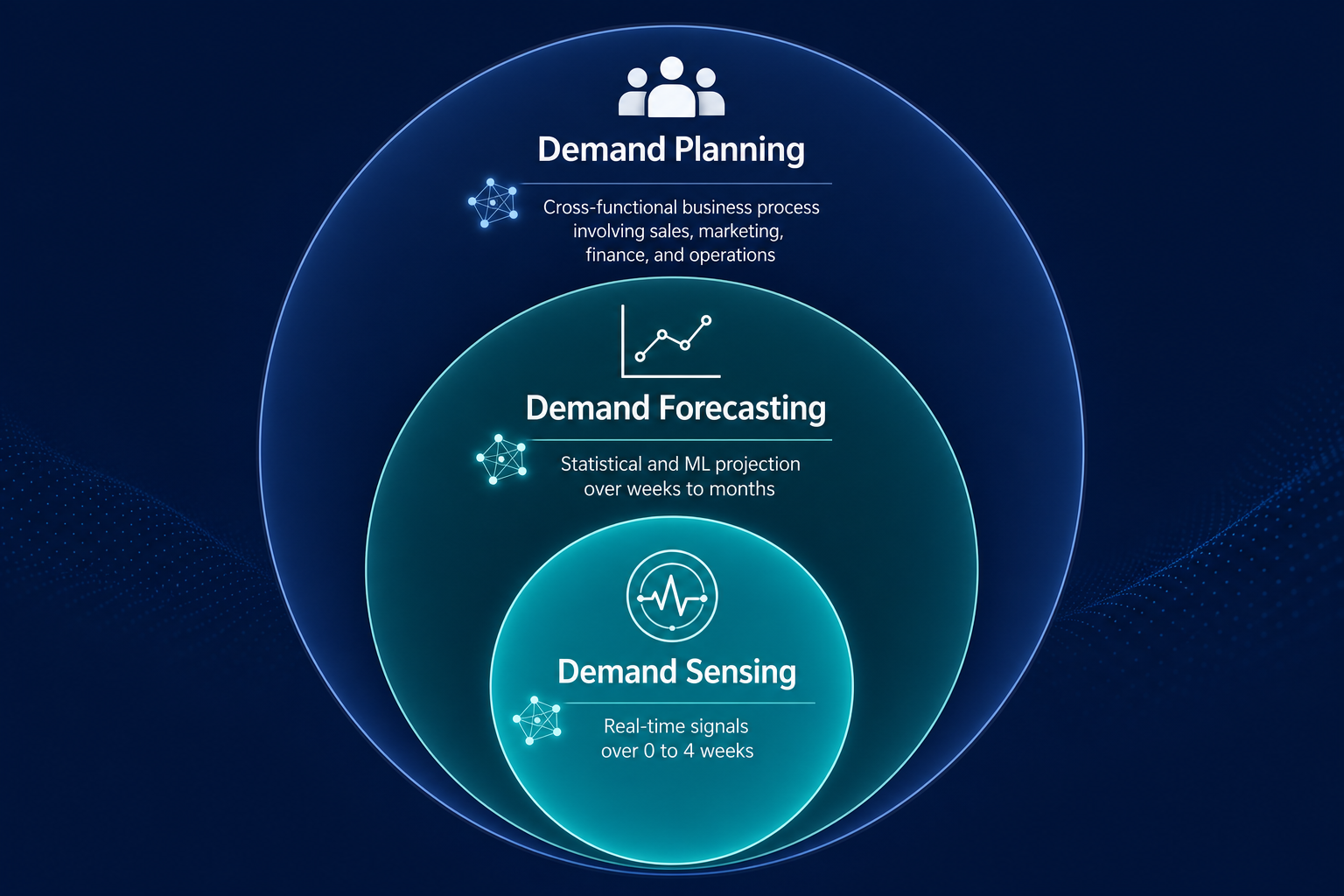
For a detailed treatment of where demand sensing ends and demand forecasting begins — including time-horizon boundaries, data input differences, and the specific AI techniques each layer uses — see the two dedicated disambiguation entries linked in the opening section of this article.
Quick-Reference Comparison: All Three Terms
| Dimension | Demand Sensing | Demand Forecasting | Demand Planning |
|---|---|---|---|
| Time horizon | 0–4 weeks (near-real-time) | Weeks to 18 months | Months to multi-year (rolling) |
| Primary data inputs | POS signals, distributor inventory, weather, promotions in flight, IoT feeds | Historical sales, market data, causal variables (price, promotions, seasonality) | Forecast outputs, consensus inputs from sales/marketing/finance, scenario assumptions, lifecycle data |
| AI technique type | Real-time data assimilation, anomaly detection, short-horizon ML adjustment | Statistical models (ARIMA, exponential smoothing), ML (gradient boosting, LSTM), probabilistic forecasting | Consensus automation, exception alerting, scenario simulation, new product curve fitting, demand shaping recommendations |
| SCOR process anchor | Feeds sP2 short-horizon inputs | Core quantitative input to sP2 | sP2 Plan Demand → feeds sP1 Plan Supply Chain |
| Decision output | Revised short-term demand signal; replenishment trigger adjustments | Demand volume projection by SKU/location/period | Consensus demand plan; S&OP input; supply, capacity, and inventory policy directives |
For practitioners who need to understand the statistical foundation that demand forecasting produces — the difference between probabilistic, deterministic, and point forecasts — see Statistical, Probabilistic, Deterministic, and Point Forecasting: A Supply Chain Terminology Reference.
Where AI Attaches to Demand Planning Beyond the Forecasting Layer
AI's role in demand planning extends beyond the forecasting subprocess. The following attachment points are specific to the planning layer — they are not covered by forecasting AI articles, which focus on ML model selection and statistical method comparison.
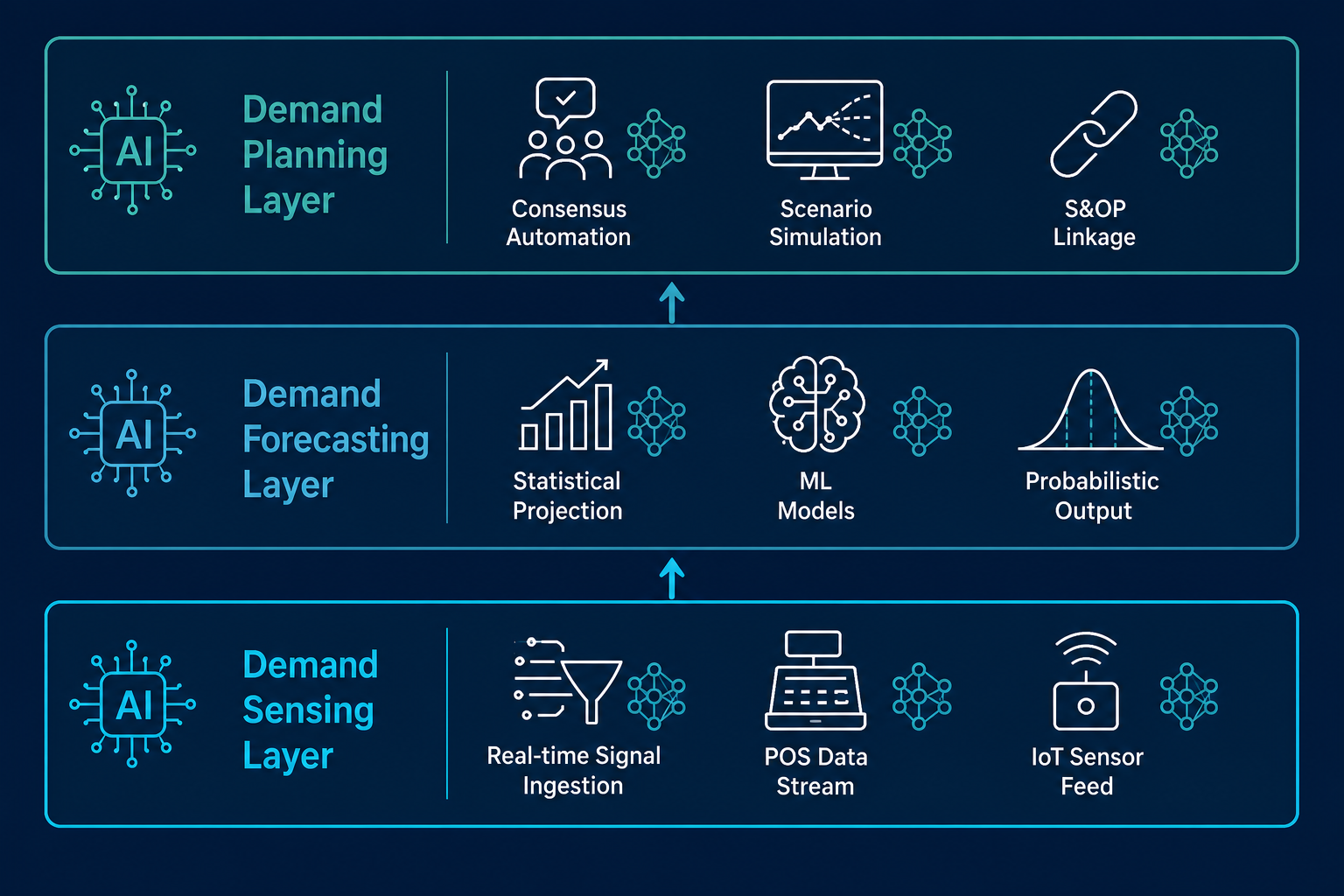
- Consensus round automation and exception management. AI can monitor the gap between the statistical forecast and the adjusted consensus number across planning cycles, flagging systematic over- or under-adjustment by specific functions or regions. Exception-based workflows surface only the items where human review is warranted, rather than requiring planners to review every SKU manually.
- Scenario simulation. Digital twin environments allow planners to model the demand and supply consequences of specific scenarios — a key account doubling its order volume, a competitor exiting a category, a promotional calendar shift — before committing to a plan. AI accelerates scenario generation and impact quantification that would otherwise require manual modeling.
- New product curve fitting. For new product introductions with no sales history, AI can identify analogous items from the existing portfolio — by attribute similarity, market positioning, or channel profile — and generate a launch demand curve based on how those comparable products ramped. This is a planning-layer capability, not a standard forecasting model function.
- Demand shaping recommendation engines. AI can model the demand response to proposed pricing changes, promotional mechanics, or substitution offers and recommend shaping actions that move demand toward more plannable or margin-favorable patterns. This connects the demand plan to commercial levers in a feedback loop that purely statistical forecasting cannot provide.
- Demand sensing integration as a real-time plan input. At the short end of the planning horizon, AI-driven sensing continuously updates the demand plan with current market signals, reducing the latency between what the market is doing and what the supply chain is responding to. This is the integration point between the sensing layer and the planning process.
For AI methods specific to the forecasting subprocess — ML model types, ensemble approaches, intermittent demand handling — see Demand Forecasting AI: Definition, Methods, and Operational Context. That article covers what happens inside the forecasting engine; this entry covers what the planning process does with its output.
Vendor Conflation: What 'Demand Planning AI' Claims vs. What Platforms Deliver
The term "demand planning AI" is used broadly in vendor marketing, but the actual scope of what platforms deliver varies significantly. Understanding the gap between the label and the capability is essential for evaluation.
The distinction matters because organizations that purchase a forecasting tool expecting a demand planning solution will find the consensus, governance, and commercial alignment work still falls entirely on their planning team. The tool produces a number; the organization still has to decide whether to believe it, adjust it, and act on it through a cross-functional process the tool does not support.
A more complete demand management platform addresses the full process stack: it ingests real-time signals at the sensing layer, generates and evaluates forecasts at the prediction layer, supports scenario simulation and new product planning at the shaping layer, and connects the resulting demand plan to replenishment and supply execution. Most platforms cover one or two of these layers well; few cover all four with equal depth.
When evaluating a platform marketed as a demand planning solution, practitioners should assess against the process scope defined in this entry — not against the vendor's capability framing. Specific questions to probe:
- Does the platform support a structured consensus workflow — not just a shared spreadsheet or comment field — that routes adjustments through defined functions with an audit trail?
- Does it connect the demand plan output directly to the S&OP or IBP process, or does that handoff require manual export and re-entry?
- Does it include scenario planning tools that let planners model demand under named assumptions, compare scenarios, and select a plan version for execution?
- Does it handle new product introductions with a distinct planning approach — not just a blank forecast — including analogous item mapping or launch curve inference?
- Does it incorporate demand sensing signals at the short end of the horizon, or does it rely solely on historical data with manual override for near-term adjustments?
A platform that cannot answer affirmatively to most of these questions is a forecasting tool, not a demand planning platform — regardless of how it is marketed.
Related Glossary Entries and Further Reading
- Demand Sensing vs. Demand Forecasting: Definition and Disambiguation — Covers the definitional boundary between sensing and forecasting, including time-horizon differences and the data inputs that distinguish each layer.
- Demand Sensing vs. Demand Forecasting: Definitions, Differences, and AI Roles — Extends the sensing/forecasting comparison to include AI technique differences and where each layer fits in supply chain execution.
- Demand Forecasting AI: Definition, Methods, and Operational Context — Covers ML and statistical methods used within the forecasting subprocess: gradient boosting, ARIMA, probabilistic models, intermittent demand handling.
- IBP vs. S&OP: Definitions, Differences, and How AI Fits Into Each — Covers the planning cycle that the demand plan feeds into, including the architectural differences between S&OP and IBP and where AI integrates at each stage.
- Statistical, Probabilistic, Deterministic, and Point Forecasting: A Supply Chain Terminology Reference — Defines the forecast output types that the demand forecasting subprocess produces and that the demand planning process must interpret — useful for practitioners evaluating forecast accuracy metrics and plan reliability.