
Berkshire Hathaway did not just buy a little Alphabet exposure and call it innovation. By mid-2026, Greg Abel had built a roughly $30 billion-plus Alphabet position from zero in three quarters, described as the fastest large-position accumulation in Berkshire’s history. The move was anchored by a $10 billion June 2026 private placement at a 6.5% discount, and it came alongside a broader portfolio purge that included complete exits from 16 positions in Q1 2026, including Amazon, Visa, Mastercard, UnitedHealth, Domino’s, and Macy’s.[1][2]
That combination matters more than the familiar headline that Berkshire finally warmed to a major technology platform. A passive rebalance does not usually arrive with that speed, that size, a negotiated private placement, and simultaneous exits from established holdings. Berkshire’s Alphabet position is better read as a capital-allocation signal about the AI infrastructure cycle: Alphabet has operating requirements that are large enough, urgent enough, and physical enough to pull demand through multiple supplier layers.

For anyone tracking Berkshire Hathaway, Alphabet, and AI supply chain stocks, the useful question is not whether Berkshire has endorsed every company touching AI data centers. It has not. No cited source confirms Berkshire owns Nvidia, Broadcom, TSMC, Marvell, or other direct AI infrastructure suppliers. The useful question is narrower and more operational: what does Berkshire appear to believe about Alphabet’s need to keep building, and which supply chains receive the clearest demand signal if that belief is right?
The Berkshire Signal Is Unusual Because the Build Was So Compressed
Berkshire spent decades with Google sitting in the category of admired-but-not-owned businesses. That history is useful, but only briefly. The present signal is not nostalgia about Warren Buffett and Charlie Munger missing a great internet franchise. It is that, under Abel’s leadership, Berkshire allocated at a scale and pace that would be hard to explain as a casual change in taste.
CNBC reported the additional $10 billion Alphabet investment on June 1, 2026, while separate coverage of Abel’s investing approach placed the purchase inside a wider shift in Berkshire’s portfolio posture.[1][2] Fortune had already characterized Berkshire’s selling as one of the most aggressive spates of selling in its modern history, based on the Q1 2026 exits.[3] The sequencing matters: cash was not merely drifting into a mega-cap technology name. Berkshire was making room.
| Observed Move | Why It Matters for the Supply Chain Read |
|---|---|
| Built Alphabet from zero to roughly $30 billion-plus in three quarters | Suggests conviction in a durable operating cycle, not a small benchmark adjustment |
| $10 billion June 2026 private placement at a 6.5% discount | Adds negotiated scale and timing to the signal |
| Exited 16 positions entirely in Q1 2026 | Shows portfolio capacity was being actively reallocated |
| No confirmed Berkshire ownership of major AI suppliers | Keeps the analysis focused on demand beneficiaries, not assumed Berkshire holdings |
The mistake would be to flatten this into “Berkshire likes tech now.” Alphabet is not just a search-and-cloud equity story in this context. It is a buyer of chips, wafers, networking gear, substations, transformers, cooling systems, land, construction labor, and grid access. Berkshire’s bet becomes more informative when it is translated into those purchase orders and constraints.
Alphabet’s AI Spending Looks Structural, Not Optional
Alphabet’s planned 2026 AI capital spending sits in a range that would have been difficult to absorb as ordinary cloud expansion only a few years ago. CNBC reported that Alphabet reset expectations for AI infrastructure spending in February 2026, while Fortune reported a record AI spending plan centered around roughly $185 billion.[4][5] Reuters separately reported that Alphabet planned to raise $80 billion for AI goals, a financing move that underlines the scale of the buildout rather than treating it as spending that can simply be tucked inside normal operating cash flow.[6]
The midpoint is blunt: $175 billion to $190 billion of 2026 AI capex, nearly double 2025’s $91.4 billion.[4][5] Those numbers do not prove the returns will be attractive. They do show that Alphabet is trying to solve a capacity problem at infrastructure scale.
The operating language is even more important than the dollar figure. CNBC reported in November 2025 that Google needed to double AI serving capacity every six months and was targeting “the next 1000x” infrastructure leap over four to five years.[7] Fortune also reported Sundar Pichai’s acknowledgment that Alphabet expected to remain supply constrained through the year despite record spending.[5] That is the sentence supply-chain people recognize: money is moving, but bottlenecks still decide what can be delivered.
A discretionary capex cycle can be deferred when margins tighten. A serving-capacity cycle tied to product availability, model latency, inference demand, and cloud customer commitments is harder to pause cleanly. Alphabet can adjust pacing, vendor mix, and architecture. It cannot wish away the physical work required to support AI usage if internal demand and customer workloads keep expanding.
Where the Demand Actually Lands
AI capex is a poor single bucket. It hides very different supply chains with different lead times, bargaining power, scarcity points, and margin structures. Alphabet’s buildout touches at least five layers: semiconductors, networking, power and energy, cooling and thermal systems, and physical data center construction.
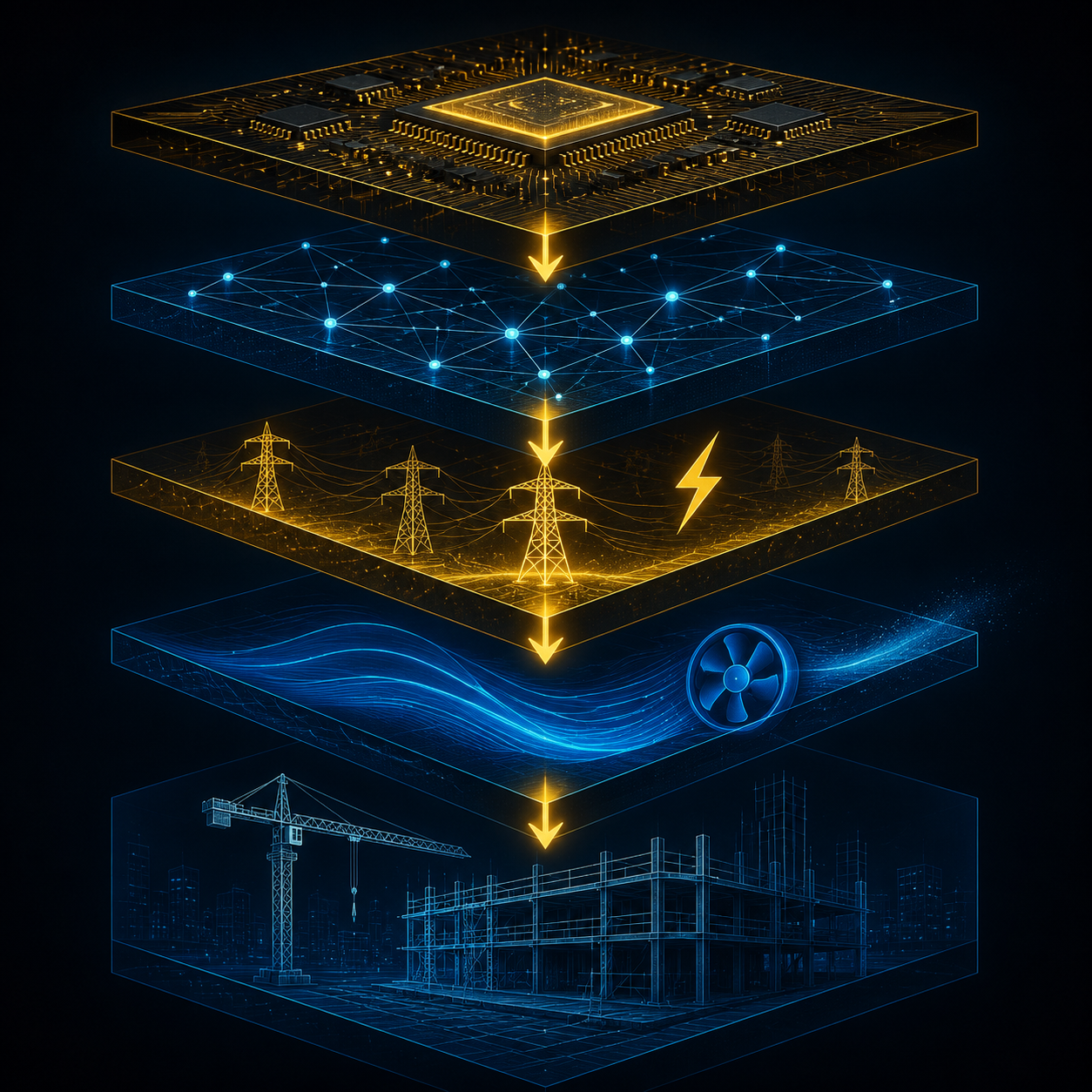
| Layer | Demand Signal | Main Constraint |
|---|---|---|
| Semiconductors | Custom AI accelerators, ASICs, memory, advanced packaging | Fabrication capacity, design wins, memory concentration, packaging availability |
| Networking | High-throughput data center connectivity and switching | Cluster scale, latency, and deployment synchronization |
| Power and energy | Grid capacity, generation, substations, transformers, interconnection | Long equipment lead times and utility approval queues |
| Cooling and thermal | Liquid cooling and heat rejection systems | Thermal density exceeding traditional air-cooled limits |
| Physical construction | Land, shells, electrical rooms, permitting, labor, fit-out | Permitting, local opposition, utility coordination, contractor capacity |
The semiconductor and power layers deserve the most attention because the bottleneck evidence is clearest. Cooling, networking, and construction matter, but their role becomes most useful when tied to the same basic question: which suppliers can keep delivering when hyperscalers are trying to compress years of infrastructure growth into shorter deployment windows?
Semiconductors: Alphabet’s Custom Silicon Push Changes the Beneficiary List
The cleanest semiconductor read is not simply “more AI means more GPUs.” Alphabet’s infrastructure strategy is deeply tied to its Tensor Processing Units, and that pulls attention toward the custom ASIC supply chain. Oplexa reported that Broadcom has a five-year Google TPU agreement through 2031, while noting that the public disclosure did not attach a dollar value to the agreement.[8] That distinction is important: the agreement is the confirmed strategic fact; revenue estimates attached to it remain estimates.
Mizuho’s estimates, cited in semiconductor coverage, put Broadcom AI revenue attributable to Google and Anthropic at $21 billion in 2026 and $42 billion in 2027.[8] Those figures should not be treated as Broadcom guidance. They are useful because they indicate how analysts are sizing the opportunity, not because they settle the actual purchase volume.
TSMC is the other unavoidable name in this layer. Counterpoint Research reported that TSMC fabricates about 99% of top-10 AI ASIC shipments, placing it at the manufacturing center of the custom accelerator cycle.[9] TNW reported that Google’s TPU v8 Sunfish and Zebrafish designs target TSMC’s 2nm process in late 2027, and that Google has assembled a four-partner chip supply chain.[10] The timing matters because the demand signal does not stop at 2026 spending; advanced-node capacity planning reaches well beyond one budget year.
Marvell appears in this discussion differently. TNW reported active talks with Google for a memory processing unit, with about 2 million units planned, and a new inference TPU.[10] That is not the same as a signed, disclosed revenue stream. It is a potential design and supply-chain role inside the same custom silicon direction.
TrendForce projections cited in semiconductor coverage expect custom ASIC shipments to surpass GPU shipments by 2028.[11] If that shift materializes, AI infrastructure investors who only watch the most visible accelerator vendor may miss the parts of the chain where Alphabet’s architecture has more direct influence: ASIC design partners, advanced foundry capacity, high-bandwidth memory exposure, and packaging bottlenecks. The broader AI chip supply chain bottleneck risk is already visible in how little slack exists across leading-edge compute components.
Memory should not be treated as an afterthought. If accelerators and custom ASICs are the compute spine, memory availability determines how efficiently that compute can be used. That is why concentration around suppliers such as Micron and SK Hynix deserves separate attention: Micron’s AI memory constraints and SK Hynix’s HBM chokepoint are not side stories when hyperscalers are trying to scale inference and training capacity at the same time.
Power: The Constraint That Can Outlast Chip Enthusiasm
The power layer is where optimistic capex schedules meet utility calendars. William Blair’s AI infrastructure research pointed to 200 TWh of new U.S. data center demand through 2030, compared with Germany’s entire electricity generation, along with transformer lead times above 12 months and interconnection queues of three to five years.[12] These are not software deployment problems. They are equipment, permitting, grid-planning, and utility-coordination problems.
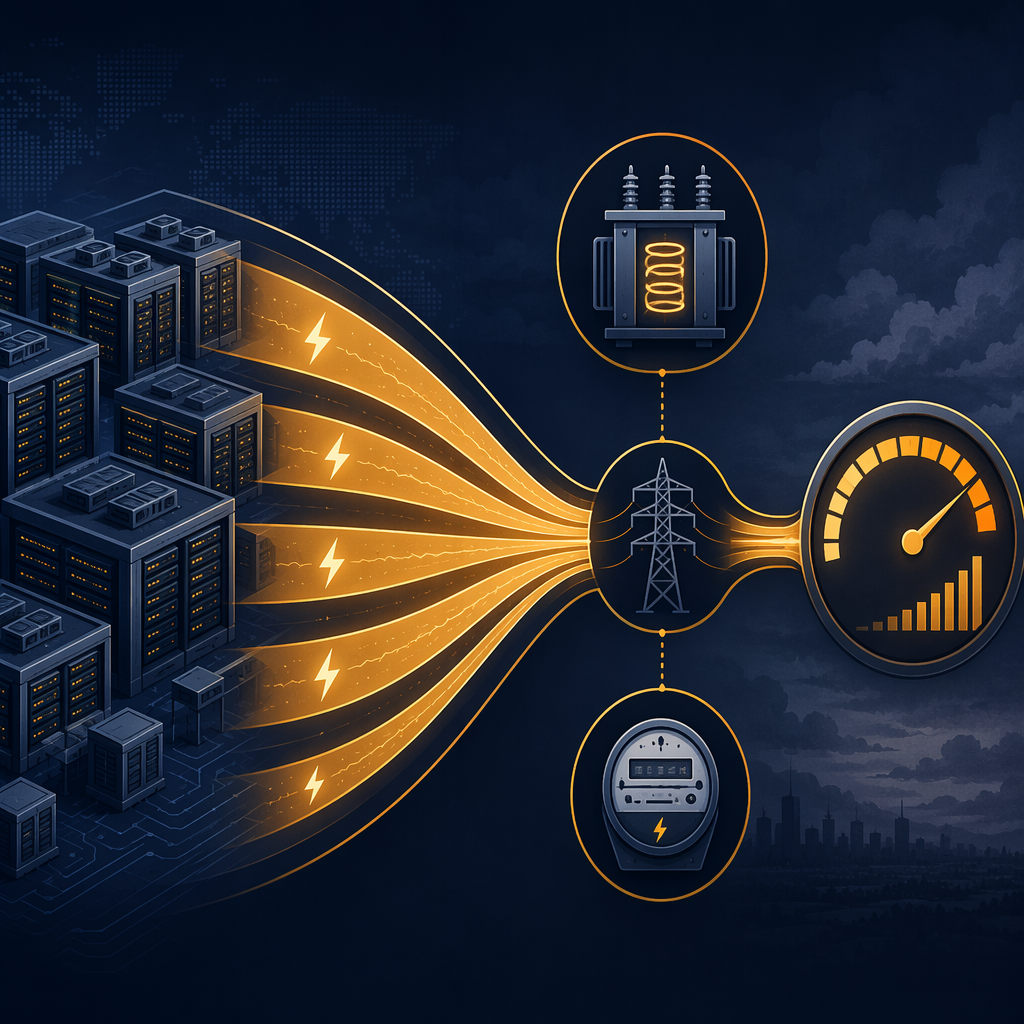
This is where Berkshire’s position has an unusual adjacency. Berkshire Hathaway Energy has a 37 GW portfolio and a $32 billion capex plan, according to industry research cited in the AI infrastructure context.[12] That does not mean there is a disclosed formal BHE-Alphabet contract. It means Berkshire is exposed to the same infrastructure cycle from two sides: as a major Alphabet shareholder and, through BHE, as an owner of regulated and energy infrastructure assets that sit near the power problem AI data centers must solve.
For suppliers, the power bottleneck changes the quality of demand. A data center developer can order servers quickly relative to the time it takes to secure interconnection, transformers, substation equipment, and local approvals. That mismatch gives utilities, electrical equipment makers, backup power providers, and grid-adjacent contractors more durable visibility than a one-quarter chip cycle would imply.
It also raises the risk that capacity exists on a hyperscaler spreadsheet before it exists on the ground. Coverage of Bloom Energy’s AI data center supply chain is relevant here because on-site and partnership-driven power models become more attractive when grid timelines stretch. The same constraint shows up in local land-use fights and rights-of-way issues, where eminent domain has become a data center bottleneck.
Cooling, Networking, and Construction Are the Deployment Reality
Cooling has moved from facility engineering detail to capacity enabler. William Blair’s March 2026 research described liquid cooling shifting from niche to mainstream as GPU thermal densities exceed air-cooled limits.[12] The point is not that every data center converts at once. It is that higher rack densities force decisions about coolant distribution, heat rejection, facility retrofits, and maintenance capability earlier in the design process.
Networking sits between the chip purchase and the usable cluster. Faster accelerators do not deliver the expected economics if the cluster cannot move data with acceptable latency and reliability. Alphabet’s push to double serving capacity every six months therefore carries demand for switches, optics, interconnects, cabling, and integration work, even when those items receive less attention than accelerators.[7]
Physical construction is the layer where all optimistic demand forecasts become sequential. Land must be controlled, permits must clear, shells must be built, power rooms must be fitted out, cooling must be installed, and equipment must arrive in the right order. William Blair’s research cited $700 billion of collective hyperscaler capex in 2026 and 100 GW of new capacity being built.[12] Those numbers explain why contractor capacity, local approvals, and utility coordination have become supply-chain variables rather than administrative footnotes.
Construction risk is also where AI infrastructure exposure can disappoint even when end demand is real. The CoreWeave stock drop is a reminder that infrastructure businesses can be pulled between customer demand, financing needs, supplier commitments, and delivery risk. Local resistance can compound that pressure; AI data center moratoriums turn demand into waiting time.
Which Stocks Benefit, and What the Berkshire Bet Does Not Prove
The direct beneficiaries of Alphabet’s AI infrastructure spending are companies positioned where Alphabet must buy capacity, not necessarily companies Berkshire itself owns. Broadcom benefits from confirmed TPU agreement exposure, while the scale attached to that exposure depends on analyst estimates rather than disclosed contract value.[8] TSMC benefits from its central role in top AI ASIC fabrication, as described by Counterpoint, and from the advanced-node requirements implied by future TPU designs.[9][10] Marvell is a possible beneficiary where reported talks become confirmed design wins or production commitments.[10]
Power and energy suppliers have a different investment profile. Their upside is less about a single named chip design and more about scarcity: generation, grid access, transformers, substations, backup power, and interconnection capacity. Berkshire Hathaway Energy’s portfolio makes the adjacency notable, but without a disclosed BHE-Alphabet contract, it should remain an adjacency, not a claimed customer relationship.[12]
Cooling vendors, networking suppliers, electrical contractors, engineering firms, and construction companies sit in the middle ground. They may not capture the same headline multiple as accelerator names, but they participate in the parts of the buildout that become unavoidable when AI clusters move from purchase orders to energized buildings.
The disciplined reading is therefore narrower than the market’s broadest AI enthusiasm. Berkshire’s Alphabet position does not prove every AI supply chain stock is attractive. It does not confirm Berkshire owns the suppliers. It does not remove valuation risk, execution risk, or the possibility that Alphabet’s architecture choices shift over time.
It does strengthen the case that Alphabet’s AI infrastructure cycle is being driven by operating necessity. A company planning $175 billion to $190 billion of 2026 AI capex, raising $80 billion for AI goals, trying to double serving capacity every six months, and still acknowledging supply constraints is not sending a vague technology signal.[4][5][6][7] It is sending demand into semiconductors, power, cooling, networking, and construction with unusual multiyear visibility. That is the supply-chain meaning of Berkshire’s $30 billion-plus Alphabet bet.
References
- Berkshire Hathaway invests extra $10 billion in Alphabet — CNBC, June 1, 2026
- Abel goes his own way with new Berkshire investments — CNBC, June 6, 2026
- Abel portfolio selling coverage — Fortune, November 2025
- Alphabet resets the bar for AI infrastructure spending — CNBC, February 4, 2026
- Alphabet plans record $185 billion AI spending — Fortune, February 4, 2026
- Alphabet plans to raise $80 billion for AI goals — Reuters, June 1, 2026
- Google must double AI serving capacity every 6 months — CNBC, November 21, 2025
- Broadcom Google TPU Deal 2026: The $46B AI Contract — Oplexa, 2026
- AI ASIC market coverage — Counterpoint Research
- Google assembles four-partner chip supply chain — TNW, 2026
- Alphabet Is Raising $80 Billion for AI Infrastructure. These 4 Semiconductor Stocks Win the Most. — Yahoo Finance, 2026
- The AI Infrastructure Supply Chain: AI Enablers — William Blair, March 2026
Comments
Join the discussion with an anonymous comment.