
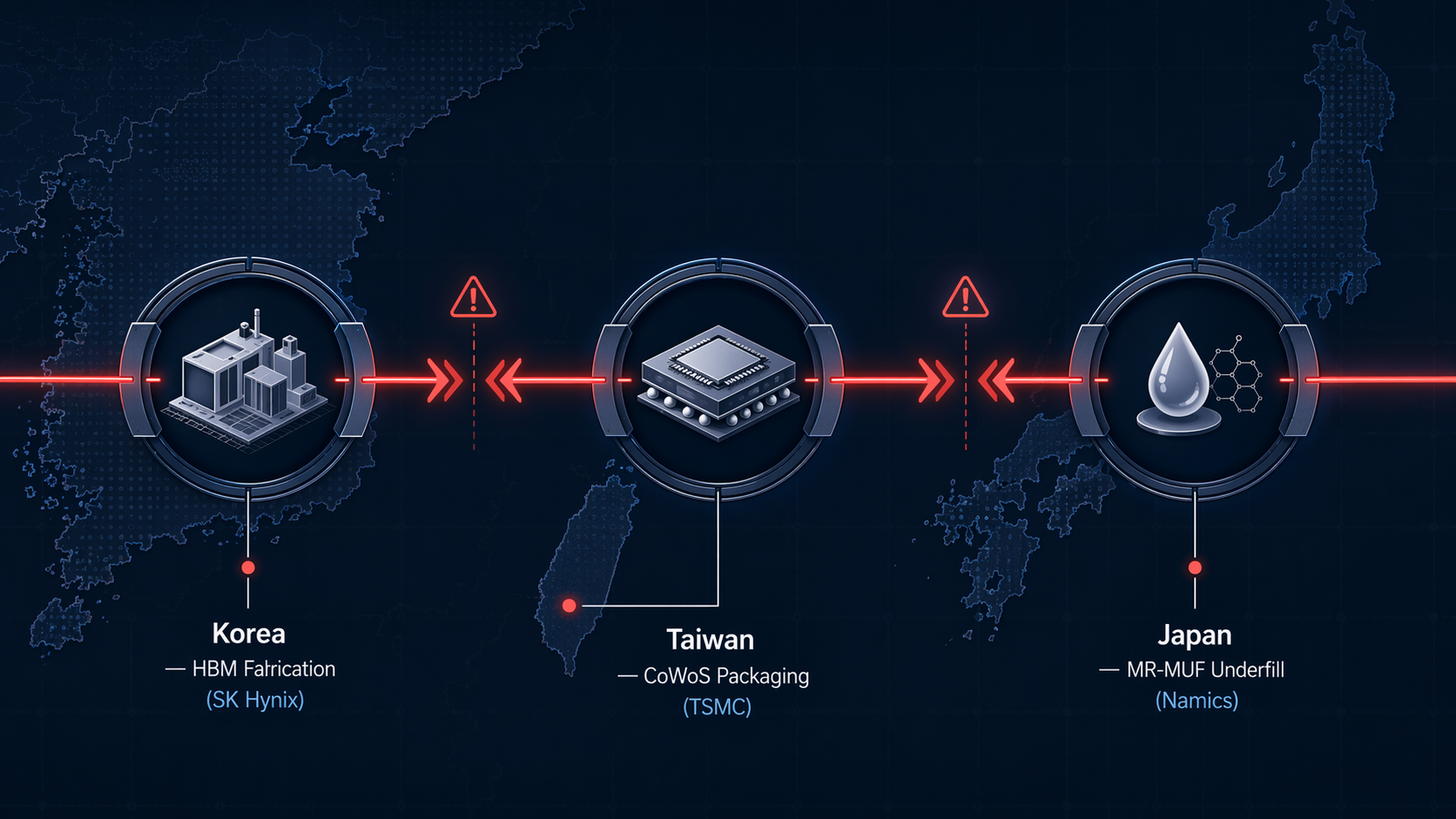
The AI semiconductor supply chain risk around SK Hynix does not stop at SK Hynix. The operating path is narrower than the usual supplier map suggests: Korean HBM capacity, heavily concentrated at SK Hynix; Taiwanese CoWoS advanced packaging capacity, practically tied to TSMC for NVIDIA-class accelerators; and a Japanese materials dependency around Namics’ MR-MUF underfill. Those are not three cushions of allied resilience. They are three consecutive gates.
The first gate is visible enough. Counterpoint data cited by ForcedAlpha places SK Hynix at roughly 57–62% of the global HBM market across Q2–Q3 2025, with SK Hynix and Samsung together controlling about 79%; the same analysis says about 90% of NVIDIA’s HBM supply flows through SK Hynix alone.[1] Market-share ranges vary by quarter and source, but the operational point does not require false precision. If the leading AI accelerator platform is waiting on one memory supplier for most of its HBM, the procurement question is no longer whether another HBM vendor exists somewhere on a slide. It is whether that alternative can pass the same qualification, packaging, yield, capacity, and delivery assumptions on the required timeline.
That is where the map matters. HBM is not a finished bottleneck when wafers leave a Korean fab. It must move through advanced packaging, where HBM stacks, logic dies, interposers, substrates, and thermal-mechanical materials have to behave together. Then it depends on material systems whose failure modes do not announce themselves in geopolitical slogans. A disruption in Korea, Taiwan, or Japan can stop the same finished AI accelerator flow. Treating those countries as three friendly redundancies mistakes political alignment for operational substitutability.
The first narrowing: HBM capacity in Korea
SK Hynix’s HBM position is not dangerous because the company is unusually fragile. It is dangerous because the AI buildout has placed a high-growth infrastructure dependency onto a memory category that is hard to expand quickly and expensive in wafer terms. SK Hynix’s own market outlook says HBM consumes about three times the wafer capacity of DDR5 per gigabyte because of TSV processing.[2] That means an HBM ramp is not just a line item added to global memory output. It competes with the rest of the memory base for process capacity, tools, and experienced engineering attention.
The pressure is already showing up in management language. On July 10, 2026, SK Hynix CEO Kwak Noh-jung told Reuters that 2027 would be “the worst year in the industry's history from the supply perspective” and said demand would exceed supply beyond 2030.[3] That warning deserves more weight than a distant demand forecast because it comes from the supplier sitting at the visible entry point of the constraint, in the current planning window, and in terms that directly concern supply scarcity rather than abstract market enthusiasm.
There is also a geographic exposure that is easy to underweight when the conversation stays at company level. ForcedAlpha maps both Korean HBM fabs at roughly 70 kilometers from the DMZ.[1] That does not make an interruption likely, and it should not be used as melodrama. It does mean that a large share of advanced AI memory capacity sits inside a geographically tight risk zone. In continuity planning, correlated geography matters even when the owners are sophisticated, the sites are well run, and the probability of any single event is debated.
Even expansion has a dependency chain under it. ForcedAlpha reports a $12.4 billion Korean trade deficit in semiconductor manufacturing equipment, which is a reminder that adding fab capacity still depends on foreign tool supply lines.[1] Announced capacity is not the same thing as unconstrained capacity. The equipment, materials, qualification, and labor sequence has to arrive in order.
The second narrowing: CoWoS as the route into AI accelerators
The next gate is packaging. For NVIDIA-class AI accelerators, the relevant dependency is not ordinary assembly capacity. It is advanced packaging capacity, especially TSMC’s CoWoS, which ForcedAlpha characterizes as near-exclusive for NVIDIA HBM packaging.[1] That distinction matters because it limits what a buyer can do with nominal supplier alternatives. Memory without qualified packaging capacity is inventory in the wrong state. A logic die without the required HBM integration path is not an accelerator shipment.
This is the point at which many risk dashboards overstate resilience. They count Korea, Taiwan, and Japan as separate allied jurisdictions and record multiple corporate names across the chain. But the flow is serial. If HBM supply tightens in Korea, CoWoS capacity cannot fabricate the missing memory. If CoWoS capacity is constrained in Taiwan, Korean HBM cannot reach the accelerator in the required form. If a qualified materials input fails, the package can become the bottleneck even when wafers and interposers are available.
This also changes how downstream exposure should be read. ForcedAlpha’s cascade simulation starts from seven Korean nodes and reaches 420 companies within four hops, representing $43 trillion in aggregate market capitalization.[1] That is not a projected loss, and it should not be repeated as if a Korean HBM disruption would erase $43 trillion. It is a graph-reach measure: a way of identifying how much listed-company value sits downstream of the dependency within a defined network radius. For teams modeling chip stock volatility, that distinction is not cosmetic. Exposure is not the same as expected loss, but exposure still tells you where a shock can travel before anyone has time to re-source.
The third narrowing: the material that turns concentration into lock-in
The least comfortable part of the map is not the biggest company. It is Namics, a materials supplier in Niigata, Japan. ForcedAlpha identifies Namics as the sole source of MR-MUF underfill for all SK Hynix HBM and rates the dependency severity-5, or irreplaceable; the same analysis says Korean alternatives are blocked by 20–30 years of customer trust data.[1] This is where the story stops being ordinary supplier concentration and becomes qualification lock-in.
Underfill is not a generic consumable in this context. It has to survive the mechanical and thermal realities of stacked memory and advanced packaging. The buyer is not simply asking whether another chemical company can formulate something similar. The relevant question is whether a substitute has demonstrated performance across the customer’s package architecture, process window, reliability testing, yield history, and field expectations. When the answer depends on decades of trust data, a second supplier with theoretical chemistry does not equal a qualified bypass.
Procurement teams know this trap. A part can look dual-sourceable in taxonomy and still be single-source in practice. The alternate supplier may exist, the product family may exist, and the purchasing system may even have a placeholder vendor code. None of that moves the first production lot through qualification. For sub-tier risk scoring, Namics is the kind of node that tends to appear late because it is buried below the semiconductor brand names; it is also the kind of node that determines whether a continuity plan is executable. The same logic sits behind broader work on sub-tier single-point-of-failure detection: the risky supplier is often not the one that appears largest in spend.
That is why “Japan is an ally” is not a useful risk control by itself. Alignment may reduce some categories of political risk, but it does not create qualified replacement material. Nor does it shorten the test history that customers require before they let a critical package material into high-volume AI hardware. In operational terms, the Japan node is not reassuring because it is friendly. It is alarming because it is specific.
Incidents do not create the risk; they multiply it
The Cheongju incidents are best read as a stress multiplier, not as proof that SK Hynix is unsafe. Fusion Worldwide reported three safety incidents at SK Hynix Cheongju Campus 4 in under three weeks during May–June 2026, in a context it described as 100% utilization.[4] The lesson is not that any one facility is uniquely vulnerable. The lesson is that high utilization leaves less slack when ordinary industrial events occur.
That distinction matters for governance. A low-probability interruption at a low-utilization node can sometimes be absorbed through inventory, overtime, expediting, or temporary allocation. A moderate interruption at a fully allocated chokepoint creates a different problem: every recovery action competes with already-promised output. The backup plan then becomes an allocation argument among customers, not a clean switch to a ready replacement.
This is also where demand shocks become more than market color. ForcedAlpha reports that the OpenAI, SoftBank, and Oracle Stargate project signed letters of intent for about 900,000 DRAM wafers per month, roughly 40% of global DRAM capacity, but that figure is not independently confirmed in SK Hynix or Samsung disclosures.[1] It should therefore be treated as an unconfirmed stress signal, not a booked capacity fact. Even with that caveat, the direction is important: AI infrastructure buyers are trying to reserve memory at a scale that can crowd the planning horizon before factories, packaging lines, and materials qualifications catch up.
Why policy capital does not govern the chain as one node
Industrial policy has become more serious about semiconductors, and that is overdue. The weak point is not that governments have ignored chips. It is that most programs still govern pieces of the stack: fabs, national champions, domestic packaging incentives, equipment access, or strategic stockpiles. The HBM path behaves less politely. Korean memory, Taiwanese packaging, and Japanese materials form one production route for a large part of frontier AI compute.
A fab subsidy does not qualify a second underfill. A packaging expansion does not create HBM wafers. A friendly materials supplier does not become replaceable because a policy memo groups Japan, Korea, Taiwan, and the United States on the same side of a strategic boundary. The bottleneck is serial, so the resilience test has to be serial: can the flow continue if this named node is unavailable, with the substitute already qualified and with enough real capacity to matter?
| Layer | Visible dependency | Operational test |
|---|---|---|
| Korean HBM fabrication | SK Hynix holds the largest HBM share, with Samsung making the Korean share still more concentrated. | Can an alternate HBM supplier meet the same volume, timing, and platform qualification assumptions? |
| Taiwanese advanced packaging | TSMC CoWoS is the practical packaging route for many NVIDIA-class AI accelerators. | Can qualified packaging capacity absorb the flow without breaking yield, schedule, or thermal-mechanical assumptions? |
| Japanese materials | Namics MR-MUF underfill is identified as the SK Hynix HBM sole-source material dependency. | Can a substitute material enter production with proven reliability history, not just nominal chemistry? |
This is the uncomfortable consequence for supplier-risk teams: country diversification and supply-chain substitutability are not the same control. A buyer may have exposure spread across three allied nations and still have no practical bypass. The map looks diversified because the flags differ. The process behaves concentrated because the gates are consecutive.
How the risk should be modeled
The Korea-Taiwan-Japan HBM axis should be modeled as one correlated dependency in AI infrastructure planning, not as three independent supplier regions. SK Hynix is the visible entry point because its HBM share is large and its customer exposure is prominent. But the failure mechanism is wider: HBM fabrication narrows into advanced packaging, which narrows into a qualified material stack.
That changes the questions procurement should ask. The useful version is not “Do we have another supplier in the category?” It is “Which exact qualified route carries the workload if this node stops, and how much volume has that route already run?” For HBM, that route includes the memory supplier, the packaging provider, the substrate and interposer assumptions, the underfill and other materials, and the customer qualification history attached to the finished package.
Inventory also has to be placed at the right state of completion. Buffering generic memory does not solve a packaging bottleneck. Buffering packaged accelerators may protect only the buyer with enough leverage and cash to hold scarce finished goods. Buffering materials helps only if the materials are already qualified and shelf-life, storage, and process controls are understood. In a serial chain, the wrong buffer can make the dashboard look prepared while the factory still waits.
The practical risk register should therefore separate three claims that are often blended together: adoption, effectiveness, and bypassability. AI demand adoption may be strong. HBM effectiveness for bandwidth-intensive accelerators may be clear. Neither proves that the supply chain can bypass SK Hynix, TSMC CoWoS, or Namics MR-MUF without schedule loss. Those are different tests, and they fail in different departments.
For frontier AI hardware, SK Hynix is the most visible node in a serial HBM dependency that runs through Korea, Taiwan, and Japan. The point is not that SK Hynix is a villain, AI infrastructure is a bubble, or allied supply chains are useless. It is that any risk model treating these layers as independent sources of resilience is giving credit for redundancy the supply chain has not actually earned.
References
- Korea HBM Supply Chain Dependency, ForcedAlpha.
- 2026 Market Outlook: Focus on the HBM-Led Memory Supercycle, SK Hynix.
- SK Hynix CEO sees worst-ever memory supply shortage in 2027, says demand to outstrip supply beyond 2030, Reuters, July 10, 2026.
- SK Hynix Was Already Sold Out. Then the Fires Started, Fusion Worldwide.
Comments
Join the discussion with an anonymous comment.