
The awkward moment in an AI data center schedule is no longer the day the interconnection study comes back. It is the day everyone realizes that an approved load still has no usable path to power.
A campus can have a site plan, a utility partner, a signed interconnection agreement, early civil work, and a transformer procurement discussion already underway. None of that energizes servers if the transmission corridor is still crossing parcels whose owners have not agreed to sell, whose state eminent domain rules are being litigated or politically challenged, or whose route may still be moved after public opposition hardens.
That is why eminent domain disputes around AI data center infrastructure have become a procurement problem, not just a legal phrase. The delay is not sitting politely at the edge of the project. It is moving onto the critical path, ahead of equipment manufacturing and, in some cases, after the interconnection milestone that used to be treated as the main gating event.
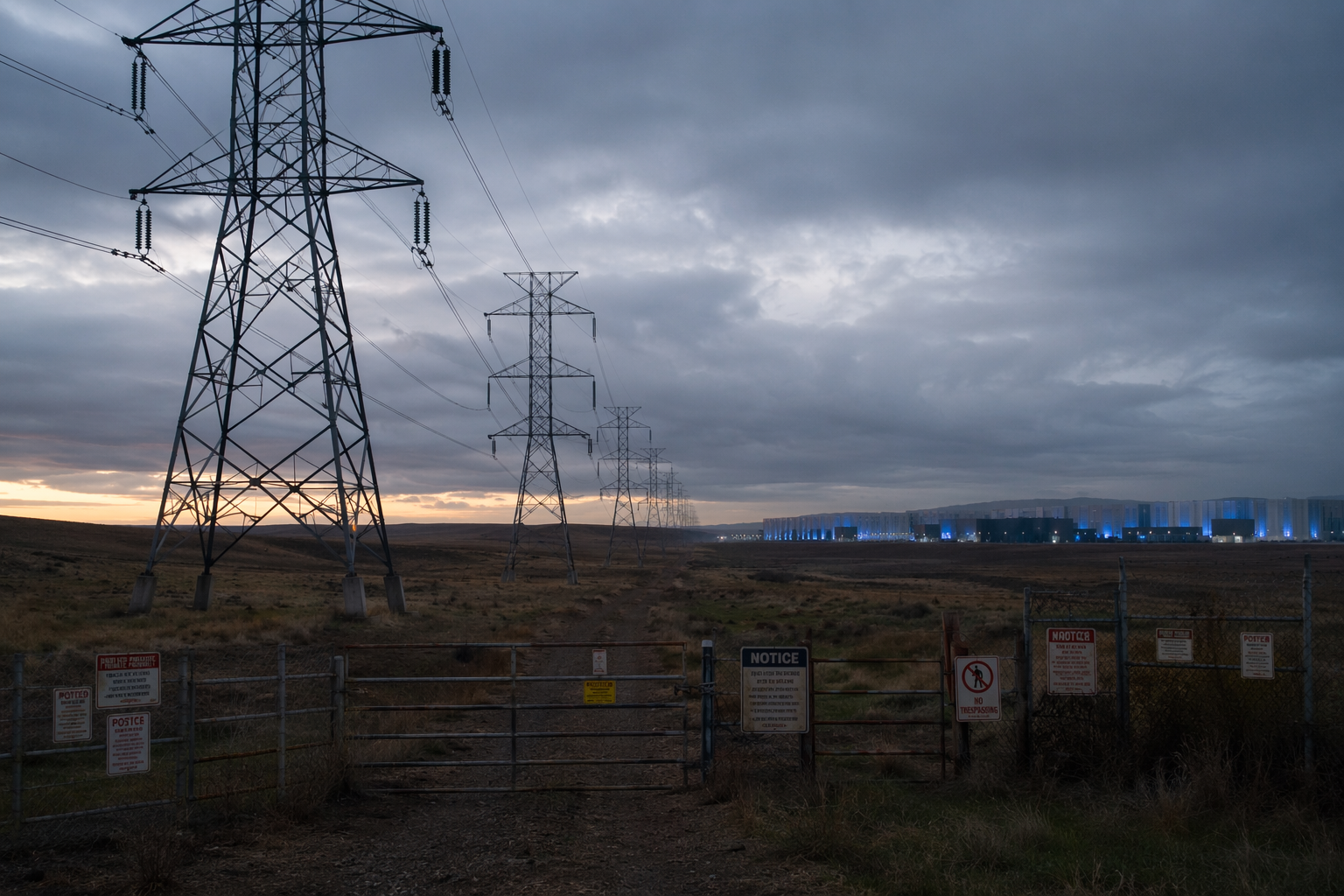
The schedule does not end at interconnection approval
PJM timeline data cited by Data Center Knowledge is the cleanest way to see the shift. Projects entering service in 2025 took more than seven years on average, and more than four of those years came after the interconnection agreement, in the transmission build and land acquisition phase.[1] That is the part of the project where permission has become less valuable than possession: possession of a route, possession of easements, and possession of enough certainty to let utilities and suppliers execute.
This does not make interconnection queues irrelevant. It changes what an interconnection agreement means. Approval identifies a path into the grid. It does not acquire the land under that path, settle compensation, survive every local challenge, or release a utility to build on a corridor that may still be contested.
The distinction matters because AI infrastructure schedules are being reported and financed around milestones that sound more final than they are. A procurement team cannot treat a transformer reservation as secure if the corridor could be rerouted. An EPC team cannot lock a commissioning date if the transmission owner still needs easements. A supplier cannot confidently assign scarce factory capacity to a delivery window if the site’s energization date is being set by court calendars, negotiated settlements, or state condemnation procedure.
| Bottleneck | What it controls | Why it may no longer be the last gating item |
|---|---|---|
| Interconnection queue | Whether and how the load can connect to the grid | Approval can arrive before the transmission corridor is physically and legally buildable |
| Transformer lead time | When major electrical equipment can be manufactured and delivered | Equipment cannot be specified, timed, or energized cleanly when route and in-service dates remain unstable |
| Land acquisition and eminent domain | Whether the transmission path can actually be built | Unresolved corridor control can stop both approved interconnection work and downstream equipment procurement from becoming actionable |
Transformer scarcity is real, but it is not always the first constraint
Large power transformers remain a serious constraint. Wood Mackenzie data cited by Data Center Knowledge shows lead times rising from roughly 50 weeks in 2021 to more than 160 weeks in 2026, with the same reporting projecting the U.S. data center electrical equipment market to grow from about $20 billion to $65 billion by 2030.[1] Those figures should not be stretched into a universal national average. Lead times vary by voltage class, manufacturer, region, and project specification, and the cited reporting may reflect PJM-specific conditions.
Even with that caveat, the supply chain implication is severe. A 160-week lead time rewards early ordering only when the buyer knows what to order and when the asset can be used. Transmission route uncertainty interferes with both. The final voltage configuration, substation scope, protection requirements, transportation plan, and requested delivery window can all depend on the route and utility build sequence.
The common answer, “order earlier,” sounds practical until the route moves. Then the early order may no longer match the needed configuration, the delivery window may arrive before the site can receive or energize the unit, or the supplier may be asked to hold a production slot against a project whose legal path is still open. In a normal shortage, manufacturing capacity is the scarce asset. In these projects, legal certainty can become the scarce input that allows manufacturing capacity to be used efficiently.
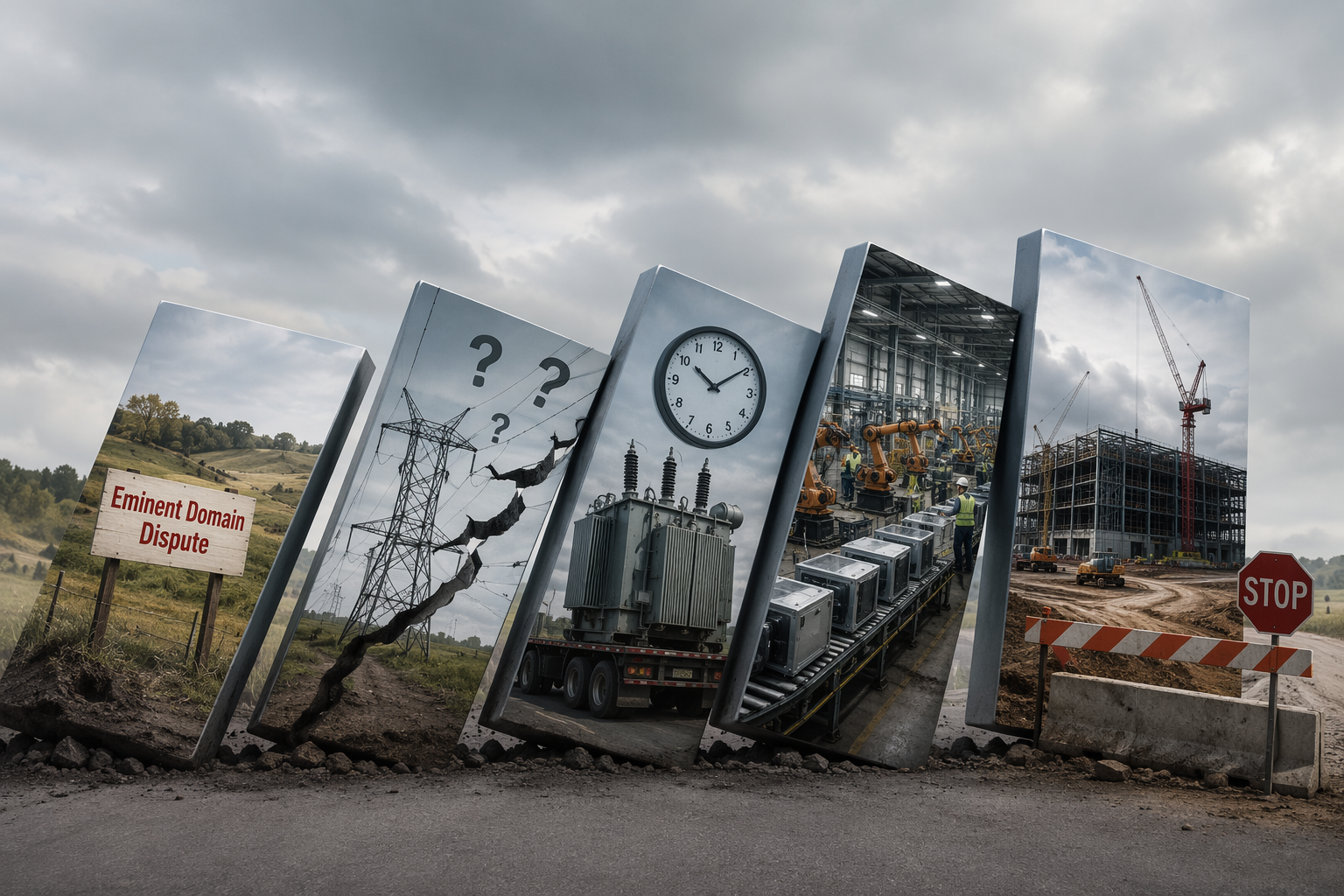
How a land dispute becomes a supplier-capacity problem
The cascade is not mysterious, but it is often modeled too late.
- A utility or developer identifies the transmission route needed to serve the data center load.
- Landowners object, compensation negotiations fail, or public opposition turns the route into a political issue.
- The route is delayed, litigated, redesigned, or held while condemnation authority is challenged.
- Transformer specifications, delivery windows, substation sequencing, and EPC mobilization dates become provisional.
- OEM production slots are reserved with more uncertainty, released late, or reshuffled among projects with firmer energization dates.
That last step is where the cost moves beyond the contested county. Suppliers do not manufacture large transformers as generic inventory for later matching. They plan around engineering requirements, customer commitments, factory bottlenecks, test capacity, logistics, and delivery dates. When a project loses route certainty after a slot has been discussed or reserved, the supplier has to decide whether to protect that slot, reassign it, or renegotiate the delivery position. Each choice creates risk for another project.
The procurement team also loses leverage. If it waits for corridor certainty, it may fall behind other buyers in a crowded transformer market. If it orders before corridor certainty, it may be carrying cancellation risk, mismatch risk, storage risk, liquidated damages exposure, or a delivery date that no longer matches the utility’s transmission schedule. The purchase order becomes a hedge against a legal process the buyer does not fully control.
This is why eminent domain belongs in the supply chain risk model. Not because every condemnation action is improper, and not because every landowner objection should defeat regional infrastructure. It belongs there because it can decide whether the rest of the supply chain is allowed to become real.
Wisconsin shows why “private load, public use” is now the live argument
The Wisconsin Stargate case puts the problem in a form procurement teams cannot ignore: a proposed 600-acre AI data center campus, described by ABC30 as a $15 billion project, where eminent domain could be used on behalf of infrastructure serving a private developer.[2] The legal question is not merely whether land can be taken for power infrastructure. It is whether the public-use justification remains politically and legally durable when the infrastructure is visibly tied to a private data center load.
The Conversation’s legal analysis is useful here because it narrows the issue. Eminent domain authority depends heavily on state law, utility status, public-use interpretation, and the structure of the infrastructure being built; it is not one national rule that cleanly answers every AI data center corridor dispute.[3] That makes national deployment planning harder. A hyperscaler may standardize server architecture across regions, but it cannot standardize condemnation authority across states in the same way.
The procurement consequence is that two projects with similar megawatt targets can have very different schedule risk. One may be served through a corridor with negotiated easements and low political visibility. Another may require a route that makes local residents believe their land is being taken for a private computing campus. Those are not the same supply chain problem, even if both projects need transformers, breakers, switchgear, and EPC crews.
Georgia makes the load allocation visible
In Georgia, CBS News reported that Georgia Power was seeking condemnation of more than 300 parcels for transmission lines, with 70% to 80% of the new line capacity dedicated to data center load.[4] That is the kind of fact that changes a land dispute from an abstract utility expansion into a direct argument over who bears the burden of AI infrastructure.
For a utility, route certainty is operationally valuable: crews need access, engineering needs a final alignment, and the system needs capacity where demand is arriving. For landowners, the same facts can look like compulsory participation in a private growth strategy. For procurement, the uncomfortable point is simpler. Once that argument begins, the transformer schedule is no longer governed only by factory availability. It is governed by whether the corridor survives.
This is where many AI infrastructure schedules still carry a bad assumption. They treat land acquisition as a legal workstream parallel to procurement. In a contested transmission corridor, land acquisition is a predecessor. It decides when specifications are stable enough, when shipping windows matter, and when a reserved unit can become an energized asset rather than an expensive object waiting for a line.
Proposed shortcuts can add their own risk
Ohio is a warning against treating speed reforms as if they automatically reduce schedule risk. News5 Cleveland reported on a proposed “deposit and build” approach under which utilities could take possession and build before final compensation is paid; the proposal was under debate, not enacted law.[5] That distinction matters. A proposed reform is not bankable schedule relief.
A faster possession mechanism might shorten one part of the route-control process if it becomes law and survives challenge. It might also intensify opposition, increase litigation risk, or make landowners more likely to organize earlier. Procurement models should not convert a legislative proposal into an earlier transformer need date until the rule is enacted, tested enough to be understood, and reflected in the utility’s actual build schedule.
That is not an argument against reform. It is an argument against confusing reform language with an executable supply plan.
The corridor fights are not isolated
Other disputes point in the same direction. Newsweek has reported on land seizure concerns across multiple states tied to data center infrastructure, including a Quincy, Washington matter involving 84 properties and data center transmission, as well as Virginia transmission fights connected to data center load.[6] Maryland’s Piedmont 67-mile transmission line has also drawn sustained community opposition, showing that the conflict is not limited to one state’s statute or one developer’s tactics.[6]
The cases differ in legal posture and project structure, so they should not be flattened into a single national backlash. Some disputes center on condemnation authority. Some center on route selection. Some center on whether the public benefit is broad enough to justify the burden placed on specific landowners. What links them operationally is corridor uncertainty attached to large new electrical loads.
That repeated pattern is more important than any one headline. AI data center developers have become accustomed to modeling utility capacity, tax incentives, fiber, water, noise limits, and zoning. Transmission corridor control now has to sit in that same first-screen site-selection layer, not in a legal appendix reviewed after the preferred parcel is already under option.
Policy risk is piling onto corridor risk
Eminent domain is not the only local constraint. Troutman Pepper has tracked more than 100 local moratoriums, more than 10 state moratorium bills, and 28 of 38 states reconsidering data center tax incentives.[7] Those are not all the same category of risk. A moratorium pauses entitlement. A tax incentive review changes project economics. A condemnation fight blocks a route. But for procurement planning, they share one effect: they make the date on the schedule less trustworthy.
ChainSignal has covered this broader fragmentation in AI Data Center Moratoriums Are Creating Supply Chain Constraints. The point here is narrower. Moratoriums and tax politics can delay or kill projects before transmission procurement gets serious. Eminent domain disputes can do something more awkward: they can arrive after teams already believe the power path is moving.
WilmerHale’s litigation overview places data centers in a wider wave of nuisance, environmental, and land-use disputes, while Hinckley Allen’s land-use guidance emphasizes early attention to zoning, permitting, utilities, and community concerns.[8][9] Those sources are legal and advisory, not proof of national frequency. Still, they line up with what the project sequence already shows: land-use risk is becoming an infrastructure delivery risk.
Noise, water, and zoning still matter, and they should be handled at site selection rather than treated as public-relations cleanup. For teams building that screen, ChainSignal’s piece on noise regulations in AI data center site selection is the adjacent issue. Eminent domain is different because it controls the off-site electrical infrastructure that lets the campus exist as a powered facility.
The blocked-project numbers are useful only when the methodology is named
Large dollar totals around delayed AI infrastructure attract attention, but they can blur more than they clarify if they combine proposed, funded, paused, litigated, and canceled projects. Server Country reported 25 canceled projects, up from 2 in 2023; that is a cancellation count from an advocacy resource, not a comprehensive independent census of all delayed AI infrastructure.[10] It is still a signal that project failure is no longer theoretical, but it should not be used interchangeably with broader blocked-investment estimates that may use different inclusion rules.
The same discipline should apply to cost inflation. Deloitte’s 2025 AI infrastructure survey of 120 executives, split between data center and power company respondents, reported construction materials up 40% over five years.[11] That is useful context for why delays hurt more now than they did in a looser market. It is not, by itself, evidence that eminent domain caused the cost increase, and it may not capture mid-2026 pricing conditions.
Supply chain leaders do not need inflated totals to justify changing the model. The PJM timeline, the transformer lead-time data, and the corridor disputes are enough. The operational risk is that a project can be nominally approved, economically attractive, and technically viable while still unable to receive the energy infrastructure it requires.
What changes in the procurement model
The practical change is not to make procurement teams into condemnation lawyers. It is to stop treating corridor certainty as a yes-or-no legal update and start treating it as a schedule variable with supplier consequences.
- Transformer reservation dates should be tied to corridor-control milestones, not only to interconnection milestones.
- Supplier capacity commitments should include scenarios for reroute, delayed possession, settlement delay, and partial corridor access.
- EPC schedules should separate utility build readiness from data center site readiness instead of blending both into one energization assumption.
- Site-selection scoring should penalize projects that require politically fragile transmission corridors, even when the parcel itself looks easy to permit.
- Cancellation and slot-reallocation terms should be negotiated with the recognition that legal delay, not factory delay, may be the reason a delivery window fails.
The harder part is cultural. Hyperscalers and developers like speed, and utilities like route certainty. Both instincts are understandable. But if the project plan assumes land acquisition can be cleaned up late, the consequence lands elsewhere: on the supplier holding capacity, on the procurement team defending a premature reservation, on the EPC manager remobilizing around a slipping utility date, or on the landowner who discovers too late that “public use” now includes the transmission buildout for an AI campus.
Eminent domain risk now belongs in AI infrastructure procurement models as a first-order schedule variable. Transformer availability still matters. Interconnection queues still matter. But for projects dependent on contested transmission corridors, corridor certainty has to be modeled before equipment availability, because no transformer lead time is short enough to solve a line that cannot yet be built.
References
- Why AI Data Center Projects Face Years of Delays After Approval, Data Center Knowledge, May 2026
- A 600-acre AI data center could cost some Wisconsin residents their land, ABC30 / Fresno
- When can a power company take your land for data center infrastructure?, The Conversation
- Georgia family says they're forced to sell home to help power AI data centers: 'It's theft', CBS News
- Ohio farmers fear new proposal would allow data centers to take property, News5 Cleveland
- Land Faces Being Seized in Multiple States to Build Data Centers, Newsweek
- Policymakers Consider Temporary Pause on AI Data Center Construction, Troutman Pepper
- Data Centers in Court: The Emerging Wave of Nuisance, Environmental, and Land-Use Litigation, WilmerHale, 2026-07-13
- Preparing for AI Data Centers: Land Use Considerations, Hinckley Allen
- Legal Actions You Can Take, Server Country
- Can US infrastructure keep up with the AI economy?, Deloitte
Comments
Join the discussion with an anonymous comment.