
AI severe weather planning in logistics is becoming a finance problem before it is a technology problem. Severe-weather disruption now arrives often enough that waiting for the next “exception” means accepting another round of premium freight, missed appointments, inventory imbalance, carrier renegotiation, and customer-service triage. The hard part is not proving that storms are disruptive. The hard part is deciding whether earlier, AI-assisted decisions are worth funding before the next disruption hits.
The cost environment has changed. An Economist Impact report commissioned by Everstream says billion-dollar weather disasters now occur about every three weeks, compared with about every four months four decades ago; Everstream also estimates $81 billion in climate risk to global trade, while FHWA-cited figures put annual U.S. trucking losses from weather delays at $2 billion to $3.5 billion.[1][2] Those are not interchangeable numbers. Global trade exposure, trucking delay losses, and regional disaster impacts measure different layers of risk. But together they explain why severe-weather planning has moved from operations cleanup to capital-committee agenda.
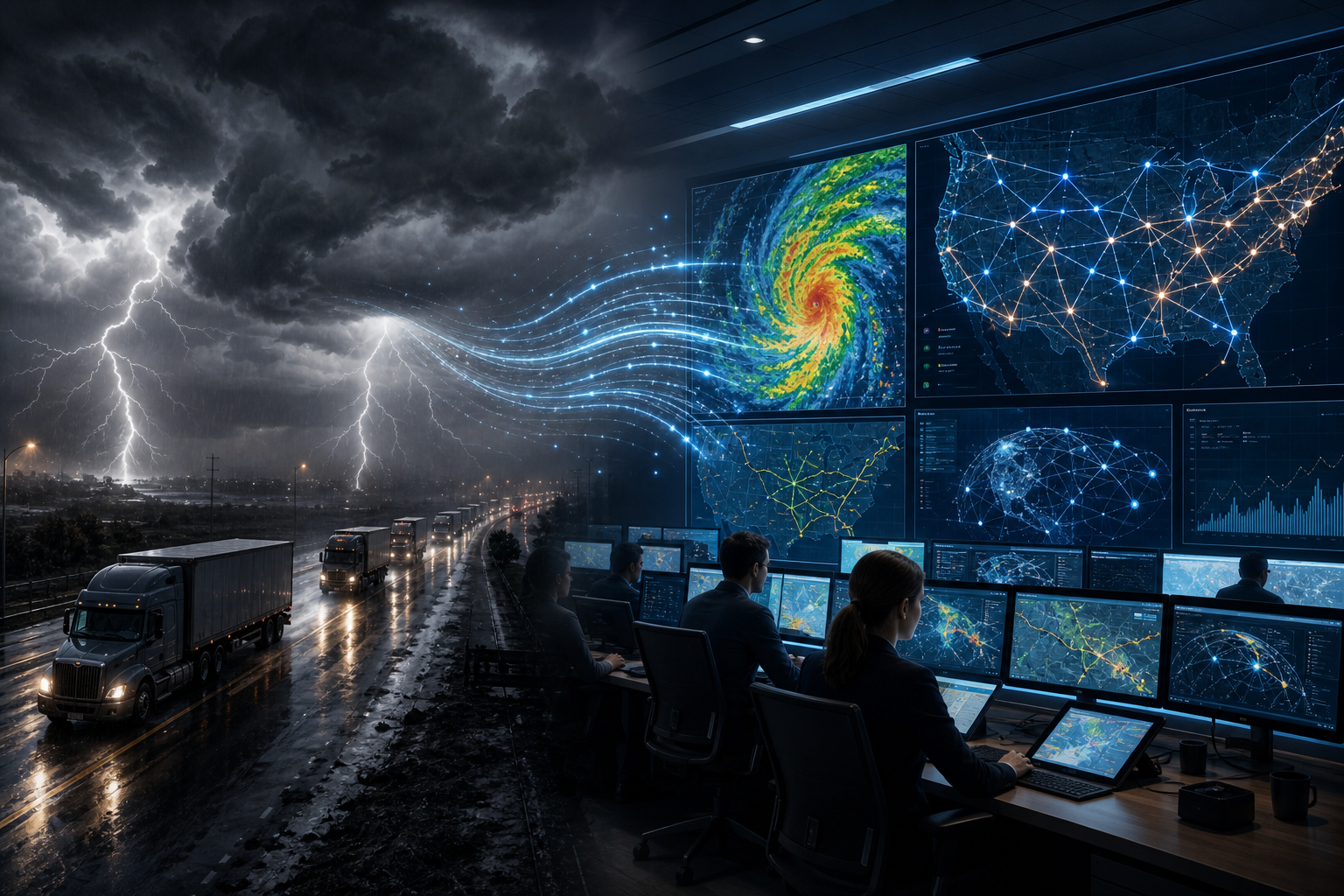
The budget question is sharper in 2026 because logistics leaders are not evaluating AI weather intelligence in a quiet market. Many organizations are already using AI somewhere in supply chain work, executives are increasing spend, and competitors are learning how to turn external signals into operating decisions. Yet formal governance is still thin. OpenSky Group reports that 72% of logistics employees already use AI tools, 94% of procurement executives use generative AI weekly, and only 23% of organizations have a formal AI strategy.[3]
That mismatch matters. Informal AI use can speed up analysis, but severe-weather logistics planning requires decisions that cross functions: transportation may reroute, inventory teams may pre-position stock, procurement may adjust carrier commitments, and customer teams may reset service promises. If those decisions still depend on ad hoc escalation, a better forecast only creates a better argument after the window to act has narrowed.
What the business case can and cannot claim
A defensible business case for AI weather intelligence starts by separating three types of evidence: disruption exposure, AI-enabled supply chain performance, and payback timing. Mixing them produces a procurement slide that looks confident and collapses under finance review.
| Evidence type | What it supports | What it does not prove |
|---|---|---|
| Weather disruption cost baselines | The scale of avoidable or manageable logistics exposure | That any single AI platform will eliminate those costs |
| General AI-enabled distribution benchmarks | The range of operational upside possible when AI changes planning decisions | A guaranteed weather-intelligence ROI |
| Adoption and strategy benchmarks | Competitive pressure and organizational readiness gaps | That adoption equals maturity or effectiveness |
| ROI timing studies | Expected investment horizon and cash-flow realism | That a short pilot should carry the full payback burden |
The strongest ROI figures available are useful, but they need tight labels. McKinsey’s reported 5% to 20% logistics cost reduction and 20% to 30% inventory reduction ranges apply to AI-enabled distribution more broadly, with weather planning as one driver rather than the whole source of value.[3] These ranges can support the direction of the case: better prediction and coordination can reduce waste in transport and inventory. They should not be copied into a model as if severe-weather planning alone will deliver the full savings.
Accenture’s finding that AI-mature supply chains are 23% more profitable, based on 1,148 companies across 10 industries, supports a strategic argument rather than a narrow weather-software payback claim.[3] The useful lesson is that companies gaining value from AI tend to embed it widely enough to change decisions, not merely add dashboards. For readers comparing broader financial evidence, the GM AI supply chain case offers another example of how AI investment can show up in business performance when it is tied to operating levers rather than experimentation alone: GM's AI supply chain tools.
The payback timeline is where the case becomes serious. Deloitte’s benchmark, cited by OpenSky Group, says most organizations see satisfactory AI ROI within two to four years, while only 6% see ROI in less than one year.[3] For severe-weather planning, that is not a footnote. A one-year payback may happen in an unusually exposed network or after a major avoided disruption, but it should not be treated as the base case.
A practical model therefore has to map benefits to decisions, not to software features. If AI weather intelligence gives a distribution network enough lead time to shift loads away from a threatened corridor, the benefit may show up as avoided detention, fewer late penalties, lower spot-market exposure, or protected revenue. If it gives inventory planners time to move product closer to likely demand, the benefit may show up as higher fill rates or fewer emergency transfers. If it gives carrier managers time to adjust commitments before capacity tightens, the benefit may show up as less expensive coverage. The forecast is only valuable when it changes who acts, how early they act, and what cost they avoid.
The adoption gap is now a competitive window
The broader AI supply chain market is expanding quickly, though this is not the same thing as the weather-intelligence market. Precedence Research estimates the AI in supply chain market at $9.94 billion in 2025 and projects it to reach $236 billion by 2035, a 37.3% compound annual growth rate.[4] That projection is useful as an investment signal. It should not be presented as the total addressable market for AI severe weather planning.
Spending intent is already moving. Supply Chain Brain reports that 85% of executives plan to increase AI spending in 2026, with one in five expecting increases of more than 20%.[5] The question for a logistics director is no longer whether AI appears in next year’s budget cycle. It is whether weather disruption is part of the funded use case or left to the same manual escalation process under a more expensive label.
Gartner’s projection raises the stakes: by 2031, 60% of supply chain disruptions are expected to be resolved autonomously.[3] That does not mean human planners disappear, and it does not mean every weather exception becomes machine-managed. It does mean the operating standard is moving toward systems that detect risk, recommend action, and in some cases execute within approved rules. Companies that wait for perfect certainty may find themselves buying basic readiness while competitors are refining exception thresholds, data quality, and governance.
This is where delayed investment carries a hidden cost. The first year of AI weather planning is rarely just model output. It is network mapping, lane prioritization, exception rules, user training, integration with transportation and inventory workflows, and agreement on who can approve a costly preventive move. If satisfactory ROI often takes two to four years, waiting until the next major disruption is already visible compresses the learning curve into the worst possible week.
Where AI weather intelligence actually changes logistics decisions
The technology context deserves enough attention to explain the mechanism, not enough to become a feature tour. Tomorrow.io describes logistics weather intelligence capabilities that combine weather data, forecasts, alerts, and operational decision support for routing, safety, and efficiency; some advanced platforms discuss forecast horizons up to 14 days.[6] That maximum lead time should be handled carefully. Usable lead time varies by hazard, geography, route density, and the decision being made.
A long-range signal may be enough to stage inventory or prepare customer communications. It may not be enough to commit a costly reroute until confidence improves. A flood-risk signal may require different data and decision rules than a hurricane landfall forecast. The Weather Company and IBM frame predictive analytics around monitoring weather risks, identifying affected assets or routes, and supporting earlier supply chain action.[7] That is the useful operating idea: AI does not make storms predictable in a finance-friendly way; it narrows the time between credible signal and approved action.
For hurricane-specific workflows, that can mean pre-storm positioning, alternate routing, facility readiness, demand sensing, and revised service commitments. Readers building an operating case can go deeper into AI hurricane disruption planning or the related problem of AI flood-risk management in supply chains. The common thread is not the hazard category. It is whether the organization has already defined the action that follows a risk threshold.
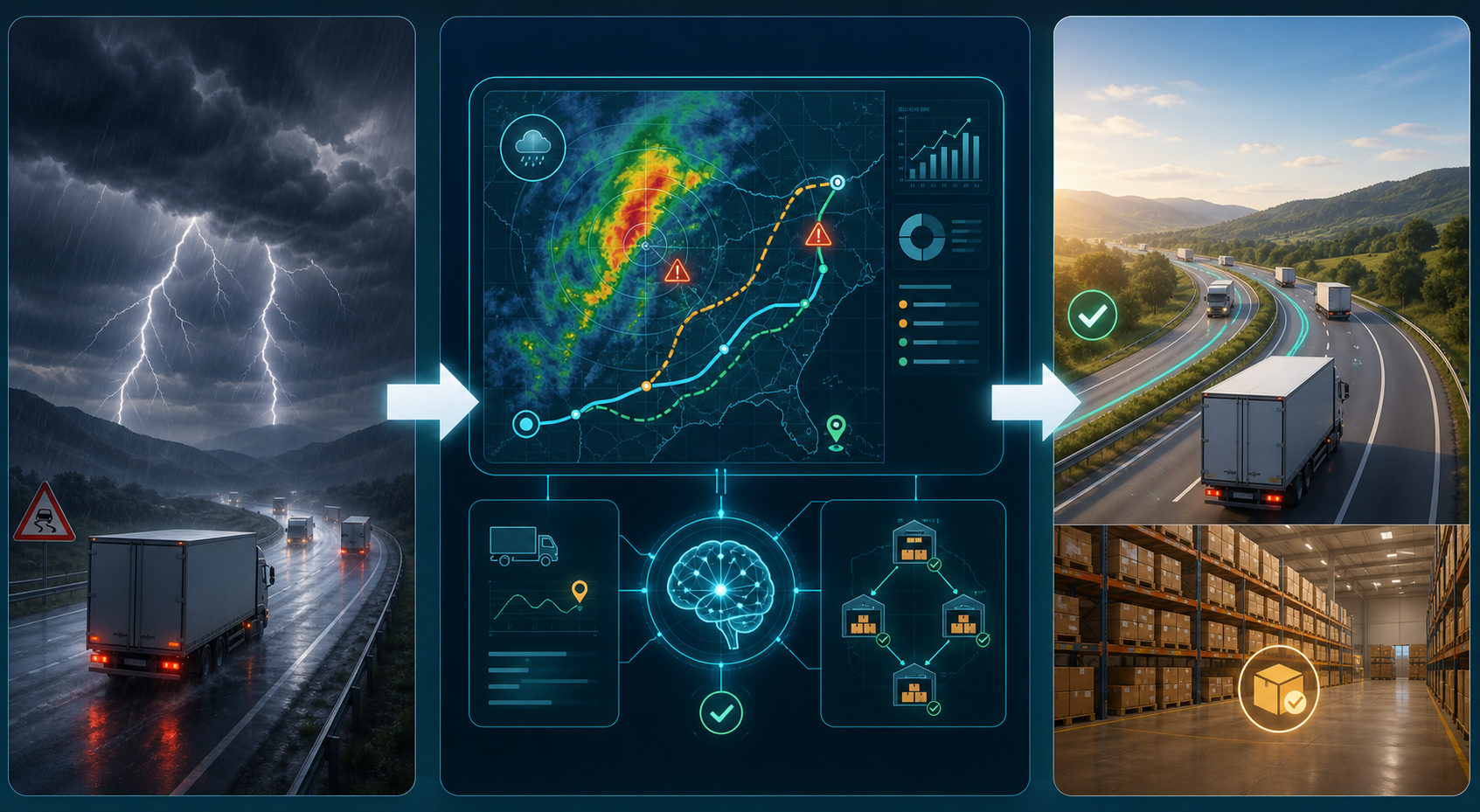
The Hurricane Ian case shows the mechanism, not the average
The clearest reported example in the research set comes from ClimateAi’s account of Hurricane Ian. A building materials company used ClimateAi’s AI-driven forecasting to pre-position Florida-code-approved inventory before the storm and captured an additional $15 million in sales.[8] The value came from a specific decision made early enough: get compliant product into the right market before demand spiked and transport conditions tightened.
That example is useful because it links forecast, action, and financial outcome. It is also a single-company, vendor-reported case. It should not be generalized into a typical payback model. A distributor with storm-relevant products, clear code requirements, flexible inventory, and enough lead time has a very different upside profile from a shipper whose main benefit is avoiding late deliveries or reducing emergency freight.
The case still helps a finance discussion because it shows what a real value pathway looks like. The company did not monetize the weather model by admiring a more accurate forecast. It monetized the forecast by moving inventory before the market needed it. In other networks, the equivalent action might be protecting refrigerated capacity, moving critical spare parts out of a flood zone, shifting delivery promises before a carrier embargo, or holding back inventory that would otherwise be stranded.
How to frame the investment for a capital committee
The most credible business case for AI severe weather planning does not start with “better forecasts.” It starts with exposed revenue, exposed cost, and decision latency. A regional logistics director can defend higher technology spend if the case identifies which facilities, lanes, carriers, SKUs, and customer commitments become expensive when weather risk is visible but action is late.
- Risk exposure: annual weather-related delay costs, storm-prone lanes, facilities in flood or hurricane zones, service-level penalties, and revenue tied to seasonal demand spikes.
- Decision latency: how long it currently takes to detect risk, confirm operational impact, approve preventive action, notify carriers, and update customers.
- Action value: avoided premium freight, reduced detention, protected fill rate, lower emergency transfers, fewer missed appointments, or incremental sales when inventory is positioned early.
- Adoption readiness: data integration, escalation rules, planner trust, executive approval thresholds, and whether AI use is governed by a formal strategy.
- Time horizon: a two- to four-year ROI expectation unless the network has unusually concentrated exposure or a near-term disruption creates measurable upside.
This framing also prevents a common mistake: treating weather intelligence as insurance. Insurance pays after loss. AI weather planning has to earn its place by changing choices before loss: reroute now or wait, position inventory now or preserve working capital, secure capacity now or gamble on the spot market, promise service now or protect credibility by resetting expectations.
Vendor evaluation belongs after that internal math, not before it. Once the organization knows which decisions need shorter latency, it can compare risk-intelligence tools, data coverage, alerting logic, workflow integrations, and governance features. A team moving from justification to market scan may find a broader AI supplier risk monitoring vendor directory useful, especially if weather risk is being evaluated alongside supplier, geopolitical, and transportation-risk signals.
The boardroom conclusion is narrower than the vendor pitch and stronger than the disaster warning. AI severe weather planning is becoming a strategic resilience investment with measurable upside, especially for networks with high weather exposure, tight service commitments, or storm-sensitive demand. But the business case should be built around exposure, decision speed, and competitive readiness over the next several years, not a guaranteed one-year payback.
References
- Weather-Proof Your Logistics Operations, Everstream Analytics
- Are You Prepared for the Supply Chain Disruptions of 2026?, Everstream Analytics
- Supply Chain AI Statistics: 18+ Statistics You Should Know for 2026, OpenSky Group
- AI in Supply Chain Market Size, Share, and Trends, Precedence Research
- 85% of Executives Plan to Increase AI Spending in 2026, Supply Chain Brain
- Weather Intelligence for Logistics | Improve Efficiency & Safety, Tomorrow.io
- Managing Supply Chain Weather Risks with Predictive Analytics, The Weather Company / IBM
- Three Ways AI Can Help Companies De-Risk Supply Chains And Capture New Opportunities During Hurricane Season, ClimateAi
Comments
Join the discussion with an anonymous comment.