
For logistics leaders, the practical question is not whether AI can draw a cleaner line across a map. It is whether AI airline route planning investments can reduce fuel burn, protect connections, improve aircraft utilization, and still hold up when dispatchers are dealing with weather, crew legality, airport congestion, maintenance limits, and cargo commitments before sunrise.
The strongest evidence now comes from production airline operations rather than lab demonstrations. Alaska Airlines says its Flyways route-optimization system helped save 1.2 million gallons of fuel in 2023, optimized 55% of eligible flights, and produced 3–5% fuel savings on flights longer than four hours.[1] Those numbers are company-reported, not independently audited, but they are operationally legible: gallons, flight share, and long-haul fuel percentage are the kind of measures a network planner, fuel analyst, or cargo operations lead can actually test against their own baseline.

What Alaska’s Flyways Case Actually Proves
Flyways matters because it sits in the exact place where route planning stops being abstract. The system evaluates changing weather, traffic flows, aircraft performance, and operational constraints, then recommends route adjustments to dispatchers. The human dispatcher still accepts or rejects the recommendation; the AI does not remove accountability from the operation.[1]
The 1.2 million gallons saved in 2023 is the headline, but the 55% optimization rate is just as important. It implies that the system was not merely tested on a handful of friendly routes. It was active often enough to touch a meaningful portion of Alaska’s eligible network, while still leaving room for the reality that not every flight has an economically useful alternative. Some flights will already be close to optimal. Others will be boxed in by air traffic flow, weather avoidance, crew timing, aircraft turn requirements, or downstream passenger and cargo connections.
The 3–5% fuel savings on flights over four hours also lands where it should: on longer sectors, where route geometry, winds, altitude planning, and congestion avoidance have enough distance to matter.[1] A short-haul operation should not copy that number into a business case without adjustment. A long-haul passenger or belly-cargo network can treat it as a more relevant starting point, especially where dispatchers regularly choose among multiple oceanic, transcontinental, or weather-avoidance options.
What the Alaska case does not prove is universal ROI. It does not say that every carrier will save 1.2 million gallons, or that the same percentage applies to every fleet, region, season, or schedule pattern. It does show that AI-assisted route planning can get out of the slide deck and into daily airline operations, with savings measured in the same units that finance, sustainability, and operations teams already use.
The Evidence Set Is Getting Broader, But the Use Cases Are Not Identical
Other airline examples reinforce the investment case, provided they are not blurred into one generic “AI in aviation” story. Swiss International Air Lines reported $5.4 million saved in 2022 through AI-optimized routing, while British Airways reported saving 100,000 tons of fuel in one year through machine-learning-enabled operations.[2] Those cases support the fuel-and-cost argument, but they do not eliminate the need to inspect route structure, fuel policy, airspace constraints, and dispatcher workflow carrier by carrier.
Ryanair’s work with Optifly belongs in a slightly different bucket. Optifly says Ryanair enabled a 38% capacity increase without adding aircraft.[3] For logistics leaders, that is not just an airline scheduling anecdote. It points to a network-utilization question: can better schedule and rotation planning create more sellable capacity from the same physical fleet?
That distinction matters for air cargo and freight forwarding. A route-optimization tool may reduce fuel on a given flight. A schedule-optimization tool may improve aircraft turns, connection banks, crew pairing feasibility, or recovery options. A maintenance-prediction tool may keep a planned aircraft from disappearing at the gate. All three can improve logistics performance, but they fail in different ways and need different data.
Delta’s APEX predictive maintenance system, for example, is useful adjacent evidence rather than route-planning proof. Delta has disclosed a 99% reduction in maintenance-related cancellations associated with APEX.[2] That result matters because route and schedule plans only create value if the aircraft is actually available. It should not be cited as evidence that AI chooses better flight paths; it is evidence that AI can improve one of the reliability inputs that route and schedule planners depend on.
| Example | What It Supports | Why It Matters For Logistics |
|---|---|---|
| Alaska Airlines Flyways | Company-reported fuel savings and route optimization in production | Shows AI-assisted route recommendations can affect gallons, emissions, and dispatcher decisions |
| Swiss International Air Lines | Cost savings from AI-optimized routing | Reinforces the operating-cost case for route optimization |
| British Airways | Large-scale fuel savings from machine-learning-enabled operations | Adds evidence that fuel impact can be material at network scale |
| Ryanair and Optifly | Capacity growth without additional aircraft | Connects AI planning to fleet utilization and sellable network capacity |
| Delta APEX | Maintenance-cancellation reduction | Supports reliability of planned operations, not route planning itself |
Where Airline Route Planning Meets The Logistics Network
Airline route planning is only one layer in a logistics network. A forwarder still has to decide whether freight should move on a direct air service, a one-stop connection, a deferred air product, or an air-ocean combination. A shipper still cares about tender cutoff, customs timing, warehouse labor, destination trucking, and the probability that a connection window survives irregular operations.
That is why the supply-chain value of AI airline route planning is strongest when airline optimization feeds into a broader control-tower or transportation-management view. A carrier may save fuel by adjusting a flight path. A cargo customer benefits only if the shipment still makes its sort window, transfer truck, or production commitment. The network needs both views: aircraft economics and shipment consequences.
The market data suggests that buyers are paying attention, but it should be treated as buying temperature rather than proof of savings. Fortune Business Insights estimates the flight route optimization market at $7.55 billion in 2026, rising to $17 billion by 2034 at a 10.68% CAGR.[4] DataIntelo separately estimates the airline schedule optimization AI market at $3.2 billion in 2025, rising to $9.8 billion by 2034 at a 13.2% CAGR, and identifies the air cargo AI sub-segment as growing at a 16.7% CAGR.[5] Those are overlapping but not identical categories, so blending them into a single market number would create more confidence than the sources support.
A ground-delivery benchmark can help set scale, as long as it stays in its lane. UPS ORION is reported as generating $300 million to $400 million in annual savings, but it is a parcel ground-routing system, not airline routing evidence.[6] Its relevance is narrower: route optimization can produce large savings when it is deployed at scale, integrated into daily work, and tied to measurable operational decisions.
The Hard Part Is Usually Not The Algorithm
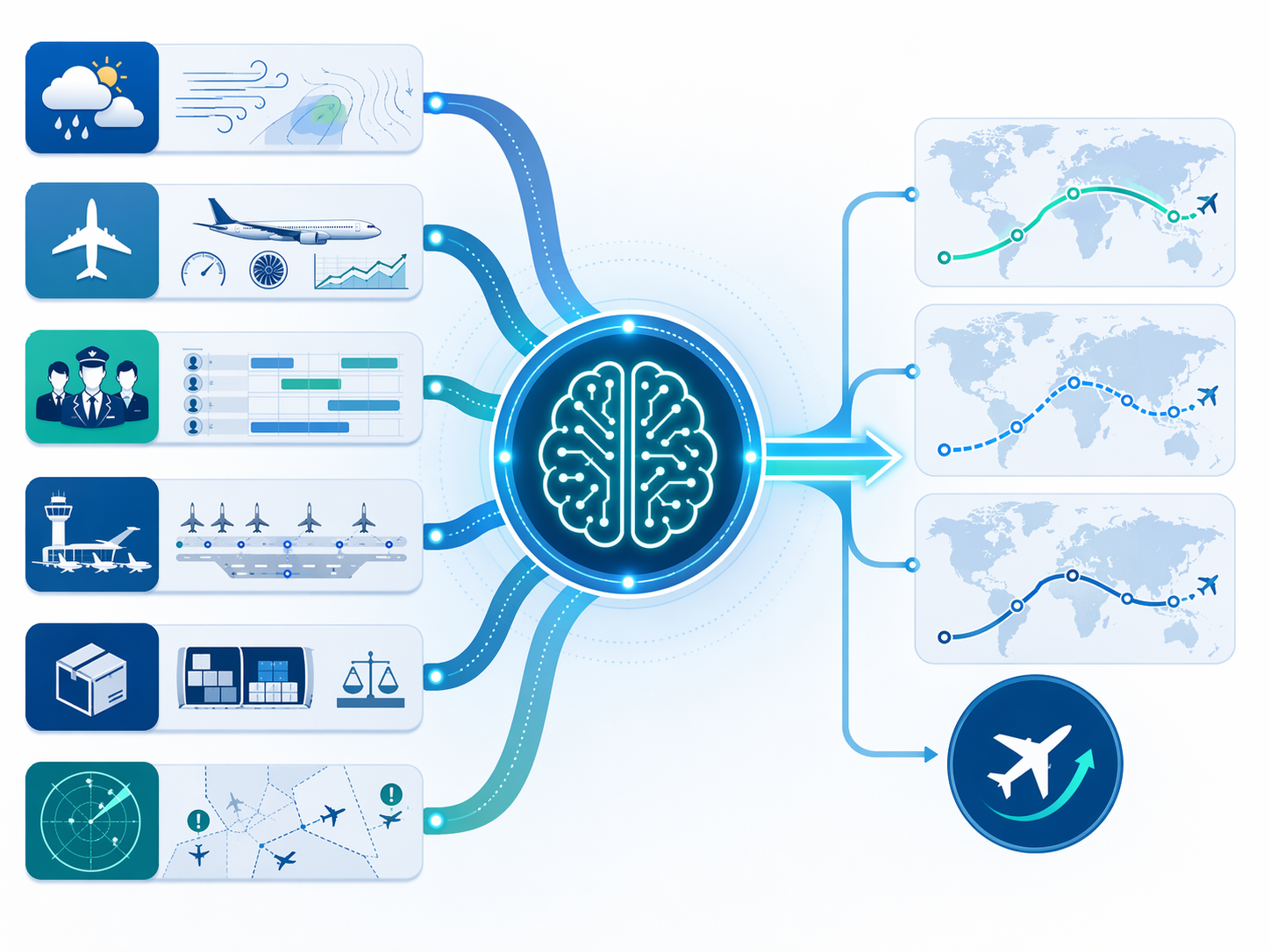
The investment case gets weaker when an organization treats the routing engine as a standalone purchase. AI route planning needs live or near-live data from flight operations, weather, aircraft performance, maintenance status, crew rules, airport constraints, air traffic restrictions, cargo commitments, and commercial priorities. For logistics integration, it also needs clean handoffs into TMS, control-tower, warehouse, and customer-visibility systems.
Bad data does not merely make the model less elegant. It changes the recommendation. If a cargo connection is missing, the system may recommend a fuel-efficient reroute that protects the aircraft but breaks a high-value shipment. If crew constraints are stale, it may create a plan that looks good until legality checks fail. If maintenance status is not connected, the schedule may assume aircraft availability that operations cannot deliver.
Planner adoption is just as material. A dispatcher or network controller who rejects recommendations because they arrive without explainable tradeoffs will quietly return the system to advisory theater. The useful version shows why a recommendation exists: expected fuel effect, weather exposure, airspace risk, arrival-time impact, crew or curfew sensitivity, and cargo connection consequences. At 5 a.m., trust is built from operational specificity, not from a model score.
What A Serious Readiness Check Should Cover
- Data coverage: flight plans, actual tracks, fuel burn, weather, air traffic restrictions, aircraft performance, maintenance status, crew rules, airport constraints, cargo commitments, and downstream logistics milestones.
- Decision rights: who can accept a route change, override it, document the reason, and reconcile the outcome after the flight.
- Baseline discipline: the organization needs a credible comparison against current dispatch, schedule, fuel, delay, cancellation, and connection performance.
- Integration scope: the tool should feed the systems where planners, cargo teams, and logistics partners already work, not require a separate screen that becomes optional during disruption.
- Adoption design: recommendations need explanations, thresholds, and audit trails so experienced planners can test them without surrendering judgment.
Cloud SaaS Is Faster, But On-Premises Still Has A Place
Deployment model choice is now part of the ROI discussion. Cloud SaaS has become the faster and increasingly common path, with reported deployment windows of 6–9 months and 57.3% of new contracts.[7] That speed matters when the first goal is to validate savings on defined city pairs, fleets, or cargo flows before expanding across the network.
Cloud deployment can also make weather feeds, model updates, and multi-station access easier to manage. For airlines and logistics providers with fragmented planning teams, that is not a small advantage. A tool that reaches dispatch, network planning, cargo operations, and partner visibility workflows faster has a better chance of becoming part of the operating rhythm.
On-premises deployment should not be dismissed as old-fashioned by default. It can be the right fit where data-control requirements, security policy, sovereign operations, latency concerns, or legacy integration depth outweigh speed. The tradeoff is usually implementation effort: more internal technical burden, slower upgrades, and a heavier requirement to maintain integrations as operational systems change.
The better question is not which model sounds more modern. It is which model lets the organization connect enough operational data, expose recommendations inside real planning workflows, and measure results against the economics that matter: fuel, delay minutes, missed connections, crew disruption, cancellation exposure, aircraft utilization, cargo service reliability, and customer commitments.
A Practical Investment Judgment
AI airline route planning is mature enough for serious evaluation. The case evidence is no longer limited to pilots, and the documented outcomes are specific enough to support investment screening. Across aviation AI cost-cutting examples, reported fuel savings in the 3–8% range and crew cost reductions in the 7–14% range are material, though they should be validated against each operator’s network rather than copied wholesale into a board case.[8]
The strongest candidates are operators with enough route variability to optimize, enough fuel or capacity exposure to make the savings matter, and enough data maturity to connect flight planning with maintenance, crew, airport, cargo, and logistics systems. Long-haul carriers, mixed passenger-cargo networks, express air operators, and forwarders with significant air procurement exposure are more likely to find the use case worth detailed validation than a small, highly constrained short-haul operation with little dispatch flexibility.
There is also a useful connection to adjacent aviation and supply-chain AI work. Fleet availability affects whether optimized schedules can be flown at all, which is why AI-driven fleet-planning and maintenance initiatives such as the internal case study on bridging the airline fleet renewal gap sit close to this investment conversation. The same is true for broader route-optimization debates, including quantum computing’s supply-chain impact, but airline route planning has a nearer-term advantage: production deployments already exist.
The investment case is weakest where a company buys a routing engine without fixing the operating environment around it. A model cannot rescue missing cargo data, stale crew feeds, untrusted recommendations, or a planner workflow that treats the AI screen as optional. The savings become more believable when the operator can trace a recommendation from data input to planner decision to flight outcome to logistics consequence.
That is the line worth holding: AI route planning is often capable of measurable savings, but the buyer is not really purchasing intelligence in isolation. The buyer is funding a disciplined operating system for better route and schedule decisions, connected tightly enough to the logistics network that gallons saved do not come at the expense of service commitments.
References
- How AI is helping Alaska Airlines plan better flight routes and lower emissions — Alaska Airlines newsroom
- How machine learning is transforming airline operations — AWS Blog
- Ryanair + Optifly enabling 38% capacity increase without additional aircraft — Optifly
- Flight Route Optimization Market Size, Share, Growth [2034] — Fortune Business Insights
- Airline Schedule Optimization AI Market Research Report 2034 — DataIntelo
- AI Route Optimization vs Traditional Methods in 2026 — FleetRabbit
- AI in Aviation: Real-World Solutions, Case Studies, and Practical Implementation — Flying Assist
- Machine Learning in Aviation: How Airlines Cut Costs with AI — ArticSledge
Comments
Join the discussion with an anonymous comment.