
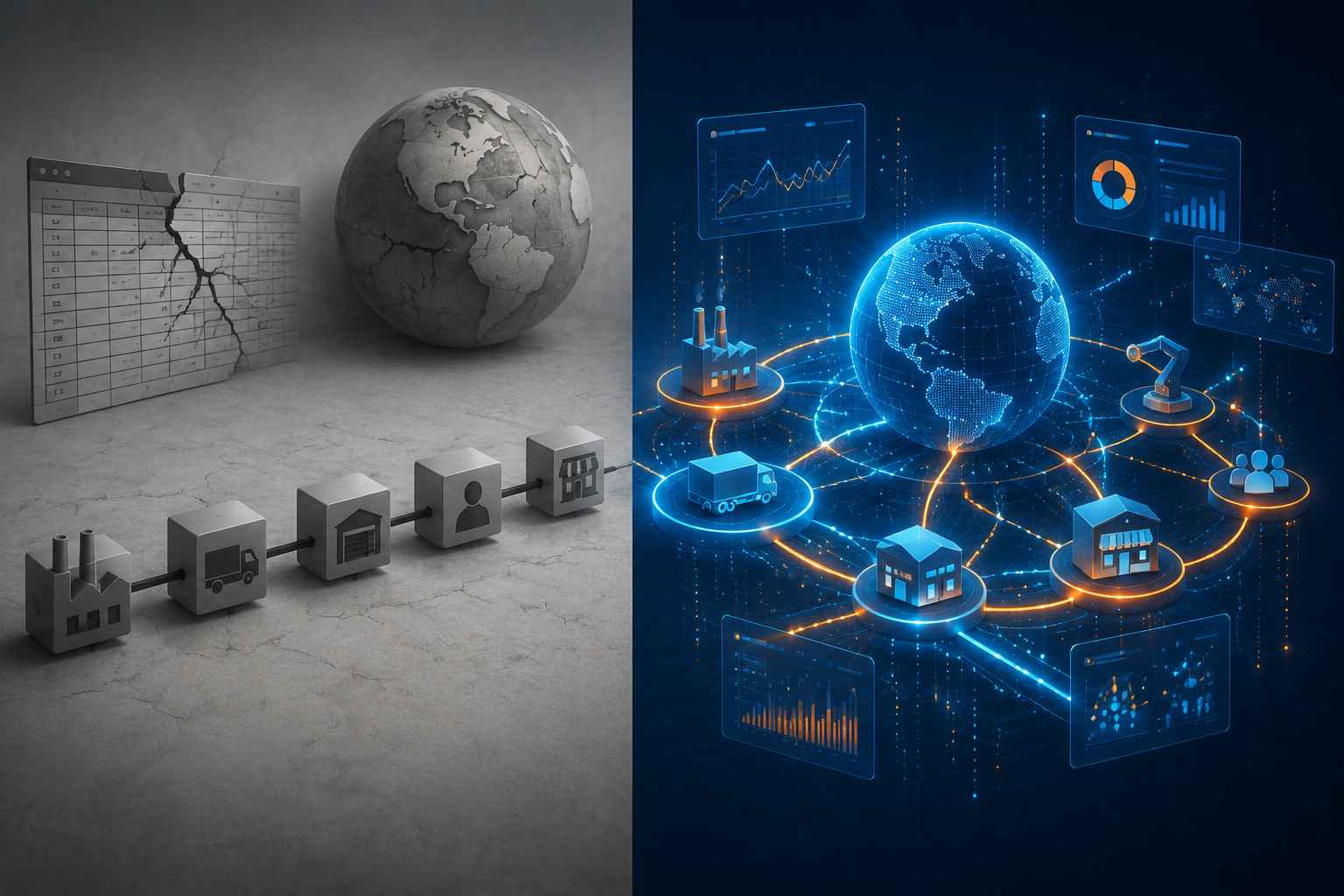
The old planning model did not fail because planners forgot how to optimize. It failed because the operating variable changed. A supply chain built to minimize unit cost and working capital can look rational until a tariff change lands in the middle of the product file, an export control removes a qualified input, or a customs review asks for sourcing records that were never maintained at decision speed.
That is the real question behind AI supply chain resilience planning for geopolitical escalation: not whether AI can make a dashboard more elegant, but whether the planning system can be re-run quickly enough to change a sourcing, inventory, production, or pricing decision before the exposure becomes an earnings problem.
The tariff environment has become too active for annual network reviews and spreadsheet exception handling. Z2Data reported that U.S. average effective tariff rates reached 18% in 2025, the highest level since 1934, and that Section 232 tariffs on steel and aluminum doubled to 50% in mid-2025; it also warned that firms can face penalties up to 200% when sourcing data is incomplete.[1] PIIE tracking cited by AI in the Chain counted nearly 90 notable tariff announcements since January 2025.[2]
When Tariffs Become a Planning Queue
A tariff increase is usually described as a policy event. Inside a multinational supply chain, it becomes a queue of decisions. Which SKUs have margin room? Which finished goods cross the affected border? Which supplier declarations are complete enough to defend? Which plants can absorb a production shift without starving another customer commitment? Which contracts allow price movement, and which ones turn the tariff into a direct margin hit?
That queue is now large enough to sit with the CFO, not only with trade compliance. Kimberly-Clark anticipated $300 million in additional costs from U.S. tariffs, while GE Aerospace projected $500 million in added costs, according to Axidio’s discussion of geopolitical risk analytics.[3] At that scale, the question is not simply whether the customs team can classify goods correctly. Finance needs to know whether the exposure is temporary, structural, recoverable through pricing, or large enough to justify a network change.
The same planning failure can arrive through export controls rather than tariff schedules. China’s April 2025 export controls on critical minerals forced Ford to shut down a plant for weeks because of shortages of high-powered magnets, according to Z2Data.[1] That case matters because it is physical. The exposure did not stop at a landed-cost calculation. It reached the production line.
Tariffs are the cleanest measurable pressure in 2026, but they are not the whole problem. Sanctions, critical mineral restrictions, semiconductor rules, regional conflict, and maritime chokepoints all create the same planning requirement: the company has to translate an external shock into product, supplier, plant, inventory, customer, and compliance consequences fast enough to act. For readers comparing tariff planning with chokepoint modeling, the same operating logic appears in AI planning for Strait of Hormuz disruption risk, where the trigger is not a customs rate but a physical routing constraint.
Why Static Cost Models Break Under Geopolitical Escalation
Cost-minimization and just-in-time logic were not foolish. They were fit for a period when many inputs were stable enough to treat low cost, low inventory, and high utilization as the dominant planning objective. The weakness shows up when those objectives are asked to carry variables they were not designed to absorb.
Most planning tools still optimize around a narrow cost function even as supply chains have become much harder to describe. RSM, cited by Dataiku, estimated that large corporate supply chains are 9 times more complex than they were 15 years ago.[4] That complexity is not an abstract management problem. It means more supplier tiers, more country-of-origin dependencies, more transportation substitutions, more documentation paths, and more cases where a decision that looks cheapest at purchase-order level becomes expensive after duty, delay, compliance risk, and customer allocation are included.
The practical failure mode is latency. A team can usually build a one-off tariff model if given enough time. It can gather supplier declarations, map affected components, estimate landed-cost changes, check alternative sources, and ask finance to compare margin scenarios. But if the policy cadence is measured in repeated announcements and the next change arrives before the last workbook has been reconciled, the model stops being planning and becomes documentation of a decision already missed.
This is where the distinction between adoption and effectiveness matters. Buying an AI planning platform does not diversify suppliers, clean country-of-origin records, or set risk appetite. Those are operating decisions. What AI can change is the rate at which the company can connect those decisions to the current network and rerun the consequences.
The Workflow Shift: From Exception Handling to Repeatable Scenario Runs
AI-powered resilience planning starts with a less glamorous prerequisite than most sales language suggests: a usable representation of the supply chain. The company needs product structures, suppliers, manufacturing sites, lanes, inventory positions, trade classifications, sourcing records, contractual constraints, and customer commitments brought into a model that can be queried together. The common name is a digital twin. The operational test is simpler: when a rule changes, can the planner ask which finished goods, plants, suppliers, and customers are touched without waiting for three functions to reconcile different files?
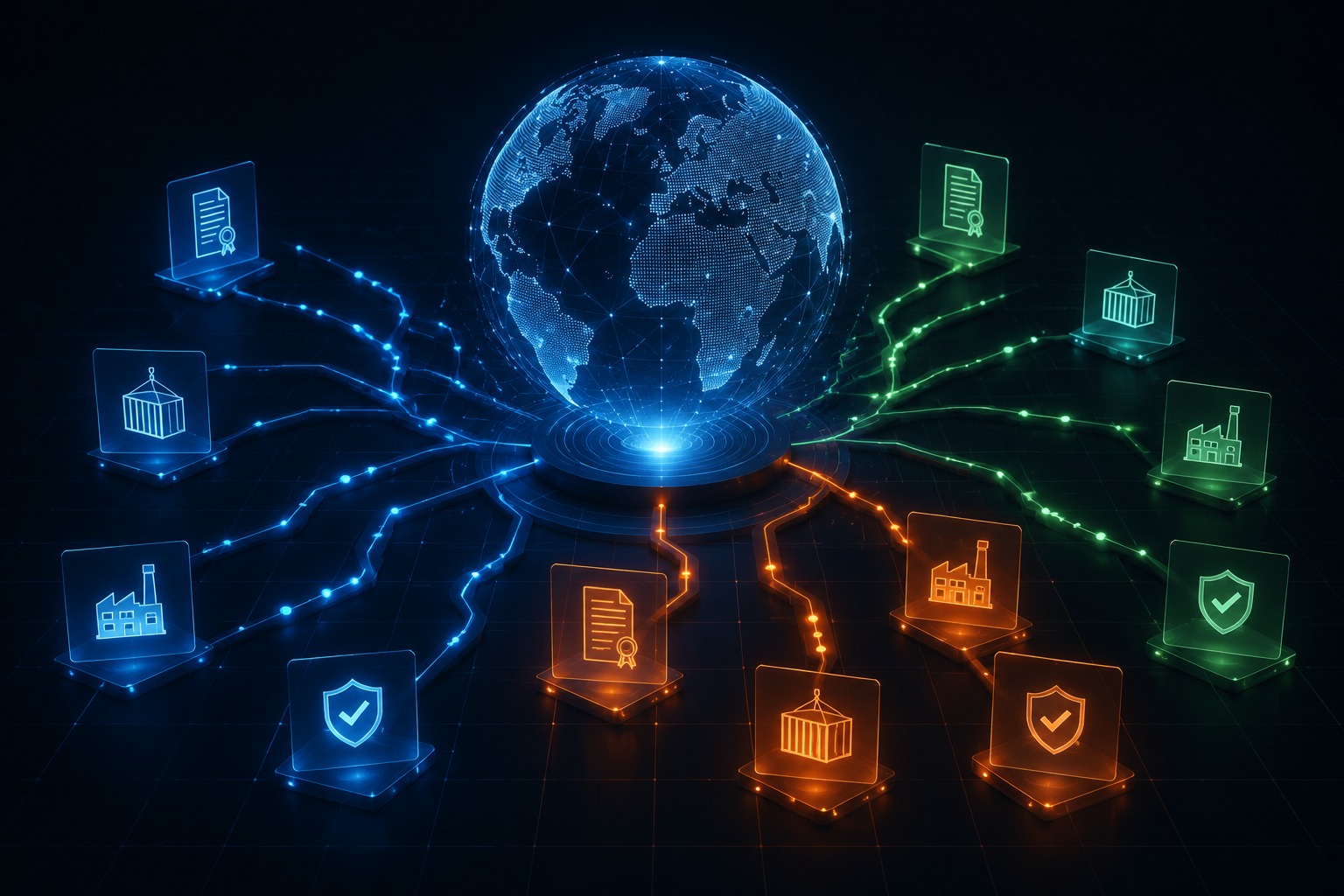
Once that representation exists, scenario modeling becomes a management routine rather than a special project. A tariff scenario can be applied to steel inputs, aluminum content, a country-of-design rule, a supplier location, or a product family. The model estimates landed-cost movement, flags records that are too incomplete to support the calculation, tests alternate suppliers against capacity and qualification constraints, and shows which inventory positions buy time. The point is not to produce one perfect answer. It is to narrow the decision set while the decision still has value.
| Planning Question | Static Model Behavior | AI-Enabled Planning Behavior |
|---|---|---|
| Which products are exposed? | Manual SKU and supplier matching across files | Product, supplier, tariff, and sourcing data queried in one model |
| Can cost be absorbed? | One-off margin workbook after finance reconciliation | Repeated landed-cost and margin scenarios by product family or customer |
| Can supply move? | Procurement checks alternates sequentially | Supplier options ranked against qualification, capacity, region, and compliance constraints |
| Where should inventory sit? | Safety stock adjusted after the disruption is visible | Inventory scenarios tested before the tariff or export-control effect reaches production |
| What is defensible to customs and customers? | Documentation gathered after exposure is identified | Incomplete sourcing and compliance records flagged as part of the scenario |
The biggest change is not that planners get more information. They get a different cadence. Instead of treating geopolitical escalation as a quarterly risk review or an emergency meeting, the planning team can ask a series of narrow questions: what if the tariff applies to this component class, what if the country-of-design rule captures this supplier, what if a critical mineral input becomes unavailable for several weeks, what if the company prioritizes margin over service for one segment but service over margin for another?
That cadence changes behavior in executive planning rooms. Finance can separate a price-recovery problem from a network-design problem. Procurement can focus qualification work on suppliers that actually relieve exposure. Operations can see whether a plant shift creates a second bottleneck. Sales can stop promising availability that the revised supply plan no longer supports. Compliance can see which sourcing records are not merely untidy but financially dangerous.
For teams deciding which AI functions deserve investment, the useful distinction is between tools that only visualize disruption and tools that support executable replanning. The adjacent comparison of AI capabilities for disruption planning is relevant here because geopolitical volatility has to be modeled as a specific disruption type, not treated as a generic risk alert.
What Early Deployments Actually Show
The strongest early evidence is about response-time compression, not universal return on investment. That is still meaningful. In geopolitical planning, a move from months to hours or weeks can determine whether the company has options or only explanations.
C3 AI describes a global consumer packaged goods company using a unified digital twin to respond within hours of a tariff hike, rerouting inventory and shifting production across its network.[5] Because the case is vendor-published, it should not be read as proof that every CPG manufacturer will get the same result. It does show the operating pattern that matters: the tariff event was not handled as an isolated customs update. It was translated into inventory movement and production allocation quickly enough to affect execution.
Dataiku reports that Zeus accelerated inventory optimization from a traditional 4-to-5-month process to 2 weeks.[4] That is a different kind of gain. It does not claim instant reaction to a single tariff notice. It suggests that a planning cycle previously too slow for repeated geopolitical scenarios became short enough to run more often. For companies that still treat inventory optimization as an annual or semiannual exercise, that change is not cosmetic.
These examples belong in the evidence file, with labels attached. They are vendor-disclosed cases, not independently verified cross-industry benchmarks. Their value is that they describe concrete planning work: rerouting inventory, shifting production, and compressing optimization cycles. They should not be stretched into a claim that AI automatically lowers cost or removes the need for redundant suppliers.
The broader executive posture is also moving. The Conference Board, cited by Axidio, reported that 85% of large-company executives are planning significant supply chain changes because of trade conflicts.[3] That is an attitude and planning signal, not proof that the changes will succeed. Still, it helps explain why AI planning is moving from innovation budget to operating infrastructure. Companies are no longer asking only how to sense disruption. They are asking how often they can redesign around it.
The Planning Decisions AI Can Support
The useful test for an AI resilience-planning system is whether it supports the decisions that actually arrive after escalation. Four decision groups usually matter most.
- Landed-cost exposure: identifying which SKUs, components, suppliers, and customer commitments absorb a tariff, duty, or rule change.
- Supplier substitution: ranking alternate sources by qualification status, available capacity, region, lead time, and compliance documentation rather than by quoted price alone.
- Inventory positioning: deciding where buffer stock buys time, where it only traps cash, and which plants or customer segments receive scarce material first.
- Compliance defensibility: flagging incomplete sourcing, country-of-origin, or classification records before penalties or shipment delays define the decision.
The supplier-substitution step is where software claims often run ahead of operating reality. An algorithm can surface candidates. It cannot make an unqualified supplier qualified overnight, create tooling capacity that does not exist, or remove the commercial risk of splitting volume. The practical gain is earlier visibility into which alternatives deserve human effort. Procurement time is scarce during escalation; wasting it on suppliers that fail basic feasibility checks is expensive.
The compliance step is becoming more central because tariff exposure is increasingly tied to proof, not only geography. When Section 232 tariff levels move and penalties for incomplete sourcing data can reach severe levels, documentation quality becomes part of supply chain resilience rather than a back-office audit concern.[1] A planning model that calculates cost but ignores missing origin or content records is giving executives a false sense of precision.
For platform selection, the buyer question should be framed around the decisions above rather than around a generic AI feature list. The relevant comparison is not which vendor says “resilience” most often; it is which system can connect trade data, supplier data, network constraints, inventory, and financial exposure in the same workflow. A broader buyer lens is covered in the 2026 AI supply chain tools comparison.
Where the Model Still Needs Human Decisions
AI can make geopolitical variables more usable in planning. It does not decide how much margin a company is willing to sacrifice, whether a strategic customer should receive scarce supply ahead of a more profitable one, or how much redundancy the balance sheet can carry. Those are governance choices.
The data problem is equally stubborn. A digital twin is only as defensible as the sourcing, supplier, product, and logistics records feeding it. If the company cannot identify where content originates, which suppliers are actually approved, or which lanes are contractually available, scenario outputs may be fast but not reliable. Speed without data discipline only moves the error earlier in the meeting.
There is also a risk of optimizing the visible shock while underweighting the next one. Tariffs provide clear rates and dates, which makes them attractive for scenario modeling. Export controls and regional conflict can be harder to parameterize. The Ford magnet shortage is the warning: a non-tariff geopolitical measure can become a production outage.[1] A resilience model that cannot represent material criticality, supplier concentration, and qualification lead times is still incomplete.
The cost of getting this wrong is not theoretical. Swiss Re, cited by Marsh, estimated that supply chain disruptions cost businesses $184 billion annually.[6] That figure covers broader disruption, not tariffs alone, so it should not be used as a tariff-impact estimate. It does put the planning investment in context: resilience planning competes with many capital requests, but unmanaged disruption already has a large bill.
The New Baseline
By Q3 2026, geopolitical escalation is no longer an occasional exception to a stable supply plan. It is one of the variables the plan has to absorb. The companies furthest along are not merely watching tariff news faster. They are connecting policy movement to SKU economics, supplier feasibility, inventory position, production allocation, and compliance exposure while there is still time to choose among imperfect options.
That is the defensible promise of AI supply chain resilience planning. It is not a shield against tariffs, export controls, sanctions, critical mineral shortages, or regional conflict. It is the operating mechanism that makes repeated replanning possible when the old model would still be collecting inputs. In a tariff-and-export-control environment, that difference is becoming the practical baseline for companies that need to re-plan before the next policy move becomes an earnings problem.
References
- 22 Critical Supply Chain Risks to Watch for in 2026, Z2Data
- Tariffs, Freight Rates, and AI: Why Supply Chains Need Real-Time Scenario Planning, AI in the Chain
- From Navigating Uncertainty: How Geopolitical Risk Analytics Are Reshaping Global Supply Chains, Axidio
- Navigating the Tariff Storm: Supply Chain Resilience With AI, Dataiku
- How to Build Tariff-Resilient Supply Chains with C3 AI, C3 AI
- Supply chain trends in 2026, Marsh
Comments
Join the discussion with an anonymous comment.