
A military-strike disruption does not behave like a late shipment, a storm-closed port, or a tariff update. Those events can be severe, but planning teams usually know which variable moved first. A strike or armed escalation can move several variables at once: a supplier region becomes inaccessible, an air corridor closes, a shipping lane becomes uninsurable, sanctions screening changes, inventory is stranded in the wrong market, and executives need to approve expensive alternatives before the next sales-and-operations call.
For supply chain disruption planning under military strikes, AI becomes a different capability from ordinary planning. The useful question is not whether AI can predict the next strike. The defensible question is whether it can turn plausible conflict scenarios into mapped, costed, and governed choices before the network is already under stress.
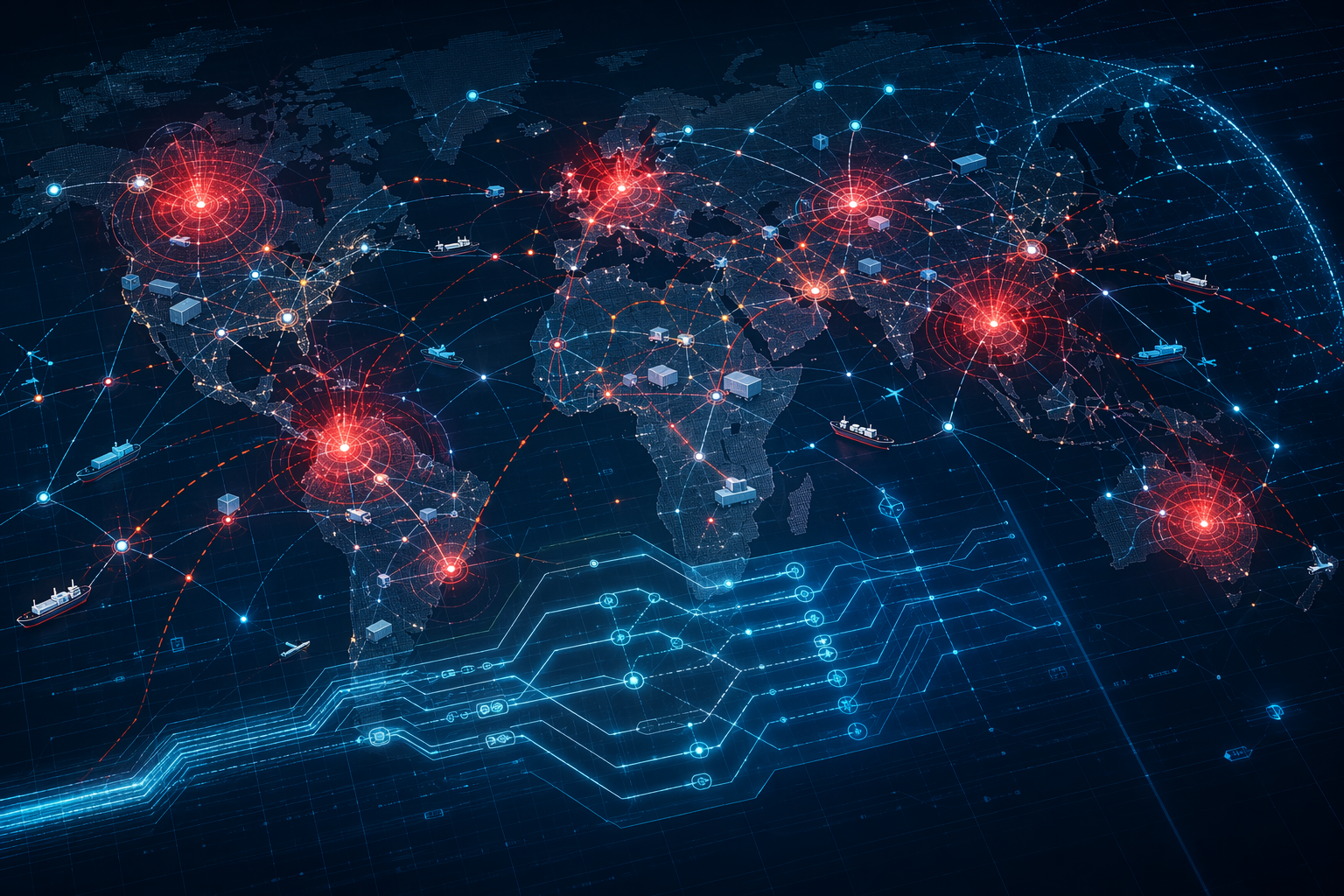
Why military-strike disruption breaks ordinary risk models
Conventional supply chain risk models often assume a primary failure: one supplier misses an order, one port loses capacity, one tariff changes landed cost, one earthquake affects one geographic cluster. The model may then calculate substitution, expediting, inventory drawdown, and revenue exposure. That logic still matters, but it underestimates conflict-driven disruption because the first failure is rarely the only failure.
A strike near a port can change vessel routing, air freight availability, marine insurance pricing, customs inspection posture, export-control exposure, supplier labor access, and executive tolerance for operating in the region. A procurement team may discover that its approved alternate supplier uses a tier-two component from the same exposed area. A logistics manager may find that the cheapest alternate route crosses a corridor now considered politically or militarily unstable. Finance may ask for the cost of rerouting before operations can confirm whether the route is even serviceable.
The difference from tariff disruption scenario planning is not that tariffs are simple. It is that tariff planning usually starts with a known policy variable and then tests sourcing, pricing, classification, and landed-cost consequences. Military-strike planning starts with uncertainty over which nodes may fail, which corridors may remain open, whether escalation will be asymmetric, and how quickly leadership is willing to authorize a different operating mode.
This is also why static heat maps age badly in conflict scenarios. A country-level risk color does not tell a planner whether the affected part is dual-sourced, whether a feeder route is exposed, whether inventory is already positioned downstream, or whether a sanctioned entity sits inside a sub-tier relationship. Under military-strike conditions, resilience depends less on knowing that a place is risky and more on knowing which executable alternatives survive when several parts of the network fail together.
The capability stack: from conflict signal to approved option
The practical workflow is not mysterious, but it is difficult to maintain manually. AI-powered scenario planning needs a living representation of the network, a feed of geopolitical and operational signals, multi-tier supplier and corridor mapping, simulation logic, and contingency playbooks that have already been reviewed by the people who will own the consequences.
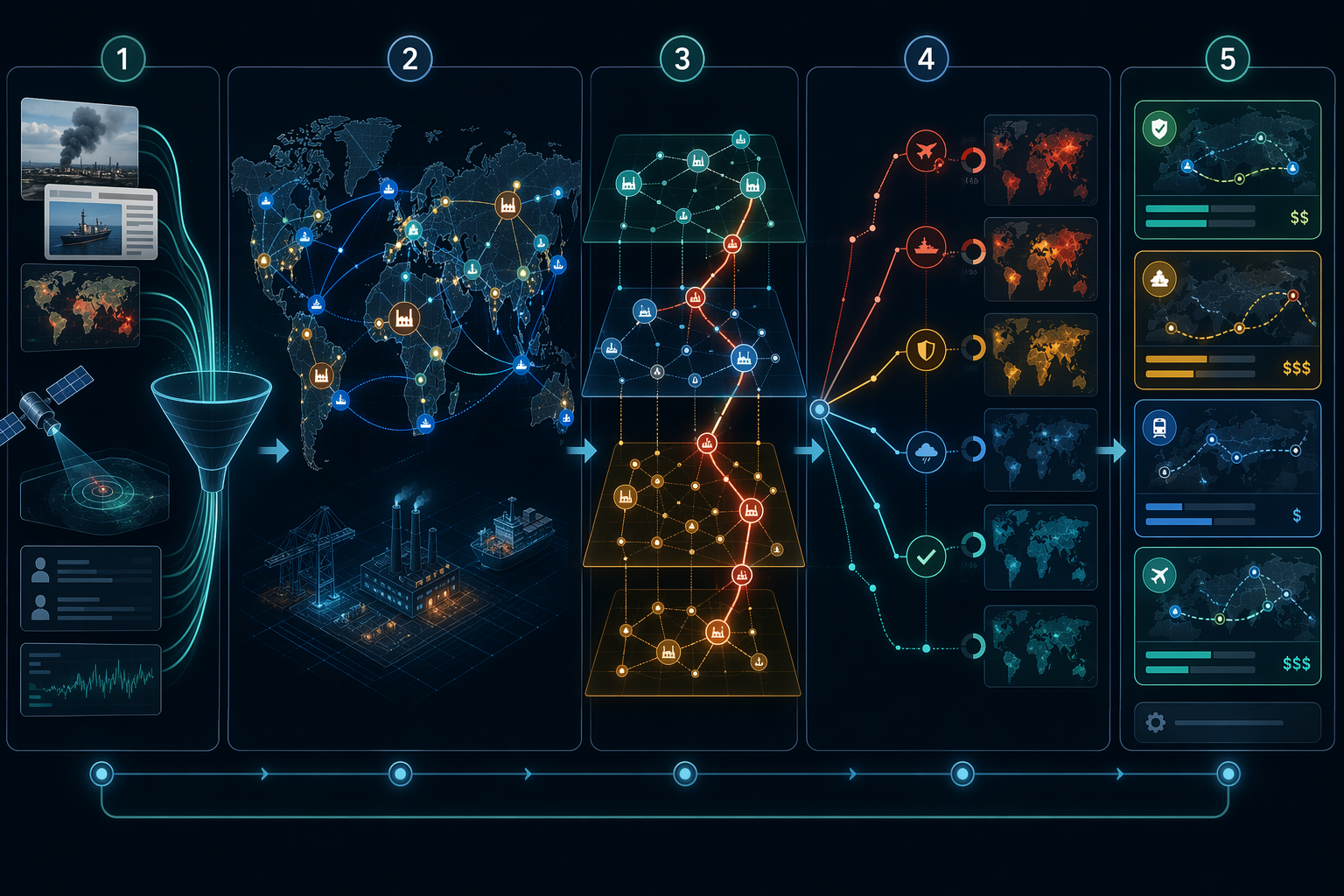
| Capability | What it must answer during a strike scenario |
|---|---|
| Digital twin of the supply network | Which products, sites, lanes, suppliers, inventories, and customers are connected to the affected region? |
| Geopolitical signal ingestion | Which warnings, incidents, corridor changes, sanctions updates, or insurance signals should trigger a scenario run? |
| Multi-tier supplier and corridor mapping | Which direct and indirect suppliers, ports, air routes, warehouses, and carriers are exposed? |
| Scenario simulation | What happens if several nodes and corridors fail at once, and which alternatives still meet cost, service, compliance, and capacity constraints? |
| Automated contingency playbooks | Which pre-approved actions can logistics, procurement, finance, and operations execute without rebuilding the model from scratch? |
The defense sector has already moved this from concept to production. The Defense Logistics Agency describes AI use for illuminating supply chain risk, and the available DLA material reports 55 AI models in production with more than 200 use cases under development.[1] That does not mean a commercial manufacturer can copy defense logistics one for one. DLA operates under different mandates, budgets, data rights, and threat assumptions. It does show something important: contested logistics is already being treated as a production AI problem, not as a strategy-slide exercise.
The same point came through in public comments from DLA leadership. GovCIO Media & Research reported in March 2026 that DLA Director Lt. Gen. Mark Simerly described AI as “the new gunpowder” and said “you cannot be lethal without logistics.”[2] Commercial supply chains do not need the martial metaphor. They do need the operating lesson: in a contested environment, logistics decisions become time-sensitive, data-heavy, and exposed to second-order effects.
What the AI model actually does before the crisis call
A good scenario-planning setup starts before the strike. It builds the connective tissue that a manual war room usually tries to reconstruct under pressure: bills of material, supplier sites, sub-tier dependencies, port pairs, carrier lanes, inventory by location, customer commitments, contract terms, regulatory constraints, and service-level priorities. The digital twin is useful only if it represents those relationships at the level where decisions are made.
Then the system watches for signals that should change the operating picture. These can include reported attacks near transport infrastructure, airspace restrictions, port advisories, sanctions announcements, border closures, insurance market changes, and abrupt carrier schedule revisions. AI is not required because each signal is incomprehensible on its own. It is useful because the signals arrive from different places, at different speeds, and with uneven reliability.
The next step is exposure translation. A regional incident has to become a product, supplier, lane, and customer question. If a strike affects a coastal logistics hub, the planning team needs to know more than the hub’s name. It needs to know which SKUs were planned through that port, which suppliers rely on feeder services into that corridor, which customers would breach service commitments first, which inventory buffers can be consumed safely, and which alternatives have already passed compliance review.
Simulation is where the military-strike use case separates itself from ordinary contingency planning. The model should not test only one closure. It should test combinations: primary port unavailable, nearby alternate congested, air freight capacity constrained, one tier-two supplier offline, insurance premium above threshold, and a sanctions rule requiring legal review. The output should rank options by service protection, cost, feasibility, compliance risk, and decision authority.
That last element matters. Speed is valuable only when the option is executable. A route that nobody has contracted, a supplier that has not passed qualification, or an exception that legal has not approved is not a contingency plan. It is a note in a spreadsheet. The strongest AI scenario-planning programs connect model output to pre-governed playbooks: who can approve an expedited shipment, when procurement can activate an alternate source, what cost premium finance has already authorized, and when escalation moves to the executive team.
A military-strike playbook is more than a route recommendation
A planner does not need a beautiful map at 2 a.m. unless the map comes with decisions. The useful playbook says which orders to protect, which shipments to hold, which route to switch to, which inventory buffer can be consumed, which supplier substitutions are allowed, which customers should receive allocation warnings, and which approvals are required before the cost curve gets worse.
- Trigger threshold: the event or signal combination that starts the scenario.
- Exposure view: affected products, suppliers, lanes, inventories, contracts, and customers.
- Alternative set: prequalified ports, carriers, suppliers, routing paths, and inventory actions.
- Decision rules: cost ceilings, service priorities, compliance holds, and approval owners.
- Execution handoff: tasks assigned to logistics, procurement, planning, finance, legal, and customer teams.
The commercial evidence is promising, but provenance matters
Executive interest is no longer speculative. ABI Research reported in 2026 that 65% of supply chain executives rate AI as critical to supply chain resilience.[3] A Procurement Trends 2026 report covered by SupplyChainBrain said AI, geopolitical disruption, digital supply chain models, and scenario planning are among the major procurement priorities for the year.[4] Those are adoption and priority signals, not proof that AI will perform well in every conflict scenario.
The performance figures most directly relevant to disruption response are also encouraging, with caveats. Trax Technologies cites MIT Center for Transportation & Logistics research saying organizations using AI-enhanced scenario planning achieved 35% faster disruption response times and 23% lower associated costs.[5] The original MIT study was not independently accessed for this article, so those figures should be treated as sourced through Trax and likely dependent on the operating context, data maturity, and type of disruption studied.
A Red Sea crisis example makes the mechanics easier to picture, but it deserves the same caution. Sensos describes an unnamed automotive manufacturer that avoided an estimated $220 million in losses during the 2024 Red Sea crisis by using AI-powered scenario planning to pre-map 12 alternative ports filtered by political stability scores.[6] Because the company is not named and the methodology is not independently verified, the case is best used as an illustration of the operating pattern: pre-map alternatives, attach risk filters, and make rerouting a governed decision rather than an improvisation.
That pattern is directly relevant to live conflict corridors. A closure or attack risk near a chokepoint such as the Strait of Hormuz can propagate through fuel prices, tanker availability, insurance, industrial inputs, and downstream customer commitments. For a closer look at agentic AI performance during an Iran-related disruption, see evidence from Iran and the Strait of Hormuz. For the oil-blockade cascade specifically, see AI supply chain risk management for oil blockade fallout.
The Taiwan Strait scenario shows why concentration becomes cascade
The Taiwan Strait is the scenario most supply chain leaders do not need explained for very long. The concentration risk is already visible. New Lines Institute notes that Taiwan produces more than 60% of the world’s semiconductors, making a military confrontation that disrupts cross-strait trade one of the most consequential single-region risks for global supply chains.[7]
The planning problem is not limited to chip buyers. A semiconductor disruption moves through automotive production, industrial equipment, medical devices, telecom hardware, consumer electronics, and defense-adjacent manufacturing. It can also collide with air and sea routing constraints, export controls, supplier allocation decisions, and national stockpiling behavior. A company several tiers away from a wafer fab can still find that its revenue exposure sits inside a component it does not directly purchase.
AI scenario planning helps here by making hidden dependence visible before allocation starts. The model can test which products rely on parts sourced from a concentrated region, which suppliers have alternate fabrication or assembly paths, which customers face the earliest service failure, and how long existing inventory can buffer demand. It can also expose uncomfortable answers: an alternate supplier may share the same upstream capacity, a regionally diversified supplier may still depend on a single test-and-packaging node, or a finished-goods buffer may protect the wrong market.
That is not geopolitical prediction. It is dependency rehearsal. The value is in asking the painful operational questions while there is still time to qualify suppliers, adjust inventory policy, negotiate capacity, and decide which customers receive priority under shortage conditions.
Where automation should stop
There is a vendor temptation to make every conflict event sound like proof that the platform sees around corners. That is the wrong standard. Some vendors frame the issue as “supply chain warfare,” and Interos uses that term to describe adversarial pressure on supply networks.[8] The phrase can be useful if it reminds leaders that supply chains can be targeted or disrupted strategically. It becomes less useful when it turns complex planning into theater.
No responsible planning team should treat an AI-generated conflict scenario as an automatic order to reroute, cancel, allocate, or source. Military-strike scenarios involve legal exposure, employee safety, sanctions risk, contractual obligations, customer commitments, and reputation. Automated playbooks should shorten decision latency, not remove accountability.
The governance layer should be explicit. A low-confidence signal may trigger monitoring and scenario refresh. A verified corridor closure may trigger logistics alternatives within an approved cost band. A sanctions-related exposure may halt execution until legal review. A customer-allocation decision may require executive approval because the commercial consequence is too large for a planning system to decide alone.
Data integration discipline is just as important. If supplier master data is stale, if sub-tier mapping is incomplete, if inventory visibility lags by days, or if transportation contracts are not connected to the model, the AI output may look precise while the operation remains fragile. Scenario planning under military strikes rewards companies that did the unglamorous work before the alert: clean supplier records, mapped dependencies, current lane data, realistic capacity assumptions, and clear approval thresholds.
How to evaluate whether the capability is ready
For mid-to-large enterprises, the buying question should not begin with model novelty. It should begin with the decisions the organization needs to make faster under conflict conditions. A planning director needs to know whether the system can identify exposed SKUs and suppliers. A logistics leader needs viable corridors and contracted capacity. Procurement needs alternate sources and qualification status. Finance needs cost ranges. Legal and compliance need sanctions and export-control visibility. Operations needs a playbook that can be approved quickly.
- Can the platform map direct and sub-tier supplier exposure to specific products and revenue streams?
- Can it simulate simultaneous supplier, port, route, inventory, and compliance disruptions?
- Can it distinguish a warning signal from an execution trigger?
- Can it rank alternatives by cost, service, feasibility, risk, and approval authority?
- Can the organization audit why the model recommended one playbook over another?
Those criteria also help separate geopolitical monitoring from operational planning. A dashboard that says a region is unstable may help the risk team. A scenario engine that tells procurement which tier-two supplier is exposed, logistics which twelve ports are viable, finance what the cost spread looks like, and operations who must approve the switch is materially different. Readers comparing vendors can use this AI platform selection framework for geopolitical supply chain risk as the next step.
Military-strike monitoring also overlaps with adjacent threat categories, especially drone attacks against ports, vessels, warehouses, and energy infrastructure. The detection problem is different from the supply planning problem, but the operational handoff is similar: warning signals have to become exposure maps and executable actions. For that adjacent use case, see AI risk monitoring for drone threats to supply chains.
The realistic promise
AI-powered scenario planning will not reliably predict the next military strike, and it should not be sold as if it can. Its stronger value is more practical: it lets companies rehearse plausible conflict-driven cascades before they happen, connect those cascades to real suppliers and corridors, and prepare alternatives that have already been costed and governed.
When a strike disrupts the network, the planning team should not be opening a blank spreadsheet while logistics, procurement, finance, legal, and operations wait for each other. The better starting point is a prepared set of options: which routes remain viable, which suppliers can be activated, which customers are exposed first, which cost thresholds apply, and who has authority to move. That is the part of resilience that becomes real when the call comes in.
References
- Utilization of AI to Illuminate Supply Chain Risk, Defense Logistics Agency.
- Pentagon Using AI to Protect Supply Chains, GovCIO Media & Research, March 2026.
- Supply Chain Disruptions 2026: How to Build Resilience with AI and Automation, ABI Research, 2026.
- Report: AI, Geopolitical Disruption Will Guide Procurement in 2026, SupplyChainBrain.
- AI-Powered Scenario Planning, Trax Technologies.
- Navigating Geopolitics and AI, Sensos.
- How Digital Twin Technology Can Curb Supply Chain Disruptions During Conflicts, New Lines Institute.
- Supply Chain Warfare, interos.ai.
Comments
Join the discussion with an anonymous comment.