
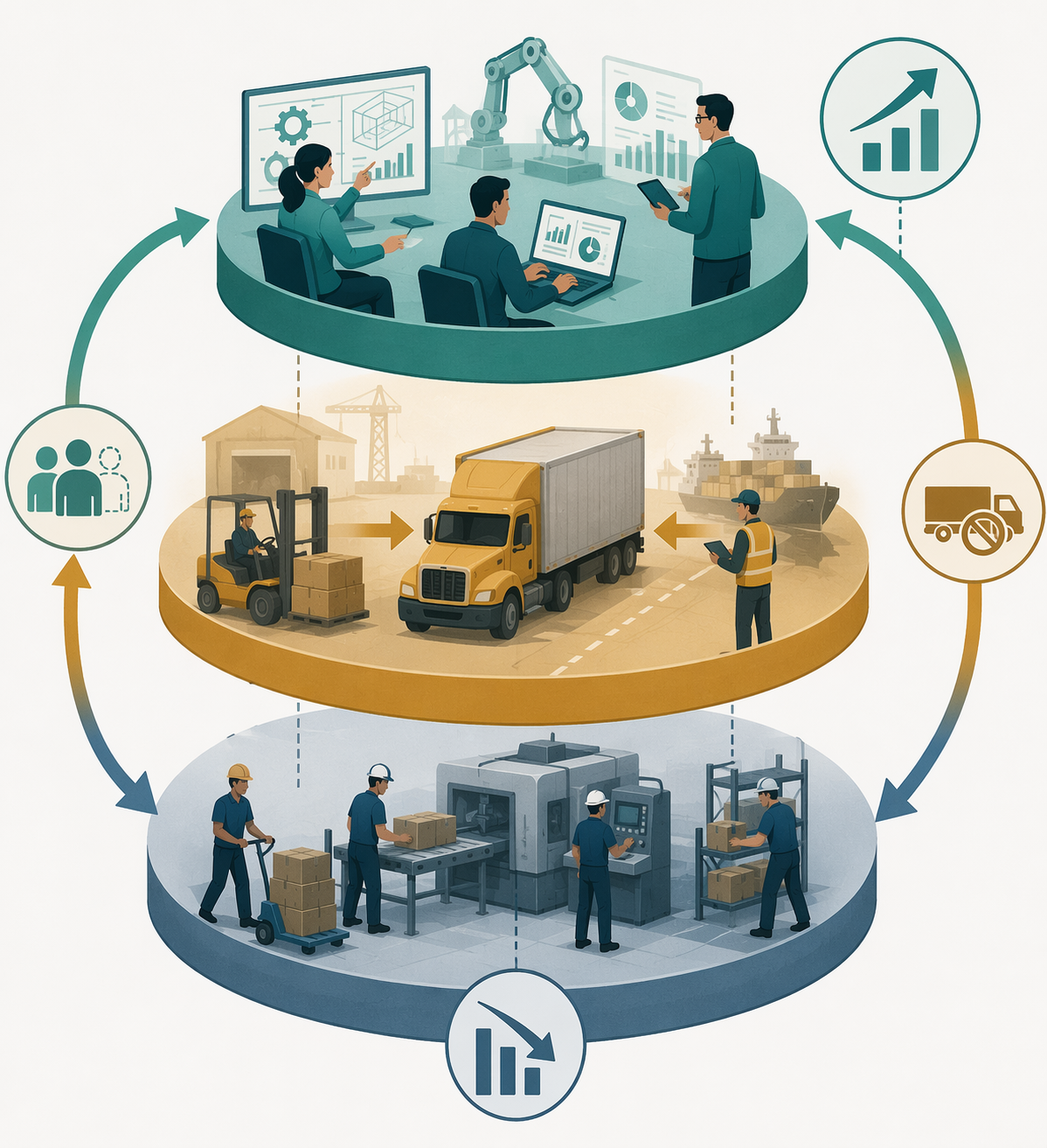
The work permit rulings reshaping supply chain labor in 2026 cannot be read one agency action at a time. The operational risk is not one lost hiring lane. It is four lanes narrowing at once: discretionary work authorization for parolees and other categories, commercial driver eligibility for certain immigrant groups, seasonal H-2B enforcement, and the cost of H-1B technical talent.
On the dock, those categories do not stay in neat legal folders. A warehouse that loses eligible applicants pushes more volume into overtime. A carrier that cannot renew enough CDL holders rejects lanes or raises rates. A manufacturer with fewer production workers delays orders. A planning team that cannot hire the AI engineer or optimization analyst it budgeted for moves slower on the automation project that was supposed to offset the frontline shortage.

The Full Workforce Stack Is Exposed
The June 2026 DHS proposed rule is the broadest frontline exposure. It targets three discretionary employment authorization document categories: parole, deferred action, and orders of supervision. DHS reported 978,308 discretionary EAD applications in FY2024 across those categories, including 792,130 for parole, 153,154 for deferred action, and 33,024 for orders of supervision.[1]
That number should not be misread as a count of supply chain workers. Discretionary EADs are open-market documents, and the rulemaking materials do not disclose occupation or employer. The tighter claim is also the more useful one: the affected labor pool is large enough to matter for sectors that already rely on immigrant workers in lower-wage operational roles. Deloitte reported that immigrant workers filled nearly 1 in 4 US manufacturing production jobs in 2024.[2]
The driver layer is narrower but more directly tied to freight capacity. A March 2026 federal rule prohibits asylum seekers, refugees, and DACA recipients from obtaining or renewing commercial driver's licenses, while an August 2025 visa pause added pressure to immigrant driver channels. Industry estimates put the potential driver impact as high as 200,000, though that figure is not independently verified by federal data.[3]
The top of the stack is the part many labor-risk discussions miss. A September 2025 presidential proclamation imposed a $100,000 fee on new H-1B petitions, and a March 2026 DOL proposed rule would raise H-1B prevailing wage minimums by 21% to 33%.[4] For supply chains, this is not only a Silicon Valley story. It affects the people building forecasting systems, robotics programs, procurement analytics, engineering workflows, and network-design models.
The H-2B enforcement action is a smaller supporting pressure point. The available sourcing is thinner than for EADs, CDL rules, or H-1B changes, so it should not be inflated into an equal pillar. But seasonal labor still touches food processing, hospitality logistics, and agriculture-adjacent supply chain work, where a small loss of available workers can become visible during peak periods.[5]
| Workforce layer | Relevant ruling | Status in Q3 2026 | Operational exposure |
|---|---|---|---|
| Frontline warehouse, manufacturing, processing | DHS discretionary EAD restrictions | Proposed rule; comment period closes Aug. 4, 2026 | Eligibility, renewal, turnover, E-Verify readiness |
| Drivers and freight movement | CDL restrictions and immigrant driver visa limits | Rule and visa actions already affecting planning assumptions | CDL access, renewals, small-carrier capacity |
| Seasonal and adjacent operations | H-2B enforcement action | Less deeply sourced; supporting pressure point | Seasonal availability in selected labor pools |
| AI, engineering, analytics, planning | H-1B fee and prevailing wage changes | Fee action in place; wage rule proposed | Talent cost, hiring pipeline, automation capacity |
Why Single-Rule Analysis Misses the Capacity Problem
A single-rule question sounds tidy: how many workers could this DHS rule remove, how many CDL renewals could be blocked, how many H-1B hires become unaffordable? That is how legal updates often land in executive inboxes. It is not how operations fail.
A distribution center does not need every labor channel to close before service degrades. It needs the margin to disappear. Fewer eligible warehouse applicants raise fill-rate risk. Higher turnover costs consume supervisor attention. If the same market also has thinner driver coverage, orders that do get picked wait longer for appointment capacity. If planning talent is delayed or priced out, the exception-management tools and automation programs meant to absorb volatility arrive late.
The DHS rule carries its own cost signal. DHS estimated 10-year undiscounted direct costs of $9.1 billion to $27.9 billion, including lost labor earnings, biometrics costs, turnover costs, and E-Verify compliance costs.[1] Those are not all costs borne by supply chain firms, and they are not a forecast of warehouse disruption. They do show that the agency itself expects the proposed change to move real labor and compliance dollars.
The E-Verify bottleneck is the immediate management problem. Only about 14% of US employers are enrolled in E-Verify, according to the Migration Policy Institute.[6] For large shippers with legal departments, enrollment may be a project. For a small carrier, regional warehouse operator, food processor, or labor subcontractor, it can be the difference between being ready to retain authorized workers and discovering the requirement after a staffing disruption has already begun.
The driver channel has its own asymmetry. Trucks moved 11.27 billion tons of freight in 2024, equal to 71% of US freight by weight, and handled 67% of surface trade with Canada and Mexico.[7] The industry already entered 2025 with an estimated shortage of 60,000 to 82,000 drivers.[8] Add a credentialing restriction to an aging workforce, and the issue becomes dispatchable capacity, not just headcount.
Foreign-born workers are not a side note in that capacity. They account for roughly 18% of US truck drivers, with about 720,000 immigrant truckers in 2021, more than double the 316,000 counted in 2000.[3] About 28% of drivers are age 55 or older, which means retirement pressure is already moving through the fleet.[7]
The small-carrier exposure is where many shipper risk models are too clean. ATA data show 92% of trucking carriers operate 10 or fewer trucks.[8] Those firms do not have bench teams waiting to redesign compliance workflows. They may not be the direct employer on a shipper's org chart, but they are often the capacity that appears when a lane gets covered at 4 p.m.
The Automation Escape Hatch Also Needs People
Automation belongs in the response plan. It does not belong in the fantasy column. The people who design, integrate, govern, and maintain automation are part of the same labor stack now under pressure.
The H-1B changes matter because supply chain modernization depends on scarce technical workers. International students account for roughly 75% to 80% of full-time graduate students in AI-related fields, according to Stuart Anderson's reporting in Forbes.[9] Immigrants also comprised 23% of the STEM workforce, and more than 55% of US startups worth over $1 billion had an immigrant founder.[10]
That does not prove any individual supply chain AI program will fail because of H-1B costs. It does mean the hiring channel many companies use for advanced analytics, engineering, data science, and AI implementation is becoming more expensive at the same moment they need those capabilities most.
There is also an offshoring risk. NBER research found that for every denied H-1B visa, US multinational companies added 0.4 overseas jobs, rising to more than 0.9 among more globalized multinationals.[11] The practical question for a CSCO is not whether work disappears. It is where the work gets done, how closely it stays tied to plant and DC reality, and whether the business still has enough internal capability to deploy automation where labor risk is highest.
This is why mitigation cannot stop at buying software. A company can license a forecasting platform faster than it can build the operating discipline to use it. It can order robotics faster than it can redesign slots, labor standards, maintenance coverage, safety protocols, and exception handling. For a deeper treatment of the automation-labor tradeoff, see whether AI can solve the supply chain labor shortage.
Planning Questions CSCOs Should Ask Now
The first task is separating certainty from exposure. The DHS EAD rule is proposed, with comments scheduled to close on Aug. 4, 2026.[1] The H-1B prevailing wage change is also proposed and may not be finalized until late 2026 or early 2027.[4] The CDL actions are already closer to operational reality, while the H-2B enforcement issue should be monitored as a seasonal pressure point rather than treated as a fully modeled national capacity shock.
That distinction matters. Proposed rules can change. Litigation can slow implementation. Advocacy organizations may emphasize downside impacts. Industry estimates can be directionally useful without being exact. None of those caveats is a reason to postpone workforce mapping. They are reasons to map exposure by scenario instead of pretending there is one clean number.
- E-Verify readiness: Which company sites, subsidiaries, staffing agencies, co-packers, carriers, and regional suppliers are enrolled, and which would need process changes before retaining affected workers?
- Frontline labor dependence: Which facilities rely most heavily on immigrant-heavy production, warehouse, food processing, or seasonal labor markets?
- Carrier concentration: Which lanes depend on small carriers, owner-operators, or regional fleets without dedicated compliance staff?
- CDL renewal risk: Which states and corridors carry the highest exposure if CDL eligibility or renewal rules remove drivers from the dispatchable pool?
- Technical talent pipeline: Which AI, engineering, procurement analytics, robotics, and planning roles depend on H-1B hiring or international graduate pipelines?
- Mitigation lead time: Which automation, nearshoring, or network redesign assumptions depend on talent that may itself become harder or more expensive to hire?
The DHS rule deserves its own technical read because it changes hiring permission and compliance workflow, not just labor cost. Readers who need the mechanics can use the DHS work permit rule supply chain labor deep dive as a companion to this broader exposure map.
The AI talent question also needs to be pulled into labor-risk meetings instead of left with the CIO. If the company is counting on analytics, machine vision, scheduling optimization, or generative AI copilots to absorb labor tightness, then technical hiring is part of the capacity plan. The AI talent shortage in supply chain analysis is useful for that portion of the review.
What Changes in the Operating Plan
The near-term move is not a grand labor transformation deck. It is a site-by-site, supplier-by-supplier exposure inventory that can survive uncertainty. A CSCO does not need to know the exact number of EAD holders in the supply chain to know whether a major co-packer has no E-Verify process, whether a warehouse relies on a staffing agency with thin compliance controls, or whether a critical lane is covered by small carriers in states exposed to CDL renewal disruption.
E-Verify enrollment deserves priority because it is one of the few controls that can be moved before final rule language is settled. Enrollment is not a labor strategy by itself. It does not create workers, credentials, or technical capability. But without it, affected employers may not be able to use the workers who remain legally eligible under the future rules.
Carrier procurement should also change. Rate, service, and safety metrics are no longer enough. Bid events and quarterly business reviews should ask how carriers monitor CDL eligibility, how exposed they are to immigrant driver channels, what share of capacity comes from subcontracted small fleets, and whether they have administrative capacity to handle renewal and documentation changes.
Manufacturing and warehouse leaders should stop treating overtime as a buffer with no ceiling. Overtime can protect a week. It cannot replace a narrowed applicant pool, higher turnover, and slower onboarding across multiple neighboring employers. The practical test is which sites lose schedule integrity if one staffing vendor, one production role, or one weekend shift becomes harder to fill.
Automation and upskilling belong in the same review, with time attached. A workforce roadmap should identify which roles can be redesigned, which supervisors need new tools, which workers can be moved into higher-value tasks, and which technical roles must be hired or developed internally. The AI workforce roadmap and supply chain AI upskilling roadmap are better starting points than assuming software adoption equals labor relief.
There are real examples of companies using AI-driven automation to respond to labor and productivity pressure, including the kind discussed in the Samsung AI workforce impact analysis. The lesson for CSCOs is not that automation makes labor policy irrelevant. It is that automation becomes a capacity strategy only when the company has enough implementation talent, process discipline, and frontline adoption time.
The Executive Judgment
The mistake in Q3 2026 would be asking each function to quantify its own isolated loss and then adding the numbers later. HR counts EAD exposure. Transportation counts CDL exposure. IT counts H-1B exposure. Procurement asks carriers for rate updates. That process will miss the compounding effect across the operating system.
The better question is where the company loses flexibility first. It may be a plant in an immigrant-heavy labor market. It may be a cross-border freight lane. It may be a regional carrier base with little compliance infrastructure. It may be an automation program that assumed AI and engineering hiring would remain available at last year's economics.
Single-rule analysis understates the risk. Workforce scenario planning and E-Verify readiness now belong in near-term supply chain governance, while automation, upskilling, and network redesign should be treated as capacity strategies with real lead times rather than instant substitutes.
References
- DHS Discretionary EAD Proposed Rule, Federal Register, June 5, 2026.
- 2026 Manufacturing Industry Outlook, Deloitte, 2026.
- Immigrant Truck Drivers and CDL Restrictions Explainer, National Immigration Forum, October 2025, updated 2026.
- H-1B Fee and Prevailing Wage Changes, SupplyChainBrain, October 9, 2025.
- H-2B Enforcement Ruling, Newsweek, August 2025.
- E-Verify Employer Enrollment Analysis, Migration Policy Institute.
- Trucking Labor and Freight Capacity Analysis, RM2 Supply Chain, June 16, 2026.
- Trucking Carrier and Driver Shortage Data, American Trucking Associations.
- International Students and AI Graduate Fields, Forbes, May 11, 2026.
- Immigrants in STEM and Billion-Dollar Startups, Forbes, January 6, 2026.
- The IT Boom and Other Unintended Consequences of Chasing the American Dream, National Bureau of Economic Research.
Comments
Join the discussion with an anonymous comment.