
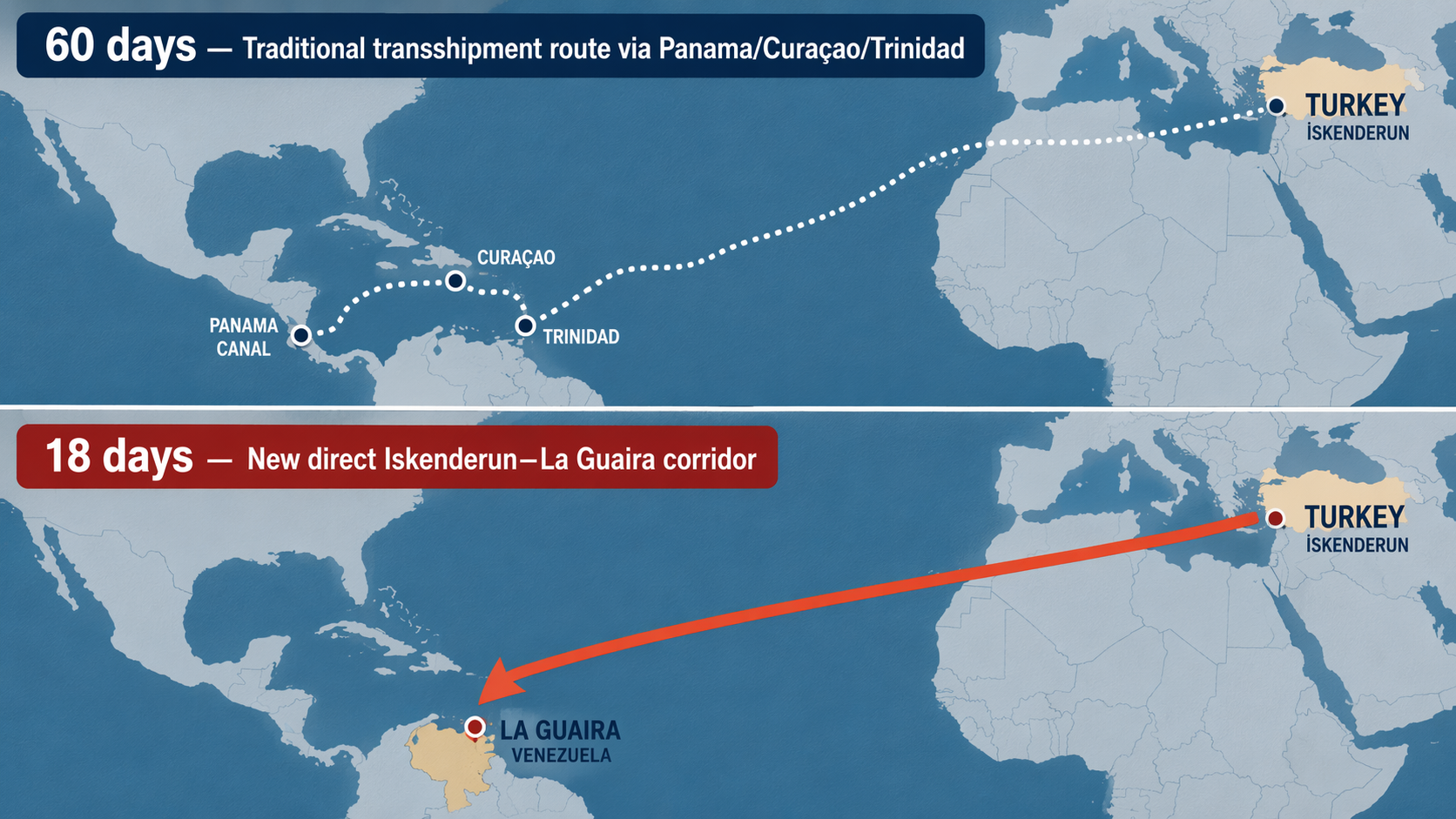
The new Turkey-Venezuela corridor starts with a simple planning variable: an Iskenderun-La Guaira maritime link activated on September 15, 2025, with a claimed transit-time cut from 60 days to 18 days. The first sailing carried 400 containers and 10,000 tons, with freight reported at roughly $3,400 per container.[1][2]
That is not a diplomatic abstraction. For a shipper, an 18-day direct lane changes reorder points, buffer stock, demurrage exposure, and the amount of time a cargo sits inside a sanctions-screening file before it can be released into an actual booking. It also changes the map: the route is described as bypassing Panama, Curaçao, and Trinidad, the kind of Caribbean transshipment pattern that adds handling points, documents, and counterparties before cargo ever reaches Venezuela.[1][2]
The useful question is not whether the first voyage happened. It is whether this can become repeatable capacity: scheduled, insured, loaded, discharged, financed, and cleared often enough to matter beyond one announcement cycle.
What the 18-day lane actually changes
A direct route does not automatically mean a low-risk route. It means fewer physical handoffs. That distinction matters. Traditional Caribbean routing gives cargo owners more established service patterns and more familiar nodes, but it also introduces additional transshipment decisions: where the box waits, which feeder leg accepts it, which intermediary touches the paperwork, and whether a delay at one hub knocks the whole shipment into a new compliance review.
The Iskenderun-La Guaira corridor compresses that chain. For time-sensitive industrial inputs, spare parts, refined-product-linked cargo, and containerized goods moving alongside energy commerce, the difference between 60 and 18 days is not cosmetic. A 42-day reduction can lower inventory tied up at sea, shorten quote validity windows, and give procurement teams a different answer when they ask whether Turkey can serve as a practical Atlantic-side supplier rather than a distant origin with a long Caribbean tail.[1][2]
| Planning variable | Reported route data | Operational implication |
|---|---|---|
| Origin and destination | Iskenderun, Turkey to La Guaira, Venezuela | Creates a named lane that forwarders, carriers, and compliance teams can evaluate directly |
| Transit time | 18 days versus 60 days through traditional transshipment routing | Changes inventory timing, booking buffers, and delay assumptions |
| Initial scale | 400 containers and 10,000 tons | Shows a real starting cargo base, but not yet a proven recurring volume |
| Reported freight | Approximately $3,400 per container | Gives shippers a benchmark for quotes, subject to carrier appetite and risk premiums |
The first sailing size is enough to take seriously and too small to overinterpret. Four hundred containers can seed a route. It does not prove a monthly service, a stable cargo mix, or a carrier base willing to expand exposure. The next signals are more prosaic: published frequency, slot reliability, port dwell time, and whether cargo continues to move when the easy inaugural loads are gone.
Why Turkey is building more than a trade lane
The route sits inside a larger bilateral target. Turkey and Venezuela recorded $448 million in trade in 2025, while officials have discussed a $3 billion target, implying roughly 6.7 times growth from that reported base.[3] A target is not throughput. It is still useful because it tells carriers and commodity traders that the lane is being framed as infrastructure, not a one-off commercial experiment.
The energy side gives the corridor its weight. PDVSA and Turkish Petroleum International Company signed a cooperation agreement in 2018, and reporting later identified a Turkish-registered firm, Grupo Iveex Insaat, loading Venezuelan crude under a barter-for-refined-products arrangement during sanctions pressure.[4][5] That makes Turkey more than a container origin. It places Turkish counterparties inside Venezuela-facing oil logistics, where crude movements, refined-product supply, payment terms, and compliance checks are all linked.
The Iveex detail is exactly where enthusiasm should slow down. A Turkish-registered company reportedly formed with $1,742 in capital handling crude cargoes under barter arrangements is not a normal credit memo for a conservative logistics desk.[4][5] It raises basic questions: who is the beneficial counterparty, who bears title risk, what bank will touch the payment leg, and which insurer is prepared to stand behind the voyage?
None of that makes the lane irrelevant. It does mean the route’s commercial development will be filtered through counterparty due diligence. In practice, a forwarder may like the 18-day sailing and still lose days to sanctions screening, cargo classification, beneficial ownership checks, and internal legal review. A shorter sea leg does not remove the paperwork drag if the trade architecture stays opaque.
The gold channel matters because it shows corridor behavior
Turkey’s role in Venezuelan commodity flows did not begin with containers. Venezuela sent about $834 million of unrefined gold to Turkey in 2018, establishing a parallel commodity channel outside ordinary bilateral merchandise trade.[6] Gold and crude do not move through identical logistics systems, but they do share institutional consequences: specialized counterparties, heightened scrutiny, non-standard payment structures, and a premium on jurisdictions willing to keep handling Venezuelan-linked flows.
That history makes the direct maritime route easier to read. It is not simply a new container service looking for demand. It is part of a corridor pattern in which Turkey becomes a receiving, processing, supplying, or intermediation point for Venezuelan commodities and energy-linked needs. The route gives that pattern a more visible physical spine.
The corridor still depends on Venezuelan supply stability
A trade lane can be well designed and still starve for cargo. Venezuela’s oil exports recovered from under 400,000 barrels per day in January 2026 to 1.25 million barrels per day in May 2026, a large enough swing to change how traders view near-term supply availability.[7][4] For logistics planning, the important part is not only the recovery. It is the volatility embedded in the range.
If Venezuelan exports hold near stronger levels, the Turkey-facing corridor has more cargo logic: crude-linked arrangements, refined-product exchanges, industrial supplies, and containerized support goods can feed one another. If production or exports slide again, the route may still operate, but it becomes narrower, more opportunistic, and more dependent on politically supported cargo rather than broad commercial adoption.
This is where the $3 billion trade target should be handled carefully. It is a demand signal, not a capacity guarantee. To turn $448 million of reported trade into several billion dollars, the corridor needs recurring cargo in both directions, not just headline energy flows. It also needs port performance that does not erase the transit-time gain at berth.
Port capacity is the constraint that does not fit in the headline
La Guaira gives the container route a logical Venezuelan endpoint, but the broader energy corridor cannot be separated from Venezuela’s port and terminal condition. Degradation at Venezuela’s José Terminal is a constraint for crude logistics, while capacity limits around Iskenderun could restrict how quickly Turkey can scale Venezuela-facing flows. Those limits do not cancel the route. They define its ceiling.
For supply chain teams, the practical risk is mismatch. A direct sailing can reduce ocean time while port congestion, documentation delays, inspection backlogs, or terminal limitations keep total lead time stubbornly high. If the route is marketed as 18 days but routinely loses time at either end, planners will price it as a risk-adjusted lane rather than a clean replacement for established transshipment options.
Iskenderun also has to be viewed as more than a dot at the eastern Mediterranean end of the line. It must absorb cargo assembly, carrier scheduling, customs processing, and any energy-linked logistics that sit behind the container movement. If Venezuela-related volumes grow faster than port-side coordination, the corridor could become strategically important before it becomes operationally smooth.
What to monitor next
The Iskenderun-La Guaira route is serious enough to enter supply chain models as an emerging option, but not mature enough to treat as stable capacity. The difference matters. A planning team can track it, request quotes, map compliance steps, and test lead-time assumptions without assuming that every future sailing will match the inaugural claim.
- Sailing frequency: whether the route develops a visible cadence rather than isolated sailings.
- Cargo mix: whether containers, energy-linked goods, refined products, and commodity flows reinforce one another.
- Port throughput: whether La Guaira, José Terminal, and Iskenderun can handle added volume without eating into the transit-time advantage.
- Compliance friction: whether counterparties become clearer or remain opaque enough to keep conservative carriers and banks away.
- Production stability: whether Venezuela’s oil export recovery proves durable enough to support recurring logistics demand.
Turkey is operationalizing a Venezuela-facing energy logistics bridge. The 18-day direct route gives that bridge a measurable transport advantage, and the PDVSA-TPIC, gold, and trade-target pieces explain why it exists now. The unresolved question is repeatability. Until sailing schedules, cargo volumes, port performance, and compliance behavior become clearer, this is a corridor to track closely rather than a mature trade lane to model as dependable capacity.
References
- CAVETURK reporting on the Iskenderun-La Guaira direct maritime route, mazo4f.com, link
- CAVETURK reporting on the Iskenderun-La Guaira direct maritime route, Ultimas Noticias, link
- Reporting on Delcy Rodríguez meeting and Turkey-Venezuela trade target, AP/FDD, June 2026, link
- Reporting on PDVSA-TPIC cooperation, Iveex Insaat, and Venezuelan crude cargoes, Reuters, link
- Reporting on PDVSA documents and Venezuelan crude barter arrangements, Al Jazeera, link
- US sanctions reporting on Venezuelan unrefined gold shipments to Turkey, link
- Reporting on Venezuela oil export recovery from January 2026 to May 2026, FDD, link
Comments
Join the discussion with an anonymous comment.