
TSMC’s Q2 2026 numbers look, at first glance, like the comforting version of the AI infrastructure story: the leading foundry is making more money, spending more money, and guiding to stronger growth. For hardware buyers, that is the wrong comfort to take from the release. The impact of TSMC’s earnings on the AI chip supply chain is not that supply is suddenly catching up. It is that demand is pressing hard enough to expand margins while the company raises spending and still warns, through the surrounding supplier base, that capacity remains claimed before many enterprise buyers ever enter the queue.
The headline set is unusually clean. Media coverage of the July 16 earnings call reported a 77% profit surge, $40.2 billion in revenue, and NT$706.6 billion in net income for Q2 2026; TSMC’s investor materials show gross margin at 67.7%, above its 65.5% to 67.5% guidance range, and operating margin at 60.3%.[1][2] The company also raised capital spending to $60 billion to $64 billion and lifted its 2026 revenue growth expectation to more than 40%, according to the same earnings coverage.[1]
Those are not loose-market numbers. A buyer waiting for “capacity coming online” has to ask a harsher question: whose backlog, allocation agreement, accelerator roadmap, memory stack, package substrate, power reservation, and data center construction schedule already have first claim on that capacity?
The earnings call is a pressure map, not a relief signal
TSMC’s financials matter because they show where bargaining power has moved. Gross margin above guidance says customers are not getting much price relief. Higher capex says the company sees durable demand. Higher revenue guidance says the AI buildout is still expanding. None of that tells an enterprise procurement lead that GPU systems will be easier to secure on acceptable terms over the next 12 to 18 months.
TSMC chief executive C.C. Wei gave the more useful version of the signal when he said “restrictions are everywhere” across the AI ecosystem and that satisfying U.S. demand with U.S.-based production would take a “very long time.”[3] That is not a statement about one fab tool or one packaging line. It is a warning that the AI hardware chain is constrained at several points at once.
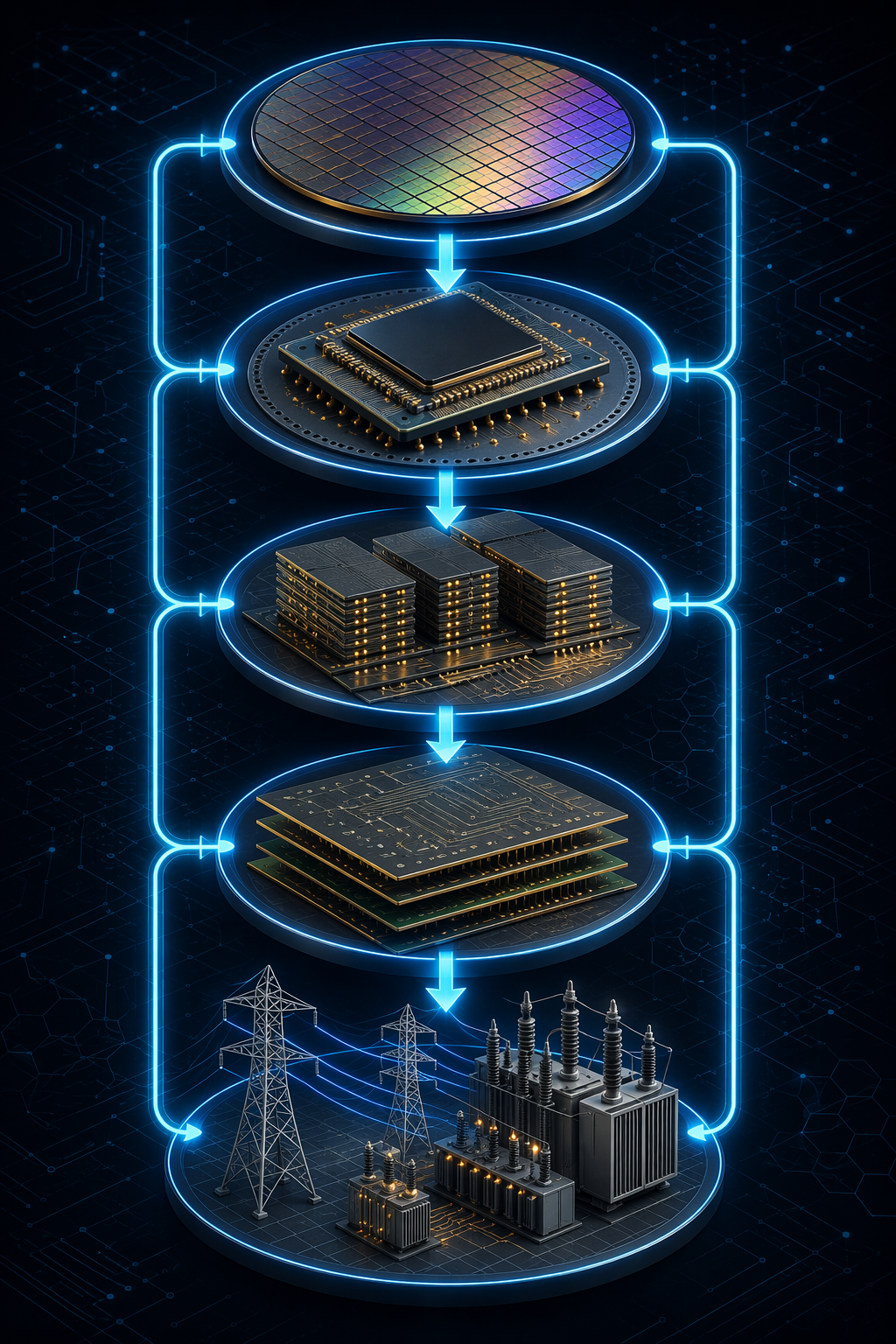
The practical map has five pressure points: advanced-node wafer capacity, CoWoS advanced packaging, HBM memory, ABF substrates, and downstream power infrastructure. They do not operate like separate procurement categories. They queue together.
Wafer capacity starts the queue, but it does not finish it
Advanced-node wafer starts are still the first visible constraint because AI accelerators, high-end CPUs, networking ASICs, and custom silicon compete for the same scarce leading-edge manufacturing base. A procurement team buying servers indirectly feels this upstream competition as opaque lead times and limited configuration choice. The buyer does not negotiate with the wafer fab, but the wafer fab’s allocation decisions determine which accelerator vendors can promise finished systems at all.
Broadcom has been unusually direct about this. Reports covering Broadcom’s supply-chain comments said the company flagged TSMC capacity as “choking the supply chain in 2026,” with related shortages extending beyond chips into PCBs, optical transceivers, and lasers.[4][5] That does not prove every device category is equally short, and the downstream laser and PCB data are less granular than the semiconductor figures. It does, however, describe the buying environment more accurately than a simple wafer-capacity chart.
For procurement, the wafer constraint changes the value of time. Spot buying works poorly when the seller has already rationed supply to customers with design wins, prepayments, volume commitments, or strategic accounts. The real negotiation moves earlier: into multi-quarter demand forecasts, reservation mechanisms, and the uncomfortable question of whether the newest accelerator is worth waiting for if a previous-generation platform can be contracted with firmer delivery.
CoWoS is where “more wafers” stops being enough
CoWoS packaging deserves more attention than it usually gets in executive summaries because it is the point where advanced logic, HBM stacks, interposers, substrates, and thermal limits start behaving as one procurement problem. A wafer can be processed successfully and still not become a usable AI accelerator if advanced packaging capacity is unavailable at the right time.
TrendForce projections cited by Tom’s Hardware put CoWoS capacity growth at about an 80% compound annual growth rate, reaching 120,000 to 130,000 wafers per month by the end of 2026, compared with roughly 75,000 in 2025.[6] The caveat matters: those figures are second-hand projections, not a TSMC audited capacity ledger. But the operational conclusion is still hard to avoid. A very fast capacity ramp can remain insufficient if AI accelerator demand is expanding faster and if hyperscalers and chip designers have already locked in priority.
This is where buyers most often misread the phrase “capacity expansion.” If a packaging line doubles but the first increments are already committed to strategic customers, the enterprise buyer sees little practical relief. The supply exists in a presentation; it does not exist in the buyer’s allocation.
CoWoS also limits substitution. Switching accelerator vendors may not escape the bottleneck if both vendors depend on similar advanced packaging flows. Even a custom ASIC strategy can run into the same packaging queue. The procurement question is therefore not only “Which chip is cheaper?” It is “Which complete package has a credible allocation path, including memory, substrate, and assembly capacity?”
HBM turns the chip shortage into a memory allocation problem
HBM is the constraint that makes AI hardware planning feel unfair to buyers who are used to treating memory as a configurable server component. For leading AI systems, HBM is not an afterthought; it is part of the accelerator supply equation. The memory vendor’s wafer starts, yields, stacking capacity, and qualification schedule all influence whether the final GPU or accelerator module ships.
IndexBox reported that HBM consumes three to four times more wafer resources than DDR5 and that Micron said it could supply only half to two-thirds of expected demand, with tightness persisting beyond 2026.[7] That is not an effectiveness claim about HBM. It is an input-consumption and fulfillment claim. The consequence is straightforward: AI demand pulls memory capacity away from easier, lower-intensity memory categories, and even major suppliers cannot cover all expected orders.
A procurement team that watches only GPU model availability will see this too late. HBM tightness shows up as narrowed SKU options, changing delivery dates, preference for large committed buyers, and pressure to accept bundled configurations. It also complicates any plan to diversify accelerator supply. Multi-sourcing across chip vendors is useful only if the alternate path has memory allocation behind it.
This is where total cost of ownership analysis has to include waiting time and utilization risk. A cutting-edge system with uncertain HBM-backed delivery may be inferior, for a specific deployment window, to a prior-generation system that can be delivered, powered, installed, and used. That is not a general argument against the newest silicon. It is a sourcing discipline: compare delivered compute, not advertised peak performance.
ABF substrates are a small line item until they are the line you cannot cross
ABF substrates rarely get the same attention as GPUs or wafers because they sit several layers below the product name on a purchase order. That makes them more dangerous for buyers who only track named semiconductor suppliers. If the substrate layer is constrained, the rest of the system cannot be completed on schedule.
IndexBox reported that Ajinomoto holds more than 95% market share in ABF materials, raised prices by about 30% in 2026, and that the ABF supply gap is projected to exceed 20% in 2027.[7] The combination matters more than any single figure. High supplier concentration limits bargaining leverage. A sharp price increase signals pricing power. A projected 2027 gap warns against treating next year as automatic relief.
The procurement response is not to pretend ABF can be easily multi-sourced. In many cases, it cannot be, at least not quickly, because qualification, package design, and supplier relationships are already embedded upstream. The useful move is visibility: ask server OEMs, accelerator vendors, and contract manufacturers how substrate allocation is being handled, which packages are most exposed, and whether alternative platforms use materially different substrate demand.
ABF is also a reminder that a “chip shortage” can be a materials shortage wearing a chip label. Procurement teams that monitor only foundry announcements will miss the supplier with the smaller brand name and the larger chokehold.
Power decides whether delivered hardware becomes usable compute
The final bottleneck sits outside the semiconductor bill of materials: power. AI hardware can clear the wafer, packaging, memory, and substrate queues and still sit behind electrical infrastructure, data center capacity, cooling, switchgear, turbines, transformers, and local grid interconnection. For the procurement lead, that changes the definition of availability. A delivered server is not the same thing as deployed compute.
Bismarck Analysis reported that GE Vernova is sold out through 2029 and cited Amazon’s CEO identifying power as the number-one data center constraint.[8] That is a downstream constraint, but it feeds back into upstream allocation because the largest buyers can reserve hardware, facilities, and power in coordinated programs. Smaller enterprise buyers are often left negotiating one layer at a time.
This is why procurement should not measure AI infrastructure risk only by accelerator lead time. A credible sourcing plan needs dates for power availability, rack readiness, cooling capacity, network gear, optics, and installation labor. Broadcom’s comments about shortages extending to PCBs, optical transceivers, and lasers make the same point from another direction: AI infrastructure has more than one queue, and several are already crowded.[4][5]
What the five bottlenecks mean for buying decisions
The cleanest mistake now would be to rank these constraints as if procurement can solve them one by one. In practice, they interact. CoWoS capacity needs HBM availability. HBM availability competes for memory wafer resources. ABF substrates shape package completion. Power and data center infrastructure determine whether the finished system has economic value. Wafer starts are necessary, but they are not sufficient.
| Constraint | What procurement should test | Where spot buying fails |
|---|---|---|
| Advanced-node wafer capacity | Whether the vendor has committed allocation behind the delivery promise | Available inventory is scarce after strategic customers receive priority |
| CoWoS packaging | Whether package capacity is reserved, not merely forecast to expand | Capacity growth may already be pre-committed to hyperscalers and chip designers |
| HBM memory | Whether the accelerator configuration has memory supply secured | Alternate chip vendors can face the same memory shortage |
| ABF substrates | Whether package substrates are qualified and allocated | Supplier concentration limits fast substitution |
| Power infrastructure | Whether the deployment site can actually energize and cool the hardware | Hardware delivery can precede usable compute by months or longer |
The strongest buyers will not be the ones with the loudest late-quarter escalation. They will be the ones that separate strategic demand from optional demand early, commit where the workload justifies it, and keep alternatives live where performance claims are less important than delivery certainty.
Hyperscaler spending makes this harder. IndexBox cited roughly $600 billion in combined annual hyperscaler capital expenditure, a scale that absorbs available capacity and crowds out smaller buyers.[7] That figure should not be read as a precise measure of chip orders alone; it is a broader capex signal. But it does explain the allocation environment. Enterprise buyers are not negotiating in an open queue. They are entering a market where the largest customers often shaped the queue before the purchase request was written.
For teams building a monitoring process around these risks, the companion problem is supplier visibility. The same logic that applies to foundries has to extend to memory, substrates, packaging partners, optical suppliers, utilities, and data center operators. ChainSignal’s analysis of US-China AI competition supply chain risk is a useful adjacent view because it treats packaging and HBM as availability risks rather than abstract semiconductor themes.
Procurement strategy for a market that will not clear on its own timetable
Panic buying is a poor response to constrained supply chains because it usually arrives after allocation has hardened. Waiting for 2027 relief is not much better when several indicators point to continued tightness in packaging, HBM, ABF materials, and power equipment. The more useful response is disciplined commitment.
- Commit earlier for strategic workloads where delay has a clear business cost, and negotiate allocation terms rather than relying on spot availability.
- Compare newest and prior-generation silicon on delivered compute, deployment date, power readiness, and utilization risk, not benchmark performance alone.
- Ask OEMs and accelerator vendors for evidence of packaging, HBM, and substrate allocation behind promised delivery dates.
- Treat memory suppliers, ABF materials, optical components, and power equipment as monitored supply risks, not background dependencies.
- Keep multi-sourcing realistic: diversify where architectures and qualifications permit it, but do not assume a second chip vendor escapes the same packaging or HBM queue.
Supplier-risk monitoring also has to become more frequent than an annual sourcing review. The relevant signals are earnings-call capacity language, price increases in concentrated materials, memory fulfillment commentary, packaging expansion schedules, and power-equipment lead times. Tools built for ongoing surveillance, such as AI supplier risk monitoring tools, are most useful when they track the non-obvious suppliers as closely as the famous chip names.
TSMC’s Q2 results are impressive. They also make the buyer’s job harder, because strong margins, higher capex, and raised growth expectations are signs of a market where capacity is valuable before it is visible. The procurement task is to secure usable compute across the full chain: wafer, package, memory, substrate, power, and site readiness.
References
- TSMC Q2 2026 earnings coverage, Yahoo Finance, July 16, 2026.
- TSMC 2026 Q2 Quarterly Results, TSMC Investor Relations.
- TSMC says US demand would take very long time to satisfy, Taipei Times, June 5, 2026.
- Broadcom flags 2026 chip supply squeeze as TSMC capacity tightens under AI demand, Astute Group.
- Broadcom TSMC AI chip supply chain constraints, Capacity Global.
- A deeper look at the tightened chipmaking supply chain, Tom’s Hardware.
- AI Growth Faces Four Major Supply Chain Bottlenecks, IndexBox.
- AI 2026: TSMC Risks Being a Bottleneck, Bismarck Analysis.
Comments
Join the discussion with an anonymous comment.