
The strongest case for AI audio surveillance in supply chains starts with safety, not spying. Warehouses, yards, cross-docks, and driver cabins are loud, fast-moving places where a missed shout, a fatigue cue, a collision sound, or a delayed incident report can matter. A microphone that flags a crash, detects distress, or helps an EHS team reconstruct what happened after a near miss has an obvious practical appeal.
That is why the issue is live in 2026. Large employers already rely heavily on productivity tracking: Ethisphere cites research finding that 8 out of 10 of the largest U.S. private employers use productivity tracking, with voice and audio monitoring growing as one subset of workplace monitoring.[1] In supply chain safety specifically, SupplyChainBrain and Evotix report that 42% of supply chain organizations are piloting AI for safety.[2]
The ethical problem begins when the same audio system that is justified as a safety layer becomes useful for something else. Microphones can capture more than alarms and impact sounds. They can capture speech patterns, tone, acoustic signatures, background conversations, and behavioral cues. Once those signals enter a vendor platform or manager dashboard, “safety monitoring” can quietly become productivity scoring, discipline support, or organizing surveillance.

Why audio changes the ethical equation
Badge scans, task timestamps, telematics, and camera footage can all be intrusive. Audio adds a different kind of exposure. Voice systems can analyze prosodic features, speech biomarkers, and acoustic signatures—signals that are difficult for a worker to control or mask during ordinary work.[3] A warehouse associate can choose not to type a personal message on a company device. They cannot easily choose not to sound tired, anxious, irritated, hoarse, or out of breath while working near a microphone.
That distinction matters because voice is not just another operational data stream. It can become biometric inference. It can also become emotional inference, even when the system does not claim to “read emotions” in plain language. A dashboard may label an interaction as escalated, frustrated, noncompliant, distracted, or high risk. Those labels can follow a worker into coaching, discipline, scheduling, or performance review.
In a supply chain environment, workers rarely have a meaningful way to opt out. A driver may need the cab system to operate the vehicle. A picker may need to pass through monitored zones to do the job. A yard worker may be recorded by ambient microphones they never touch. Consent is thin when the alternative is not doing assigned work.
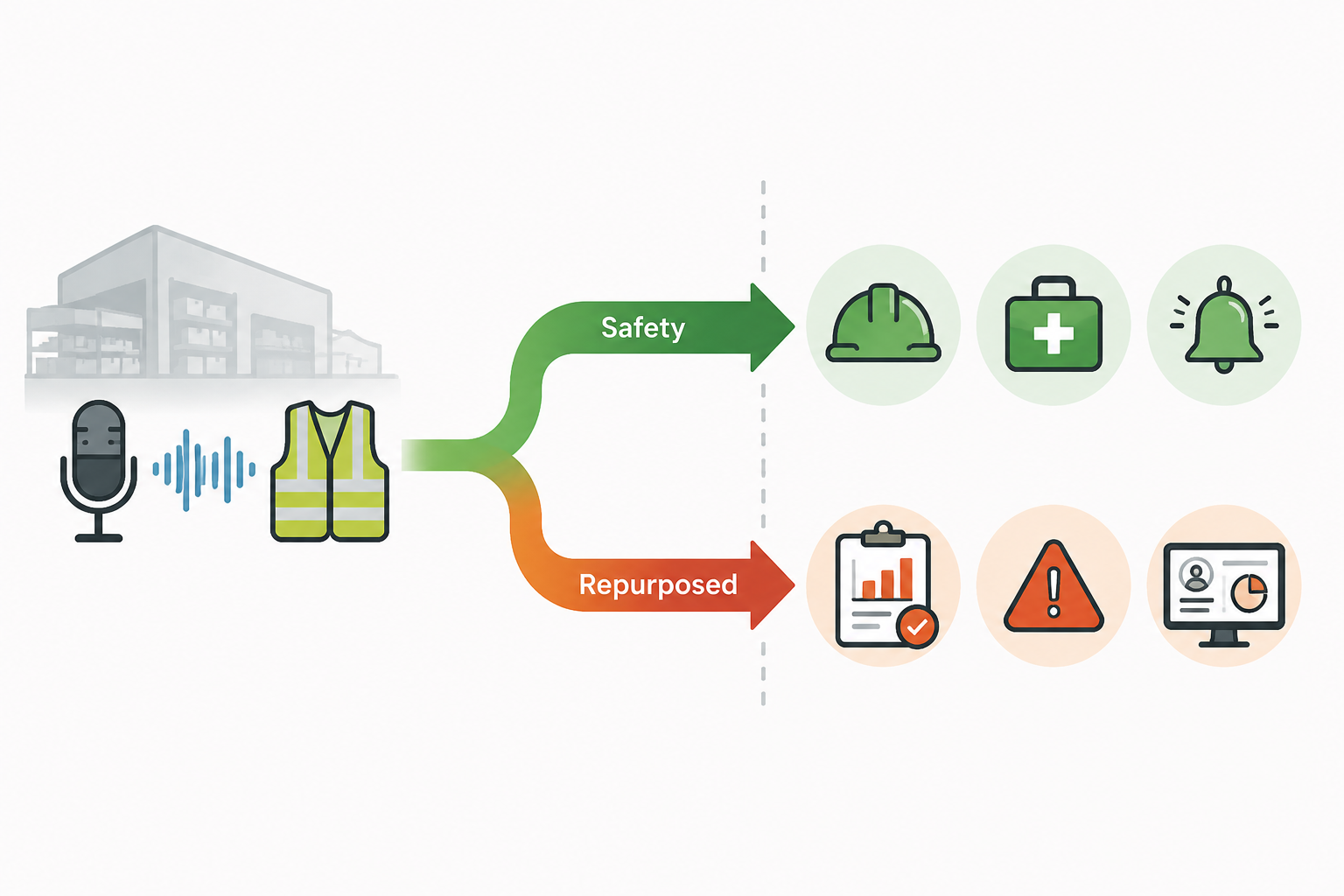
The repurposing risk is the center of the problem
The buying story for these tools is usually narrow: detect hazards, document incidents, support fatigue alerts, speed emergency response. The operating reality can widen quickly. A system that starts by recognizing distress calls may also identify who talks to whom. A system that flags aggressive exchanges may also score tone. A system that captures cabin audio for safety review may also give supervisors another way to evaluate pacing, breaks, or compliance with instructions.
That widening does not require a dramatic boardroom decision. It can happen through a software update, a new dashboard permission, a vendor feature toggle, an integration with workforce management software, or a manager asking whether the audio tool can help “coach” low performers. The ethical failure is not only the final misuse. It is the absence of a hard boundary that prevents the tool from drifting into uses workers were never told about and EHS teams may never have intended.
This is where supply chain leaders need to be more precise than the usual privacy language. The question is not whether microphones are always unacceptable. The question is what the employer can prove before deployment: who is recorded, what is inferred, who can see it, what decisions it can influence, and what uses are prohibited even if the technology makes them easy.
Monitoring exposure is not evenly distributed
Workplace surveillance is often discussed as though it falls evenly across a workforce. The evidence cited by Ethisphere points in a different direction: a major 2023 study found that 82% of Black workers and 73% of Hispanic workers reported being monitored, compared with 65% of White workers.[1]
Those figures do not prove that every supply chain audio deployment is discriminatory. They do show why a company cannot treat monitoring exposure as a neutral technical configuration. If the most heavily monitored roles are also lower-wage, more racially diverse, more contingent, or more physically demanding, the surveillance burden is being assigned through the structure of the operation.
For audio systems, the exposure question should be asked before procurement approval. Which job families are recorded? Which shifts? Which facilities? Which languages or accents are more likely to be analyzed by voice tools? Which workers are subject to constant capture rather than event-based capture? A deployment that cannot answer those questions is not ready to claim it has assessed bias.
The injury data makes this operational, not abstract
Privacy harm is often framed as intangible. The monitoring data cited by Ethisphere connects the issue to bodily consequences. Among constantly monitored workers, 46% reported feeling pressured to work at unhealthy speeds, and 9% reported workplace injuries—nearly double the roughly 4.5% injury rate reported by non-monitored workers.[1]
That finding should be read carefully. It does not mean every monitoring tool causes injuries. It does mean that constant monitoring can coincide with work conditions where people feel pushed to move faster than is healthy, and where injury rates are higher. For supply chain operations, that is not a side issue. Speed, fatigue, repetition, and pressure are already part of the risk profile.
Audio surveillance can intensify that pressure if workers believe every pause, exchange, tone shift, or delay may be interpreted. A microphone placed for safety may still change behavior. People may skip informal recovery moments, avoid asking for help, or rush through a task because the system is understood as another signal in the productivity file.
| Governance question | Why it matters |
|---|---|
| Is the audio tool event-based or always on? | Constant capture creates a broader behavioral record than incident-triggered monitoring. |
| Can audio outputs influence productivity scores? | Safety signals can become discipline inputs if systems are connected without limits. |
| Are monitored roles disproportionately concentrated by race, language, wage level, or employment status? | Uneven exposure can turn a neutral policy into a disparate burden. |
| Can workers challenge an inference? | Voice and tone labels can be difficult to contest after they enter a personnel process. |
| Can managers change settings without legal, EHS, and worker-review controls? | Silent repurposing often happens through permissions and integrations, not public policy changes. |
Labor-law exposure is no longer theoretical
The clearest public labor-law warning comes from Amazon. In May 2024, The Guardian reported that Amazon’s warehouse surveillance program—including CCTV, audio, and algorithmic productivity scoring—faced active National Labor Relations Board charges alleging interference with workers’ union-organizing rights.[4]
That case should not be stretched into proof that every supply chain audio tool is unlawful. The public record of supply-chain-specific audio surveillance disputes is still thin. But it is a serious signal because it shows how audio and algorithmic management can move from safety or productivity administration into protected-activity risk.
The National Labor Relations Board had already pointed in this direction. A 2022 General Counsel memo announced an intent to protect workers from AI-enabled monitoring of labor organizing activities.[6] For employers, the practical lesson is straightforward: if a system can identify worker conversations, map association patterns, or flag organizing-related activity, it belongs on the labor-law risk register before it belongs in a pilot.
Regulators are drawing lines around biometric and emotional inference
The regulatory landscape is fragmenting, and supply chain networks are exactly the kind of organizations that feel that fragmentation first. A company may operate warehouses in California, contract logistics sites in other U.S. states, and distribution operations serving European customers. A single vendor setting can create different legal questions in each place.
In California, SB 238 passed the Senate during the 2025-2026 session and would require employers to annually disclose all workplace surveillance tools to the state Department of Industrial Relations, including audio monitoring, according to DataGuidance coverage.[5] Because that detail comes from secondary legal reporting rather than bill text provided here, employers should verify the final statutory language before relying on it. The direction is still notable: disclosure duties are moving toward tool-level transparency, not vague employee handbook statements.
In the European Union, policy analysis of the EU AI Act identifies emotion recognition and biometric monitoring as high-risk systems requiring conformity assessments and human oversight.[6] That classification is important for voice tools because vendors may describe outputs as engagement, fatigue, distress, aggression, or sentiment rather than emotion recognition. The label in the sales deck will not necessarily control the legal analysis.
Labor pressure is also rising. The AFL-CIO’s October 2025 “Workers First” AI agenda called for tighter guardrails on AI surveillance and represents 15 million workers.[6] That does not make any specific audio deployment unlawful, but it does make clear that worker organizations are treating AI surveillance as a bargaining, enforcement, and public-accountability issue.
The vendor did not assume your duty of care
Procurement teams often treat AI risk as a vendor-management problem: ask for security documentation, review a data-processing addendum, collect a model card if one exists, and move on. That is not enough for workplace audio systems. Trowers’ January 2026 analysis of AI ethics in supply chains emphasizes that legal responsibility for AI outcomes remains with the deploying organization even when the company did not build the AI itself.[7]
That point should change the buying process. If a warehouse operator deploys a voice analytics tool that misclassifies accents, flags protected conversations, enables excessive pace pressure, or feeds discipline decisions without adequate review, the operator cannot credibly say the harm belongs to the software company. The employer chose the tool, chose the setting, chose the integration, and chose the work environment in which the output would be used.
There is also a governance gap. JIT Transportation reports that only 24% of logistics firms have clear AI accountability policies; the figure should be treated as industry-blog context rather than a definitive sector benchmark, but it points to a familiar procurement pattern: tools arrive faster than accountability structures.[8] SupplyChainBrain and Evotix also report that 89% of supply chain organizations are not integrating human-centric factors into safety programs, even as many pilot AI for safety.[2]
What leaders must prove before deployment
A defensible audio AI program starts with a permitted-purpose rule. The organization should define, in writing, the specific safety purpose before deployment: for example, incident detection, emergency response, fatigue alerting, or post-incident review. That purpose should be narrow enough that a worker, supervisor, EHS lead, and legal reviewer can all tell whether a proposed use is inside or outside the boundary.
Silent repurposing should be prohibited. If the company wants to use audio-derived data for productivity management, discipline, attendance, loss prevention, or labor-relations monitoring, that should trigger a new review rather than a configuration change. The most dangerous governance failure is the one that looks like ordinary system administration.
- Disclose what is recorded: ambient sound, worker speech, driver-cabin audio, radio traffic, customer calls, or event-triggered clips.
- Disclose what is inferred: identity, fatigue, distress, tone, aggression, sentiment, compliance, location, or association patterns.
- Disclose who can act on outputs: EHS, operations supervisors, HR, security, labor relations, vendors, insurers, or legal teams.
- Disclose what the system cannot be used for: protected activity monitoring, productivity discipline, automated termination, or off-purpose coaching.
Worker disclosure should not be buried in a generic technology policy. People need to know where microphones are, when they are active, what triggers recording, how long clips are retained, and how to challenge an interpretation. Consultation matters because workers often understand practical exposure better than the project team: which zones capture break conversations, which radios are shared, which tasks require shouting, which accents or languages the system may mishandle, and where a safety pilot will feel like discipline.
Keep safety signals out of productivity discipline
If the business case is safety, the data architecture should reflect that. Safety alerts should be routed to EHS or trained responders, not automatically merged into productivity scorecards. Post-incident review should be limited to the incident window, not converted into a searchable archive of worker conversations. Any exception should require documented legal and labor review.
Human review is necessary but not sufficient. A supervisor looking at an AI-generated tone label can still treat the label as objective fact. Reviewers need instructions on what the system cannot determine, when audio evidence is too ambiguous to use, and when a worker must be given a chance to respond before any adverse action.
Test exposure and outcomes, not just model accuracy
A vendor accuracy score does not answer the workplace ethics question. The company should test who is recorded more often, whose speech is misclassified, whose alerts are escalated, and whose work pace changes after deployment. Those results should be reviewed by role, facility, shift, language, employment status, and other lawful categories relevant to disparate exposure and outcomes.
The same review should include injury, near-miss, and unhealthy-speed indicators. If the safety tool is associated with faster work, fewer breaks, more coaching, or more injuries in monitored roles, the company has not solved a safety problem. It has moved the risk into the work design.
Demand auditability before the purchase order
Vendor review should cover more than cybersecurity and uptime. Buyers need to know what audio is stored, whether raw audio is retained, whether models are trained on customer recordings, which features are enabled by default, how emotion or tone outputs are generated, how false positives are measured, and whether the customer can disable categories of inference entirely.
Contracts should preserve audit rights, configuration records, access logs, deletion obligations, and notice requirements for material model changes. If the vendor cannot explain how the system produces a label that may affect a worker, the employer should assume it cannot defend that label in an investigation, grievance, or courtroom.
Set retention, access, and accountability limits
Audio retention should be short by default and tied to the stated safety purpose. Access should be role-based and logged. Raw audio should not be broadly searchable. Secondary use should require approval from legal, EHS, HR, and an accountable operations leader, with worker notice where required.
Accountability also needs a named owner inside the deploying company. Not the vendor. Not a steering committee with no decision rights. A senior leader should be responsible for the tool’s permitted uses, audit results, worker complaints, incident escalations, and shutdown criteria.
Treat microphones as high-risk workplace infrastructure
AI audio surveillance may be defensible in supply chain operations when it is narrow, disclosed, auditable, and genuinely separated from productivity discipline. A microphone that helps detect a crash or summon help can serve a legitimate safety purpose. The same microphone, left loosely governed, can become a behavioral surveillance system workers cannot avoid.
Procurement, EHS, and operations leaders should carry the burden of proof before deployment. If they cannot explain who is recorded, what is inferred, who acts on it, how long it is kept, how workers challenge it, and how misuse is prevented, they are not ready to put microphones into the workplace.
References
- Watching the Watchers: The Ethics of AI-Enabled Workplace Surveillance, Ethisphere
- Supply Chains Take a New Approach to Workplace Safety in 2026, SupplyChainBrain/Evotix, 2026
- Ethical and privacy risks of AI voice agents, Aircall
- Workers claim Amazon's surveillance violates labor law, The Guardian, May 2024
- California: Bill on workplace surveillance passes Senate, DataGuidance
- A policy primer and roadmap on AI worker surveillance, PMC
- AI ethics in the supply chain: what happens when you didn't build the AI, Trowers, January 2026
- Ethics of AI in Warehouse Operations, JIT Transportation
Comments
Join the discussion with an anonymous comment.