
An AI robo-advisor for supply chain financial planning is not yet a formal software category. Vendors are not lining up under that exact label. It is a useful descriptive frame for a set of systems that are starting to behave in the same way: specialized AI agents continuously monitor operating and financial signals, evaluate the trade-offs across service, cost, margin, and cash, then recommend or execute actions inside financial guardrails.
The important word is not “robo.” It is “advisor.” In wealth management, a robo-advisor watches a portfolio against a stated objective, rebalances within rules, and escalates when the situation falls outside tolerance. In supply chain finance, the comparable job is not to rebalance stocks and bonds. It is to watch gross margin by SKU, working capital exposure, cash flow, DSO, inventory risk, payment terms, logistics cost, and cost variance while the underlying operating decision is still changeable.

That distinction matters because finance usually sees many supply chain problems after they have already landed in the P&L, balance sheet, or cash-flow bridge. The freight premium has been booked. The inventory write-down is no longer theoretical. The service recovery decision protected revenue but damaged margin. Everyone can explain the variance in the monthly review, but the review itself arrives too late to change the operational choice.
The emerging category tries to move financial judgment upstream. XMPro’s Supply Chain Financial Performance Agent, for example, is positioned around real-time monitoring of gross margin, working capital, cash flow, and cost variance, including detecting cost variance when it occurs rather than waiting for the monthly cycle [1]. That is the right starting point for understanding the category: not as another forecasting dashboard, but as an operating-finance loop.
The Operating Loop: Sense, Evaluate, Act
A supply chain finance robo-advisor has to do three things in sequence, repeatedly. If it only reports, it is analytics. If it only forecasts, it is planning support. If it can watch live signals, evaluate financial consequences, and trigger a decision path, it starts to look like an advisor.
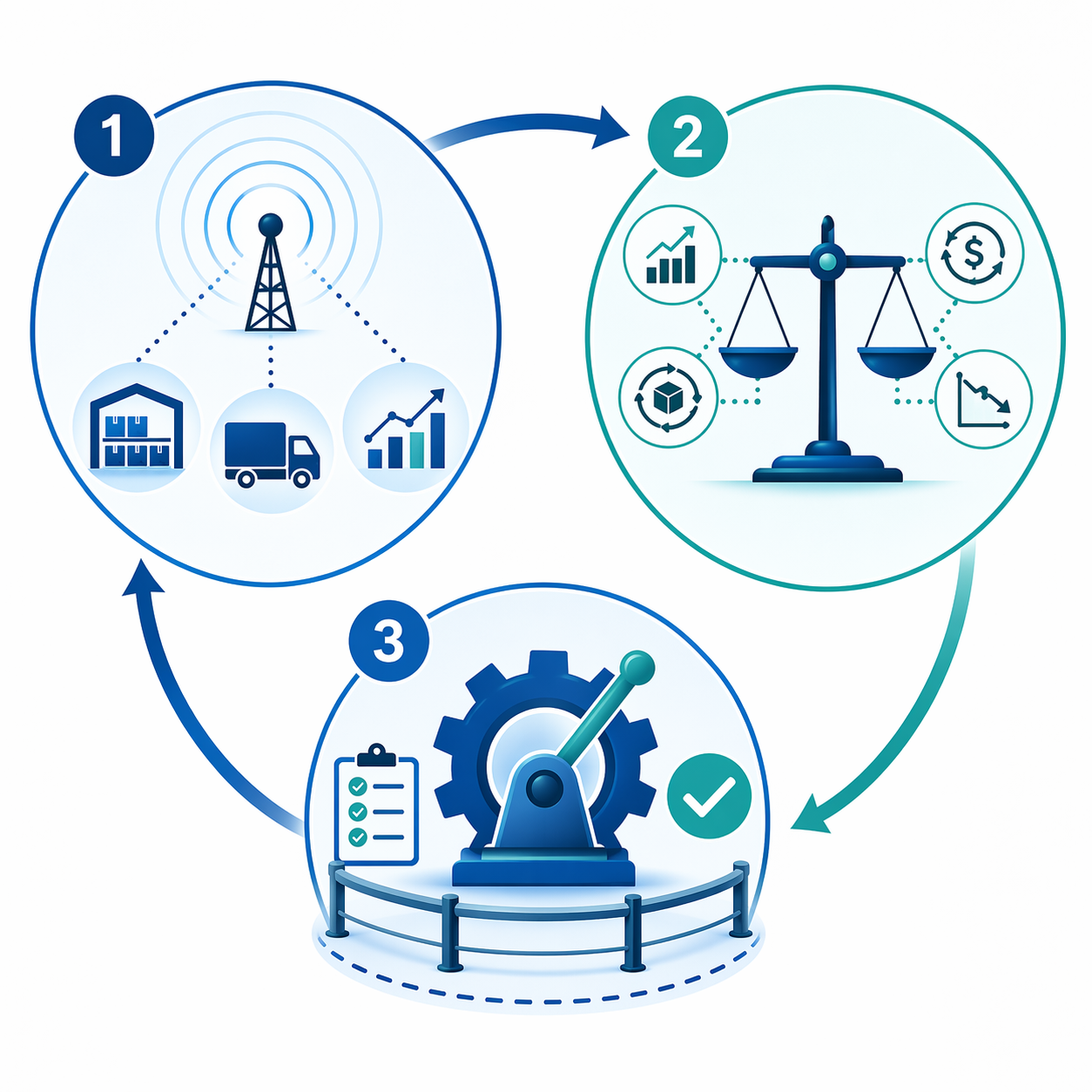
- Sense: ingest demand changes, supply disruptions, receivables behavior, inventory positions, freight rates, supplier terms, customer payment patterns, and actual cost movements.
- Evaluate: translate those signals into gross margin, cash conversion cycle, DSO, working capital, EBITDA, free cash flow, and service-level consequences.
- Act: recommend or execute decisions such as changing a replenishment plan, reprioritizing collections, adjusting payment timing, flagging a margin-risk order, or escalating a sourcing choice that breaches a guardrail.
The loop is simple to describe and hard to run. The agent has to connect data that often sits in different systems: ERP records, order management, warehouse data, transportation costs, receivables, procurement contracts, planning assumptions, and cash forecasts. It also needs decision rights. A recommendation to delay a purchase order is different from authority to delay it. A collections-priority alert is different from automatically changing the collector’s queue.
Financial guardrails are what keep the analogy honest. A supply chain finance agent should not simply optimize one metric. It may be told to protect a minimum service level, avoid a working-capital threshold, preserve margin on specific SKUs, limit expedited freight, or escalate any action that improves cash at the expense of a strategic customer. Without those guardrails, the system is just chasing a local optimum.
What Changes Compared With Traditional FP&A
Traditional FP&A and supply chain planning cycles are built around periodic consolidation. Finance collects actuals, planners update assumptions, operations explains what happened, and leadership decides whether the next cycle needs a change. That process is necessary, but it is poorly timed for decisions that decay quickly.

Consider a margin problem created by a small chain of operational choices. Demand shifts toward a lower-margin SKU. The plant changes the production sequence. A supplier delay forces a premium freight decision. Inventory builds in the wrong location. The customer pays later than expected. None of those events belongs exclusively to finance, but finance absorbs the combined effect through gross margin, working capital, and cash flow.
A useful agent does not wait for the final variance. It watches the margin and cash consequences as the chain forms. If the gross margin on a SKU starts moving outside tolerance because freight cost changed, the agent can flag the order while there is still time to re-route, reprice, substitute, or escalate. If DSO risk rises for a customer segment, it can shift collections attention before the cash forecast breaks. If inventory exposure rises because the demand plan changed, it can show the working-capital effect before the next S&OP meeting.
That is the practical difference between reporting and intervention. A dashboard tells the finance analyst where the bruise is. A finance-aware agent should tell the business which decision is causing it, how large the financial consequence may be, and who has the authority to change course.
Where the Category Shows Up Today
Because the market has not settled on the phrase “AI robo-advisor for supply chain financial planning,” the relevant products appear under several neighboring names: autonomous planning, working capital optimization, finance agents, AR collections agents, cash-flow forecasting, integrated business planning, and supply chain performance agents. The overlap is not a flaw in the label. It is how the market currently looks.
Beam.ai’s Working Capital Optimization AI Agent reports a 17% cash conversion cycle improvement, a 34% DSO reduction, and a 12% increase in free cash flow [2]. Those are vendor-published figures, so they should not be treated as a universal benchmark. They are still useful because they identify the kind of financial outcomes these systems are being built to affect: cash conversion, receivables speed, and free cash generation.
BCG makes the broader operating-finance case from a consultancy perspective. In its 2026 work on AI agents in supply chains, BCG says organizations deploying agentic AI across supply chain and finance can achieve working capital reductions of up to 30% and EBITDA uplift of 2 to 4 percentage points [3]. The “up to” language matters. This is a projection or observed potential in a consulting context, not a guaranteed result from buying a software module.
KPMG’s 2025 working-capital analysis identifies five tangible AI applications: predictive receivables, automated contract-term reconciliation, inventory optimization, dynamic payment-term benchmarking, and AI cash-flow forecasting agents [4]. That list is useful because it shows why supply chain finance cannot be reduced to demand planning. The cash consequence often sits in contract terms, customer behavior, supplier payment choices, and inventory timing.
| Function | What the agent is trying to change | Evidence in the market |
|---|---|---|
| Working capital optimization | Cash conversion cycle, DSO, free cash flow, inventory exposure | Beam.ai reports 17% cash conversion cycle improvement, 34% DSO reduction, and 12% free cash flow increase for its Working Capital Optimization AI Agent [2]. |
| Real-time financial performance monitoring | Gross margin, working capital, cash flow, and cost variance during live operations | XMPro positions its Supply Chain Financial Performance Agent around detecting cost variance when it occurs rather than in the monthly review cycle [1]. |
| Receivables and collections | Collections prioritization and DSO reduction | Paraglide describes AR collections agents that reduce days sales outstanding, though the source should be read as vendor material rather than independent measurement [5]. |
| Cash-flow forecasting | Predictive cash visibility and finance planning speed | SAP Taulia discusses AI-powered cash-flow management using predictive analytics for finance teams [6]. |
| Finance-process automation | Time spent in finance workflows and forecasting accuracy | PwC says AI agents can deliver up to 90% time savings in key finance processes and up to 40% improvement in forecasting accuracy and speed [7]. |
| Integrated planning | Inventory, service levels, planning touchlessness, and loss reduction | o9 Solutions cites AB InBev outcomes including a 60% reduction in stock-outs, a 53% decrease in inventory losses, and 70% to 90% touchless planning adoption [8]. |
The table mixes vendor claims, consultancy conclusions, and platform case material on purpose. That is the evidence base available in Q3 2026. It is enough to show that the function is emerging, but not enough to claim that these outcomes are standard across industries, operating models, or implementation maturity.
The Finance Metrics Are the Point
Supply chain AI often gets evaluated through operational metrics: forecast accuracy, inventory turns, service levels, stock-outs, planner productivity. Those still matter. But a supply chain financial planning agent earns its place by connecting those operational movements to financial statements and cash.
A stock-out reduction is valuable, but the finance question is what it did to revenue protection, margin, and working capital. A lower inventory position is attractive, unless it raises expedite costs or service penalties. A payment-term extension improves short-term cash, but it may transfer stress to a supplier or damage continuity of supply. A faster planning cycle matters most when the decision it accelerates is material enough to change cash, cost, or margin.
IBM’s 2026 FP&A trend work says 69% of CFOs view AI as integral to their finance transformation strategy, and it describes planning cycles compressing from weeks to hours [9]. That does not prove supply chain finance agents cause better outcomes by themselves. It does show that finance leaders are no longer treating AI only as a back-office automation layer. The planning clock is becoming a competitive variable.
Accenture’s 2026 planning analysis adds an operating benchmark: AI-driven supply chain optimization achieved nearly 6% average monthly cost savings, while integrated autonomous planning can shorten planning cycles by up to 30% [10]. Again, the exact result will depend on scope and implementation. But cost savings and cycle compression are the right measures to watch because they sit close to the decisions finance actually has to defend.
Autonomous Planning and Financial Planning Are Blurring
It would be tidy to draw a clean line between autonomous supply chain planning and AI for supply chain financial planning. The market does not support that clean separation. Demand, supply, inventory, logistics, and procurement choices become financial choices as soon as they affect service, cost, margin, cash, or working capital.
EY’s 2026 work on autonomous planning says 69% of supply chain executives believe failing to integrate GenAI will put them at a competitive disadvantage, while only 28% have achieved low-human-touch planning [11]. That gap is important. Adoption intent is not operational autonomy. Interest in agents is not the same thing as trusted decision execution.
Deloitte’s 2026 agentic supply chain research says more than half of surveyed supply chain executives are already deploying AI agents to automate workflows. The same source cites Gartner’s prediction that by 2030, 50% of cross-functional supply chain management solutions will use intelligent agents for autonomous decisions [12]. Those figures support the broader direction of travel, not a claim that finance-led autonomy is already mature.
o9’s integrated business planning materials show why the boundary is difficult. The AB InBev case cited by o9 includes operational outcomes such as stock-out reduction and inventory-loss reduction, along with high touchless planning adoption [8]. Those are planning outcomes, but they have direct financial consequences. A CFO may not own the replenishment decision, but the balance sheet and income statement will still register the result.
What a Good Agent Would Actually Do
The most useful test is to describe the work in plain operating terms. A supply chain finance robo-advisor should reduce the lag between an operational event and its financial consequence. It should also make accountability clearer, not foggier.
- When freight cost rises on a live lane, the agent identifies which SKUs, orders, or customers are now below margin tolerance.
- When receivables risk changes, it reprioritizes collections activity and updates the cash forecast rather than waiting for a DSO review.
- When inventory builds ahead of demand, it translates the exposure into working capital and possible write-down risk.
- When a supplier payment-term choice improves cash but raises supply risk, it escalates the trade-off instead of hiding it inside procurement.
- When a planning scenario protects service at a high cost, it shows the EBITDA and cash-flow effect before the plan is approved.
This is also where weaker implementations will fail. If the data is stale, the agent is only faster at producing old answers. If finance metrics are bolted on after the operational recommendation, the system will optimize service or cost and ask finance to reconcile the consequence later. If decision rights are unclear, every recommendation becomes another alert in a queue that no one owns.
Kyriba’s working-capital optimization positioning, SAP Taulia’s cash-flow management materials, and KPMG’s working-capital AI use cases all point to the same operational reality: receivables, payables, cash forecasting, inventory, and supplier terms are increasingly being handled as connected decision areas rather than separate finance reports [4][6][13]. The value is not in making each dashboard smarter. It is in shortening the distance between the decision and the cash consequence.
How to Read the Outcome Claims
The numbers around this category are promising, but they are not yet a neutral benchmark set. Beam.ai’s cash conversion, DSO, and free cash flow improvements are vendor-published [2]. BCG’s working-capital and EBITDA figures come from consultancy analysis [3]. PwC’s time-savings and forecasting-improvement figures are framed around finance-function AI agents, not exclusively supply chain finance [7]. Accenture’s cost-savings and planning-cycle figures apply to AI-driven planning and supply chain optimization, which may include but is not limited to finance-specific agents [10].
That does not make the evidence unusable. It means the responsible conclusion is narrower. Early adopters and vendors report measurable improvements in cash conversion, DSO, free cash flow, cost savings, planning speed, stock-outs, inventory losses, and touchless planning. The available material does not yet prove that a company buying any “AI agent” product should expect the same results.
The right due-diligence questions are therefore financial and operational at the same time: Which metric improved? Over what baseline? Which decisions were automated, and which were only recommended? Was the result measured in one process, one business unit, or across the enterprise? Did service level, margin, and cash all improve, or did one metric benefit at another’s expense?
The Practical Definition
An AI robo-advisor for supply chain financial planning is best defined as a finance-aware autonomous agent, or network of agents, that continuously monitors supply chain and financial signals, evaluates trade-offs across service, cost, margin, cash, and working capital, then recommends or executes decisions within approved financial guardrails.
The category is genuine in function even if it is not yet established in name. XMPro, Beam.ai, Paraglide, SAP Taulia, Kyriba, o9, and adjacent finance-agent platforms are building pieces of it. BCG, KPMG, PwC, IBM, Accenture, EY, and Deloitte are describing the same shift from periodic planning toward agent-assisted operating decisions. The strongest claims are tied to working capital, cash conversion, DSO, EBITDA, planning-cycle compression, cost savings, and touchless planning. The unresolved issue is not whether the function exists. It is how broadly the early reported outcomes will hold once the evidence moves beyond vendor and consultancy sources.
References
- Supply Chain Financial Performance Agent — XMPro.
- Working Capital Optimization AI Agent — Beam.ai.
- How AI Agents Are Transforming Supply Chains — BCG, 2026.
- Deploying AI to transform working capital management — KPMG, Sep 2025.
- How AI agents transform working capital management — Paraglide.
- AI-Powered Cash Flow Management — SAP Taulia.
- AI agents for finance: How to build an AI-powered finance function — PwC, 2025/2026.
- AI-Driven Integrated Business Planning Software — o9 Solutions.
- 5 key FP&A trends to watch for 2026 — IBM, Feb 2026.
- A targeted AI approach to maximizing value in planning — Accenture, Feb 2026.
- Autonomous planning for global supply chains — EY, 2026.
- Resilient by design: The agentic supply chain — Deloitte, Mar 2026.
- Working capital optimization — Kyriba.
Comments
Join the discussion with an anonymous comment.