
A ship does not need AI to tell it that an outbreak is obvious after cabins are already full of sick guests, sanitation teams are stretched, and the next port call is being renegotiated. The useful signal is earlier and less dramatic: enough evidence to isolate, substitute inventory, change a loading plan, notify a port supplier, or protect a crew schedule before the operational problem becomes visible everywhere.
That is why AI outbreak prediction for cruise supply chains should be judged less like a dashboard demo and more like a handoff problem. In the CDC Vessel Sanitation Program record for January through July 2026, eight gastrointestinal illness outbreaks were posted for cruise ships, with norovirus identified in five of them.[1] The VSP record is not a complete global count; ships outside the program’s coverage and itineraries beyond its reporting scope can sit outside that window. Still, it is enough to show that outbreak planning is not a retrospective compliance exercise for 2026. It is current-season operating risk.
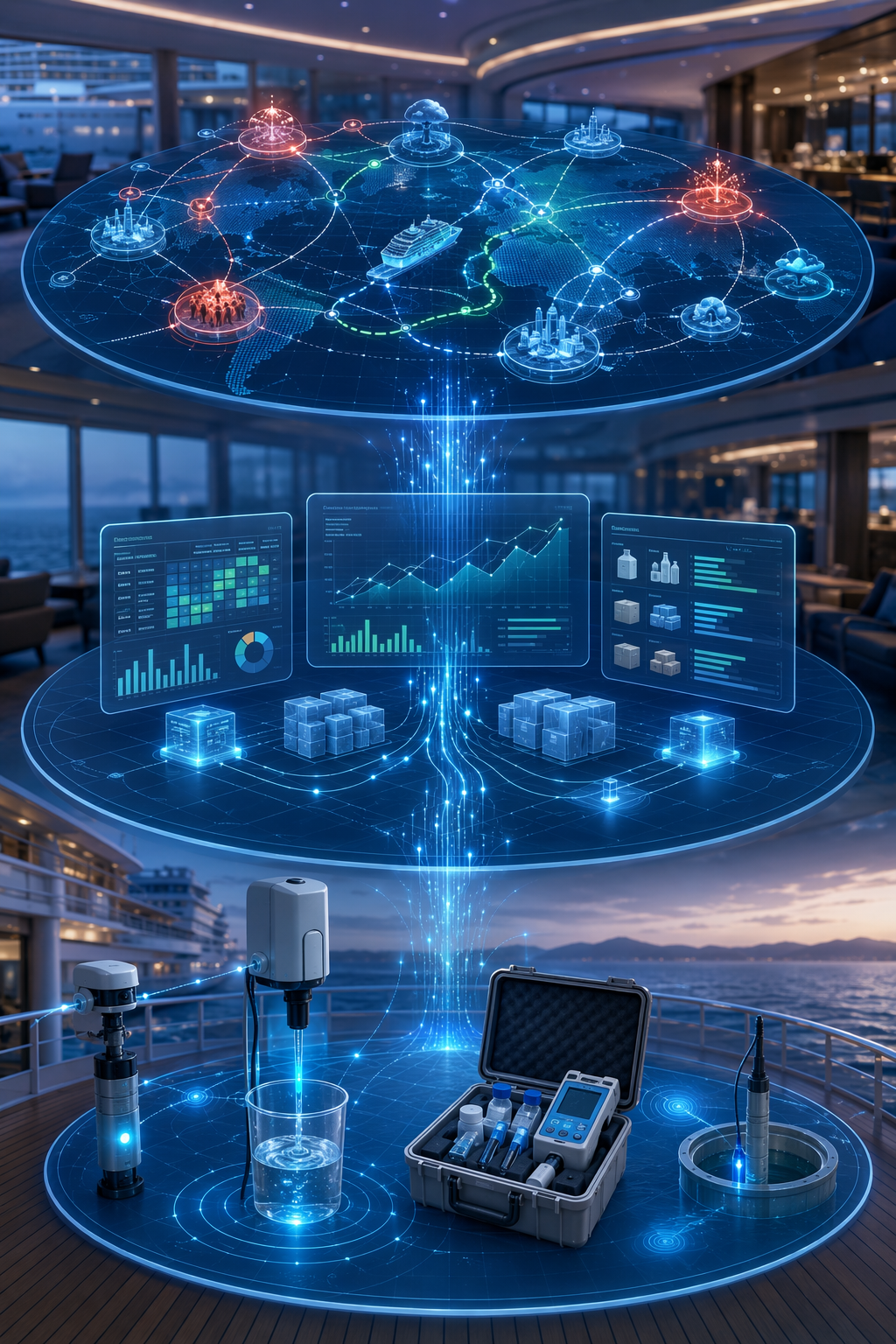
The supply chain impact starts the moment illness changes behavior. Isolation changes linen, tray delivery, bottled water, PPE, waste handling, and medical consumables. Reduced venue traffic changes food and beverage pull. Intensified cleaning changes chemical and labor demand. An itinerary adjustment can move replenishment from a familiar port to a constrained one. A supplier who hears about the change after the purchase order is already wrong is no longer forecasting demand; they are expediting damage control.
The Hondius hantavirus outbreak shows the cost of a late or incomplete handoff in a sharper way than any abstract resilience diagram. WHO reported 13 infections and three deaths in an April-to-July 2026 outbreak associated with the vessel, with cases spread across more than seven countries. Twenty-nine passengers disembarked on April 24 before the cluster was confirmed, and the United Kingdom later isolated returning nationals for 45 days.[2] The point for cruise supply chains is not that every pathogen behaves like hantavirus or that every ship will face the same response. The point is that passengers, inventory, itineraries, and epidemiological data can all move faster than confirmation.
The practical architecture now emerging has three layers: onboard detection, consumption forecasting, and disruption simulation. None of the available evidence shows a cruise line running an integrated end-to-end system that turns a pathogen signal into trusted procurement, hotel operations, and routing actions automatically. The pieces exist separately. The hard work is making them usable together.
The first layer is an onboard signal someone can act on
Onboard detection matters because cruise operations are built around cutoffs. Stores are loaded at specific times. Housekeeping rosters are fixed before service starts. Port agents, waste handlers, laundry providers, and caterers need notice. A medical note that becomes credible only after the operational window closes is still clinically important, but it is weaker as a supply chain signal.
Kraken Sense’s automated qPCR platform is interesting for that reason. The company says its system can detect norovirus in cruise ship water systems within 60 minutes, and describes a case in which a major operator detected norovirus in a storage tank early enough to isolate before widespread spread.[3] This is vendor-reported, not an independent fleetwide effectiveness study. It still points to the right operational unit: not a broad promise to “use AI,” but a time-bounded signal that can move a checklist.
The operational value is not only in the test result. It is in whether the result arrives in a form that the ship can convert into actions: block a tank, increase sampling, isolate symptomatic cabins, change galley handling, raise sanitation consumption forecasts, and alert shore-side replenishment. If that signal lives in a lab portal while hotel operations continues in handwritten checklists and procurement continues in a separate workbook, the detection layer has done its job and the system has still failed.
The diagnostic-delay evidence makes the timing issue harder to dismiss. Population Medicine analyzed seven norovirus outbreaks involving 365 cases and found that 47% to 63% of secondary cases were caused by 10% of infected individuals with longer diagnostic delays. The longer-delay group averaged 73 hours versus 37 hours, isolation upon symptoms reduced transmissibility by 94%, and models that integrated diagnostic delays improved forecast accuracy by 78% beyond 72-hour horizons.[4] Those findings come from a specific seven-outbreak sample, so they should not be stretched into a universal cruise law. They do support a narrower and important point: delay is not just a medical inconvenience; it changes both spread and the quality of the forecast.
For supply chain teams, that means the first AI layer should not be evaluated only on pathogen classification. It should be evaluated on the time between signal and replenishment decision. Can the medical team flag an isolation scenario before the next linen order is frozen? Can hotel stores see a sanitation multiplier before chemicals are rationed informally? Can port procurement see that a vessel may need substitution stock rather than the usual order? These are not glamorous questions, but they are the ones that determine whether early detection changes the voyage.
Consumption forecasting is where the outbreak becomes a planning problem
Once illness changes onboard routines, demand stops resembling the base voyage plan. A buffet item may drop while room-service packaging rises. Uniform demand can shift if teams are reassigned. Retail can soften or spike depending on passenger movement. Hotel stores can become the constraint faster than food. The forecast has to absorb behavior that did not exist when the vessel was provisioned.
Cruise operators are already moving AI consumption forecasting into that wider operating space. At an April 2026 Seatrade Cruise Global panel, MSC Cruises CIO Angelo Raia said AI consumption forecasting was expanding from food and beverage into uniforms, hotel areas, and retail. In the same report, Carnival Corp.’s MAST program identified data accuracy as “key to enabling everything downstream with supply chain.”[5] That second phrase is the one worth keeping on the wall. The forecast is only as useful as the data it can safely inherit.
An outbreak forecast that can see water-test results but not cabin isolation counts will misread demand. A hotel inventory model that can see historical towel turns but not enhanced cleaning protocols will understate laundry and chemical pressure. A purchasing model that can see average voyage consumption but not a port substitution constraint will recommend stock that cannot arrive. The issue is not that AI cannot calculate. It is that cruise operations still contain too many places where critical facts are delayed, handwritten, locally interpreted, or trapped in a supplier’s system.
| Operational change | Supply chain consequence | Forecast input that has to arrive early |
|---|---|---|
| Cabin isolation increases | More tray service, linens, bottled water, PPE, and waste handling | Symptom reports, isolation counts, expected isolation duration |
| Public venues are restricted or avoided | Different food and beverage pull, lower retail traffic, altered staffing | Venue traffic, menu substitutions, passenger movement constraints |
| Sanitation protocols intensify | Higher chemical, wipes, gloves, laundry, and labor demand | Cleaning frequency, affected zones, confirmed or suspected pathogen |
| Itinerary or port handling changes | Replenishment windows, approved suppliers, and logistics costs shift | Port status, public-health instructions, inventory burn rate |
This is where outbreak prediction becomes less like epidemiology and more like short-cycle demand planning. The onboard signal must change the consumption baseline by category, location, and time remaining before the next feasible load. The procurement planner does not need a mysterious risk score. They need to know whether the vessel should carry extra disinfectant, whether a hotel item should be substituted at the next port, whether a standing F&B order should be reduced, and whether a supplier has enough notice to meet the revised requirement.
There is also a workforce problem hiding inside the data problem. Teams that live in spreadsheets are not irrational for distrusting a black-box recommendation when the cost of being wrong is visible on the ship. Lufthansa Industry Solutions’ Schmal has flagged the psychological challenge of Excel-native workforces adopting AI, and in cruise supply chain work that challenge is practical: planners need to see which input changed, which assumption moved, and which operational action follows. A model that cannot explain why it wants more inventory will be second-guessed, copied into Excel, and quietly diluted.
Disruption simulation is useful, but it is not a cruise control tower by itself
The third layer is simulation: testing what happens if the vessel misses a port, a supplier cannot load, a sanitation load rises, or a recovery action is mistimed. This layer is necessary because outbreak response is not a single decision. It is a chain of decisions across medical, hotel, marine operations, procurement, suppliers, and public-health authorities.
The strongest evidence here is adjacent rather than cruise-specific. Ivanov’s 2020 simulation-based analysis of COVID-19 supply chain disruption found that synchronized facility recovery timing across echelons limited profit decline to about 33%, while a 90-day upstream disruption without synchronization could produce about 90% profit erosion.[6] The exact economics do not transfer neatly to a cruise voyage. The planning lesson does: recovery timing across layers matters. A ship that changes sanitation demand, port loading, and supplier commitments at different speeds can make a manageable outbreak more expensive.
Forecasting benchmarks from the COVID-19 period also support the value of better sensing and planning, without proving a cruise-specific outbreak system. A McKinsey benchmark cited by Körber reported that businesses adopting AI technologies saw forecast accuracy improvements of 20% to 50% during COVID-19.[7] That range is useful as a resilience benchmark, not as a guarantee that a cruise line will get the same result from norovirus detection or itinerary simulation.
In a cruise setting, simulation should answer concrete questions rather than decorate a control room. If symptoms rise before a sea day, which inventory categories run short first? If the next port imposes added handling requirements, which supplier alternatives are already approved? If a loading window is lost, which substitutions protect guest care and crew safety rather than simply preserving the original menu? If isolation ends earlier than expected, which orders should be canceled before they become waste?
Graph models, digital twins, and large-language-model interfaces can all be relevant to this layer, but the practical question is narrower: can the simulation consume trusted shipboard data quickly enough to produce a decision that operations will use? Pandemic-scale modeling tools may be promising in public-health contexts, but without validation for cruise ship operations they should remain boundary markers, not proof that vessel-specific disruption planning is solved.
The missing piece is governed handoff
The Hondius case makes a governance issue visible: epidemiological information can sit inside private cruise systems while public-health authorities, passengers, and downstream operational partners are still catching up. That is not only a legal or reputational concern. It affects supply chain timing. If a port supplier does not know whether demand is normal, elevated, restricted, or redirected, the supplier cannot reserve capacity intelligently. If shore-side planners do not know which health signal is credible, they either overreact or wait.
Yang’s July 2026 “outbreak escrow” proposal is useful here because it frames cruise lines as “de facto epidemiological institutions” and argues for pre-positioned encrypted data packets that could be released under defined conditions.[8] This is a policy proposal, not enacted legislation, and it does not by itself solve procurement planning. Its value is in naming the bottleneck: outbreak-relevant data needs rules before the outbreak, not improvised permissions after passengers have dispersed.
For supply chain leaders, the same principle applies internally. A detection alert should have a predetermined route into hotel operations, medical review, demand planning, port logistics, and supplier communication. The alert does not have to trigger automatic purchasing. It does need to trigger a trusted planning state: watch, isolate, substitute, expedite, hold, or reroute. Without that state change, the organization has purchased sensing but not resilience.
What is deployable now, and what still blocks adoption
The deployable pieces are easier to name than the deployable system. Onboard pathogen detection can shorten the time to a credible signal. AI consumption forecasting is already being extended into cruise hotel, uniform, retail, and F&B categories. Disruption simulation can test recovery timing and replenishment alternatives. Together, these layers describe a usable pattern for outbreak-resilient cruise supply chains.
- Detection layer: identify a credible onboard health or environmental signal early enough to change containment and provisioning actions.
- Forecasting layer: translate that signal into changed category-level demand for hotel, medical, sanitation, F&B, retail, and crew-support inventories.
- Simulation layer: test itinerary, supplier, and recovery options when the original loading plan no longer fits the voyage.
- Governance layer: define who receives the signal, who approves the planning action, and what data can be shared with public-health and port-side partners.
The blockers are not exotic. Handwritten sanitation and medical-adjacent checklists delay structured data. Supplier systems fragment visibility. Public-health data is sensitive and often private. Excel-native teams want to understand the recommendation before they let it alter a purchase order. Those constraints are less exciting than model architecture, but they are usually closer to the critical path.
A practical test for a cruise line is therefore straightforward: when an onboard health signal appears, can the organization turn it into a trusted supply chain planning action before the next operational cutoff? If the answer depends on manual calls, copied spreadsheets, delayed public-health confirmation, and supplier improvisation, then the AI layer may be real, but outbreak-resilient supply chain execution is still unfinished.
References
- Cruise Ship Outbreak Updates, CDC Vessel Sanitation Program.
- Disease Outbreak News; Hantavirus disease - Multi-country, World Health Organization, Apr-Jul 2026.
- Kraken Sense for Early Detection of Norovirus in Cruise Ship Water Systems, Kraken Sense.
- Reducing diagnostic delays is key for norovirus control on cruise ships, Population Medicine, Dec 2025.
- Cruise lines playing catchup with AI to help supply chain needs, Seatrade Cruise News, Apr 2026.
- Predicting the impacts of epidemic outbreaks on global supply chains: A simulation-based analysis on the coronavirus outbreak (COVID-19/SARS-CoV-2) case, International Journal of Production Research, 2020.
- AI in supply chain resilience, Körber Supply Chain Insights.
- How Industry Can Help Prevent the Next Cruise Ship Outbreak, Think Global Health, July 9, 2026.
Comments
Join the discussion with an anonymous comment.